
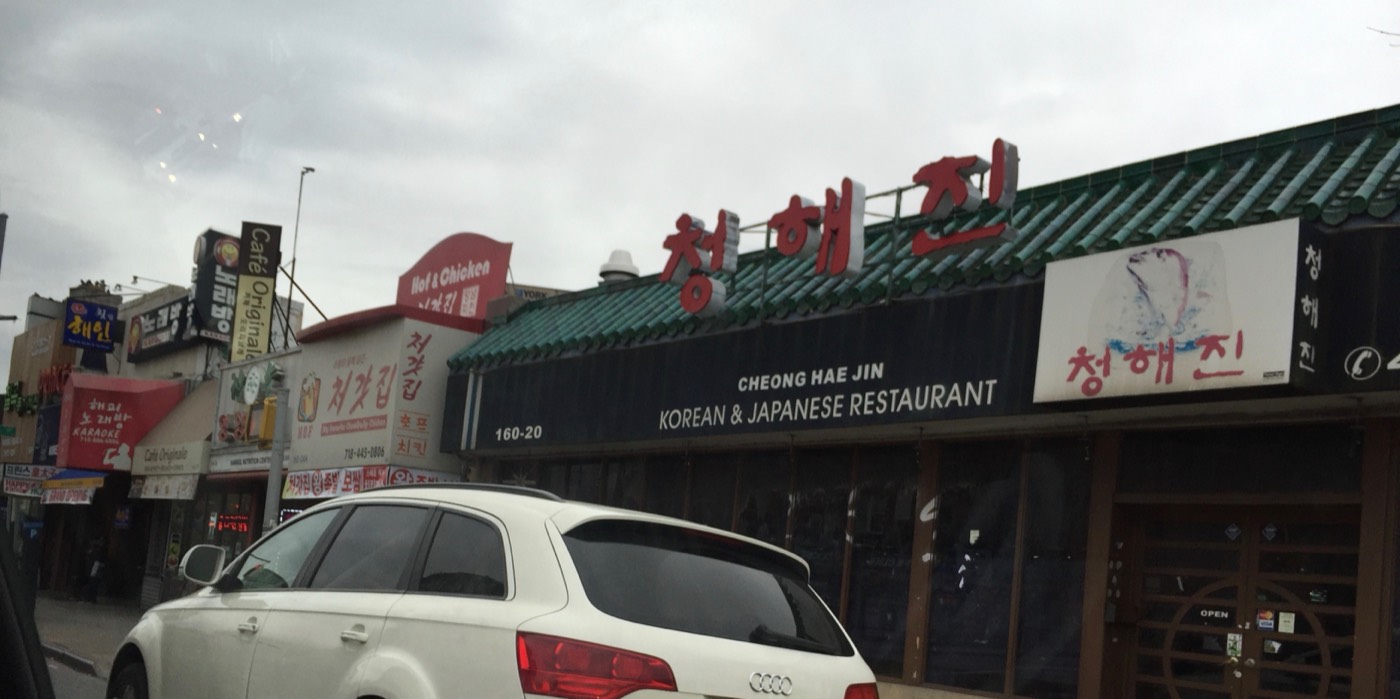
Drive east along Northern Boulevard, past the noodle houses and the bubble tea signs and the bilingual real estate offices, and you will reach a tall white building set back from the road with a dome and a cross. This is the Greek Orthodox Shrine Church of St. Nicholas, and for the better part of seventy years it has been the centre of gravity for the Greeks in Flushing, Queens. The neighbourhood around it has become one of the largest Chinatowns in America. The church has stayed exactly where it was.
The Place
Flushing is one of the oldest settlements in New York. It began in 1645 as Vlissingen, a Dutch colonial town on the eastern bank of Flushing Creek, and it is remembered as a birthplace of religious freedom in the New World, the place where John Bowne held Quaker meetings in his farmhouse on Bowne Street in defiance of the colonial governor, a story told in full in Flushing’s long civic record.
For most of the twentieth century it was a comfortable, leafy, predominantly white neighbourhood in north-central Queens, Irish and Italian and Jewish, with a small Japanese presence. Then the immigration law changed in 1965, and Taiwanese newcomers began arriving in the 1970s, the start of a transformation so complete that downtown Flushing is now sometimes called Little Taipei.
The Greek story here belongs to the older Flushing, the one before the change. It is a story of a generation that built something solid and then, in large part, moved on.
How It Became Greek
A church before there was a community
The Greeks of Flushing did something unusual. In most diaspora neighbourhoods the people arrive first and the church follows. Here the church and the community were, in effect, willed into being together, in a single remarkable year.
In early 1955 a Flushing physician named Dr. Anthony Vasilas and his father, Peter Vasilas, proposed the idea of a Greek Orthodox community in their part of Queens. Within ten weeks more than 450 Greek Orthodox faithful gathered at the Good Citizenship Hall to establish a parish, with representatives of the Archdiocese present. His Grace Demetrius, Bishop of Olympus, granted approval that same day.
On 18 September 1955 the new community opened its doors in a building it had bought for $30,000 on Beech Avenue. More than 1,500 people came. It was, by the count of the day, the 348th Greek Orthodox church in the Western Hemisphere.
Bidding for a saint
The naming of the church, on Sunday 13 November 1955 at the Flushing Armory, says a great deal about the people who built it. Archbishop Michael celebrated the liturgy and offered the first proposed name, St. John Chrysostom. Then the parishioners were invited to buy votes for the name they wanted. After two hours of bidding the choice came down to St. John Chrysostom and St. Nicholas, and St. Nicholas won by a margin of around 200 votes.
It was a community that paid for what it believed in, literally and by the head. That instinct would build a great deal over the following decades.
The years of growth
Through the late 1950s and the 1960s the parish grew from a couple of hundred families into a thousand and more, fed by the second wave of Greek immigration that arrived in America between the 1960s and the early 1980s. Many of these newcomers came through Astoria, the great Greek heart of Queens, and then looked east for more room.
By the end of the 1960s the original Beech Avenue building was far too small. The parish raised the money for a far larger church on Northern Boulevard, and the new building was officially opened by Archbishop Iakovos on 28 March 1971, with construction completed that year.
The relics and the shrine
The defining moment came on 5 December 1972. Archbishop Iakovos, the Greek Orthodox primate of North and South America, received relics of St. Nicholas donated by the Roman Catholic Bishop of Bari, Italy, the city that has held the saint’s remains since the eleventh century. The reliquary held a fragment of the casket in which his body had been carried to Bari, tiny fragments of his skull, and a vial of holy myrrh.
The relics were enshrined at a vespers service attended by clergy of both faiths, including the Roman Catholic Bishop of Brooklyn, Francis Mugavero. At that service the church received its new and permanent name: the Greek Orthodox Shrine Church of St. Nicholas. The relics rest today in a case beneath a seventeenth-century icon of the saint, candles on either side.
Building a Greek education
A community that intends to stay builds schools, just as the Greeks who settled in Port Washington across the county line did. In September 1977 the parish founded the William Spyropoulos Greek American Day School, a parochial school for the early grades through the eighth, which has grown into one of the largest day schools in the entire Greek Orthodox Archdiocese, with hundreds of pupils. Alongside it the parish ran an afternoon Greek school and, from the year 2000, a preschool.
These schools are why so many Flushing Greek children grew up reading and writing the language of their grandparents even as the streets outside filled with Mandarin and Korean. The neighbourhood changed around the classrooms, but the classrooms kept teaching Greek.
The Landmarks
Greek Orthodox Shrine Church of St. Nicholas, 196-10 Northern Boulevard. The anchor of everything. Founded in 1955, rebuilt here in 1971, raised to a shrine in 1972 with the relics of St. Nicholas. It remains among the largest and most prominent Greek Orthodox parishes in the United States, with well over a thousand families and a calendar full of ministries, organisations and feast days.
William Spyropoulos Greek American Day School, on the St. Nicholas campus. Founded in September 1977, this parochial day school has become one of the biggest in the Archdiocese. Generations of Flushing and Whitestone Greek children have learned their alphabet, their faith and their grammar here, often long after their families had moved out of the immediate neighbourhood.
The St. Nicholas Greek Festival, each May on Northern Boulevard. In 1971 St. Nicholas became the first parish in the New York metropolitan area to stage a large-scale Greek festival, and the model spread to Orthodox parishes across the country. It still runs every May, drawing thousands for souvlaki and loukoumades, live music and folk dancing, a yearly homecoming for families who long ago left the area but still come back to the corner where they grew up.
Mythos Authentic Hellenic Cuisine, 196-29 Northern Boulevard. A family-owned taverna that opened in 2001, sitting almost directly across Northern Boulevard from the church. Its spinach pie and its menu of mainland classics make it a fixture for the Greek families of Flushing, Whitestone and Bayside, the kind of place where a christening lunch and a memorial meal can happen on the same Sunday.
The Flushing Armory. The hall where, in November 1955, the founding parishioners bid two hours’ worth of votes to name their church St. Nicholas. It is a reminder that the institutions of this community were not handed down but decided, in public, by the people who paid for them.
Bowne Street and the old East Flushing blocks. The quiet residential streets of East Flushing once held a real mix of Irish, Italian, Jewish and Greek households. It was here, in the modest two-family houses and the apartment blocks within walking distance of the church, that the first Greek families of the parish lived before the move outward to larger homes began.
Where They Came From
The Flushing Greeks were part of two great migrations. The earliest belonged to the Great Migration of the early twentieth century, when villagers from the Peloponnese, from the islands and from the mountain regions of mainland Greece crossed to America in enormous numbers. The larger share of the St. Nicholas families, though, came in the second wave between the 1960s and the early 1980s, after restrictive quotas were lifted.
Most arrived by way of Astoria, the densest Greek settlement in the country, and many had roots in the same regions: the Peloponnese, the Dodecanese and the Aegean islands, Cyprus, and the towns of central and northern Greece. They came for the reasons immigrants have always come to Queens, work, family already established, and the chance to own something.
Flushing Today
Downtown Flushing today is overwhelmingly Asian, one of the largest Chinatowns in the world, and the casual visitor would not guess that a major Greek community ever lived here. The grocers sell Chinese produce, the signs are in Mandarin and Korean, and the demographic centre of the neighbourhood has shifted entirely.
Yet the Greek institutions did not collapse. They relocated their congregations without relocating their buildings. As the older generation grew prosperous they did what their Astoria cousins did, buying bigger houses with driveways in Whitestone, in Bayside, and out across the line into the suburbs of Long Island, some of them settling near the older Greek families of Port Washington on the North Shore, and not far from the newer Korean community of Bayside that took shape as Flushing changed. They left the apartments of East Flushing but they kept the church, driving back every Sunday and every feast day to the white building on Northern Boulevard.
The era is, honestly, a quieter one than it was. In December 2024 Father Paul Palesty retired after twenty-seven years at St. Nicholas, a changing of the guard that the Greek American press marked as the end of an era, even as more than five hundred people filled the church for the feast day service. The parish endures, large and active, its school full, its May festival still drawing the diaspora home. The Greeks of Flushing no longer mostly live in Flushing. But on the corner of 196th Street and Northern Boulevard, they still belong here.
Frequently Asked Questions
Is there still a Greek community in Flushing, Queens?
Yes, though it is now centred on its institutions rather than on residence. Most of the Greeks in Flushing, Queens long ago moved to nearby Whitestone, Bayside and Long Island, but they return to the Greek Orthodox Shrine Church of St. Nicholas on Northern Boulevard for worship, schooling and the annual festival.
What is the main Greek church in Flushing?
The Greek Orthodox Shrine Church of St. Nicholas, at 196-10 Northern Boulevard. Founded in 1955 and rebuilt at its current site in 1971, it is one of the largest Greek Orthodox parishes in the United States and holds relics of St. Nicholas received from Bari, Italy in 1972.
When did Greeks settle in Flushing?
The community formed in the mid-1950s, with the parish established in 1955, and grew rapidly through the 1960s and 1970s during the second wave of Greek immigration to America. Many of the Greeks in Flushing, Queens arrived by way of nearby Astoria.
Why did the Greek community move out of Flushing?
Two things happened at once. Flushing transformed into a largely Asian neighbourhood after 1965, and at the same time prosperous Greek families sought larger suburban homes, moving to Whitestone, Bayside and Long Island while keeping their church and schools in Flushing.
What is the St. Nicholas Greek Festival?
An annual May festival on Northern Boulevard that St. Nicholas pioneered in 1971 as the first large-scale Greek festival in the New York metropolitan area. It draws thousands for Greek food, music and dancing, and serves as a yearly reunion for families who have moved away.
Are the relics of St. Nicholas really in Flushing?
Yes. On 5 December 1972 the Roman Catholic Bishop of Bari, Italy donated relics of St. Nicholas to the Flushing parish, which were enshrined by Archbishop Iakovos. The church was renamed the Greek Orthodox Shrine Church of St. Nicholas to mark the occasion.
If your family’s story passed through Flushing, or any of the places Greeks have made home in America, Atlas of Home can trace that journey. From a village in the Peloponnese to a pew at St. Nicholas on Northern Boulevard, to a house in Whitestone or Bayside, to wherever you are now.