
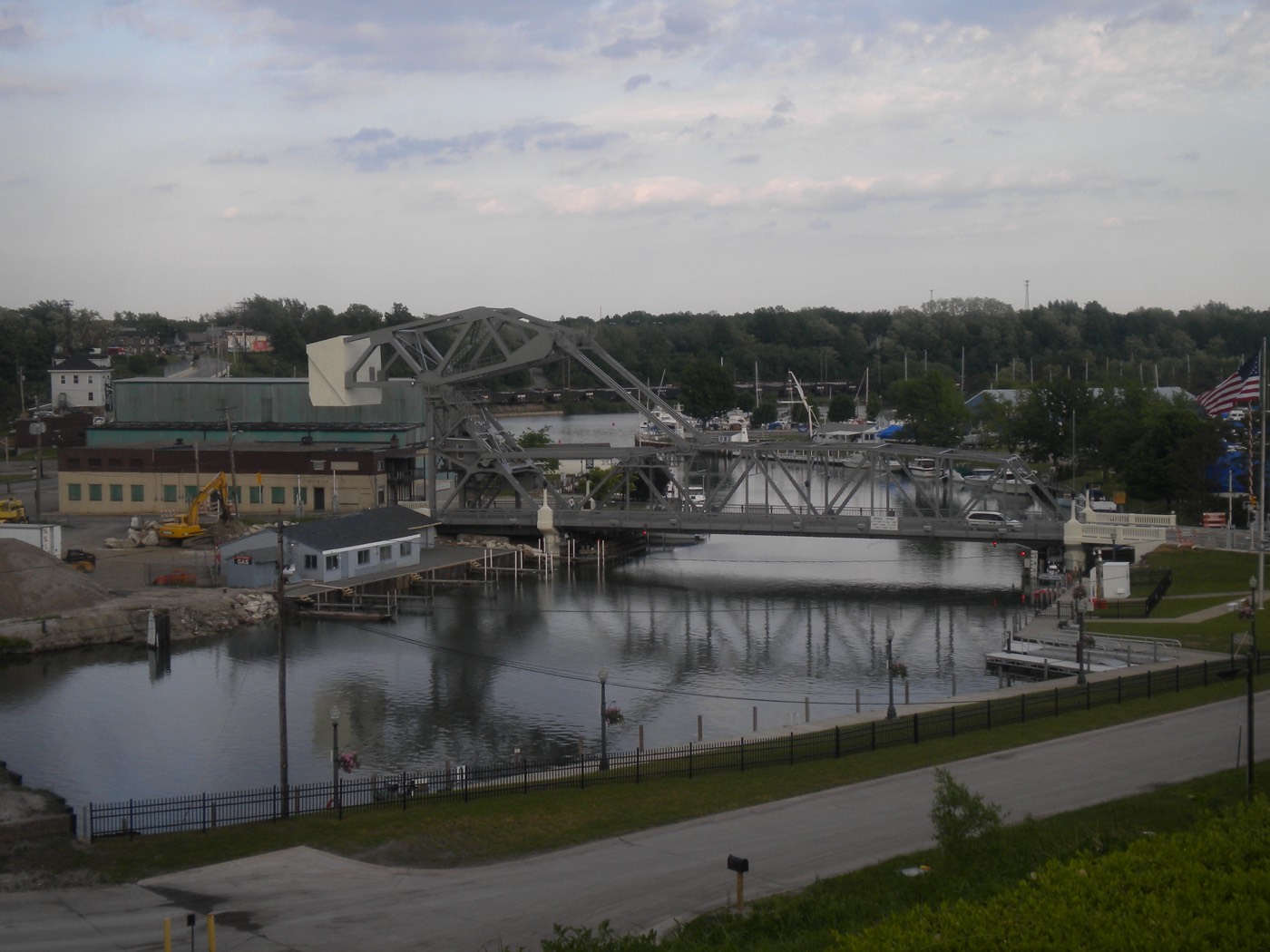
Stand at Point Park on a summer evening, where the Ashtabula River bends toward Lake Erie under the grey iron span of the 1925 lift bridge, and you are looking down on the ground the Finns claimed first. The Finns in Ashtabula came for the docks, the ore and the wage, and they stayed long enough to build saunas on the hillside, two churches by the water and a hall said to be the largest wooden structure in Ohio. This is the story of Finn Hollow, the Lake Erie port the Finnish called Iloinen, and the quiet that came after the ore boats stopped.
The Place
Ashtabula sits on the Lake Erie shore in Ohio’s far northeast corner, an hour east of Cleveland and a short drive from the Pennsylvania line. Its name comes from an Algonquian phrase meaning the river of many fish, and for a long time fish were the only commerce the water offered.
That changed in 1873, when competing railroads finally linked the sleepy harbour to the steel mills of Pittsburgh and Youngstown. Within two decades Ashtabula Harbor had become the greatest iron ore receiving port on the Great Lakes, a place where coal went out by ship and red Minnesota ore came in by the boatload.
The town today counts roughly 17,000 people, down from nearly 18,000 in 2020. Up the hill from the harbour, the streets where the Finns settled still carry their old shape, even where the families have gone.
How It Became Finnish
The first gangs, 1872
The Finns did not arrive as families with trunks and plans. They arrived as labour. As early as 1872, a Finnish section gang was at work in Ashtabula Harbor laying track for the Ashtabula, Youngstown and Pittsburgh Railroad.
These first men erected simple dwellings along the east slope of the Grand River, on a wooded incline that came to be known as Finn Hollow. It was not chosen for its views. It was the ground left over once the railroads and the dock companies had taken what they wanted.
The push behind them had come from home. A catastrophic crop failure in 1867 had driven masses of Finns, especially from rural Ostrobothnia on the country’s western coast, out of their parishes and into migration, first to Norway and then across the Atlantic.
The ore shovellers
What kept the Finns in Ashtabula was the harbour itself. The demand for labour to load coal and unload iron ore was relentless, and it drew Irish, Italian, Swedish and Finnish men to the same docks.
Fourteen Finnish workers found employment as ore shovellers at the Hanna unloading docks, becoming the Finnish counterpart to the Irish, Swedish and Portuguese gangs already bent to the same backbreaking work. Before the great mechanical Hulett unloaders took over, ore came off the boats by hand, shovel by shovel, in heat and coal dust.
Boarding houses and the second wave
Because the Finns reached Ashtabula Harbor before the town had decent housing or urban improvements, the early arrivals crowded into boarding houses. The number of these communal homes increased rapidly through the first decade of the 1900s, each one a kitchen, a stove and a row of beds for single men working the docks.
The larger wave came around 1900, as Finns fled the Russification of their homeland and a conscription law that declared Finnish men could be drafted to fight anywhere in the Russian Empire. Many landed in Ashtabula precisely because the Great Lakes shipping that employed them connected directly to the world they had crossed to escape.
By then the harbour core of Finnish Ohio ran along the lakeshore through Ashtabula and the nearby towns of Conneaut, Painesville and Fairport Harbor, a chain of ports tied together by the same ore trade.
A church on the water
Community followed work. On 6 January 1890, the Finns of the harbour organised the Ashtabula Harbor New Independent Finnish Lutheran Evangelic Congregation, the first formal institution of their own.
In 1922 the congregation took the name it still carries, the Bethany Evangelical Lutheran Church. Its anniversary publications became, in effect, the written history of the community, a trustworthy guide to who arrived, who married and who was buried on the hill.
Halls, bands and choirs
The Finns built for leisure as energetically as they worked. The Humina Band was founded on 18 April 1894 and grew into a serious musical institution, affiliating with the American Federation of Musicians in 1900.
Under George Wahlstrom, born in Helsinki in 1883, the band reached national prominence and toured Finland in 1927. Wahlstrom died in 1930, but the appetite for music continued: the Sovinto Male Chorus formed in 1934 and sang through the Second World War.
Above all there was Sovinto Hall, built in 1897 and said to be the largest wooden structure in Ohio. It began as a temperance society, then became the cultural and recreational centre of the first and second generation Finns, a place for plays, dances, lectures and the long Finnish-language evenings that held the community together.
The Landmarks
The Ashtabula Lift Bridge, Bridge Street at the Ashtabula River. Built in 1925 by the Cleveland firm Wendell P. Brown for $179,000, this Strauss bascule bridge still rises on its concrete counterweight to let boats pass. A National Historic Landmark and the last single-leaf lift bridge on Ohio’s state highway system, it is the image every harbour Finn would have recognised on the walk home from the docks.
Finnish American Cultural Center, corner of West 8th and Joseph Avenue. A log cabin raised in 2006 on the very site of the demolished Sovinto Hall, the centre marks 20 years of operation in 2026. Inside sits a cantilever rug loom made in the late 1890s, and the museum opens Saturdays from May to September, 11am to 3pm, or by appointment.
Bethany Evangelical Lutheran Church, 933 Michigan Avenue. The lineal descendant of the 1890 harbour congregation, Bethany kept the Finnish faith anchored above the docks for generations. It remains an active ELCA parish, and Finnish baking traditions still surface at its tables.
Bridge Street, the Harbor commercial district. In the Finns’ day this short street carried six public Finnish saunas and seven Finnish-owned pubs, a working-class main street for men coming off the ore boats. Today it is a restored historic district of shops and restaurants that won a national main street title, but the bones are the same.
The former Sovinto Hall site, West 8th Street. The 1897 hall stood at 1330 West 8th Street until the city demolished it in 1961 as membership declined. The log cultural centre now standing on the ground is a deliberate act of memory, built where the dancing and the choirs once filled three storeys of timber.
Point Park, at the mouth of the harbour. The grassy bluff where the river meets Lake Erie offers the view that defined the Finnish neighbourhood: the bridge, the moored boats, the long flat lake. It is the spot from which Finn Hollow looked out on the water that gave it work.
Kaleva Hall, formerly 431 Lake Avenue. A converted Episcopal church, this building housed the Kaleva men’s and women’s lodges for 33 years until they disbanded in 1976, one of the last formal Finnish fraternal homes in the city.
Where They Came From
The Ashtabula Finns were overwhelmingly a people of the Finnish countryside, and above all of Ostrobothnia, the flat agricultural coast on the Gulf of Bothnia. It was Ostrobothnia that the failed harvest of 1867 hit hardest, and Ostrobothnia that sent its young people abroad in the largest numbers.
Across the whole emigration roughly 300,000 Finns, close to a tenth of the nation, resettled in the United States and Canada, drawn west by land, mines and the lakes trade. The men who came to Ashtabula were not seeking adventure. They were leaving crop failure, Russian conscription and a future with no room in it.
What made Ashtabula different from the Finnish mining settlements of Michigan and Minnesota was the harbour. These were dock Finns, ore Finns, men whose work began where the lake ended, and that maritime cast set the community apart from the inland Finns who shared their language and their saunas. The same ore-and-shipping logic seeded the parallel Finnish communities at the Columbia River mouth in Astoria, Oregon and the granite and textile towns further east.
Ashtabula Today
The ore boom that built Finn Hollow has long since faded, and with it much of the visible Finnishness of the harbour. By the late twentieth century the community had largely assimilated into the broader fabric of the town, its language carried only by the oldest descendants and its saunas mostly gone.
Yet the traces are stubborn. Zion Lutheran held services in Finnish into the early 1970s. Finnish women still bake and sell nisu, the cardamom-scented sweet bread also called pulla, at the Lutheran church, and korppu, the twice-baked rusk taken with coffee, turns up at fish fries and Christmas parties.
The living heart of it is now the log cultural centre on West 8th, where the Finnish American Heritage Association keeps the loom, the photographs and the band records. Each June the centre hosts a Juhannus celebration around the 22nd, the Finnish midsummer, lighting the long evening in a town where the sun once felt as far north as home. It is a smaller community than the one that shovelled ore for the Hanna docks, but it has refused to disappear.
For families tracing this thread, Ashtabula sits within a wider Finnish-American map that runs from the mill city of Fitchburg, Massachusetts and Finnish Sunset Park in Brooklyn to the copper country of Hancock, Michigan and the winter colony of Lake Worth Beach, Florida. Ohio’s harbour Finns belong to that constellation, the saltwater and freshwater branch of a single migration.
Frequently Asked Questions
When did the Finns first arrive in Ashtabula?
Finnish railroad gangs were laying track in Ashtabula Harbor as early as 1872, making the Finns in Ashtabula one of the earliest immigrant groups in the port. A much larger wave arrived around 1900, fleeing Russian conscription and economic hardship in Finland.
Why did Finns settle in Ashtabula specifically?
The harbour. After 1873 Ashtabula became the greatest iron ore receiving port on the Great Lakes, and the constant demand for dock labour drew Finnish men to shovel ore and load coal. Many had crossed the Atlantic precisely because Great Lakes shipping offered the work they needed.
What is Finn Hollow?
Finn Hollow was the name given to the wooded east slope of the Grand River where the first Finnish arrivals built their simple homes from 1872 onward. It became the residential heart of the Finns in Ashtabula, perched on the hillside above the docks where the men worked.
Where did the Ashtabula Finns come from in Finland?
Most came from Ostrobothnia, the agricultural coast on the Gulf of Bothnia, which was hit hardest by the crop failure of 1867. That disaster, followed by Russification and conscription laws, drove roughly 300,000 Finns to North America, many of them westerners from the Ostrobothnian parishes.
Can you still see Finnish heritage in Ashtabula today?
Yes. The Finnish American Cultural Center, a log cabin on West 8th Street built in 2006, preserves the loom, photographs and band records of the community and opens on summer Saturdays. Bethany Lutheran Church continues, and Finnish women still sell nisu sweet bread at the Lutheran church.
What was Sovinto Hall?
Sovinto Hall, built in 1897 at 1330 West 8th Street, was said to be the largest wooden structure in Ohio and served as the cultural and recreational centre for first and second generation Finns. It was demolished by the city in 1961, and the Finnish American Cultural Center now stands on its former site.
If your family’s story passed through Ashtabula, or any of the harbours and mill towns where Finns have made home in America, Atlas of Home can trace that journey. From the Ostrobothnian parishes emptied by the 1867 famine, to a boarding house in Finn Hollow above the ore docks, to wherever you are now.