
On a Sunday morning along Foothill Boulevard, the parking lot at Seafood City fills with families who could be anywhere in Metro Manila: lolas with shopping lists written in Tagalog, kids angling for Jollibee, men weighing bangus at the seafood counter. This is the rhythm of Filipinos in Rancho Cucamonga, a community that arrived quietly, by way of hospital shifts and good schools, and made a foothill suburb at the edge of the San Bernardino Mountains feel like a second hometown.
The Place
Rancho Cucamonga sits in the western Inland Empire, in San Bernardino County, about 40 miles east of downtown Los Angeles. It rises from the valley floor toward the San Gabriel range, with Cucamonga Peak as its constant backdrop. The land was once one of the largest winegrape-growing centres on earth, a sweep of vineyards and citrus groves that gave way to subdivisions in the 1970s and 1980s.
Today it is home to roughly 175,000 residents and counts among the more affluent cities of the Inland Empire, anchored by the open-air lifestyle centre Victoria Gardens and a reputation for safe streets and strong schools. It is the kind of place families move to on purpose, and Filipino families have moved here in numbers.
The city’s name carries its own layered history. Cucamonga comes from the language of the Tongva people who lived here long before the Spanish land grants; the Rancho prefix recalls the nineteenth-century estate that grew wine grapes on a scale few places in the world could match. By the time the modern city incorporated in 1977, the vineyards were nearly gone, replaced by the cul-de-sacs and shopping centres that would draw the families who live here now.
How It Became Filipino
The Filipino presence in Rancho Cucamonga did not begin with a single dramatic wave. It accumulated, household by household, over the last quarter of the twentieth century and into the first decades of the twenty-first, as the Inland Empire transformed from farmland into a destination for middle-class families priced out of coastal Los Angeles and Orange counties.
The healthcare pipeline
To understand Filipinos in Rancho Cucamonga, start in the hospitals. The Philippines has been the single largest source of foreign-trained nurses to the United States for more than half a century, a pattern that historian Catherine Ceniza Choy traced to the American colonial period and the English-language nursing schools it left behind.
When the United States liberalised its immigration laws in 1965, abolishing the old national-origins quotas, Filipino nurses and other professionals were among the first to benefit. By recent counts, roughly a fifth of California’s registered nurses are Filipino. As Kaiser Permanente, hospitals across San Bernardino County, and the wider Inland Empire medical system expanded, Filipino nurses and healthcare workers followed the jobs east.
The pattern repeated itself the way it always had. A pioneer arrives first, finds her footing, and then sponsors the family and the classmates who follow. What began as a trickle of individual nurses became, over a generation, a network of households knit together by petition papers, shared shifts and standing dinner invitations. The hospital corridor was, in a real sense, the first Filipino institution in the Inland Empire, long before there was a supermarket or a parish ministry to gather around.
The spillover years
In the late 1980s and through the 1990s, the Inland Empire became what planners called a spillover region: more affordable housing within reach of Los Angeles wages. For Filipino families already established in places like West Covina and the San Gabriel Valley, Rancho Cucamonga offered a clear trade. A larger home, a new master-planned neighbourhood, and a public school district that consistently performed well.
That calculation drove a familiar chain. A nurse buys a house near her hospital. Her sister follows. A cousin who works in logistics, drawn by the Inland Empire’s vast warehouse economy, settles a few streets away. Filipino immigrants came to make up the second-largest foreign-born group in the city, after Mexican immigrants, drawn overwhelmingly by healthcare and professional service work.
From scattered families to a visible community
For years the community was present but dispersed, visible mainly at parish Masses and in private kitchens. The turning point came with commerce. When Seafood City, the largest Filipino supermarket chain in North America, opened a Rancho Cucamonga branch in 2013 inside a former Best Buy on Foothill Boulevard, it gave the community a centre of gravity it had never quite had before.
Suddenly there was a single place to buy ube, longganisa, fresh tilapia and pan de sal, eat Jollibee with the kids, and run into half a dozen people you knew. A scattered population became a destination. The store did not create the community. It made the community legible to itself.
Word travelled fast. Filipino families from neighbouring Fontana, Ontario, Eastvale and even out toward Riverside began folding the Rancho Cucamonga store into their weekend routines, so that the parking lot on a Saturday became a small census of the western Inland Empire’s Filipino population. What had been a quiet network of nurses and engineers now had a public square, even if that square happened to be a supermarket.
The Landmarks
Seafood City Supermarket, 11098 Foothill Boulevard. Opened in 2013 in a converted Best Buy, this is the anchor of Filipino life in the city. Beyond the groceries, an attached food court holds Jollibee, the Filipino grill-and-rice concept Grill City, the bakery Bakers Avenue, and the boba stand Bubble Street, making it as much a gathering place as a market.
Jollibee, 11098 Foothill Boulevard. The beloved Manila fast-food chain, with its mascot bee and signature Chickenjoy and sweet-style spaghetti, sits at the Seafood City complex. For many Filipino families it is the taste of childhood, and the line on weekends proves it.
Sacred Heart Catholic Church, 12704 Foothill Boulevard. One of the spiritual homes of the Filipino community, Sacred Heart began hosting the nine-day Simbang Gabi novena Masses in 1997, among the earlier parishes in the area to take up the tradition. Its Filipino ministry operates under the name Sacred Heart Kapamilya, the Tagalog word for family.
Victoria Gardens, 12505 North Mainstreet. The 147-acre open-air lifestyle centre opened on 28 October 2004 and serves as the city’s unofficial downtown. On weekends its town square and walkways fill with multi-generational Filipino families, part of the wider mix that makes the centre the social heart of Rancho Cucamonga.
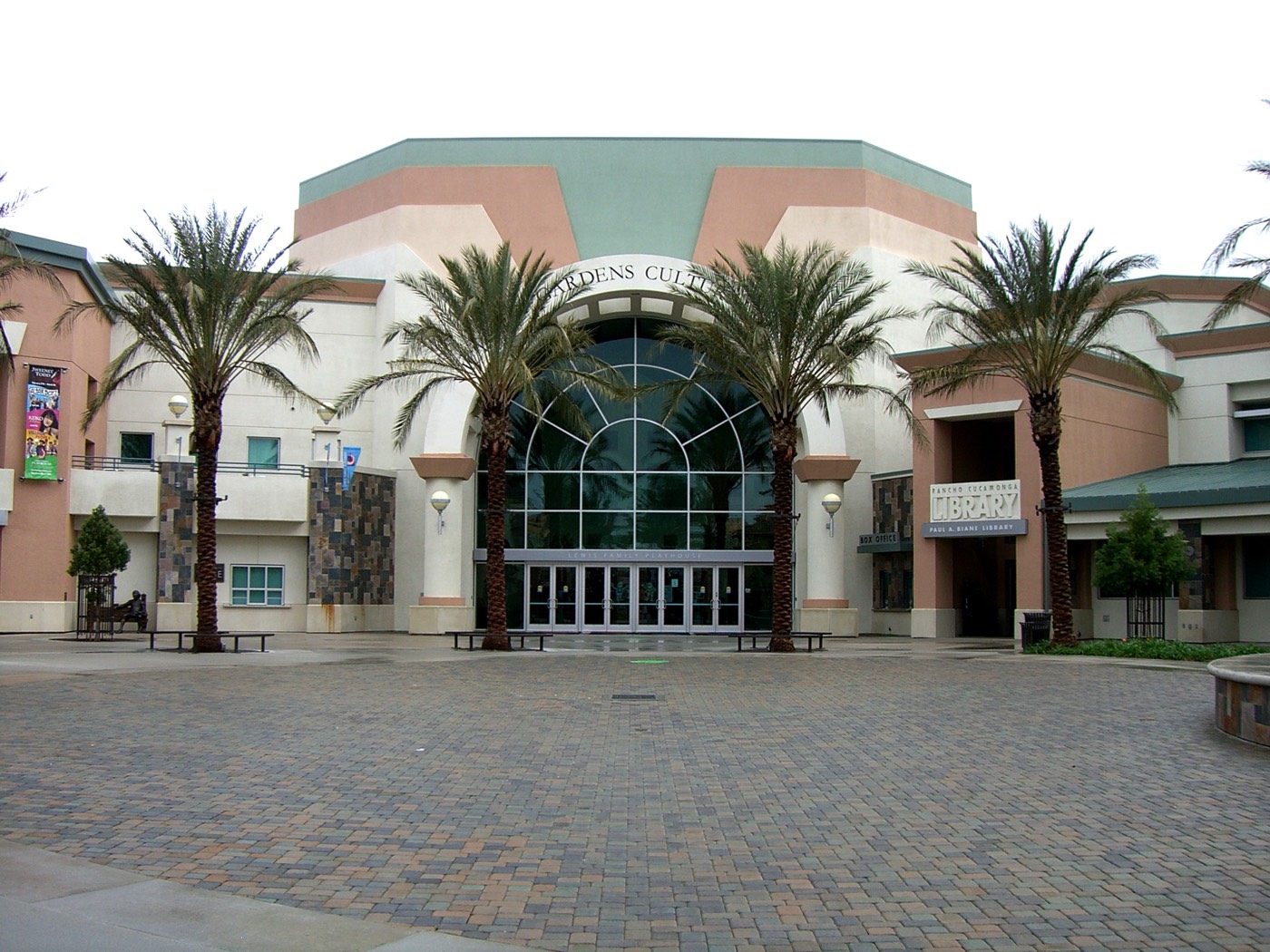
Victoria Gardens Cultural Center. Within the lifestyle centre sits a public cultural complex housing the city’s library, the Lewis Family Playhouse theatre, and exhibition space. It hosts cultural performances and family events that draw the area’s diverse communities, Filipino families among them.
Grill City, 11098 Foothill Boulevard. Tucked into the Seafood City food court, Grill City serves grilled and barbecued chicken, pork and seafood alongside Filipino plate lunches. It is the kind of unpretentious counter where a paper tray of pork barbecue and garlic rice does the work of a homecoming.
Where They Came From
Filipino migration to the United States has never drawn from one province alone, and Rancho Cucamonga reflects that breadth. Families trace roots to Luzon, the Visayas and Mindanao, with Tagalog-speaking regions around Metro Manila well represented alongside Ilocano and Visayan families.
What unites them is less a single home province than a common path. The professional and healthcare migration that began after 1965 favoured the educated, English-speaking and urban, the products of the Philippines’ nursing colleges, medical schools and universities. Many arrived first in older Filipino centres, in Los Angeles, the San Gabriel Valley, or Cerritos, before moving inland for space and affordability.
That history links Rancho Cucamonga to a constellation of Southern California Filipino communities. Families here have relatives and parish ties in the Filipino community in Cerritos, in West Covina, and in the fast-growing Inland Empire suburb of Eastvale, just across the county line.
Rancho Cucamonga Today
The Filipinos in Rancho Cucamonga are, by and large, a settled and prosperous community. According to the 2020 census, Asian residents make up roughly 14 percent of the city, around 25,000 people, with Filipinos forming the largest share of that group alongside Chinese and Vietnamese neighbours. Tagalog, including Filipino, is one of the most commonly spoken languages in city households after Spanish and Chinese.
This is not an immigrant enclave in the old sense. There is no Filipino Town here, no historic strip of storefronts like the one that anchors Little Manila in Queens. It is instead a suburban community of homeowners, nurses, engineers, logistics managers and small-business owners whose children attend Rancho Cucamonga’s well-regarded schools and whose cultural life runs through parish ministries, supermarket aisles and family gatherings rather than a single ethnic main street.
That dispersed, prosperous shape is itself the story. The Filipinos who settled here did not come to rebuild Manila in miniature. They came to fold their traditions into a comfortable American suburb, and they have done exactly that, raising bilingual children who order Chickenjoy in the same breath as they discuss college applications.
The public expressions of identity are real but seasonal. Sacred Heart’s Simbang Gabi fills the church each December, the dawn Masses ending in shared bibingka and puto bumbong long before the rest of the city wakes. The Filipino-American Association of the Inland Empire marks Philippine Independence Day each June with performances, food and cultural exhibits. In between, the community lives much as its neighbours do, distinct in the kitchen and the chapel, woven into the ordinary fabric of a foothill suburb the rest of the time.
Frequently Asked Questions
How many Filipinos live in Rancho Cucamonga?
Exact ethnic counts are not published separately, but the 2020 census recorded roughly 25,000 Asian residents, about 14 percent of the city’s population of around 175,000. Filipinos make up the largest portion of that group, which is why Filipinos in Rancho Cucamonga are such a visible presence in its churches, schools and shops.
Why did Filipinos settle in Rancho Cucamonga?
Most came for two reasons: work and family life. The Inland Empire’s hospitals and healthcare system drew Filipino nurses and medical professionals, while affordable homes and strong public schools attracted families priced out of coastal Los Angeles and Orange counties.
Where is the best Filipino food in Rancho Cucamonga?
The hub is the Seafood City complex at 11098 Foothill Boulevard, which houses Jollibee, Grill City, the bakery Bakers Avenue and the boba stand Bubble Street. The supermarket itself also stocks the full range of Filipino groceries and a hot-food counter.
Is there a Filipino Catholic church in Rancho Cucamonga?
Sacred Heart Catholic Church at 12704 Foothill Boulevard is a centre of Filipino Catholic life. It has hosted the Simbang Gabi novena Masses since 1997 and runs a Filipino ministry known as Sacred Heart Kapamilya.
What is Victoria Gardens and why does it matter to the community?
Victoria Gardens is a 147-acre open-air lifestyle centre that opened in 2004 and functions as the city’s unofficial downtown. Filipino families in Rancho Cucamonga gather there for shopping, dining and cultural events at its adjoining Cultural Center.
When do Filipinos in Rancho Cucamonga celebrate their heritage?
The two main moments are Philippine Independence Day in June, marked by the Filipino-American Association of the Inland Empire, and the Simbang Gabi novena at Sacred Heart each December in the run-up to Christmas.
If your family’s story passed through Rancho Cucamonga, or any of the places Filipinos have made home in America, Atlas of Home can trace that journey. From a nursing college in Manila to a Sunday morning at Seafood City on Foothill Boulevard, to wherever you are now.