
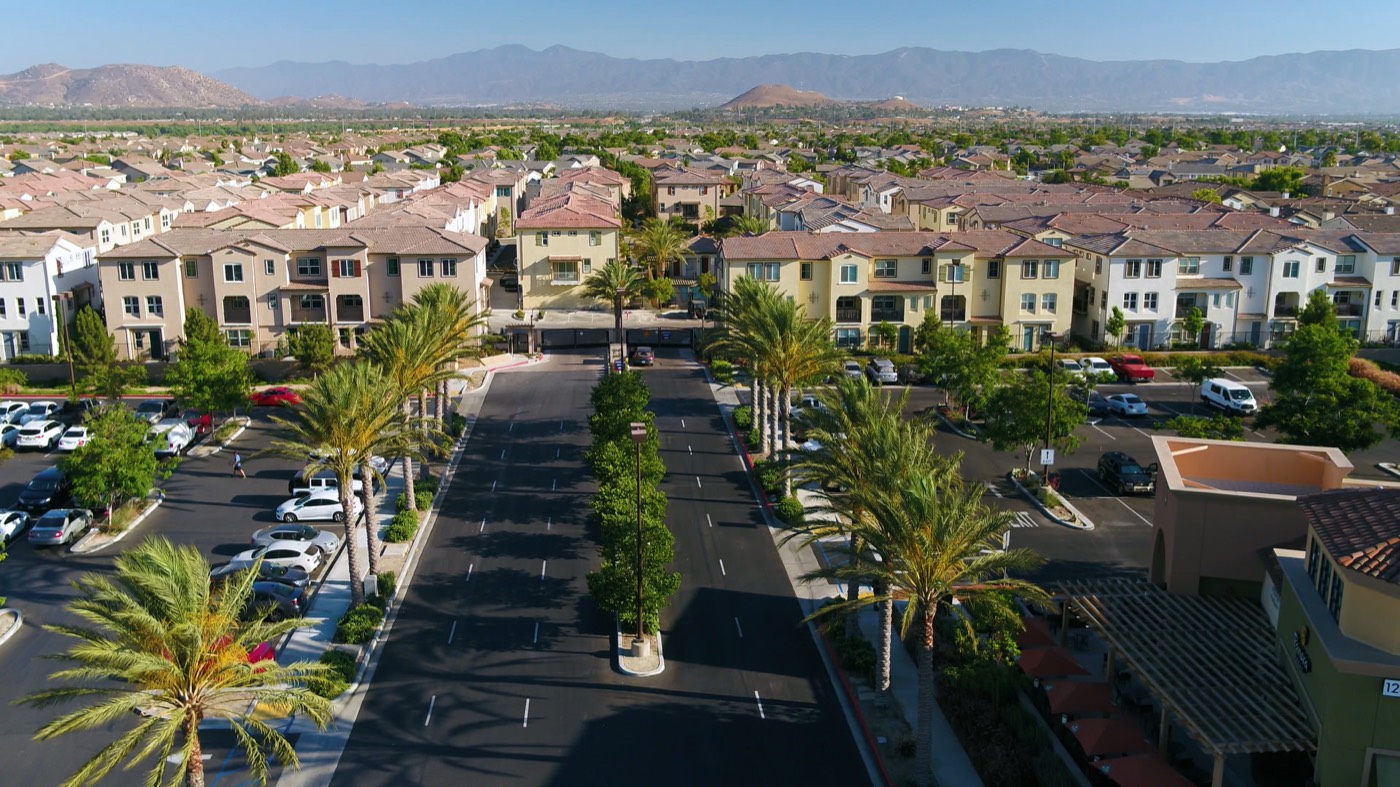
On a Sunday morning in Eastvale, the Costco lot off Hamner Avenue fills early, the school fields hum with youth football, and somewhere a rice cooker clicks to warm before the family heads to Mass. The Filipinos in Eastvale did not inherit an old quarter the way earlier generations found one in Daly City or National City. They built into something brand new: a master-planned grid of big stucco houses raised on what had been dairy pasture, chosen for space, for schools, and for the simple arithmetic of a registered nurse who could finally afford a four-bedroom home an hour east of the hospital.
The Place
Eastvale sits in the far northwest corner of Riverside County, pressed against the Santa Ana River and bordered by Chino, Ontario, Jurupa Valley, Norco, and Corona. It covers a little over thirteen square miles of the Inland Empire, almost all of it laid down since the late 1990s.
It is one of California’s youngest cities, incorporated on 1 October 2010 as Riverside County’s twenty-seventh municipality. By the 2020 census it held 69,757 people, a thirty percent jump in a decade, with a median household income above $151,000, one of the highest in the country.
Nearly a third of Eastvale’s residents are Asian, and Filipinos are among the largest of those communities. They came not to a historic enclave but to a frontier of cul-de-sacs and three-car garages, and made it home.
How It Became Filipino
From dairy land to subdivision
Before the houses, there were cows. For most of the twentieth century the land that is now Eastvale was farmland and dairy pasture, and from the 1950s onward the dairies of this valley, along with neighbouring Chino and Ontario, were owned largely by Dutch and Portuguese families who had moved their herds inland.
The name itself is older than the city. It traces to an 1893 school district designation, “East Vale,” recorded by the county. For generations that was all the name meant: a stretch of vale east of the river, smelling of alfalfa and milk.
That changed in the late 1990s. As land in Orange and Los Angeles counties grew unaffordable, developers turned the dairies into master-planned communities, and families seeking more house for their money began driving the freeways east. The transformation was fast and near total. A place that had been pasture within living memory became, within fifteen years, a city of seventy thousand.
The nurses lead the way
Filipino migration to the United States has long run through hospitals. Decades of recruitment from the Philippines built a generation of Filipino American nurses, respiratory therapists, and medical technicians, and Southern California’s healthcare system leaned heavily on them. The Inland Empire’s hospitals, in Riverside, Corona, Ontario, and Fontana, did the same.
When those professionals looked for somewhere to raise children, the calculation favoured Eastvale. The homes were new and large. The schools were strong. And the price, though high by national standards, undercut anything comparable in coastal Los Angeles or Orange County. A two-income household of healthcare workers could buy here what they could only rent closer to the sea.
So the first arrivals were often families with a nurse at the centre, commuting to shifts across the region while the house anchored everyone else. Word travelled the way it always has among Filipinos: through cousins, parish friends, and former classmates from nursing programmes back home.
It is a pattern as old as Filipino America itself. The hospital corridor and the suburban driveway have always been two ends of the same migration, the night shift paying for the mortgage, the mortgage holding three generations under one roof. Eastvale simply gave that pattern more room than the older cities could.
Chain migration, suburban style
What followed was chain migration in a new key. Instead of one relative sponsoring another into a crowded apartment, a sibling or parent followed a brother who had already closed on a house. Lolas and lolos moved into bedrooms to watch grandchildren during night shifts. Cousins rented until they could buy a street or two over.
Eastvale’s growth made it possible. For a stretch in the mid-2010s it was among the fastest growing cities in Riverside County, with new tracts opening almost continuously. There was always another phase of homes, another model row to tour after church.
The community that took shape was professional and family-centred rather than concentrated in a single district. Filipino families spread across Eastvale’s subdivisions, recognising one another at the supermarket, the youth sports field, and above all at Mass, rather than clustering on a single block.
The Landmarks
Saint Oscar Romero Catholic Community, 14395 Chandler St. Eastvale’s young Catholic parish, part of the Diocese of San Bernardino, has no grand church building yet and celebrates Mass at a local school campus. For a heavily Catholic Filipino community, it has become the natural gathering point, the place where Advent brings the dawn novena of Simbang Gabi and where families mark the milestones of a year.
Dr. Augustine Ramirez Intermediate School, 6905 Harrison Ave. The school auditorium doubles as Saint Oscar Romero’s worship space on weekends, a fitting arrangement in a city this new. On Sunday mornings the parking lot fills with families dressed for Mass, the sacred borrowing the civic until a permanent church rises.
Eleanor Roosevelt High School, 8001 Galena St. One of the Corona-Norco Unified School District’s flagship campuses, Roosevelt enrols well over four thousand students and graduates nearly all of them. For Filipino parents who measured cities by their schools before they measured anything else, its reputation is one of the reasons Eastvale won out.
Eastvale Gateway, Limonite Avenue at Hamner Avenue. Anchored by Target, Best Buy, and a multiplex, the Gateway is the commercial heart of the city. It is where families converge for errands and where a quick stop turns into a run-in with half the parish, the everyday crossroads of suburban Filipino life.
Costco Wholesale, 5030 Hamner Ave. No Filipino American suburb is complete without a Costco, and Eastvale’s is a Sunday institution. Multi-generational households shop in bulk here, lumpia wrappers and jasmine rice loaded beside the rotisserie chickens, the warehouse run a ritual of the week.
San Antonio Regional Hospital, Eastvale medical plaza. The hospital’s Eastvale satellite brought outpatient care closer to home for a community full of people who work in healthcare. For Filipino families whose livelihoods are bound up with hospitals, a medical campus in their own city carries a particular meaning.
Valerio’s Tropical Bakeshop, near Limonite Avenue. For pandesal still warm in the morning, ube rolls, siopao, and the sweet bread that tastes of home, families turn to Filipino bakeries serving the area. A box of pastries carried to a relative’s house is one of the quiet currencies of belonging here.
Where They Came From
Eastvale’s Filipinos come from across the archipelago, but the threads run especially through Metro Manila and the surrounding Tagalog provinces, and through the Ilocano north that has sent emigrants to California for over a century. Many arrived in the United States through the nursing and healthcare pathways that drew Filipino professionals in wave after wave.
Few came straight to Eastvale. The more common path ran through the older Filipino centres of Southern California first: a first apartment in Los Angeles County, years in West Covina or Cerritos, perhaps a stretch closer to the coast in National City near San Diego. Eastvale was the next step, the move made when children needed bedrooms and a yard.
In that sense Eastvale is a second-generation suburb, the place a family lands once it has already gained a foothold elsewhere. Its Filipino residents carry the memory of those earlier neighbourhoods, the communities of Filipinos in West Covina, of Filipinos in Cerritos, and of Filipinos in National City, even as they put down roots on the dairy land of the Inland Empire.
Eastvale Today
Eastvale today is prosperous, young, and still being built. The median household income has climbed past $160,000, the schools remain among the region’s best, and the houses keep their tidy newness. It is, by most measures, exactly what its residents drove inland to find.
For the Filipino families who chose it, the trade-offs are real. The commutes are long, the freeways back toward the coastal hospitals and offices are punishing, and the city has the slightly unfinished feel of a place whose institutions are still catching up to its people. A parish without its own church, a downtown that is really a shopping centre.
Children raised here are growing up as a distinctly Inland Empire generation of Filipino Americans, fluent in suburban California, marking fiestas and Christmas the way their grandparents did, often more comfortable on a freeway than on a jeepney. What they will make of Eastvale as it matures, whether the parish gets its church and the city grows a centre of its own, is a story still being written.
Yet the community fills those gaps the way Filipinos always have, with one another. The same instinct that built the historic enclaves of Filipinos in Daly City in an earlier era is at work here, only now in cul-de-sacs instead of foggy hillside streets. Eastvale’s Filipinos have proved that a homeland can be assembled on fresh ground, out of a parish, a Costco run, a Sunday table, and a network of relatives who all, somehow, ended up out east together.
Frequently Asked Questions
Is there a large Filipino community in Eastvale, California?
Yes. Nearly a third of Eastvale’s roughly seventy thousand residents are Asian, and Filipinos are among the largest groups within that population. The Filipinos in Eastvale are concentrated in family households rather than a single district, recognising one another at church, schools, and shopping centres across the city.
Why did Filipinos move to Eastvale?
Many Filipino families moved to Eastvale for affordable large homes, strong schools, and space, after years in pricier parts of Los Angeles, Orange, or San Diego counties. A great number work in healthcare, and Eastvale offered nurses and other professionals a home they could own within reach of the region’s hospitals.
When did Eastvale become a city?
Eastvale incorporated on 1 October 2010, becoming Riverside County’s twenty-seventh city. Before that it was unincorporated dairy land and farmland that began converting to master-planned housing in the late 1990s as families moved inland from Los Angeles and Orange counties.
Where do Filipinos in Eastvale worship?
Many Filipino Catholics in Eastvale belong to Saint Oscar Romero Catholic Community, a young Diocese of San Bernardino parish that celebrates Mass at a local school campus. It hosts Filipino traditions such as the Simbang Gabi dawn novena during Advent.
What schools serve Eastvale?
Eastvale is served by the Corona-Norco Unified School District, whose campuses include the highly regarded Eleanor Roosevelt High School. The strength of these schools is one of the main reasons Filipino and other families chose to settle in the city.
Where can you find Filipino food in Eastvale?
Filipino families in Eastvale shop at large warehouse stores like the Costco on Hamner Avenue and visit Filipino bakeries serving the area, such as Valerio’s Tropical Bakeshop, for pandesal, siopao, and ube treats. The wider Inland Empire offers additional Filipino markets and restaurants a short drive away.
If your family’s story passed through Eastvale, or any of the places Filipinos have made home in America, Atlas of Home can trace that journey. From the dairy land of the Inland Empire and the nursing wards that drew a generation west, to the master-planned streets of Eastvale, to wherever you are now.