
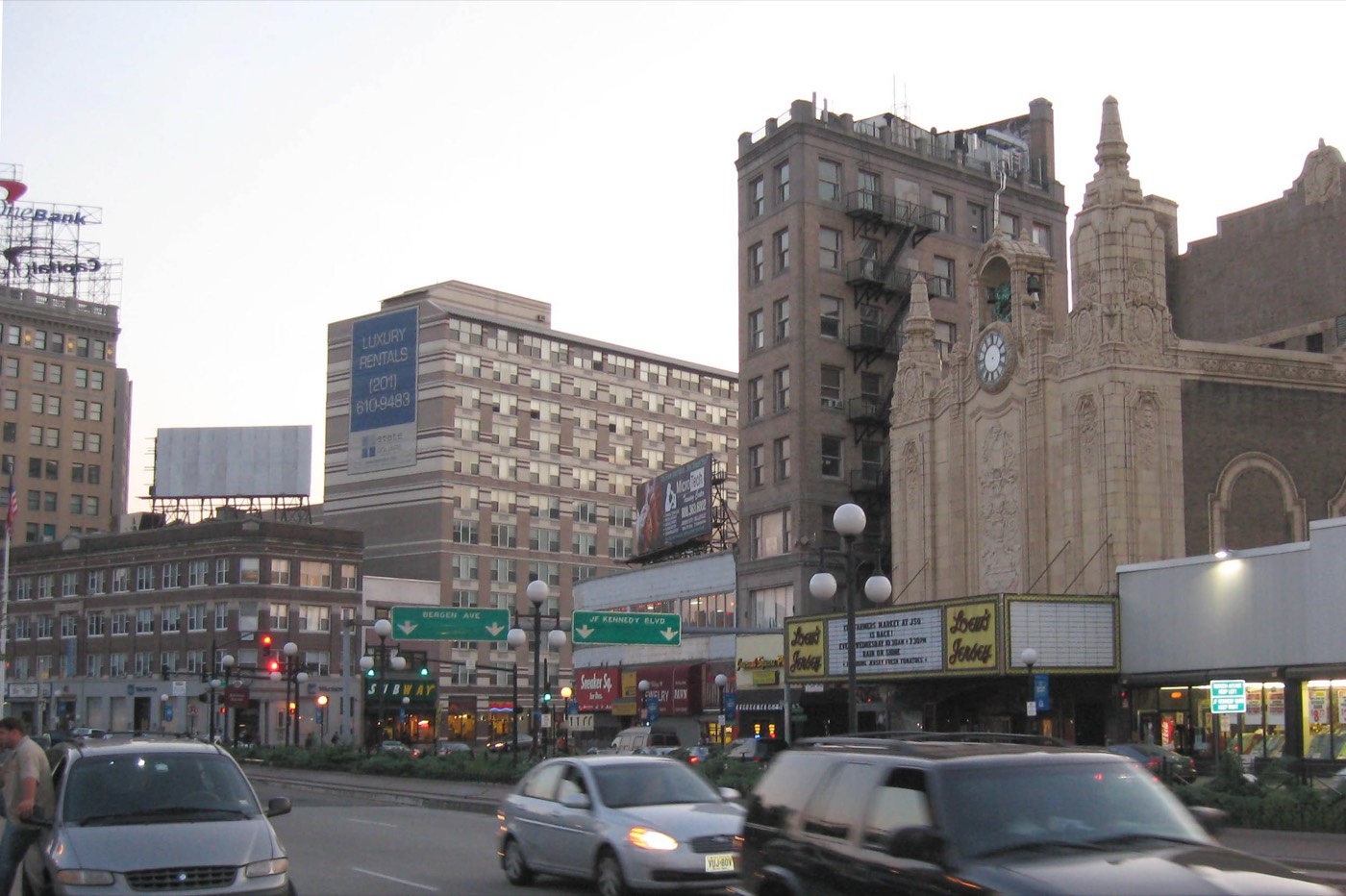
On an October Saturday, the plaza beside the Journal Square PATH station fills with the smell of grilled kofta and the sound of Arabic spilling from two sets of speakers at once. Children chase each other past a stall selling konafa, and somewhere a recording of Umm Kulthum competes with a DJ. This is the Egyptian Festival, and it is the clearest single window into the Egyptians in Jersey City, a community that has spent more than half a century turning a working harbour town into one of the most important Egyptian addresses in the United States.
New Jersey holds the largest concentration of Egyptians of any state, and within it Jersey City is the historic heart. The community here is not a single story. It is Coptic Christians and Muslims, doctors and shopkeepers, the first arrivals of the 1960s and the cousins who followed decades later.
The Place
Jersey City sits on the west bank of the Hudson River, close enough to Lower Manhattan that the financial district seems to float just across the water. For most of the twentieth century it was a railroad and shipping town, a place of warehouses, rail yards and tight rows of brick and brownstone.
That geography is the whole point. A PATH train carries a commuter from Journal Square into Manhattan in roughly fifteen minutes, and for decades the rent on the Jersey side was a fraction of the rent across the river. Newcomers without much money but with ambition could live cheaply and work anywhere.
The neighbourhoods that drew Egyptians were the southern and central ones: Journal Square, McGinley Square, Bergen-Lafayette and Greenville, the old district that nineteenth-century developers named for its open land. These were never the glass-tower waterfront where median incomes now top two hundred thousand dollars. They were the affordable, unglamorous streets where a family could put down roots.
How It Became Egyptian
The Egyptians did not arrive in Jersey City by accident. They came through a specific door opened by American law, and once the first families settled, they pulled in everyone they knew.
The professionals of the 1960s
The first significant wave of Egyptian immigration to the United States followed the landmark Immigration and Nationality Act of 1965, which prioritised skilled workers. That law selected precisely the kind of person Egypt was then producing in large numbers: university-trained doctors, engineers, accountants and pharmacists.
Many of these early arrivals were Coptic Christians, members of Egypt’s ancient Orthodox church, leaving a country where political winds after the 1952 revolution had grown unpredictable and, for a religious minority, increasingly uncomfortable. They were educated and willing to start again, and New Jersey, with its hospitals, laboratories and easy reach into New York, suited them.
The first church, 1970
The decisive moment came in 1970, when Egyptian immigrants in Jersey City founded St. Mark Coptic Orthodox Church. The first liturgy was celebrated on 22 March 1970, and the parish is recognised as the first Coptic Orthodox church building in North America, the mother church from which the entire denomination grew on this continent.
A church is more than a building. It is a Sunday gathering, a school, a marriage hall and a switchboard for news from home. Once St. Mark existed, Jersey City was no longer just somewhere Egyptians happened to live. It was somewhere they belonged, and that pulled the next arrivals straight to it.
A second parish, St. George and St. Shenouda, was incorporated in 1973, and over the following decades the two original congregations seeded more than a dozen further parishes across New Jersey. In 1977 Pope Shenouda III, the head of the Coptic church, made his first pastoral visit to North America and stopped at Jersey City’s churches, confirming the city’s standing at the centre of the diaspora. The fuller story of that religious life is told in our piece on the Coptic Egyptians in Jersey City.
Chain migration and the wider community
What began as a trickle of professionals became a chain. Family networks are the primary route of entry: roughly a third of foreign-born Egyptians gain permanent residency as the immediate relatives of citizens. A brother sponsored a brother, a cousin sponsored a cousin, and a single household in Greenville could over twenty years become a whole extended clan spread across three or four streets.
Those who followed were not only Christians, and not only doctors. They were grocers, mechanics, taxi drivers and small-business owners, Muslim and Coptic alike, drawn by the same rents and the same train. The professional founders gave the community its institutions; the later arrivals gave it its shops, restaurants and everyday street life.
The migration accelerated again after the turmoil of 2011 in Egypt, when economic uncertainty and renewed worry among Copts sent another generation looking for stability. They came to the place their relatives already knew.
A community that put down roots
By the 2019 to 2023 American Community Survey, the United States Census Bureau counted 5,811 people of Egyptian ancestry in Jersey City, the second-largest Egyptian population of any city in New Jersey, just behind neighbouring Bayonne. Egyptians make up around two per cent of the city’s residents, and Jersey City alone accounts for roughly an eighth of the state’s entire Egyptian population.
Those are the verified figures. Community estimates that count Sunday congregations and unrecorded relatives run considerably higher, and no single count captures a population spread across churches, mosques, shops and households. What is beyond dispute is the visible result: a stretch of central Jersey City where Egyptian life is woven into the ordinary fabric of the day.
The Landmarks
St. Mark Coptic Orthodox Church, 427 West Side Avenue. Founded in 1970, this is the first Coptic Orthodox parish building in North America and the spiritual anchor of the entire community. Its place on Pope Shenouda’s 1977 itinerary made it a pilgrimage point as much as a parish, and it still serves hundreds of Egyptian American families.
St. George and St. Shenouda Coptic Orthodox Church, 835 Bergen Avenue. Incorporated in 1973 as the community’s second parish, it sits on the Bergen Avenue corridor that runs like a spine through the Egyptian neighbourhoods. The pairing of these two early churches is why Jersey City, and not any city in Egypt’s vast diaspora, became the denomination’s North American home.
The Egyptian Festival, Journal Square PATH Plaza. Organised by the Jersey City Egyptian Committee, this annual October festival has run for well over fifteen years, drawing more than a thousand people for food, dancing and music beside the busiest transit hub in Hudson County. It is the one day a year when the whole community, Christian and Muslim, shares the same public square.
Gypsy Grill, 187 Newark Avenue. A family-run restaurant that bills itself as New Jersey’s first Egyptian restaurant, serving the shawarma, kofta, falafel and hummus that anchor the Egyptian table. It sits on Newark Avenue, the downtown dining strip, carrying Egyptian cooking out of the home neighbourhoods and into the city’s wider food scene.
Here is Cairo, 20 Garfield Avenue. A small Egyptian kitchen serving the country’s true comfort food: koshari, the layered lentils, rice and pasta that is Egypt’s unofficial national dish, alongside ful, the slow-cooked fava beans eaten at breakfast across Cairo. It is the kind of place that tells you a community is here to live, not just to visit.
Pope Shenouda III Way. A stretch of central Jersey City street co-named in honour of the late Coptic pope, a quiet civic acknowledgement that the Egyptian church has shaped this city’s identity. Street signs are how American cities admit, permanently, that a community belongs to them.
The Bergen Avenue corridor. Not a single address but a living street, lined over the years with Egyptian groceries, bakeries and small businesses, the everyday infrastructure of a diaspora. Here you can buy the right cheese, the right bread and the right coffee without explaining yourself to anyone.
Where They Came From
The roots of Jersey City’s Egyptian community reach back, in large part, to Upper Egypt: the southern governorates of Minya, Asyut and Sohag, the historic heartland of Coptic Christianity, where ancient monasteries still dot the Nile valley. This rural, conservative south, distinct from cosmopolitan Cairo and Alexandria, sent a disproportionate share of the early Coptic migrants.
Cairo contributed too, particularly the educated professional families who left in the 1960s and 1970s. An engineer from the capital and a farmer’s son from a village near Asyut might have had little in common in Egypt, but in Jersey City they shared a church, a language and a longing for the same food.
That southern, Coptic core gives Jersey City’s Egyptian community a particular flavour, more church-centred and more closely tied to Upper Egyptian village networks than the Egyptian populations of some other American cities. The chain migration ran along family lines back to specific towns, so arriving relatives stepped into a community where the neighbours already knew their grandparents.
Jersey City Today
The Jersey City that the first Egyptians found, all cheap rent and easy commutes, is changing fast. The waterfront has become a wall of luxury towers, and gentrification has pushed up the river through Journal Square and Bergen-Lafayette, the very neighbourhoods where Egyptian families settled. Affordable space, the thing that made the community possible, is harder to find every year.
Its founders and their children are now thoroughly American professionals, many long since moved to roomier suburbs in Bayonne and beyond, while the churches and the festival keep pulling everyone back to the old centre. The institutions outlast the geography.
What remains in central Jersey City is unmistakable. The Coptic churches still fill on Sunday and on Coptic Christmas in January. The restaurants still serve koshari and konafa. The festival still claims Journal Square for an afternoon each autumn. Egyptians here now share the city with a large Filipino community in Jersey City and many others, part of one of the most diverse small cities in America, and they hold their corner of it with the confidence of people who got there first. For the parallel Egyptian story across the Hudson, see the Egyptians on Steinway Street in Astoria.
The Egyptian arc fits a wider New Jersey pattern, in which whole ethnic communities anchor themselves to one or two towns and grow there for generations. It is the same logic that built the Chinese community in Princeton, the Syrian Jews of Deal and the Koreans of Norwood. According to the record of Egyptian Americans, New Jersey holds the largest share of the country’s Egyptians, and Jersey City is where that story began.
Frequently Asked Questions
Why are there so many Egyptians in Jersey City?
The Egyptians in Jersey City arrived because of cheap rent, a fifteen-minute PATH commute into Manhattan, and the 1965 immigration law that favoured skilled professionals. Once the first families and St. Mark’s church were established in 1970, chain migration through family ties brought relatives directly to the same neighbourhoods.
How large is the Egyptian community in Jersey City?
The 2019 to 2023 American Community Survey counted 5,811 people of Egyptian ancestry in Jersey City, the second-largest Egyptian population of any city in New Jersey after Bayonne. Community estimates that count church congregations and extended families run higher, and New Jersey has the largest Egyptian population of any state.
Are most Egyptians in Jersey City Coptic Christian or Muslim?
The historic core of the Egyptians in Jersey City is Coptic Christian, drawn from Upper Egypt, and the city is home to the first Coptic Orthodox church in North America. The community also includes many Egyptian Muslims, particularly among the grocers, drivers and small-business owners who arrived in later waves.
Where is the Egyptian neighbourhood in Jersey City?
Egyptian life centres on the southern and central neighbourhoods: Journal Square, McGinley Square, Bergen-Lafayette and Greenville. The Bergen Avenue corridor in particular has long held Egyptian churches, groceries and shops, and Journal Square hosts the annual Egyptian Festival.
What is the oldest Coptic church in Jersey City?
St. Mark Coptic Orthodox Church on West Side Avenue, founded in 1970 with its first liturgy on 22 March of that year, is both the oldest Coptic church in Jersey City and the first Coptic Orthodox parish building in all of North America. St. George and St. Shenouda followed as the second parish in 1973.
Where in Egypt did Jersey City’s Egyptians come from?
Many of the Egyptians in Jersey City trace their roots to Upper Egypt, especially the governorates of Minya, Asyut and Sohag, the historic heartland of Coptic Christianity. Educated professional families from Cairo also came in the early waves, and chain migration kept the links to specific southern towns alive across generations.
If your family’s story passed through Jersey City, or any of the places Egyptians have made home in America, Atlas of Home can trace that journey. From a village near Asyut on the Nile to a brick parish on West Side Avenue, to wherever you are now.