
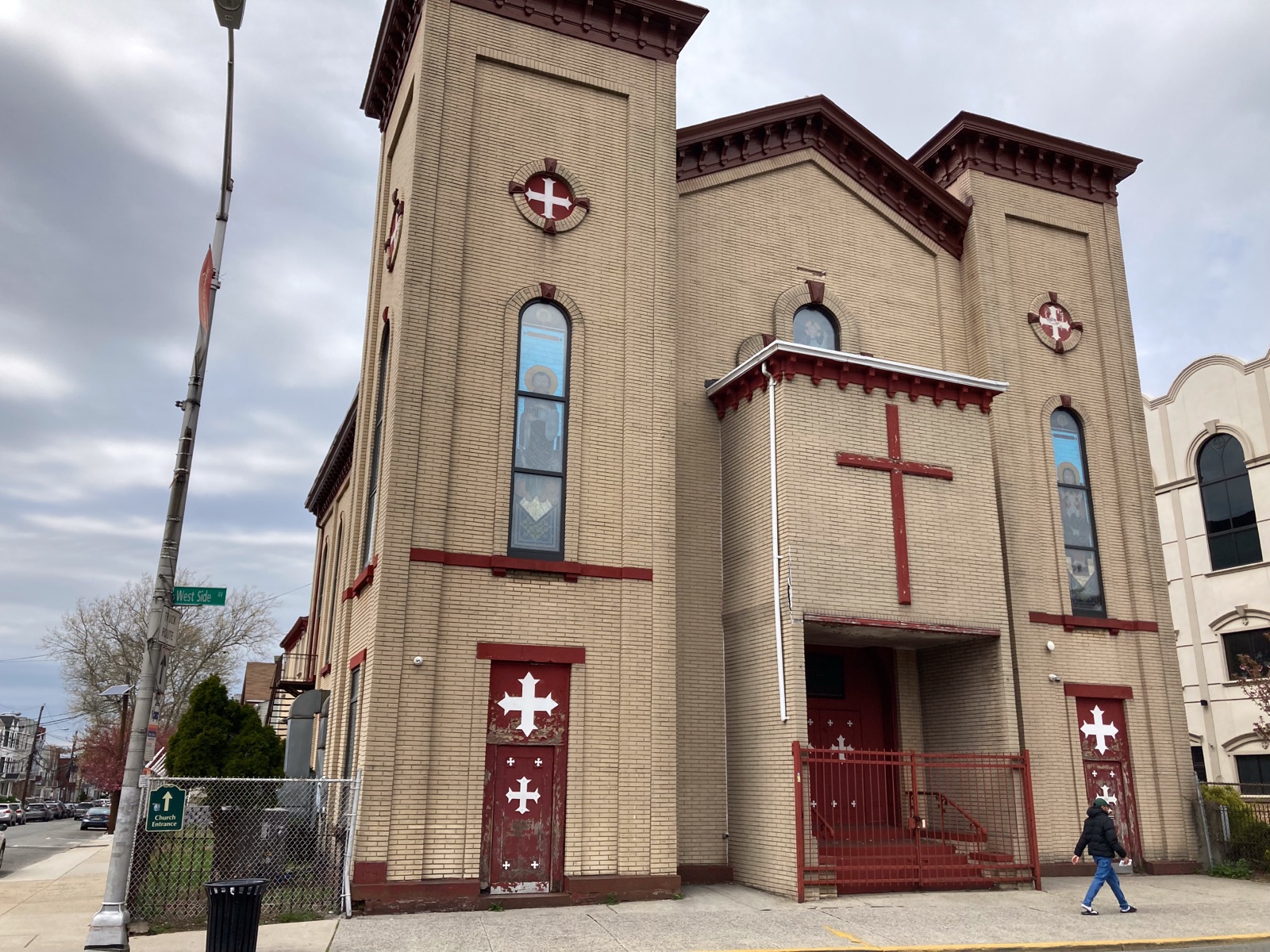
On a Sunday morning on West Side Avenue, the incense reaches the sidewalk before the singing does. Inside the doors of St. Mark’s, a deacon swings a censer in slow figure-eights while a chorus of voices climbs through hymns that were first sung in Alexandria seventeen centuries ago. The language is Coptic, then Arabic, then English.
A small Coptic cross is taped to the window of a bakery two blocks east. From Bramhall Avenue to Bergen, this is the densest concentration of Coptic Christians anywhere in the Americas, and almost none of the people walking past on a Saturday afternoon know it.
Jersey City carries one of the deepest stories of any neighbourhood in the United States. It is the place where the Coptic Orthodox Church, one of the oldest Christian communities in the world, planted its first permanent building on this side of the Atlantic. It is where a community of Egyptian Christians, who trace themselves back through the early Church to the Pharaohs, made an American home.
Jersey City, The Place
Jersey City sits in Hudson County, across the river from Lower Manhattan, with the Statue of Liberty visible from its shoreline parks. The Coptic story here unfolds in the southern and central wards: Greenville, Bergen-Lafayette, McGinley Square, and the streets around Journal Square. These are working and middle-class neighbourhoods of brick row houses, three-deckers, and aluminium-sided two-families, stitched together by the PATH trains at Journal Square and by Kennedy Boulevard running north to south.
It is a city of about 300,000 people and an honest patchwork of immigrants: Filipino, Indian, Dominican, Egyptian, Irish, Black American, Polish. The Coptic blocks are not a single ethnic enclave the way Bensonhurst is Italian. They are a thread woven through these neighbourhoods, marked less by storefronts than by the bells of three Coptic churches calling the same families to liturgy each Sunday morning.
How Jersey City Became Coptic
Before the Copts
Before the Egyptian Christians arrived, the southern half of Jersey City was Irish and then Italian and Polish. The waterfront jobs at the rail yards and the Holland Tunnel approaches drew working families through the early twentieth century. By the 1960s, the white-ethnic neighbourhoods were thinning. Catholic parishes were closing rectories. Frame houses on Bergen Avenue and West Side Avenue were going up for sale at prices a young immigrant doctor or engineer could just about manage on an American salary.
That timing mattered. When the first Copts started looking for a building they could call a church, Jersey City had inventory. A Protestant congregation on West Side Avenue, a stone building with a steeple and a small parking lot, came onto the market in 1969. A handful of Egyptian families noticed.
The Copts Arrive
The first wave of Coptic emigration to the United States began in the 1950s, after Gamal Abdel Nasser’s 1952 revolution and the wave of nationalisations that followed. The land reforms cut into the endowments of the Coptic Church. Christian-owned businesses were broken up. A generation of educated Copts, doctors, engineers, accountants, started looking abroad. The Immigration and Nationality Act of 1965 opened the door wider, and through the late 1960s and early 1970s, Coptic families began arriving in New York and New Jersey in numbers that finally justified a parish of their own.
St. Mark’s Coptic Orthodox Church on West Side Avenue celebrated its first liturgy on 22 March 1970, led by Father Rafael Younan. It was the first Coptic Orthodox parish ever established in North America. A few months later, in August 1970, Pope Cyril VI of Alexandria ordained Hakeem Amin Abdel-Sayed as Father Gabriel, who became the church’s first long-serving priest. He would shepherd the congregation for the next twenty-three years.
In 1973, a second parish was incorporated on the other side of town. St. George and St. Shenouda began on Bergen Avenue to serve the growing Coptic population in the eastern half of the city. The two churches divided the city roughly along Kennedy Boulevard and have served their corners of Jersey City ever since.
Jersey City at Its Peak
By the 1980s and 1990s, Jersey City had become the recognised heart of Coptic America. Anwar Sadat’s increasingly Islamist-leaning politics through the 1970s, his assassination in 1981, and the rise of sectarian incidents under the early Mubarak years all pushed new Coptic families to follow relatives who were already on West Side Avenue or Bergen Avenue. Chain migration was the engine. A brother sponsored a brother. A cousin in Cairo wrote to a cousin in Hudson County. A bride flew in for a wedding at St. Mark’s and stayed.
Pope Shenouda III, who led the Coptic Orthodox Church from 1971 until 2012, made his first pastoral visit to North America in 1977. He came to Jersey City. By the time he made his last visit decades later, there were Coptic parishes from Cedar Grove to Bay Ridge to Holmdel, but Jersey City remained the first stop.
In 1989, the Pope Shenouda III Coptic Orthodox Theological Seminary was founded in Cedar Grove, twenty-five minutes northwest of Jersey City. For the first time, Coptic priests could be trained on American soil. The North American diocese had its institutional spine.
Daily life in Coptic Jersey City was layered. Children went to public school on Bergen or Ocean or Communipaw and then to Sunday school in the church basement. Saturdays brought tasbeha hymn practice. Easter, in the Julian-calendar Coptic rite, often fell weeks after the Western Easter, and entire blocks of West Side Avenue would smell of basboussa and konafa baked for the breaking of the Great Lent. The Coptic year started on Nairouz, the first of September on the ancient Alexandrian calendar, when families remembered the martyrs.
The Change
The next wave came after the 2011 Arab Spring. The Egyptian revolution that toppled Hosni Mubarak was followed, almost immediately, by a sharp uptick in sectarian violence against Copts. The Two Saints Church bombing in Alexandria on New Year’s Eve 2010 had already killed 21 people.
The Maspero massacre of 9 October 2011, when the Egyptian military killed 25 Coptic protesters in Cairo, sent a fresh shock through the diaspora. Between 2011 and 2014, under the Muslim Brotherhood’s brief government and the violence that followed its fall, dozens of Coptic churches in Upper Egypt were burned.
Coptic families who had been hesitating started filling visa applications. Many of them came to Jersey City because they had family there. St. Mark’s and St. George’s both took on new arrivals, sometimes still carrying the smoke of a burned Upper Egyptian church on their stories. In 2012, the city of Jersey City renamed the intersection at Vroom and West Side as Pope Shenouda III Way. The Pope had died earlier that year. Bishop David, then patriarchal exarch of the North American archdiocese, attended the ceremony.
The Landmarks of Coptic Jersey City
St. Mark’s Coptic Orthodox Church (427 West Side Avenue). The mother church. The first Coptic Orthodox parish in North America, founded in 1970 in a converted Protestant building on the corner of West Side and Clarke. It now serves about 750 Coptic American families and still anchors the western half of the city. The iconography inside, painted in the distinctive Coptic style with elongated eyes and gold-leaf halos, is the work of artists trained in Cairo and Alexandria.
St. George and St. Shenouda Coptic Orthodox Church (835 Bergen Avenue). The second Coptic parish in Jersey City, founded in 1973, serving roughly 1,500 families on the city’s eastern flank near McGinley Square. The community is currently raising funds, through an initiative called HAVEN, for a new building on Sip Avenue that will house the worship space plus a multi-purpose hall.
Pope Shenouda III Way. The stretch of Vroom Street where it meets West Side Avenue, renamed by the city of Jersey City in October 2012, eight months after the Pope’s death. It is the only American street named after the Coptic Patriarch and sits a block from St. Mark’s.
The Pope Shenouda III Coptic Orthodox Theological Seminary (Cedar Grove, NJ). Twenty-five minutes from Jersey City, founded in 1989, this is where deacons and priests serving Coptic parishes from Maine to Virginia are now trained. The seminary’s existence is the reason Coptic clergy no longer have to fly to Cairo to be ordained.
Jesus the King Coptic Catholic Church (Bayonne). The Coptic Catholic minority, distinct from the Orthodox majority, established its first New Jersey congregation in 1988 under Monsignor Louis Nasser and Father Hanna Farag. Today it serves Coptic Catholics from across Hudson and Bergen counties.
The Bergen Avenue Egyptian strip. The half-mile of Bergen Avenue around McGinley Square is the most visibly Egyptian commercial stretch in the city. Egyptian groceries with shelves of fava beans and white cheese, halal butchers serving Muslim and Christian Egyptian customers alike, and small cafes serving Turkish coffee and hibiscus karkadeh sit cheek by jowl. The Coptic cross stuck to a cash register tells you which households are which.
Coptic Christmas, 7 January. Not a building but a date. Every year on the Julian-calendar Coptic Christmas, the two Jersey City churches hold midnight liturgies that fill to the doors with families in dark suits and headscarves, the bishop’s chant carrying out into the cold winter air. For a few hours, two blocks of Jersey City sound exactly like a village in Asyut.
Where the Jersey City Copts Came From
Egypt’s Christian population is heaviest in the south. The governorates of Upper Egypt, Minya, Asyut, and Sohag, have for centuries been the strongholds of the Coptic Orthodox Church. These are farming provinces along the Nile, where Christian villages sit beside Muslim ones, and where the desert monasteries of St. Anthony and St. Macarius have anchored the faith since the third century. Many of the Jersey City families trace themselves to specific villages around Asyut or to the Minya towns of Mallawi and Samalut.
A second strand comes from Alexandria and Cairo. These are the urban professional Copts: the doctors and pharmacists and engineers who left in the Nasser years and who built the first congregation at St. Mark’s. The Faiyum oasis sends a smaller share, mostly to the eastern half of the city around St. George’s. Whatever the origin, almost every Coptic family in Jersey City can name a village or a parish in Egypt where a grandmother is buried and where the family icon was first kissed.
Jersey City Today
The Coptic community in Jersey City is not fading. If anything it is still growing. Estimates of Coptic parishioners in the city run from 15,000 to over 30,000, with around 50,000 Copts across New Jersey state as a whole. The two original parishes have spawned a third, smaller daughter congregation, and Coptic families now spread north into Cedar Grove and west into Edison and East Brunswick as second-generation Coptic Americans buy houses in the suburbs.
What is shifting is the language. In the 1970s, the liturgy at St. Mark’s was sung in Coptic and Arabic, with a sprinkle of English. Now an entire English-language liturgy runs alongside the Arabic one, designed for the children of children of immigrants who speak English at home and learn Coptic only the way other American children learn Latin: a few words, a few prayers, a sense of where it came from.
The Bergen Avenue groceries are still here. The bakeries still sell konafa in the days before Coptic Easter. Pope Tawadros II, who succeeded Shenouda III in 2012, has visited Jersey City multiple times. The Theological Seminary in Cedar Grove keeps ordaining new priests. The community that built the first Coptic church in North America has not just survived in Jersey City. It has put down a second set of roots.
Frequently Asked Questions
Why did Coptic Egyptians settle in Jersey City?
Coptic Egyptians first settled in Jersey City in the late 1960s because it offered affordable housing close to the professional jobs of Manhattan, reachable by the PATH train. When a Protestant church building on West Side Avenue came up for sale in 1969, the early Coptic families bought it and founded St. Mark’s in 1970, the first Coptic Orthodox parish in North America. Every Coptic family that came afterwards followed that anchor.
Is Jersey City still home to Coptic Egyptians?
Yes, very much so. Jersey City still has the largest concentration of Coptic Christians in the United States, with estimates running between 15,000 and over 30,000 Copts in the city alone and around 50,000 across New Jersey. The community is still growing, fed by ongoing migration from Egypt and by Coptic American families staying close to the original parishes.
What are the most famous Coptic landmarks in Jersey City?
The two flagship landmarks are St. Mark’s Coptic Orthodox Church at 427 West Side Avenue, the first Coptic parish ever founded in North America, and St. George and St. Shenouda Coptic Orthodox Church at 835 Bergen Avenue. The city also features Pope Shenouda III Way, the intersection at Vroom and West Side renamed in 2012 to honour the Coptic Patriarch.
Where in Egypt did the Jersey City Copts come from?
Most Coptic families in Jersey City trace their origins to Upper Egypt, particularly the governorates of Minya, Asyut, and Sohag, where Christian villages have anchored the Coptic Orthodox Church for centuries. A second wave came from Alexandria and Cairo, mostly professional families who left after Nasser’s nationalisations in the 1950s and 1960s.
When did Coptic Egyptians first arrive in Jersey City?
The first Coptic families began arriving in the 1950s and 1960s, after the 1952 Egyptian revolution prompted educated Copts to seek opportunities abroad. The community reached the critical mass needed for its own church in 1969, and St. Mark’s celebrated its first liturgy on 22 March 1970, the founding moment of Coptic Christianity in North America.
If your family’s story passed through Jersey City, or through a village in Asyut or Minya before that, Atlas of Home can trace the journey. From an Upper Egyptian parish to a brick house on West Side Avenue to wherever you find yourself today, every step belongs in one map.