
On a Saturday before Christmas, the smell reaches the sidewalk before you reach the door: walnuts, butter, a little chocolate, the warm yeast of dough stretched paper-thin across a kitchen table and rolled into a spiral. This is povitica, and for more than a century the bluff above the rivers in Kansas City, Kansas, has run on it. The Croatians in Strawberry Hill built a parish, a school, and an orphanage up here. They built the bread, too, and the bread outlasted almost everything else.
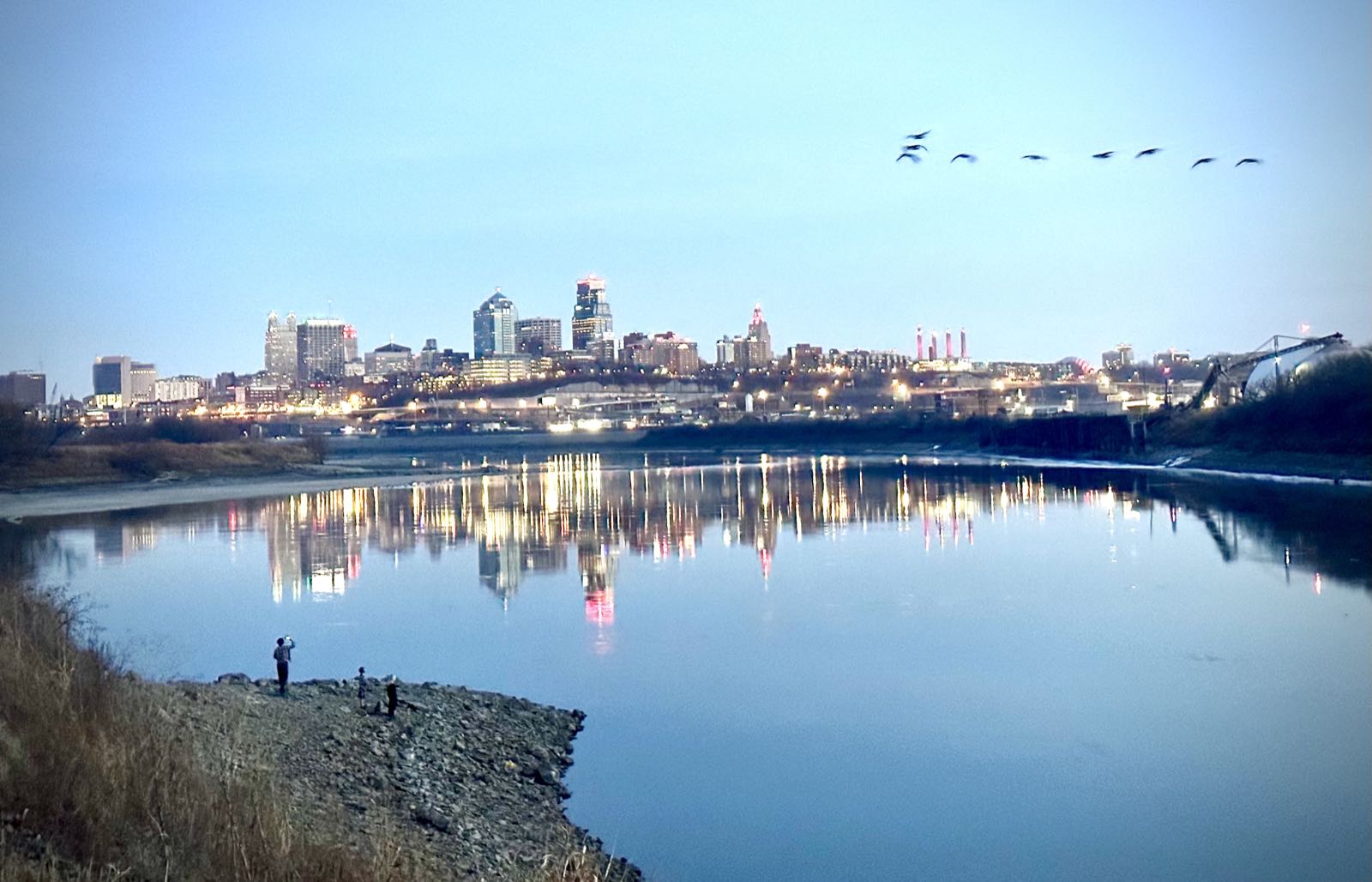
Stand at the edge of the hill and you understand why they stayed. The land drops away to the spot where the Kansas River pours into the Missouri, and across the water the downtown towers of Kansas City, Missouri, catch the last light. Below, in the flat ground called the West Bottoms, were the stockyards and the packing houses that drew them here in the first place.
Strawberry Hill: The Place
Strawberry Hill sits on a bluff in Wyandotte County, Kansas City, Kansas, overlooking the confluence of the Kansas and Missouri rivers at Kaw Point. Downtown Kansas City, Missouri, is about ten minutes east, across the state line that the rivers help draw. The housing stock is dense and old: narrow frame and brick homes on tight lots, brick sidewalks, churches at the high points. The neighborhood was once larger, before Interstate 70 carved away its western edge in the 1950s.
How Strawberry Hill Became Croatian
Before the Croatians
The hill had names before it had Croatians. It was once Splitlog’s Hill, after Mathias Splitlog, a Cayuga man who grew wealthy and bought the land in 1870 meaning to build on it. When the property was subdivided late in the century, Irish and German families filled in first, drawn like everyone after them to the work waiting at the bottom of the hill.
That work was meat. The West Bottoms, the flat industrial ground where the rivers met, held one of the largest stockyards and packing districts in the country by the 1880s and 1890s. Armour and the other great packing houses needed hands, and they recruited them from Europe by the thousands.
The Croatians Arrive
The first Croatian families reached Kansas City in the 1880s, following the packing-house trail that had carried them through Ellis Island and Chicago to this river and rail hub. They settled at first in the bottoms themselves, in a low district near the plants that locals called the Strawberry Patch for the wild berries on the slopes. The men worked the killing floors and the cutting rooms; the work was brutal, steady, and close to home.
Then the river took it. The catastrophic flood of 1903 drowned the bottoms and pushed the Croatians, along with their Slovene and Serb neighbors, up onto the bluff above the strawberry slopes. The neighborhood they founded there took the name of the fruit: Strawberry Hill. They were Catholics from the old country, and at first they scattered among other parishes, some to the Polish church of St. Joseph because the Poles were Slavs too and the languages were cousins.
They wanted their own. On May 26, 1900, Croatian men met in Union Hall on West Ninth Street and voted, on a motion from a parishioner named Janko Zugecic, that a church be built and a committee chosen to build it. In June 1902 Father Martin Davorin Krmpotic arrived from Croatia as the first permanent pastor. The cornerstone of St. John the Baptist was blessed on May 15, 1904, and the finished church was dedicated in January 1905.
Strawberry Hill at Its Peak
By 1907 the parish had raised enough to open a school, the first Croatian Catholic school in the United States, staffed by four Sisters of St. Francis brought over from Croatia. The following year Father Krmpotic brought another piece of home: Oton Ivekovic, a painter from the art school at Zagreb, who frescoed the interior of the church. It was the first time the artist had shown his work in America.
Life on the hill ran on a Croatian clock. There were two confessionals in St. John’s, one for English and one for confessing in Croatian. Midnight Mass filled with carols from the old country. Widows came up the brick walks with rosaries and prayer books, praying in the language they were born to. At weddings the tamburitza orchestra played and the whole hall joined the kolo, the circle dance, while toasts went round in plum brandy.
The hill held more than one faith. The Serbs built St. George Serbian Orthodox Church in 1906, a second Catholic parish, Holy Family, followed in 1908, and Holy Trinity Orthodox came in 1917. Strawberry Hill was Slavic top to bottom, but it was the Croatian institutions, the church, the school, the festival, that gave the neighborhood its lasting name.
The Change
The first wound came from disease. The influenza pandemic of 1918 and 1919 tore through the close houses on the hill and left children without parents. In 1919 the Sisters of St. Francis opened an orphanage in an 1887 mansion at the top of the bluff to take them in, a home tied to St. John’s that would care for children for decades.
The river struck again in 1951. The Great Flood of that July swamped the West Bottoms and Armourdale, and the packing industry that had built Strawberry Hill never fully recovered. Plants closed, jobs vanished, and the reason the neighborhood existed began to drain away.
Then came the road. In 1957 the path of Interstate 70 was cut straight through the lower edge of the hill. Roughly 219 households, around a third of the neighborhood, along with shops and a park, were taken by eminent domain and bulldozed. First, Second, Third, and parts of Fourth Street disappeared. The grandchildren of the founders scattered, many of them out to Johnson County to the south.
The Landmarks of Strawberry Hill
St. John the Baptist Catholic Church (708 N. 4th Street). The red brick parish on the bluff has been the center of Croatian life here since its dedication in 1905. Father Krmpotic served it for nearly twenty-nine years until his death in 1931, and inside hang the frescoes Oton Ivekovic painted in 1908. In October 2025 the parish marked its 125th anniversary with a Mass and tamburitza music.
Strawberry Hill Museum and Cultural Center (720 N. 4th Street). The Queen Anne mansion next to the church was built in 1887 for the Cruise-Scroggs family by a young architect, John G. Braecklein, on his first commission. In 1919 it became St. John’s Orphanage under the Sisters of St. Francis, a role it held until 1988, when it reopened as a museum of the hill’s many nationalities. Its Olde World Christmas displays draw the scattered families back every winter.
St. John’s Catholic Club. The hall beside the church carries the social half of parish life, with a bowling alley downstairs and Croatian soccer watch parties when the national team plays. During the 2018 World Cup, with Croatia surging toward the final, the club and the neighborhood roared together.
St. George Serbian Orthodox Church. Founded in 1906 by the hill’s Serbian families, St. George is a reminder that Strawberry Hill was never one people alone. Catholic and Orthodox neighbors lived door to door, worked the same packing floors, and raised their children on the same brick streets.
Strawberry Hill Baking Company (now in Merriam, Kansas). Harley O’Leary, descended from a family that carried its povitica recipe across the ocean in a suitcase, opened the first Strawberry Hill bakery at Fifth and Barnett in 1984. His sons now run a plant that ships hundreds of thousands of walnut loaves a year. The recipe traces to his great-great-grandmother, a hill woman who used to gather her friends at six on Saturday mornings to make the dough.
Kaw Point. At the foot of the bluff, where the Kansas River meets the Missouri, is the spot that explains the whole story. The packing houses that drew the Croatians stood on this flat ground, and the floods that reshaped their lives rose from these two rivers.
Where the Strawberry Hill Croatians Came From
Most of the founding families came from a narrow band of Croatia and its borderlands: the Primorje-Gorski Kotar region and the county of Karlovac, the wooded hill country inland from the Adriatic coast. Names like Ribnik, Lipnik, Cabar, and Osilnica recur in the parish rolls, small villages in the highlands where land was poor and families were large.
The pattern was chain migration in its purest form. One man crossed for a packing-house job, sent word and money home, and a brother or cousin followed to the same address on the same hill. Whole villages effectively relocated to a few square blocks above the Kansas River, which is why the church needed a Croatian confessional and why the bread tasted exactly like home. Croatians took similar routes to other industrial cities, building communities like the Croatians of Cleveland, Ohio and the fishing families who became the Croatians of San Pedro, Los Angeles.
Strawberry Hill Today
The hill is no longer a Croatian village, and it does not pretend to be. A wave of Croat and Bosniak refugees from the wars of the 1990s renewed the old ties for a time, and in recent years the neighborhood’s historic character and view have brought a housing boom and new arrivals who never worked a packing floor. Many of the founders’ descendants live in the suburbs now and drive back in.
But they do drive back. They come for the museum’s Christmas rooms and the parish festival in August, which still draws close to two thousand people to the church grounds. They come for the kolo lessons that brothers like Joe Baric teach for free in the St. John’s gym, so the circle dance does not die with the old people. And they come, always, for the povitica.
The painter Marijana Grisnik, born on the hill to Croatian parents, spent decades putting the lost streets back on canvas, the weddings and the bread days and the houses I-70 erased. Her work hangs in Zagreb now, which is the right shape for this story: a neighborhood that sent its children out into Kansas and the world, and sent its memory back home to Croatia. The hill remembers, and the bread keeps rising.
Frequently Asked Questions
Why did Croatians settle in Strawberry Hill?
The Croatians in Strawberry Hill came for the packing-house jobs in the West Bottoms below the bluff, one of the largest meatpacking districts in the country by the 1890s. They first lived in the lowlands near the plants, then moved up to the hill after the flood of 1903. The high ground was safe, cheap, and close to work.
Is Strawberry Hill still Croatian today?
Strawberry Hill is no longer a majority-Croatian neighborhood, but the legacy of the Croatians in Strawberry Hill still beats through St. John the Baptist parish, the Strawberry Hill Museum, and the August festival. Many descendants moved to the suburbs after Interstate 70 cut through in 1957, yet they return for Mass, the Christmas displays, kolo dancing, and povitica.
What are the most famous landmarks in Strawberry Hill?
The two anchors stand side by side on North 4th Street: St. John the Baptist Catholic Church, dedicated in 1905, and the Strawberry Hill Museum and Cultural Center in the 1887 Cruise-Scroggs mansion that once served as the parish orphanage. Strawberry Hill Baking Company, born here in 1984, is the third landmark, now famous nationwide for its povitica.
Where did the Strawberry Hill Croatians come from?
Most founding families came from the Primorje-Gorski Kotar region and Karlovac County, the hill country inland from Croatia’s Adriatic coast, from villages such as Ribnik, Lipnik, Cabar, and Osilnica. Chain migration meant that one worker would bring over relatives from the same village, recreating whole communities on the bluff.
When did Croatians first arrive in Strawberry Hill?
The first Croatian families reached Kansas City in the 1880s, settling near the packing houses before the 1903 flood pushed them up onto the bluff. They founded St. John the Baptist parish in 1900 and dedicated their church in 1905, which makes the parish older than the neighborhood’s modern name.
If your family’s story passed through the packing houses of the West Bottoms or the brick streets of the hill above them, the names and dates are worth holding onto. The Slovaks of Whiting, Indiana followed a similar industrial path, and every such neighborhood holds a family thread waiting to be traced.