
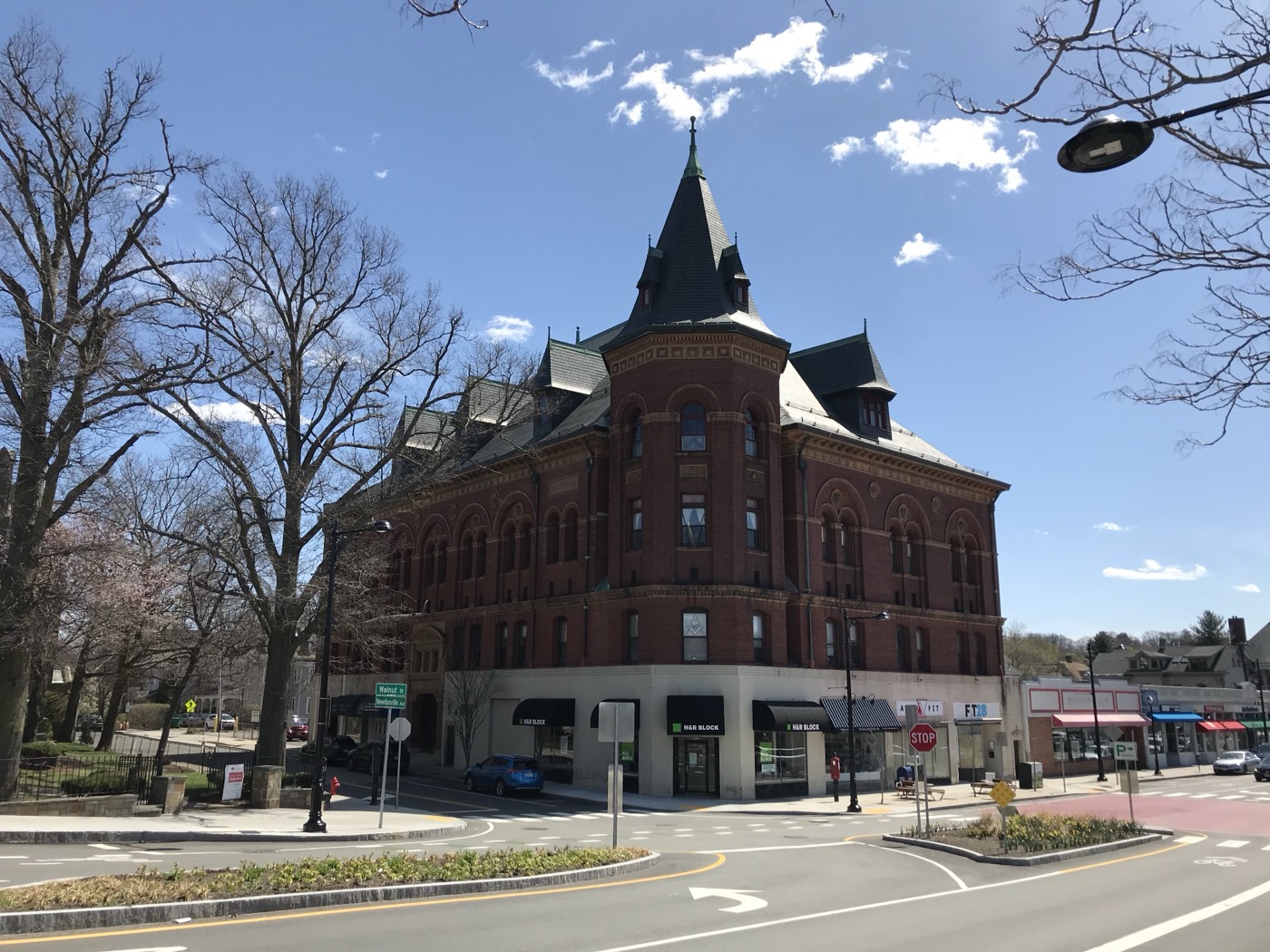
On a Saturday morning in West Newton, a brick building at 437 Cherry Street fills with the sound of children reciting tones. Outside, the Garden City goes about its leafy weekend. Inside, a Chinese language class repeats a phrase until it lands. The Chinese in Newton, Massachusetts are not a downtown enclave with lantern-strung streets. They are a professional, dispersed community woven through one of America’s most coveted school districts, drawn here by classrooms, laboratories and the long pull of Boston’s universities.
The Place
Newton sits seven miles west of downtown Boston, a city of roughly 88,000 people made up of thirteen distinct villages, from Newton Centre and Newtonville to Waban, Chestnut Hill and West Newton. Settled in 1630 as part of “the newe towne” and incorporated as a city in 1873, it earned the nickname the Garden City in 1874 as its mill villages gave way to tree-lined commuter neighbourhoods.
It became one of America’s earliest commuter suburbs after the Boston and Worcester Railroad reached West Newton in 1834. Today it is one of the wealthiest municipalities in Massachusetts, prized above almost everything else for its public schools.
That single fact, more than any temple or restaurant, explains why so many Chinese families have chosen Newton.
How It Became Chinese
Newton’s Chinese story did not begin with a wave of arrivals. It began with a club.
A social club, 1956
In 1956, a small group of Chinese residents in the Boston area founded what would become the Greater Boston Chinese Cultural Association as a social club. These were not laundry or restaurant workers of the old Chinatown generation. Many were students, scholars and early professionals orbiting Harvard, MIT and the hospitals.
In 1959 the club funded the first Chinese language school in Newton, a quiet signal of where Chinese families were already settling. The association incorporated formally as the GBCCA in 1963.
The Route 128 generation
The deeper transformation came with Route 128, the highway arc that became known as America’s Technology Highway. From the 1960s onward, the corridor’s electronics, defence and later biotech firms drew engineers and scientists, and the universities of Cambridge and Boston produced and retained a steady stream of Chinese and Taiwanese graduate students.
Many of those students stayed. They took jobs in the laboratories of Route 128 and Kendall Square, in the teaching hospitals, in the software and pharmaceutical companies clustered along the ring road. When they had families, they looked for the best schools they could reach. Newton, sitting where the Massachusetts Turnpike meets Route 128, was the obvious answer.
The pattern was self-reinforcing. A young researcher who bought a house near a particular elementary school told a colleague, who told another. Real estate agents learned which streets fed which schools. Within a generation, certain Newton villages had become quietly understood as places where a Chinese family arriving from a Cambridge lab or a Waltham biotech could expect to find neighbours who had taken the same road.
Mainland and Taiwan, side by side
The community that formed was layered. Taiwanese families arrived first in significant numbers through the 1970s and 1980s, often academics and professionals who had come for graduate study. After the 1990s, and especially as China sent more students abroad in the 2000s and 2010s, mainland Chinese families became a larger and larger share, many of them in technology, finance and biotechnology.
The institutions grew with them. The GBCCA founded a Lexington Chinese Language School in 1972 and a Chelmsford school in 1982, tracing the suburban spread of Chinese professionals across Greater Boston. The association opened its first activity centre in Weston in 1982.
A home at 437 Cherry Street
The community’s anchor took shape in the 1990s, when the GBCCA established its Chinese Community Center at 437 Cherry Street in West Newton. The building became the physical heart of the community: a weekend language school, a library opened in 2001, and in 2005 the Huaxin School of Arts teaching calligraphy, painting and music.
By the 2000s the association was bringing Chinese cultural workshops into the Newton Public Schools themselves, introducing calligraphy and painting to children who were not Chinese. The community had moved from the margins to the mainstream of civic Newton.
The cultural calendar grew alongside the institutions. The GBCCA helped co-found a dragon boat festival on the Charles River in 1979, an event that drew Chinese families from across the western suburbs onto the water each summer. Lunar New Year celebrations, recitals and folk dance performances became fixtures of the community year, woven into the same civic life as Newton’s school concerts and town meetings.
The numbers tell the story
The growth shows up plainly in the census. By the 2020 Census, Newton was about 16.5 percent Asian, with Chinese residents the largest single group within that share. In a city long defined by its established Jewish and old-stock New England families, Asian Newton had become one of the most visible threads in the civic fabric.
That history runs alongside another. Newton is also home to one of the most established Jewish communities in suburban Boston, and the two stories share the same streets, the same schools and the same fierce attachment to education.
The Landmarks
Greater Boston Chinese Cultural Association, 437 Cherry Street, West Newton. The community’s institutional home since the 1990s. A converted building that holds a weekend language school, a Chinese library opened in 2001, and the Huaxin School of Arts founded in 2005. Decades of recitals, calligraphy classes and Lunar New Year gatherings have passed through its rooms.
Newton Chinese Language School. Tracing its roots to the late 1950s, it is one of the oldest and largest Chinese schools in Greater Boston, teaching language from kindergarten through grade ten alongside folk dance, painting and martial arts. For thousands of Newton children, Saturday morning has meant Chinese class.
Newton Cantonese School. Founded in 1978, it preserves Cantonese instruction in a community increasingly shaped by Mandarin, a reminder that Chinese Newton was never a single dialect or a single point of origin.
Sichuan Gourmet House, 1203 Walnut Street, Newton Highlands. One of the area’s best-regarded Sichuan restaurants, the kind of place where the numbing-spicy dishes are cooked for diners who grew up with them rather than toned down for the suburbs. It is a fixture for families across the western suburbs.
Newton South High School, 140 Brandeis Road, Oak Hill. Opened in 1960 and consistently ranked among the top public high schools in Massachusetts. Its academic intensity is a magnet for Chinese families, and its student body reflects the community that settled around it.
Newton City Hall and the village centres. The Garden City’s villages, Newton Centre, Newtonville and West Newton chief among them, are where Chinese Newton lives day to day: in the bakeries, the after-school tutoring, the orchestra programmes and the queues at the better dumpling houses.
Where They Came From
Chinese Newton was built by two main streams. The first came from Taiwan, beginning in the 1970s and 1980s: graduate students and professionals who studied at Boston’s universities and stayed to work in technology, medicine and academia. Many had family roots across China carried to Taiwan in mid-century, and they brought with them a deep investment in education.
The second, larger stream came from mainland China, growing rapidly after the 1990s and through the 2000s and 2010s as China sent students abroad in record numbers. These newer arrivals clustered in biotechnology, software, finance and research, the industries that define modern Greater Boston.
Both streams chose Newton for the same reason their predecessors had. They followed the universities and the laboratories, and then they followed the schools. The path that runs from a graduate programme in Cambridge to a laboratory on Route 128 to a house in Newton has been walked thousands of times.
Newton Today
Chinese Newton in 2026 is a community without a centre of gravity, and that is the point. There is no Chinatown here, no single street of shopfronts. Instead there are children in nearly every elementary school, weekend language classes, parent networks organised around music and maths, and a calendar quietly marked by Lunar New Year.
The community sits within a wider regional map. Many Chinese families weigh Newton against neighbouring towns, and the region’s Chinese story extends to the academic enclave of Lexington, the more working and middle-class Chinese hub of Quincy south of the city, and the historic core of Boston’s Chinatown. Newton’s version is the professional, school-first chapter of that larger Boston-area story.
The community is also visibly second-generation now. Children who grew up attending Saturday classes at the Cherry Street centre have gone on to Newton North and Newton South, then to the universities that first drew their parents to Boston. Some have come back to raise their own families in the same villages, this time as the established residents rather than the newcomers.
What holds it together is less geography than expectation: that the next generation will do well, that Saturday mornings belong to Chinese school, and that the schools that drew everyone here will be guarded fiercely. It is an immigrant story told not through restaurants and storefronts but through report cards, recitals and the long, deliberate work of belonging.
Frequently Asked Questions
How many Chinese people live in Newton, Massachusetts?
Newton was about 16.5 percent Asian as of the 2020 Census, with Chinese residents the largest single group within that population. The Chinese in Newton, Massachusetts number in the thousands and are spread across all thirteen of the city’s villages rather than concentrated in one neighbourhood.
Why did Chinese families settle in Newton?
The main draw was, and remains, the Newton Public Schools, consistently among the best in Massachusetts. Chinese professionals working in the universities, hospitals and the technology and biotech firms along Route 128 chose Newton for its schools and its proximity to Boston’s research hubs.
Is there a Chinatown in Newton?
No. Unlike Boston’s Chinatown, the Chinese in Newton, Massachusetts are a dispersed, professional community without a single commercial enclave. The closest thing to a communal hub is the Greater Boston Chinese Cultural Association on Cherry Street in West Newton.
What is the Greater Boston Chinese Cultural Association?
Founded as a social club in 1956 and incorporated in 1963, the GBCCA established its Chinese Community Center at 437 Cherry Street in West Newton in the 1990s. It runs a weekend language school, a Chinese library and the Huaxin School of Arts.
Where can I find good Chinese food in Newton?
Newton has a strong cluster of Chinese restaurants, with Sichuan cooking especially well represented. Sichuan Gourmet House at 1203 Walnut Street in Newton Highlands is among the best regarded in the western suburbs.
How does Newton compare to Lexington and Quincy for Chinese families?
All three are major Chinese centres in Greater Boston. Lexington is a comparable affluent, academically focused suburb, Quincy is a larger and more working and middle-class Chinese hub south of the city, and Newton sits among the most school-driven and professional of the three.
If your family’s story passed through Newton, or any of the places Chinese Americans have made home in America, Atlas of Home can trace that journey. From a graduate programme in Cambridge or a town in Taiwan or mainland China, to a Saturday classroom on Cherry Street, to wherever you are now.