
On the third weekend of January, the parking lot at Clarke Middle School fills with families balancing trays of dumplings, while inside, lion dancers thread between folding tables hung with red lanterns. The Lunar New Year celebration is one of the largest gatherings of the year in this town of 34,000, and it is run by the Chinese in Lexington, Massachusetts, a community that has grown from a handful of families into roughly one in six residents. That it happens in the town where the American Revolution began is a quiet irony nobody here misses.
The Place
Lexington sits about eleven miles northwest of downtown Boston, just inside the arc of Route 128, the highway that gave the region its first nickname as a technology corridor. It is best known for what happened on its Battle Green on the morning of 19 April 1775, when colonial militiamen faced British regulars and the first shots of the Revolutionary War were fired.
The town has guarded that heritage carefully. The Minute Man statue, Buckman Tavern and the Hancock-Clarke House still anchor the centre, and the Common is a National Historic Landmark.
It is also, by almost any measure, one of the most affluent and best-educated suburbs in Massachusetts, a town of leafy streets, large lots, and a school system that ranks among the very best in the state. Those two things, the schools and the position on Route 128, explain almost everything about who moved here next.
How It Became Chinese
For most of its history Lexington was overwhelmingly white. In 1940, in a population of 13,187, there were just five residents who were neither Black nor white. The town that fought for American independence was, demographically, almost entirely of European descent well into the second half of the twentieth century.
The first families, the 1970s and 1980s
The change began slowly. By 1970, Asians made up about 2 per cent of the town, counted in the census under “Chinese” and “Other Asian.” These were largely academic and engineering families, drawn by the same logic that built the Route 128 economy: proximity to MIT, Harvard and the defence and electronics firms that lined the highway.
In 1983, a group of these Chinese American families formed the Chinese American Association of Lexington, known as CAAL. It started as an affinity group, a way for scattered households to find one another, and its first signature events were a Chinese New Year celebration and a candidates’ forum for local elections. Both still run today.
The wave, the 1990s and 2000s
The real surge came later. After emigration restrictions from mainland China loosened in the late 1980s, and as Taiwan’s professional class looked abroad, the trickle into Greater Boston became a flood. Across the region, the Asian American population rose sharply, with the fastest growth in wealthier suburbs like Lexington.
Lexington absorbed a large share of it. Asians were roughly 6.5 per cent of the town in 1990, around 11 per cent by 2000, and 25 per cent by 2016. The newcomers were overwhelmingly professionals: software engineers, biotech researchers, physicians, finance and academic workers, the kind of households that could afford Lexington’s prices and were buying, above all, the schools.
Schools as the engine
It is impossible to separate the Chinese growth in Lexington from its public schools. Lexington High School routinely ranks in the top three traditional public high schools in Massachusetts, and in the top 1 per cent statewide for test scores: in recent years roughly 94 per cent of students reach proficiency in maths against a state average near 42 per cent.
By the 2020s, about 46 per cent of Lexington High School’s students were Asian. For many Chinese families, choosing Lexington was a single decision dressed up as several: the house, the commute, the safety, but underneath, the school. Word travelled through professional and church networks, and chain migration did the rest, one family recommending the town to the next.
The same calculation drew other groups to other suburbs along the same corridor, much as it pulled a different community to Newton a few miles south. In Lexington the schools were the lure, and the Chinese arrivals were buying them as deliberately as anyone ever has.
From quiet presence to civic force
What changed in the 2010s was not just the numbers but the visibility. CAAL registered formally as a nonprofit in 2013, founded a Community Task Force in 2011 to push civic involvement, and in 2017 spun off a political action committee focused on local elections.
The shift showed during the pandemic, when the community mobilised to donate more than 280,000 dollars in relief funds and half a million pieces of protective equipment, and gave grants to the Lexington Food Pantry and the local symphony. A community that had arrived as scattered engineers now logged thousands of volunteer hours a year and ran more than twenty projects annually.
The Landmarks
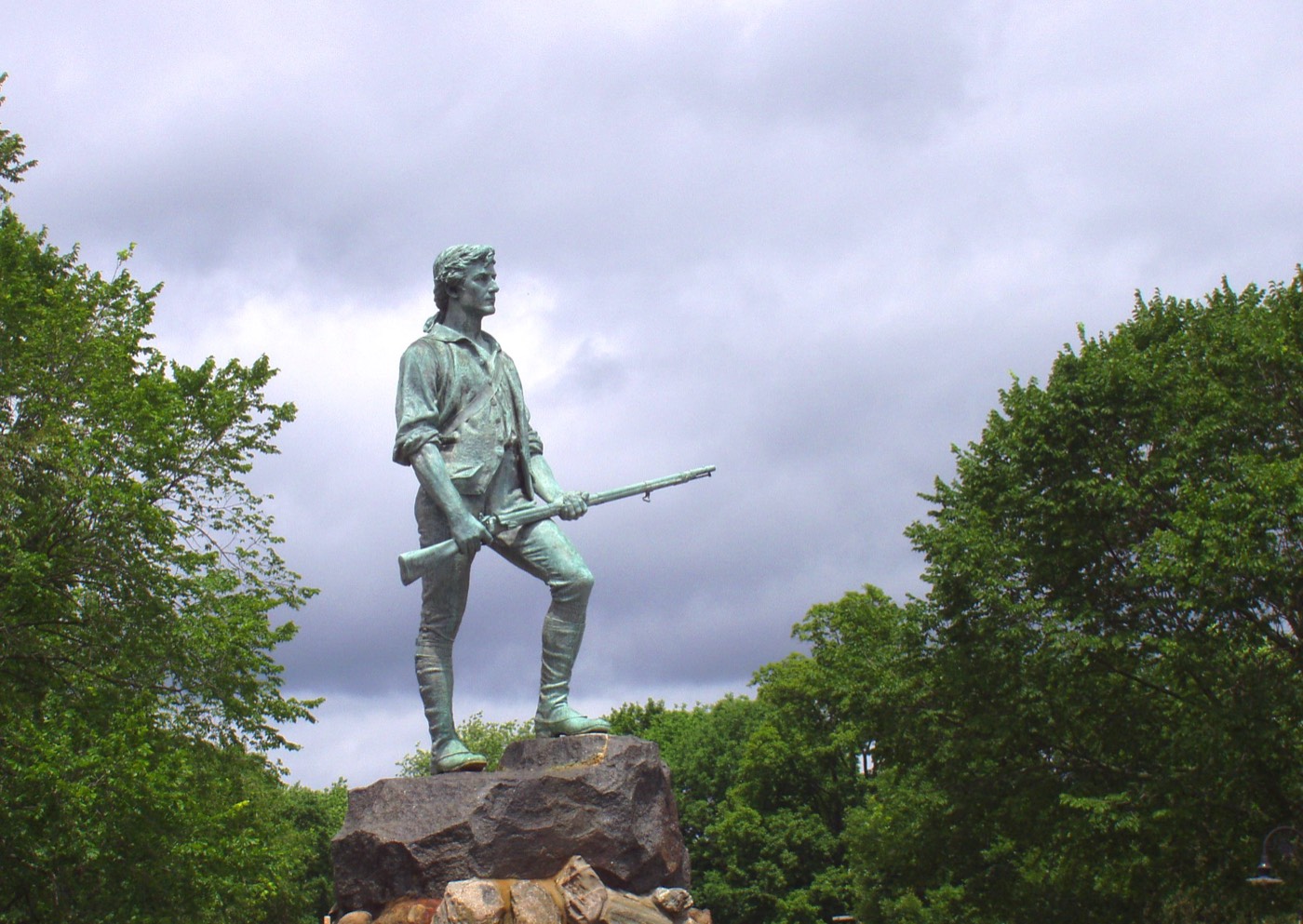
Lexington Battle Green, Massachusetts Avenue at Bedford Street. The triangular Common where the Revolution began is, for Chinese families raising children here, the civics lesson at the end of the street. The Minute Man statue, unveiled on the 125th anniversary in 1900, looks down the road the British marched, and the new arrivals fold its story into their own American beginning.
The Chinese Language School, at Clarke Middle School, 17 Stedman Road. Run by volunteers on Sundays, the school teaches language, a kindergarten programme and bilingual classes to the children of Lexington’s Chinese families. The borrowed public-school building, lit up on a weekend, is the most ordinary and telling symbol of the community: a Mandarin classroom inside an American middle school.
Taipei Gourmet, 211 Massachusetts Avenue. A Taiwanese restaurant near the town centre, known for noodle soups, weekend dim sum and a loyal following that crosses the whole region. For Taiwanese families in particular it functions as a canteen and a meeting point as much as a restaurant.
Beijing Chinese Dining, 1709 Massachusetts Avenue. Further along the avenue, this kitchen does weekend dim sum service and the kind of regional mainland cooking that signals a community large enough to be choosy. On a Sunday at noon the carts move steadily between tables of multi-generational families.
Lexington High School, 251 Waltham Street. The single most powerful magnet in town. Nearly half its students are Asian, and its results are the reason countless Chinese families chose Lexington over a cheaper address one town over. It is less a landmark than the foundation everything else sits on.
Cary Memorial Building, 1605 Massachusetts Avenue. The town’s grand 1928 auditorium hosts CAAL’s larger gatherings and candidate forums, the rooms where the Chinese community moved from cultural celebration to political participation. To fill Cary Hall is to be unmistakably part of the town.
Where They Came From
Lexington’s Chinese community is overwhelmingly first- and second-generation, and it splits broadly into two streams. The larger is from mainland China, families who left in the wave that followed the loosening of emigration controls in the late 1980s and the surging student and professional migration of the 1990s and 2000s.
The second is from Taiwan, an older and slightly earlier professional migration that helped seed the community in the 1970s and 1980s and still shapes its institutions, from restaurants to language schools. By 2020, about 17 per cent of Lexington’s residents were ethnically Chinese, proportionally the second-highest share of any of the 351 cities and towns in Massachusetts.
What united both streams was occupation rather than origin. These were research and technology households, drawn to the universities, hospitals and the Route 128 and biotech economy, who then sorted themselves toward the town with the strongest schools.
Many arrived first as graduate students or postdoctoral researchers, settling in Cambridge or Somerville before children and salaries pushed them outward. Lexington was rarely the first American address. It was the one chosen on purpose, once a family had decided to stay.
Lexington Today
Today roughly a third of Lexington is Asian, and the Chinese are by far the largest single group within that. The town’s earlier history as one of the few concentrations of Chinese Americans outside Boston’s Chinatown has been completely overtaken: Lexington is now a destination in its own right, not an overflow.
The community is also no longer only Chinese. Lexington has a large and growing Indian population alongside Korean, Japanese, Vietnamese and Bangladeshi residents, and the cultural calendar reflects it. But the Chinese presence remains the most established, with the deepest institutions, the oldest association and the most visible civic footprint.
You can read the change in small things: the Mandarin signs taped up at the Sunday language school, the dim sum carts on Massachusetts Avenue, the candidate forums where questions are asked in two languages. None of it is performed for visitors. It is simply how a third of the town now lives.
It is not without tension. Debates over school admissions, housing density and the pressure of academic competition surface here as they do in other high-achieving suburbs. Yet the broad story is one of arrival completed. A town defined for two centuries by a single April morning has quietly become, in two generations, one of the most Chinese places in New England, and the families who made it so now help run it.
Frequently Asked Questions
How large is the Chinese community in Lexington, Massachusetts?
About 17 per cent of Lexington’s residents were ethnically Chinese as of 2020, proportionally the second-highest share of any town in Massachusetts. The Chinese in Lexington, Massachusetts are the largest group within an Asian population that makes up roughly a third of the town.
Why did so many Chinese families move to Lexington?
The two main draws were the public schools and the location. Lexington High School ranks among the top traditional public high schools in the state, and the town sits inside Route 128, close to MIT, Harvard, area hospitals and the biotech and technology employers that hire its largely professional residents.
When did Chinese families start settling in Lexington?
The first significant arrivals were academic and engineering families in the 1970s, when Asians were about 2 per cent of the town. The major growth came after the late 1980s, rising to roughly 11 per cent Asian by 2000 and 25 per cent by 2016.
What is CAAL?
CAAL is the Chinese American Association of Lexington, founded in 1983 and registered as a nonprofit in 2013. It runs the town’s Lunar New Year celebration and a local candidates’ forum, and has become a significant civic and volunteer force among the Chinese in Lexington, Massachusetts.
Is there a Chinese school in Lexington?
Yes. The Chinese Language School meets on Sundays at Clarke Middle School on Stedman Road, teaching language, kindergarten and bilingual classes. It is one of several Chinese-language education options serving families across the Greater Boston area.
How does Lexington compare to other Chinese communities near Boston?
Lexington is the affluent professional counterpart to working-class and historic centres like Quincy and Boston’s Chinatown. It most resembles tech-driven suburbs such as Cupertino, California, where schools and the technology economy concentrate Chinese families.
If your family’s story passed through Lexington, or any of the places Chinese families have made home in America, Atlas of Home can trace that journey. From a village in Guangdong or a city in Taiwan, to a Sunday classroom on Stedman Road, to wherever you are now.