
On a Saturday morning at the corner of Preston Road and Warren Parkway, the car park outside 99 Ranch Market fills with families pushing trolleys of bok choy, live tilapia and pineapple buns still warm from the bakery. The Chinese in Frisco, Texas did not arrive to a Chinatown. They built their gathering places one storefront, one church hall and one school car line at a time, in a town that twenty years ago was mostly cotton fields and cattle.
The Place
Frisco sits at the northern edge of the Dallas-Fort Worth sprawl, straddling Collin and Denton counties about thirty miles from downtown Dallas. For most of the twentieth century it was a quiet farming town on the old St. Louis-San Francisco Railway, the line that gave the place its name.
Then the suburban tide that had filled Plano in the 1990s spilled north. Frisco was the fastest-growing city in the United States in 2017, and its population climbed from a few thousand in 1990 to more than 200,000 by the 2020 census. Corporate headquarters, the Dallas Cowboys practice facility and master-planned neighbourhoods followed the rooftops.
The names that relocated here read like a directory of corporate America: the PGA of America, T-Mobile, the financial firm TIAA and others built campuses along the Dallas North Tollway. Each headquarters brought engineers, analysts and managers, and a meaningful share of those new hires were Chinese professionals already living in the metroplex or recruited into it.
What set Frisco apart from older Dallas suburbs was who moved in: well-paid professionals chasing top-rated schools and new-build houses. Among them, in growing numbers, were Chinese families.
How It Became Chinese
The Chinese story in north Dallas did not begin in Frisco. It began further south, and it moved one suburb at a time until it reached the cotton fields that became Frisco’s subdivisions.
From Richardson to Plano
The first modern wave of Chinese professionals settled in Richardson around 1975, drawn by the technology corridor that earned the area its “Telecom Corridor” nickname. By the mid-1980s, most Chinese K-12 students in the metroplex lived in Richardson, and the DFW China Town shopping centre there became the community’s commercial anchor.
Starting around 1991, Chinese engineers and managers began moving north into Plano in large numbers. Plano Independent School District launched a Chinese bilingual program that same year, an early signal of how central schools would be to where Chinese families chose to live. For two decades, Plano was the centre of Chinese life in the northern suburbs.
The Move North After 2000
After 2000, Collin County kept expanding, and the rooftops marched past Plano’s northern border into Allen, Frisco and McKinney. This wave differed from the laundries and restaurants of a century earlier. These were working professionals: software engineers, doctors, finance staff, telecom workers and a growing number employed by the corporate names relocating to Frisco itself.
Families who might once have bought in Plano found newer, larger houses in Frisco for similar money, inside a school district that was racking up state and national rankings. Word travelled through WeChat groups, temple networks and office break rooms. A neighbour told a colleague, a colleague told a cousin, and the Chinese share of Frisco grew with every closing.
The Numbers Behind the Shift
The census makes the speed plain. Frisco’s Asian population more than quadrupled between 2010 and 2020, rising from 11,568 to 52,672 residents. By 2020 roughly 26 percent of Frisco identified as Asian, against about five percent statewide in Texas. It was the city’s fastest-growing demographic group of the decade.
Chinese Americans are a major part of that figure across Collin County, which is home to more than 35,000 Chinese residents, distributed mainly across Plano, Frisco, Allen and Richardson. In Frisco’s schools the change is even more visible than in the citywide totals, a point that quietly drove much of the migration. Families with school-age children weighted the city’s classrooms toward the young.
Frisco’s growth made it a natural extension of the corridor that runs up from Richardson through Plano, the same path traced by the Chinese community in Plano a generation earlier.
A Community That Built Outward, Not Inward
Unlike the Chinatowns of San Francisco or New York, Frisco’s Chinese community never concentrated into a single district. It spread across master-planned neighbourhoods near the better-rated schools, with commerce clustering in a handful of shopping centres rather than one dense quarter.
That pattern reflects who came: suburban professionals who wanted lawns, garages and short commutes, not walk-up tenements. The community is real and growing, but it lives in the rhythm of school pickups, weekend grocery runs and Sunday services rather than in a postcard street of red lanterns.
It is a quietly powerful kind of belonging. A family can spend a Saturday entirely inside a familiar world, breakfast of soy milk and youtiao at home, a morning at 99 Ranch, lunch of soup dumplings, an afternoon class in Mandarin, and then drive five minutes to a neighbourhood that looks like any other in north Texas. The two lives sit side by side without friction.
The Landmarks
99 Ranch Market, 9292 Warren Parkway. The Taiwanese-American supermarket chain opened its Frisco store in 2019, near the busy intersection of Preston Road and Warren Parkway. For many Chinese families it became the unofficial town square, with a food court, a bakery and aisles of goods that no mainstream grocer stocks.
Kitchen Master, 9285 Preston Road. A short walk from 99 Ranch, this restaurant draws crowds for Shanghainese cooking, soup dumplings and dim sum. On weekends the wait spills onto the pavement, a sign of how many Chinese households now treat this corner of Frisco as their dining hub.
Frisco Community Bible Church, 10055 Warren Parkway. An independent, non-denominational congregation holding worship in English, Mandarin and Cantonese. For Chinese-speaking newcomers, churches like this serve as both spiritual home and landing pad, offering language ministries and a ready-made network of neighbours.
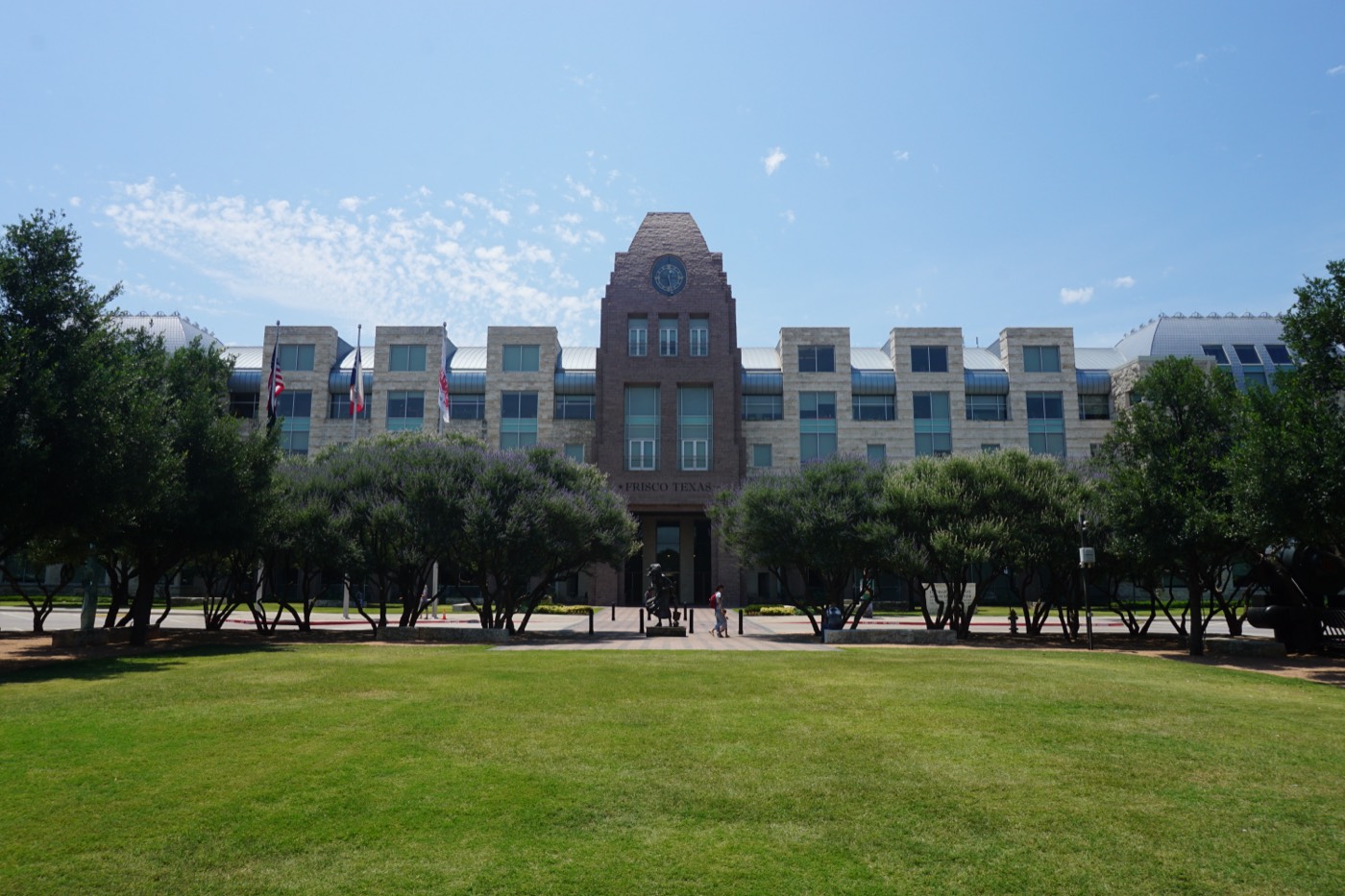
Frisco Lunar New Year Festival, Simpson Plaza at Frisco City Hall. Hosted by the Frisco Asian Community Engagement team, this free festival has grown to draw more than 4,000 attendees, with lion dancing, food stalls and family activities outside city hall. The city only began hosting it after its Asian population surpassed a quarter of residents.
Liberty High School, Frisco ISD. One of the district’s top-rated campuses, Liberty and its sister schools became magnets for Chinese families weighing where to buy. Across Frisco ISD, Asian students now make up close to 45 percent of enrolment, a figure that reshaped the city’s classrooms within a single generation.
Stonebriar Centre, 2601 Preston Road. The 165-store regional mall is not a Chinese institution, but it is where many Chinese families spend weekend afternoons, and its surrounding corridor of restaurants and plazas has filled with Asian-owned businesses serving the new residents.
Jusgo Supermarket, Carrollton corridor. Slightly south of Frisco, Jusgo is one of the area’s larger Asian grocers and a frequent destination for Frisco households making a bigger weekend shop. Together with 99 Ranch and the H Mart locations in Plano and Carrollton, it anchors a ring of stores that keep the community supplied.
Where They Came From
Frisco’s Chinese residents trace back to two broad streams. The earlier one, rooted in the 1970s and 1980s, brought many families from Taiwan, drawn first to Richardson’s technology firms and universities. Their children and grandchildren are now part of the wider Texas-born generation.
The larger, more recent stream came from mainland China, accelerating through the 2000s and 2010s as graduate students and skilled-visa professionals settled into the metroplex’s technology, telecom, healthcare and finance sectors. Many arrived via the University of Texas at Dallas, which has long enrolled a substantial Chinese student body, then stayed in the region for work.
For most, Frisco was a second or third American address rather than a first. They came not directly from Beijing or Taipei but from Richardson, Plano or another metroplex suburb, moving up to bigger houses and newer schools as careers matured. That same northward ladder carried families to nearby Allen and McKinney, and west toward Houston’s suburbs like the Chinese community in Sugar Land.
Frisco Today
Today the Chinese presence in Frisco is woven into the ordinary texture of an affluent Texas suburb. It shows up in the Mandarin overheard in the 99 Ranch checkout line, in the weekend Chinese-language classes, in the lion dance outside city hall each February and in the heavy Asian enrolment at schools like Liberty and Lone Star.
It is not a self-contained enclave, and that is the point. Chinese families here generally live alongside their neighbours rather than apart from them, sending children to the same public schools and shopping at the same malls, while keeping a parallel circuit of grocers, restaurants and churches that make the place feel like home.
Frisco’s Chinese community is also still young and still growing. With Collin County drawing tens of thousands of new Asian residents in recent years, the storefronts, congregations and festivals that the community has built are likely to multiply rather than fade. The cotton fields are gone, but a new layer of the town’s story is only a generation deep, and Frisco shares that arc with its larger neighbour, the Indian community of Frisco, whose presence here grew on a parallel track.
Frequently Asked Questions
How large is the Chinese community in Frisco, Texas?
Frisco’s overall Asian population reached about 52,672 in the 2020 census, roughly 26 percent of the city, with Chinese Americans forming a major share. Collin County as a whole is home to more than 35,000 Chinese residents, concentrated in Frisco, Plano, Allen and Richardson.
Why did so many Chinese families move to Frisco?
Top-rated Frisco ISD schools, new-build housing and proximity to north Dallas technology and corporate employers drew Chinese professional families north from Richardson and Plano after 2000. Word spread through workplace, church and family networks, steadily raising the Chinese share of the city.
Where do Chinese residents in Frisco shop for groceries?
The 99 Ranch Market at 9292 Warren Parkway, opened in 2019, is the main Chinese grocery hub in Frisco itself. Many families also drive to Jusgo Supermarket and to H Mart locations in nearby Plano and Carrollton for a wider Asian selection.
Is there a Chinatown in Frisco?
No. The Chinese in Frisco, Texas never formed a single dense district. The community instead spread across master-planned neighbourhoods near the best schools, with commerce clustering in shopping centres such as the plaza around 99 Ranch on Warren Parkway.
Are there Chinese churches or cultural events in Frisco?
Yes. Frisco Community Bible Church on Warren Parkway holds Mandarin and Cantonese services, and the annual Frisco Lunar New Year Festival at Simpson Plaza draws thousands each February. Chinese-language schools serving the area operate in nearby Plano and Carrollton.
How does Frisco’s Chinese community differ from its Indian community?
Both are large and fast-growing, but they are distinct. Frisco’s Indian community is the metroplex’s largest South Asian concentration, while the Chinese community traces a separate path up from Richardson and Plano, with its own grocers, restaurants and churches.
If your family’s story passed through Frisco, or any of the places Chinese families have made home in America, Atlas of Home can trace that journey. From a first apartment in Richardson or Plano to a new-build house by a Frisco school, to wherever you are now.