
Drive west out of Naperville along the edge of the Fox River valley and the subdivisions keep going, only the names on the doorbells start to change. The Indians in Aurora, Illinois did not arrive in a single wave or settle a single street. They filled in the eastern flank of Illinois’s second largest city quietly, one engineer and one cul-de-sac at a time, until a gold-spired temple on Sullivan Road and a high school where two in five students are Asian made the pattern impossible to miss.
The Place
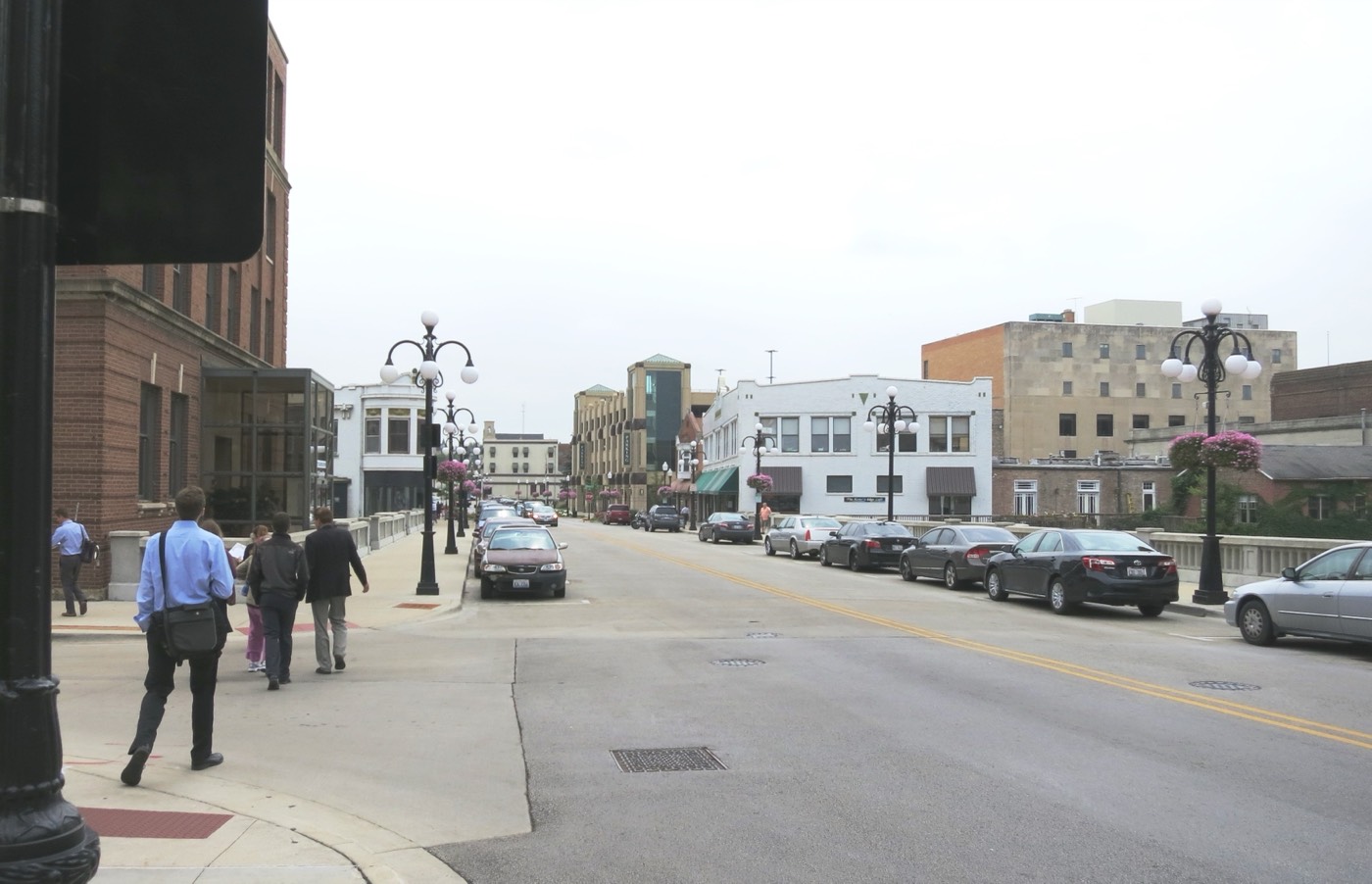
Aurora sits about forty miles west of downtown Chicago, straddling the Fox River across Kane, DuPage, Will and Kendall counties. It grew up as a railroad and manufacturing town on the Chicago, Burlington and Quincy line, a place of foundries and factories that emptied out when heavy industry left in the 1980s.
Then it did something most rust-belt cities never manage. Through the 1990s and 2000s, Aurora’s eastern edge filled with new subdivisions, corporate parks and schools, and the city added tens of thousands of residents. Between 2000 and 2003 the Census Bureau ranked it among the fastest-growing cities in the country. By the mid-2020s it counted roughly 181,000 people, the second most populous city in the state after Chicago.
That eastern side, the part that bleeds into Naperville, is where the Indian story is concentrated.
How It Became Indian
The Indian presence in Aurora is best understood as the western shoulder of a much larger suburban migration. For decades, Chicago’s Indian centre of gravity was Devon Avenue on the city’s North Side, the saree shops and sweet houses that anchored the first generation. The families who built careers there did what immigrant families across America have always done. They moved out toward the schools.
The corridor takes shape
By the 1980s and 1990s, the new destination was the western suburbs, and the most magnetic of them all was Naperville, with its nationally ranked schools and its corporate campuses. Aurora, sharing both the school district and the county line, became the natural overflow and, for many, the deliberate choice.
The reason was arithmetic as much as ambition. Aurora’s eastern subdivisions offered the same Indian Prairie School District 204 schools, the same proximity to the technology and corporate employers strung along the East-West corridor, and homes that cost less than Naperville’s. For a young engineering family weighing every dollar against the children’s prospects, the trade was obvious.
The work that brought them
The men and women who filled these houses were overwhelmingly professionals. The Indian migration to the western suburbs ran on the H-1B visa and the graduate degree, on software, telecommunications, pharmaceuticals and finance. They were the engineers and analysts who staffed the office parks of DuPage County, the doctors at the regional hospitals, the consultants who commuted east toward the city.
This was chain migration of a particular, credentialled kind. One cousin sponsored another, one colleague recommended a neighbourhood to a friend still in Hyderabad or Chennai, and a realtor who understood what a Telugu or Tamil family was looking for steered them toward the right cul-de-sac off Eola Road.
The pattern compounded on itself. Each Indian family that arrived made the next one more likely, because the questions a newcomer asked, where to find a good doctor, which streets fed which schools, where the temple was, all now had answers from someone who spoke the same language and had made the same move a year or two before.
The temple comes first
Institutions followed the families, but in Aurora one institution arrived early and grew with them. In 1985, nine philanthropic families donated twenty acres of land with a farmhouse on Sullivan Road, on the western side of the city, as the site for a temple to Lord Venkateswara, the Balaji of Tirumala.
For years, Midwestern Hindu families had driven all the way to Pittsburgh for darshan of Balaji. The Aurora temple, inaugurated in 1986, ended that pilgrimage. It became one of the anchor Hindu institutions of greater Chicago, and a reason for South Indian families in particular to settle within easy reach of Sullivan Road.
From overflow to destination
What started as Naperville’s affordable alternative became a destination in its own right. As the eastern subdivisions matured through the 2000s and 2010s, Indian families were no longer settling for Aurora. They were choosing it, and the proportion of Indian and South Asian residents in the District 204 attendance area climbed steadily until it reshaped the schools themselves.
The Landmarks
Sri Venkateswara Swami (Balaji) Temple, 1145 Sullivan Road. The spiritual anchor of Indian Aurora and one of the oldest major Hindu temples in the Midwest. Built to a design by the temple architect Padmasri M. Muthiah Sthapathy of India and the Chicago architect Subhash Nadkarni, it blends ancient Shilpa Shastra principles with modern construction. Devotees can perform pradakshina, the ritual circumambulation, around the main deity and every major shrine inside.
Sai Baba Mandir, 1101 Foran Lane. A quieter devotional centre dedicated to Shirdi Sai Baba, serving the many families across the Aurora area for whom Sai worship is a daily practice. It rounds out a local religious landscape that, between the two temples, gives Hindu Aurora somewhere to gather on its own ground rather than driving across the suburbs.
Waubonsie Valley High School, 2590 Ogden Avenue. One of the two District 204 high schools that absorbed the Indian influx on Aurora’s eastern side. Its hallways, science fairs and debate teams reflect a student body that across the district runs close to forty percent Asian, among the highest of any large district in Illinois.
Metea Valley High School, 1801 North Eola Road. Opened in 2009 to relieve the crowding that growth on the east side had created, Metea Valley sits squarely in the corridor where Indian Aurora is densest. Its Diwali celebrations, Bollywood-inflected cultural nights and Indian student clubs are simply part of the calendar.
Indian Prairie School District 204, headquartered in Aurora. The institution that, more than any temple or restaurant, explains why Indian families came. Serving roughly 26,000 students across more than thirty schools shared with Naperville, its student body is about 39 percent Asian, a figure that quietly tells the whole demographic story.
Patel Brothers, 1568 West Ogden Avenue, Naperville. The grocery lifeline for Aurora’s east-side Indian families sits just over the municipal line, close enough that a Saturday run for atta, curry leaves, fresh produce and festival sweets is part of the weekend rhythm. Its presence is the surest commercial sign of how many Indian households the corridor now holds.
The Eola Road corridor. The spine of Indian Aurora is not a single shopfront but a stretch of road and subdivision. Along and around Eola Road, the strip-mall restaurants, the South Asian doctors’ offices and the grocery runs to neighbouring Naperville map out where the community actually lives.
Where They Came From
Aurora’s Indians did not come from one place in India, but the South is heavily represented, a pattern written into the very founding of the Balaji temple. Telugu families from Andhra Pradesh and Telangana, and Tamil families from Chennai and the rest of Tamil Nadu, formed a large share of the early professional migration, drawn by the engineering and software economy and by a temple dedicated to the deity of Tirumala.
Gujarati and Hindi-speaking North Indian families came too, many by way of Devon Avenue or the older Chicago suburbs, alongside Punjabi, Malayali and Bengali households. What united them was less a single region than a class: graduate-degreed professionals who arrived through the skilled-visa pipeline of the 1990s and 2000s.
It is the same engine that built Indian Schaumburg to the north and Indian Edison, New Jersey half a country away. Aurora’s version simply ran on the Fox River.
The diversity within is real and often invisible to outsiders. A Tamil family and a Gujarati family on the same street may share a school carpool and almost nothing else: different languages at home, different festivals marked first, different food on the stove. What they share is the corridor, and a second generation now growing up American in the classrooms of District 204.
Aurora Today
Asian residents make up roughly eleven percent of Aurora as a whole, close to twenty thousand people, but that citywide figure flattens a sharp geography. On the heavily Hispanic west and central sides, the share is small. On the eastern edge inside District 204, it is a defining feature of daily life, and Indians are the largest part of it.
That concentration shows up in ordinary ways. It is the Diwali lights along an Eola Road subdivision in autumn, the pickup cricket on a summer evening, the queue at the Balaji temple on a festival weekend, the science-fair rosters and spelling-bee finals at Metea Valley and Waubonsie Valley.
Aurora has not become a single-ethnicity enclave, and it never set out to be one. It is a genuinely mixed city, Hispanic and white and Black and Asian, where the Indian community occupies one corner with quiet thoroughness. The temple on Sullivan Road has stood for nearly forty years now, longer than many of the families it serves have been in America, and that permanence is the point. What began as the affordable side of Naperville has become, for tens of thousands of Indian Americans, simply home.
Frequently Asked Questions
How many Indians live in Aurora, Illinois?
The Census records Aurora’s total Asian population at about 19,800, roughly 11 percent of the city, in the 2019 to 2023 American Community Survey estimates. Indians are the largest Asian group, concentrated on the city’s eastern side, though the Census does not publish an exact Indian-only count for Aurora.
Why did so many Indians settle in Aurora rather than Naperville?
Aurora’s eastern subdivisions share the same Indian Prairie School District 204 schools and the same access to the corporate corridor as Naperville, but historically at lower home prices. For Indian professional families weighing schools against cost, Aurora offered the same advantages for less, making it a natural choice and overflow.
What is the main Hindu temple for the Indians in Aurora, Illinois?
The Sri Venkateswara Swami (Balaji) Temple at 1145 Sullivan Road is the principal Hindu temple, inaugurated in 1986 on land donated by nine families. It is one of the oldest major Hindu temples in the Midwest and draws devotees from across greater Chicago.
Which schools serve Aurora’s Indian community?
Indian families on Aurora’s east side are served by Indian Prairie School District 204, shared with Naperville, whose student body is roughly 39 percent Asian. Waubonsie Valley and Metea Valley high schools are the two main secondary schools in the area.
When did Indians start moving to Aurora?
The migration built through the 1990s and 2000s, as Indian professional families moved out from Chicago’s Devon Avenue and older suburbs toward the western corridor’s schools and technology jobs. The Balaji temple, founded in the mid-1980s, predated and then anchored that growth.
Where can you buy Indian groceries near Aurora?
The closest major Indian grocer is Patel Brothers in neighbouring Naperville, at 1568 West Ogden Avenue, an easy run from Aurora’s east-side subdivisions. It is the regular weekend source for spices, flours, fresh produce and festival items for the community.
If your family’s story passed through Aurora, or any of the places Indians have made home in America, Atlas of Home can trace that journey. From a temple town in Andhra Pradesh or Tamil Nadu to a cul-de-sac off Eola Road, to wherever you are now.