
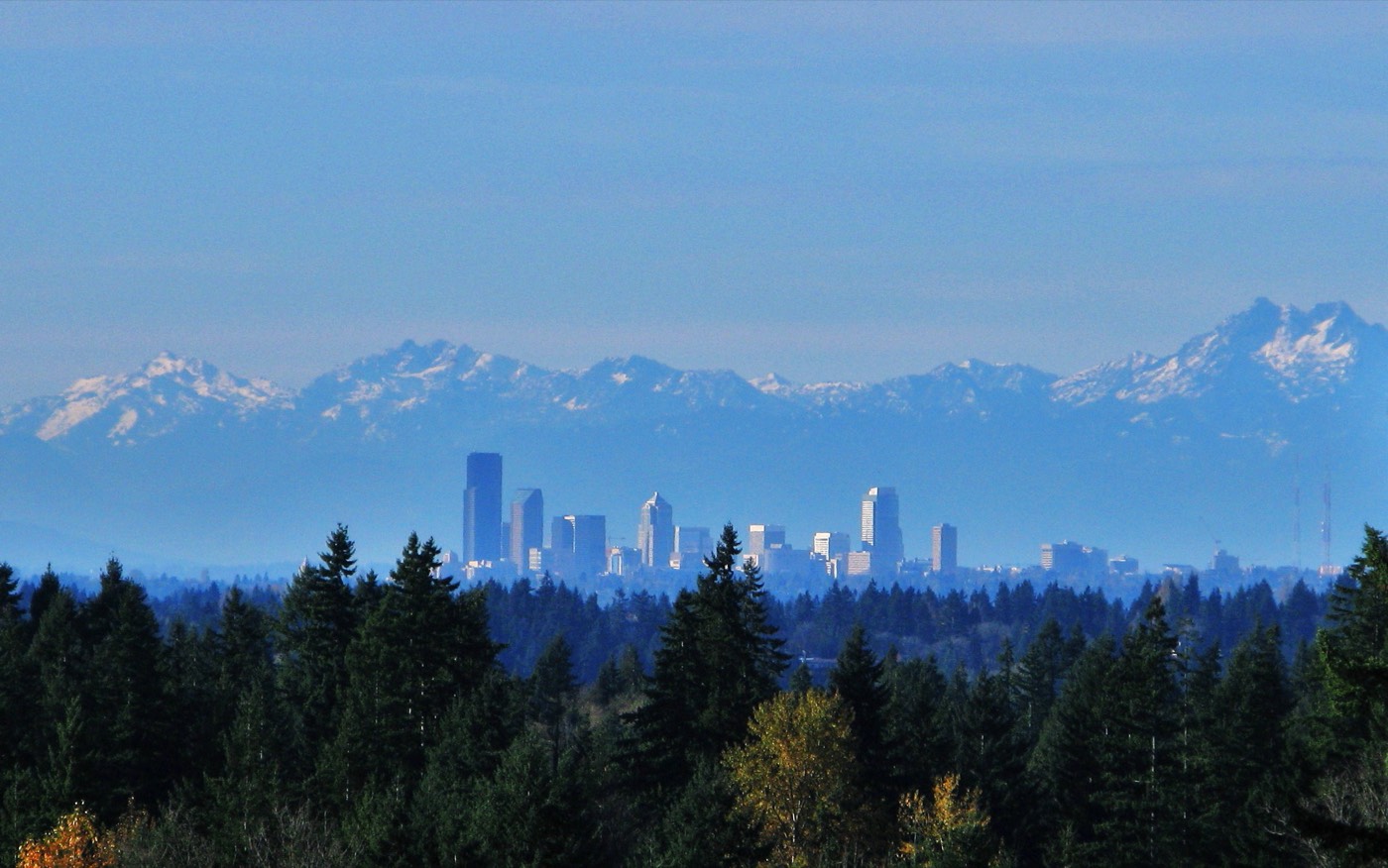
Drive up onto the Sammamish Plateau on a clear morning and the first thing you notice is how green and how quiet it is, a city of cul-de-sacs and second-growth fir tucked between two lakes. The second thing, if you linger at the Saturday queue outside a bubble tea counter or read the names taped to the lockers at Skyline High, is that a great many of the families who fill these streets came from China. The Chinese in Sammamish are not a downtown, not a Chinatown with a gate. They are a plateau full of engineers, and one of the most concentrated communities of Chinese professionals anywhere in the Pacific Northwest.
The Place
Sammamish sits on a forested plateau in King County, east of Seattle, hemmed by Lake Sammamish on the west and the Snoqualmie Valley on the east. It stayed rural and resort-dotted into the 1970s, then filled with suburban subdivisions, and finally incorporated as a city only on 31 August 1999.
It is, by the numbers, extraordinarily wealthy. In recent census data Sammamish has posted one of the highest median household incomes of any city its size in the United States, well north of 200,000 dollars, with a median home value above 1.5 million. The houses are big, the schools are famous, and almost everyone, it can feel, works at Microsoft.
How It Became Chinese
The story of the Chinese in Sammamish is really the story of the Eastside tech boom, told one family at a time. There was no railroad-era settlement here, no cannery, no laundry district. The Chinese arrived recently, by air and by job offer, and they arrived because of the campus fifteen minutes to the north.
The Redmond gravity
Microsoft’s headquarters in Redmond is the gravitational centre of this whole plateau. Seven of the ten richest large cities in Washington sit within fifteen miles of that campus, and Sammamish is the richest of them all. When Microsoft, and later Amazon, Google, and Meta, began hiring software engineers from mainland China and Taiwan in large numbers through the 1990s and 2000s, those engineers needed somewhere to raise children. They found the plateau.
The appeal was specific and practical. A Sammamish house offered space, safety, new construction, and a short commute to Redmond. For a young couple arriving on an H-1B visa with a newborn, it was close enough to work and far enough from the city to feel like the suburban America they had imagined.
The decade that flipped the plateau
The change is visible in the census. Between 2010 and 2020 Sammamish’s Asian population grew by roughly 112 percent, while its white population fell by about 15 percent. Asians went from a small minority to nearly 37 percent of the city, the single force behind almost all of Sammamish’s population growth in that decade.
Chinese and Indian families together drove most of that surge, and Sammamish became known for housing two of the largest South and East Asian professional communities in the state side by side. The Indian community in Sammamish grew along the same arc and for the same reason, the Redmond payroll, which is why the two stories are best read as neighbours rather than rivals.
By 2020 Sammamish was, alongside Bellevue and Redmond, one of the most Chinese-influenced suburbs on the Eastside. Roughly a third of the city was foreign-born, and a large share of those residents had been born in Asia.
Why the schools sealed it
If the campus brought the first wave, the schools kept them and pulled in the rest. Sammamish straddles two of Washington’s strongest public districts, the Lake Washington School District in the north and the Issaquah School District in the south, both routinely rated at or near the top of the state.
Word travelled fast through Chinese professional networks: buy in Sammamish, send your child to Skyline or Eastlake, and the public school will rival a private one. It became a self-reinforcing loop. The high test scores attracted academically driven families, and those families pushed the scores higher still. At Skyline High School roughly 42 percent of students are now Asian; at Eastlake the figure is around 39 percent.
For many Chinese parents the calculation was explicit. The premium they paid for a Sammamish house was, in part, tuition for a school they would never have to write a cheque for.
Building the soft infrastructure
What Sammamish itself lacked was the everyday machinery of Chinese life, the grocers and weekend schools and banquet halls. So the community borrowed it from down the hill. Families learned to live across a small constellation of Eastside towns, sleeping in Sammamish and shopping, eating, and studying in Redmond and Bellevue.
The most important of these borrowed institutions is the weekend Chinese school. The Northwest Chinese School, a non-profit founded in 1995, runs dozens of Mandarin classes on Saturdays at Newport High School in Bellevue, drawing plateau families down the hill every weekend to keep their children literate in Chinese characters and Pinyin. For a Sammamish parent, Saturday morning means the same drive thousands of others make, children half-asleep in the back seat, heading to Chinese school.
The Landmarks
The map of Chinese Sammamish spreads across the plateau and down into the Eastside towns below. These are the anchors.
August Moon Chinese Restaurant, 2904 228th Ave SE, Sammamish. Tucked into the Pine Lake Village shopping centre beside the QFC, this family-run room is one of the few full Chinese restaurants on the plateau itself. For families who do not want to drive to Bellevue, it is the neighbourhood standby, the place you end up on a Tuesday night.
Pine Lake Village, 228th Ave SE, Sammamish. Anchored by a QFC and joined later by an upscale Metropolitan Market, this centre is the closest thing the plateau has to a town square. It is not a Chinese plaza, but it is where Chinese Sammamish does its weekday errands, and August Moon and the bubble tea counters sit within it.
Skyline High School, 1122 228th Ave SE, Sammamish. With well over 40 percent of its students of Asian heritage and a top-five-percent ranking in the state, Skyline is the institution most Chinese families came here for. Its robotics teams, music programmes, and AP results are a point of fierce parental pride.
Northwest Chinese School, classes at Newport High School, 4333 Factoria Blvd SE, Bellevue. Founded in 1995, this Saturday school is where plateau children learn to read and write Mandarin. It is the spine of the weekend, the shared appointment that links Sammamish families to one another across a dozen subdivisions.
Din Tai Fung, Lincoln Square, 700 Bellevue Way NE, Bellevue. The famous Taiwanese soup-dumpling house in downtown Bellevue is the special-occasion destination, the restaurant you take visiting parents to from Beijing or Shanghai. For Eastside Chinese families it is shorthand for arrival.
Crossroads, Bellevue. The Crossroads and Highlands neighbourhoods of Bellevue, a short drive down the hill, are the Eastside’s true Asian food belt. The Bellevue Marketplace centre alone packs in more than a dozen Asian restaurants alongside the Asian Family Market grocery, supplying the hot pot, Yunnan noodles, and pantry staples the plateau does not stock.
99 Ranch Market and H Mart, Bellevue and Redmond. The big pan-Asian supermarkets that ring Sammamish are where the weekly Chinese grocery run happens. A fridge full of greens, live fish, and frozen dumplings on the Eastside almost always began as a Saturday cart pushed through one of these aisles.
Where They Came From
The Chinese of Sammamish are overwhelmingly a recent, professional migration rather than a descendant community. Most arrived as adults, many on student or work visas, and most came from mainland China, with a meaningful Taiwanese presence threaded through.
They tend to be people who studied engineering or computer science, often completing graduate degrees at American universities before being recruited onto the Eastside payrolls. The chain that brought them was not a village network but a corporate one: a cousin already at Microsoft, a college classmate at Amazon, a recruiter’s email.
This origin shapes the community’s texture. It is highly educated, highly mobile, and oriented around career and children’s education. It looks, in many ways, like the Chinese communities of Cupertino and Palo Alto in Silicon Valley, a tech-built diaspora that chose its suburb for its schools.
Sammamish Today
Today the Chinese presence in Sammamish is woven so thoroughly into the city that it no longer reads as new. It is in the spread of names on a class roster, the Lunar New Year decorations in subdivision windows, the after-school enrichment classes and the SAT prep, the WeChat groups that organise carpools and sell secondhand strollers.
It is not, and may never become, a visible Chinatown. The plateau has no gate, no district of red lanterns, no street of herbalists. The community’s life happens inside houses, inside schools, and in the strip-mall restaurants and supermarkets of Bellevue and Redmond down the hill. To an outsider driving through, Sammamish looks like any prosperous American suburb. To the families who live there, it is unmistakably Chinese.
There are tensions familiar to any high-pressure enclave: debates over school workload and gifted programmes, the cost of belonging in a city where the median home tops 1.5 million dollars, the quiet question of whether children raised entirely on the plateau will keep their Mandarin or their parents’ patience for it. But for now Sammamish remains one of the most successful, and least heralded, Chinese suburban communities in the country, an entire plateau that filled, house by house, with the engineers of Redmond.
Frequently Asked Questions
How large is the Chinese community in Sammamish, Washington?
Sammamish is about 37 percent Asian, and Chinese residents are one of the two largest Asian groups in the city alongside Indians. The Chinese in Sammamish are heavily concentrated among tech professionals and their families, and the city’s Asian population grew by roughly 112 percent between 2010 and 2020.
Why did so many Chinese families move to Sammamish?
Two reasons above all: jobs and schools. Microsoft’s Redmond campus, plus Amazon, Google, and Meta, recruited large numbers of Chinese engineers, and Sammamish offered a short commute, new homes, and access to two of Washington’s top-rated public school districts.
Are there Chinese schools and grocers in Sammamish?
The plateau itself has the family-run August Moon restaurant and the Pine Lake Village shops, but most Chinese institutions sit just down the hill. Families drive to the Northwest Chinese School in Bellevue on Saturdays and shop at 99 Ranch Market and H Mart in Bellevue and Redmond.
Which schools do Chinese families in Sammamish choose?
Sammamish is split between the Lake Washington and Issaquah school districts, both among the best in the state. Skyline High School, where about 42 percent of students are Asian, and Eastlake High School are the two big draws for academically focused Chinese families.
How does Chinese Sammamish relate to Bellevue and the rest of the Eastside?
They function as one extended community. Chinese families in Sammamish live on the plateau but lean on Bellevue and Redmond for restaurants, supermarkets, and weekend Chinese school, much like the larger Chinese community in nearby Bellevue.
Is there a Chinatown in Sammamish?
No. The Chinese in Sammamish form a dispersed suburban community rather than a dense ethnic district. There is no gate or commercial Chinatown; community life runs through homes, schools, online networks, and the Asian businesses of neighbouring Eastside cities.
If your family’s story passed through Sammamish, or any of the places Chinese families have made home in America, Atlas of Home can trace that journey. From a village in Guangdong or a campus in Beijing, to a house on the Sammamish Plateau within sight of the Cascades, to wherever you are now.