
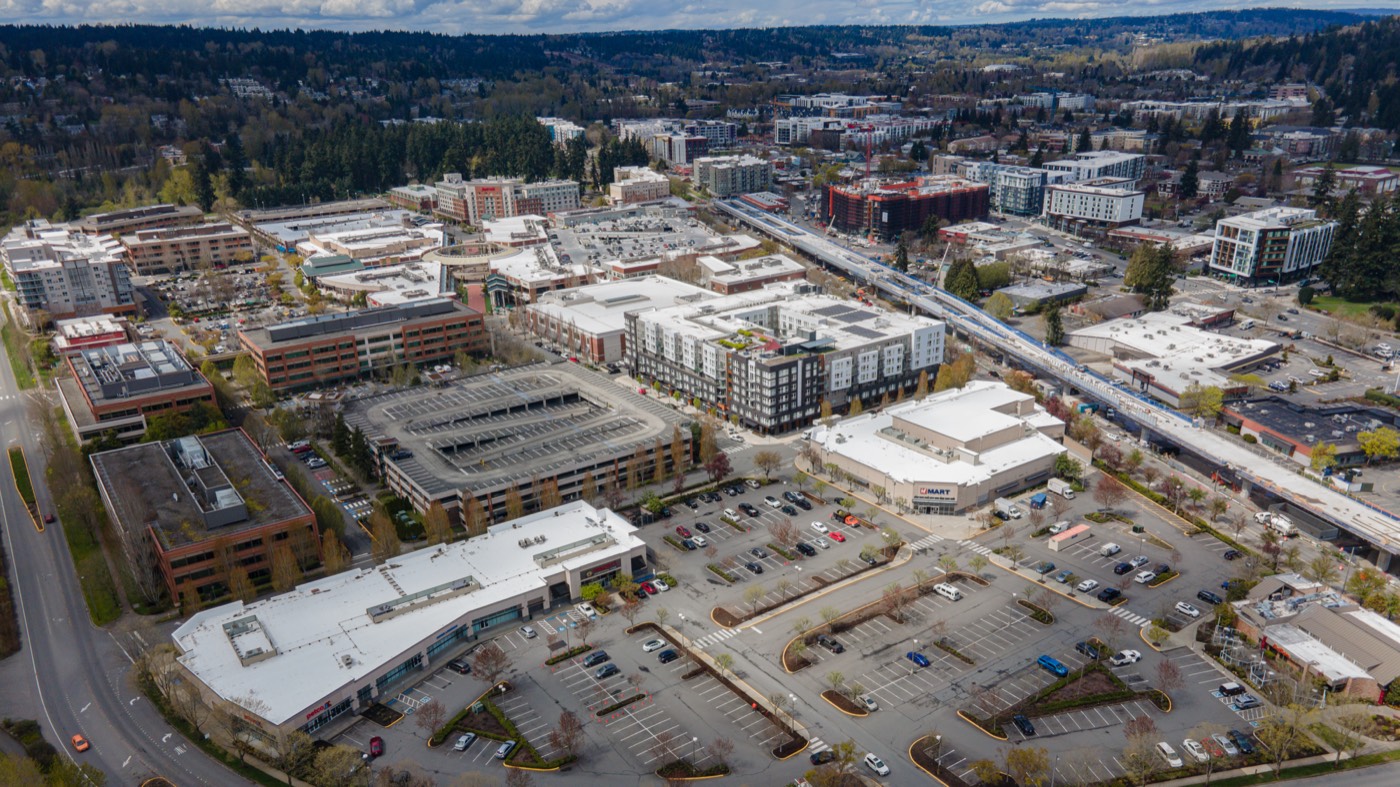
On a weekday morning in southeast Redmond, the 2 Line train glides past office towers full of engineers, and a good share of the people stepping off at Redmond Technology station grew up half a world away, in Hyderabad or Chennai or Pune. The Indians in Redmond are not a quiet footnote to this Eastside city. They are, by some counts, close to its centre. Few American suburbs have been reshaped so completely, and so recently, by one country’s talent.
The Place
Redmond sits about 15 miles east of Seattle, across Lake Washington, in the green folds of the Sammamish valley. It was founded in 1871 as a logging, fishing and farming settlement, first nicknamed Salmonberg, then renamed for Luke McRedmond, an early farmer and its first postmaster.
For nearly a century it stayed small. The opening of the Evergreen Point Floating Bridge in 1963 finally tied the area to Seattle and set the suburb growing. By 1978 the U.S. Census Bureau called Redmond the fastest-growing city in Washington.
Today it is a city of roughly 77,000 people, home to Microsoft and Nintendo of America, and one of the most Asian cities in the state.
How It Became Indian
The story of Indians in Redmond is, to an unusual degree, the story of a single company and the visas that followed it. But it did not start with Microsoft.
Four raisins in a rice bowl
In 1969, before the software industry existed here, the RajGuru family arrived in Redmond. Madhavi and her husband had worked at the American Embassy in New Delhi, and they came to the quiet suburb because they had befriended an American couple who had visited them in India.
Both parents took jobs with the Kirkland school district and raised their children, Devki and her brother, in a split-level home on a cul-de-sac for nearly 30 years. The children were the only Indians in their schools through high school. The family, as Devki later told KUOW, called themselves “four raisins in a rice bowl.”
Madhavi packed only four boxes for the move, kitchen things and dozens of bright saris, a small bundle of India to carry into a town that had never met an Indian family. A local newspaper wrote them up as a curiosity. For most of three decades they remained, as far as their neighbours knew, the only one.
For two more decades the Indian presence stayed thin. As late as 1990, the entire Asian Indian population of King County was only about 4,000 people.
Microsoft moves the centre of gravity
Microsoft moved its headquarters from Albuquerque to the Seattle area in 1979, first to Bellevue, then in 1986 onto a large new campus in Redmond. The company grew into the city’s defining employer, eventually filling more than 8 million square feet of office space.
As the campus expanded through the 1990s, so did its appetite for software engineers. American computer-science graduates were never going to be enough. The company became one of the country’s most aggressive sponsors of the H-1B visa, the temporary work permit that lets employers hire skilled foreign professionals.
India, with its enormous output of engineering graduates and its English-language schooling, supplied the largest share. Year after year, recruiters flew to campuses in southern and western India, and new arrivals settled where the work was: in Redmond, Bellevue and the towns around them.
The arrangement suited both sides. For the company it was access to a deep pool of trained engineers; for the engineers it was a foothold in the American software industry at its source. A first apartment near the campus, a first car, a first winter under the grey Pacific Northwest sky: the early years followed a familiar script repeated thousands of times.
Chain migration, Eastside style
What began as individual recruitment became chain migration of the most modern kind. An engineer who landed an H-1B job at Microsoft would, within a few years, sponsor a spouse, recommend a former classmate, mention an opening to a cousin still in Bengaluru.
Software consulting firms set up shop to place Indian contractors on Eastside projects. Amazon’s later boom in nearby Bellevue and Seattle drew thousands more. The region’s Asian Indian population, around 4,000 in 1990, roughly tripled each decade, passing 58,000 across the county by the 2010s.
In Redmond the concentration became extraordinary. By recent counts roughly one in ten residents was born in India, and South Asians make up a far larger share of the city than of the country as a whole. The local racial breakdown now lists Asian residents at around 40 percent of the population, second only to white residents and rising.
From visa holders to neighbours
For a long time the Indian community here felt provisional, a population of temporary visa holders who might be sent home. Green cards and citizenship changed that. Families bought houses, joined school boards, opened restaurants and built temples.
The transformation rippled outward to the neighbouring suburbs. Just south, the schools and cul-de-sacs of Indians in Sammamish fill with the same engineers. To the north, the older congregations of Indians in Bothell anchor the region’s largest Hindu temple. And in next-door Bellevue, the tech boom drew so many newcomers that the Chinese in Bellevue grew alongside the Indians into a shared Asian Eastside.
The Landmarks
VEDA Sri Venkateswara Temple, 7305 208th Ave NE, Redmond. Founded in 2007 so that Redmond’s Hindu families could mark festivals close to home, the temple dedicated its Sri Venkateswara shrine in 2009 and moved into its own building in 2018. Alongside daily puja it runs regular classes in Indian languages, yoga and Hindustani music.
Hindu Temple and Cultural Center, 3818 212th St SE, Bothell. A short drive north of Redmond, the HTCC grew out of an effort begun in the early 1980s; the community bought land in 1994 and built in stages. It is now the largest Hindu temple in the Northwest, and for many Redmond families it is the place for the big festival crowds.
Mayuri International Foods, 2010 148th Ave NE, Redmond. The Eastside flagship of a chain that has served South Asian shoppers for over 25 years, Mayuri pairs a full grocery, halal butcher and bakery with a counter of chaats, biryanis and fresh parathas. On weekends the aisles fill with families stocking up on spices and snacks from India, Pakistan, Sri Lanka and Nepal.
Redmond Town Center, 7525 166th Ave NE, Redmond. Opened in August 1997 on the site of a defunct golf course, this open-air mall has become a default gathering place for Indian families, who shop, eat and stroll its lanes. Microsoft offices fill part of the complex, a reminder of how closely work and weekend life overlap here.
Nikola Tesla STEM High School, Redmond. A lottery-admission magnet within the Lake Washington School District, Tesla STEM has been ranked the top public high school in Washington by U.S. News and among the best in the nation. Its enrolment is roughly three-quarters Asian, a figure that maps almost exactly onto the engineering families who chose Redmond partly for its schools.
Marymoor Park, 6046 W Lake Sammamish Pkwy NE, Redmond. King County’s busiest park is also the chosen home of the Seattle Orcas, the region’s Major League Cricket team, with plans for a 6,000-seat cricket community park. On any dry weekend its informal pitches already draw casual cricket matches among Eastside Indians.
Downtown Redmond station. When the 2 Line light rail reached downtown Redmond in May 2025, after opening to Redmond Technology station in April 2024, it stitched the Eastside’s tech corridor together by rail. For thousands of Indian commuters it turned the daily trip to Microsoft and beyond into a train ride.
Where They Came From
Redmond’s Indians are overwhelmingly a high-skilled, recent migration, drawn directly by technology jobs rather than by older waves of family settlement. That shapes who they are and where in India they began.
Many came from the southern technology hubs: Hyderabad in Telangana, Chennai in Tamil Nadu, Bengaluru in Karnataka, the cities that feed India’s own software industry. Others came from Pune and Mumbai in the west, and from across the north. They tend to be young, university-educated and English-speaking, often arriving in their twenties on an H-1B and putting down roots once the green card arrives.
It is a mirror image of the same pull that drew the Indians in Cupertino to Silicon Valley. Different campus, same gravity.
Redmond Today
Walk through Redmond now and the Indian presence is simply part of the texture. The grocery store carries fresh curry leaves and a wall of lentils. Diwali lights go up across the Eastside each autumn, with festivities at the nearby Bellevue Collection and community halls, and Ganesh celebrations draw crowds in Redmond itself.
The community is prosperous and, by the usual measures, settled. Yet it carries the particular strain of a tech-visa population: long green-card backlogs for Indian nationals, the pressure of dual-income careers, and children who grow up fluent in two worlds and sometimes neither language fully.
What Redmond offers in return is a place where none of that has to be hidden. A child can find classmates who also eat dosa for breakfast, a temple is a short drive away, and the festival of lights is on the city calendar. For a migration barely two generations old, that is a remarkable amount of home built fast.
Frequently Asked Questions
How many Indians live in Redmond, Washington?
Exact figures vary by source, but roughly one in ten Redmond residents was born in India, and Asian residents make up about 40 percent of the city’s population. That makes the Indians in Redmond one of the densest such communities in the United States.
Why are there so many Indians in Redmond?
The main reason is Microsoft, headquartered in Redmond since 1986. As the company and the wider Eastside tech industry grew, they recruited heavily from India on H-1B visas, and chain migration of family and former classmates followed.
Is there a Hindu temple in Redmond?
Yes. VEDA Sri Venkateswara Temple at 7305 208th Ave NE serves Redmond’s Hindu families, with daily puja and classes in language, yoga and music. The larger Hindu Temple and Cultural Center is a short drive north in Bothell.
Where can I buy Indian groceries in Redmond?
Mayuri International Foods on 148th Ave NE is the Eastside flagship for South Asian groceries, with a full marketplace, halal butcher, bakery and a counter serving chaats, biryanis and parathas.
What schools do Indian families in Redmond choose?
The Lake Washington School District is a major draw, and Nikola Tesla STEM High School in Redmond is ranked Washington’s top public high school. Its enrolment is roughly three-quarters Asian, reflecting the engineering families who settled here.
How do Indians in Redmond celebrate festivals like Diwali?
Diwali is marked across the Eastside each autumn with community events, temple gatherings and workplace celebrations, alongside Ganesh festivals in Redmond. Cricket is the other great communal ritual, centred on Marymoor Park.
If your family’s story passed through Redmond, or any of the places Indians have made home in America, Atlas of Home can trace that journey. From a campus in Hyderabad or Chennai to a cul-de-sac near the Microsoft campus, to wherever you are now.