
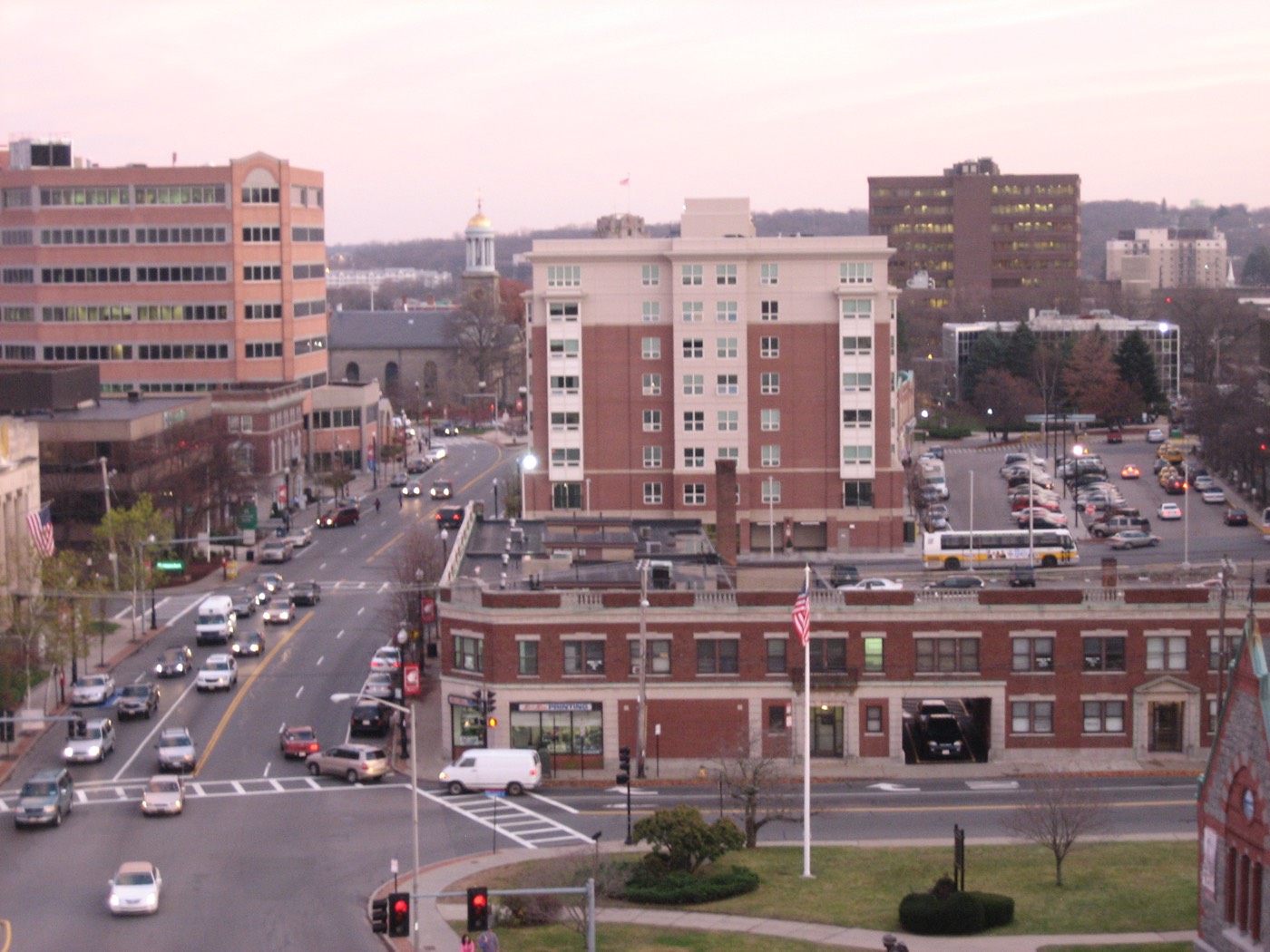
On a Saturday morning along Hancock Street, the City of Presidents speaks Cantonese and Mandarin. Bakery cases fill with egg tarts and pineapple buns, dim sum carts roll between tables, and grocery aisles stretch with bok choy and fresh fish. The Chinese in Quincy, Massachusetts have built the largest Chinese community in the state outside Boston’s Chinatown, and they did it one Red Line stop at a time.
The Place
Quincy sits just south of Boston, hugging the harbour where the Neponset River meets Massachusetts Bay. It is the City of Presidents, birthplace of John Adams and John Quincy Adams, and the home town of John Hancock, whose name now marks the street where the city’s Chinese life is loudest.
For most of its history Quincy was a working city of granite quarries and shipyards. Quincy granite went into the Bunker Hill Monument and the Washington Monument, and the Fore River Shipyard, established in 1883, became one of the largest yards in the country during the Second World War. The granite trade drew Irish, Scottish, Finnish, Swedish and Italian quarrymen, and the yard pulled in thousands more.
The newcomers who arrived from Hong Kong, Guangzhou and Taiwan in the late twentieth century did not find a sleepy suburb. They found an old industrial city with affordable triple-deckers, good schools and a subway line that ran straight back into Chinatown. By the time the old industries faded, Quincy was a city of immigrant neighbourhoods looking for its next chapter.
How It Became Chinese
Quincy’s transformation is one of the fastest demographic shifts in Massachusetts. As recently as 1980, the census counted only about 330 Asian Americans in the entire city. By 2020 that number had grown to 21,463, roughly 23 percent of Quincy’s population, with Chinese residents the largest share. The story of how that happened runs north along the Red Line.
The Chinatown spillover
By the 1980s, Boston’s Chinatown had become intensely overcrowded. Urban renewal had carved away housing, highways had hemmed the neighbourhood in, and rents climbed faster than working families could follow. Chinese residents needed somewhere to go that was still close to the restaurants, churches and family associations that anchored their lives.
Quincy was the answer. A 1988 survey found that many of the city’s newcomers, mostly from Hong Kong, Taiwan and Guangzhou, had first lived in Chinatown before moving south. The pull was simple: cheaper housing, decent schools, and a one-seat ride back to the old neighbourhood. The pattern echoed Chinese suburbanisation across the country, from Flushing in Queens to Monterey Park in California.
The Red Line did the work
What made Quincy different from other suburbs was the train. The MBTA’s Red Line had pushed south through the city in the 1970s, with stations at Wollaston, North Quincy and Quincy Center. A worker could keep a kitchen job or a garment-shop shift in Chinatown and still sleep in a Quincy apartment, twenty minutes away.
The neighbourhoods nearest the stations, North Quincy and Wollaston, filled first. Triple-deckers that had once housed Irish and Italian quarry families now took in Chinese tenants, then Chinese owners. By the 1990s, Asian-owned businesses had spread through both commercial districts.
From a few hundred to a quarter of the city
The numbers climbed in waves. There were about 5,577 Asian Americans in Quincy by 1990, and by 2000 the city’s Asian American population was more than three times the size of Boston’s Chinatown. Hong Kong handover anxiety in 1997, then a later surge of mainland Chinese students and families, kept the pipeline full.
It was not always a gentle welcome. The 1980s brought racial tensions and incidents of violence aimed at Southeast Asian and Chinese residents. Institutions stepped in to help. The Wollaston Lutheran Church hired a bilingual pastor in 1988 and began offering English classes, job placement and sponsorship help to immigrant families.
In 2001, a small group of residents founded Quincy Asian Resources, Inc., now the city’s central immigrant-services and cultural organisation. Its August Moon Festival, a community tradition dating to 1987 and now run with the city, draws more than 15,000 people and was named Best Street Festival by Boston Magazine in 2018.
A community that built its own institutions
What started as a place to sleep became a place to live a whole life. Chinese families opened restaurants, bakeries, salons, accountants’ offices and medical practices. Children moved through Quincy’s public schools in such numbers that Asian students became the single largest group in the system, a concentration that recalls high-achieving suburban districts like Bellevue, Washington.
Politics followed. In 2015, Nina Liang, born in Quincy to immigrant parents, became the first Chinese American elected to the City Council. From 2020 to 2022 she served as the council’s first minority president, a milestone in a city that had counted a few hundred Asian residents within living memory.
The institutions multiplied alongside the population. Asian American physicians, dentists, accountants and lawyers opened offices along Hancock Street, and Chinese-language churches, Buddhist groups and family associations followed their members south from Chinatown. What had been a commuter outpost became a place where a family could be born, schooled, employed and buried without ever leaving the city.
The Landmarks
Kam Man Marketplace, 219 Quincy Avenue. The anchor Asian supermarket for the South Shore, Kam Man fills its aisles with everything from live seafood and Chinese greens to housewares and herbal medicine. For many Quincy families it is the weekend ritual, the place where the shopping list is still written in characters.
Winsor Dim Sum House, 706 to 708 Hancock Street. A Hancock Street fixture serving made-to-order dim sum all day, from siu mai and barbecue pork buns to shrimp and chive dumplings. It is the kind of room where three generations share a table and the tea never runs dry.
Ming Seafood, 477 Hancock Street. This North Quincy restaurant earned national attention when The New York Times named it among its picks for the Greater Boston area, the only South Shore business to make the list. Its reputation has helped recast Quincy, not Chinatown, as the place to come for serious Chinese food.
Quincy Asian Resources, Inc., 1509 Hancock Street. The nonprofit that knits the community together, offering citizenship help, youth programmes, English classes and elder services along Hancock Street in Quincy Center. It is the organiser behind the August Moon Festival and a first stop for many newly arrived families.
H Mart, 101 Falls Boulevard. America’s largest Asian supermarket chain opened a Quincy store with a sprawling food hall, adding Korean bakeries, fried chicken and bubble tea to the city’s Asian food map. Its arrival was a sign that Quincy had become a destination, not just a neighbourhood.
North Quincy High School, 316 Hancock Street. The neighbourhood high school where Asian students now make up more than half the enrolment. Its Asian Culture Club and Lunar New Year celebrations reflect a student body that has reshaped the city, even as families campaign to make the holiday an official day off.
The August Moon Festival, Quincy Center. Each August, Hancock Street closes to traffic for one of the largest mid-autumn festivals in the Northeast. Lion dancers, food stalls and tens of thousands of visitors fill the downtown that the Adams family once walked.
Where They Came From
The earliest Quincy Chinese came largely from Hong Kong, the Pearl River Delta around Guangzhou, and Taiwan, the same Cantonese-speaking heartland that had built Boston’s Chinatown a century before. They were restaurant workers, garment-shop sewers and shopkeepers looking for a foothold and a back yard.
The handover of Hong Kong to China in 1997 sent a wave of families seeking stability abroad. Later arrivals came increasingly from mainland China, including students and professionals, shifting the language of the streets from mostly Cantonese toward more Mandarin.
Vietnamese refugees and other East Asian immigrants arrived in the same decades, and Quincy’s Asian identity today is layered rather than singular. But the Chinese remain the largest thread, and it is Cantonese and Mandarin, more than any other languages, that fill the bakeries and markets of Hancock Street.
What held across the generations was proximity. Quincy was never a break from Chinatown so much as an extension of it, close enough to keep the old ties and far enough to own a home.
Quincy Today
Quincy today is a genuinely Asian American city, and its Chinese community is the heart of that identity. Roughly three in ten residents are Asian, the highest share of any municipality in Massachusetts, and Chinese-owned restaurants, bakeries, markets and offices line Hancock Street through North Quincy, Wollaston and Quincy Center.
The community has moved from survival to leadership. A Chinese American has led the City Council, the public schools count Asian students as their largest group, and the August Moon Festival is one of the city’s signature events. Debates over recognising Lunar New Year as a school holiday show a community confident enough to ask the city to change.
Tensions and growing pains have not vanished, and questions about welcome and belonging still surface in local politics. But on a weekend morning, with dim sum carts rolling and the bakeries full, the Chinese in Quincy have unmistakably made this old shipbuilding city their own.
Frequently Asked Questions
Why did so many Chinese families move to Quincy?
By the 1980s Boston’s Chinatown was overcrowded and expensive after decades of urban renewal. Quincy offered cheaper housing, good schools and a Red Line connection straight back to Chinatown, which made it the natural place for Chinese families to settle.
Is Quincy the biggest Chinese community in Massachusetts outside Boston’s Chinatown?
Yes. The Chinese in Quincy, Massachusetts form the largest Chinese community in the state outside Boston’s Chinatown. By 2000 Quincy’s Asian American population was already more than three times the size of Chinatown’s.
Which Quincy neighbourhoods are most Chinese?
North Quincy and Wollaston, the areas nearest the Red Line stations, filled first and remain the centre of Chinese life. Quincy Center, along Hancock Street, is also dense with Chinese businesses and institutions.
What is the August Moon Festival?
It is Quincy’s annual mid-autumn festival, a tradition since 1987 now run by Quincy Asian Resources with the city. It closes Hancock Street to traffic and draws more than 15,000 people, making it one of the largest such festivals in the Northeast.
Where do Quincy’s Chinese residents come from?
The earliest arrivals came mostly from Hong Kong, Guangzhou and Taiwan, the same Cantonese-speaking regions that built Boston’s Chinatown. Later waves, including after the 1997 Hong Kong handover, came increasingly from mainland China, adding more Mandarin speakers.
Has the Chinese community changed Quincy’s politics and schools?
Yes. The Chinese in Quincy, Massachusetts helped elect Nina Liang, the city’s first Chinese American councillor and first minority council president. Asian students are now the largest group in Quincy’s public schools, where families campaign for Lunar New Year to be a holiday.
If your family’s story passed through Quincy, or any of the places Chinese Americans have made home in America, Atlas of Home can trace that journey. From the lanes of Guangzhou and the harbour of Hong Kong, to a triple-decker off Hancock Street, to wherever you are now.