
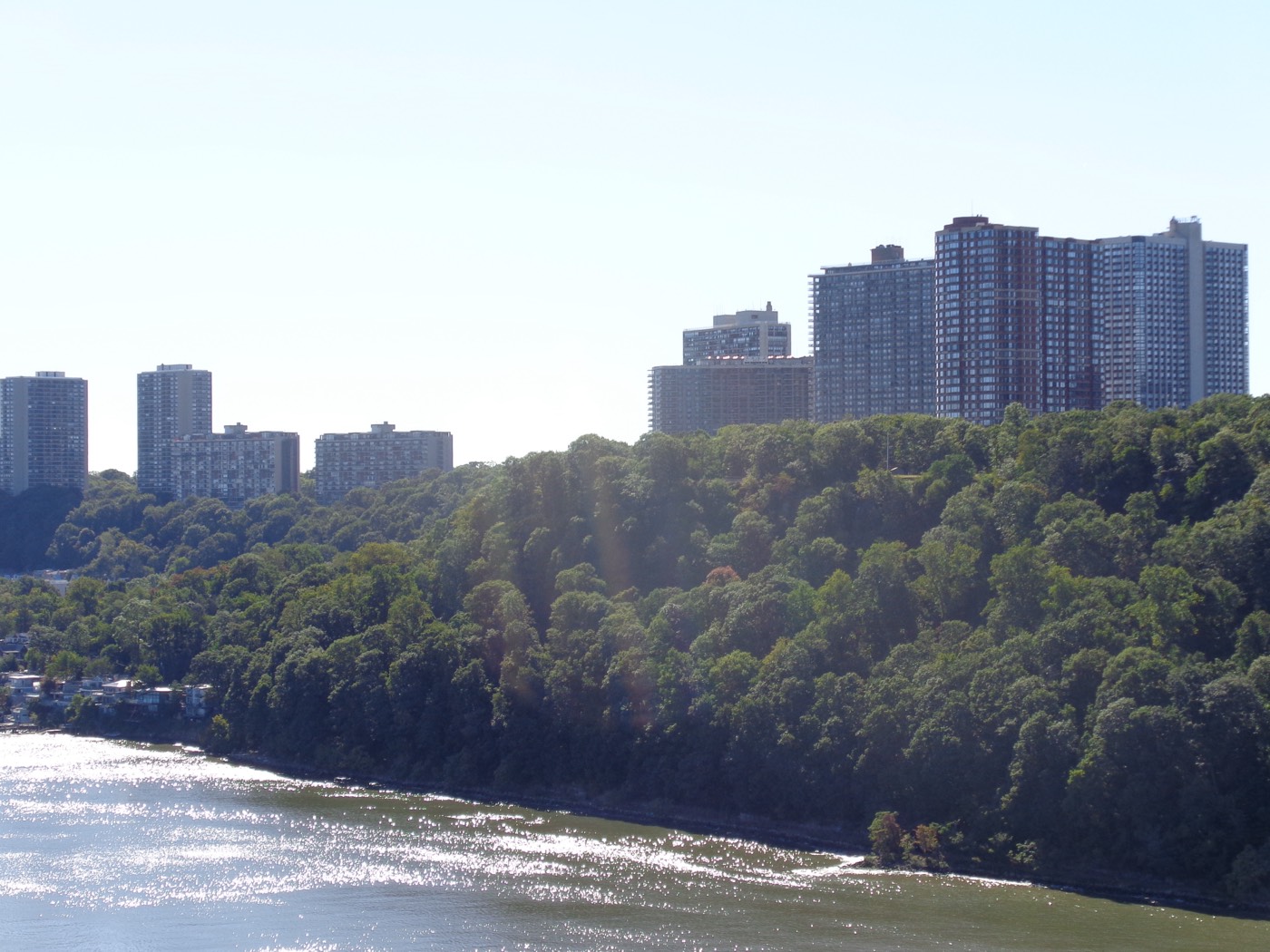
Stand at the western foot of the George Washington Bridge, where the span lands in New Jersey, and you are standing in one of the most Korean places in America. The Koreans in Fort Lee have turned this Bergen County borough into a high-rise Seoul above the Hudson, where the bakeries smell of red bean and butter, the banks post their rates in Hangul, and the cram schools fill on weekday evenings. To understand how a small Revolutionary War garrison town became this, you have to follow the bridge east, into Manhattan and Queens, and then back again.
The Place
Fort Lee sits at the eastern edge of Bergen County, perched on the Palisades cliffs directly across the Hudson from Upper Manhattan. The George Washington Bridge lands here, dropping fourteen lanes of traffic onto a borough barely two and a half square miles in size.
The town takes its name from Fort Constitution, renamed Fort Lee for General Charles Lee, a Continental Army garrison that General Washington abandoned in 1776 as the British advanced. For a brief stretch in the early twentieth century it was something grander still: America’s first film capital, before the studios decamped for Hollywood.
What defines Fort Lee now is verticality. Cluster after cluster of high-rise condominium towers line the bluff, many with floor-to-ceiling views of the Manhattan skyline a few hundred metres across the water. It is dense, affluent and intensely convenient, a suburb that lives like a city.
That density is the key to everything that follows. A borough this small and this vertical concentrates people, shops and institutions tightly together, and when a single community arrives in numbers it can remake the whole texture of a place. In Fort Lee, that community was Korean, and the transformation was thorough.
How It Became Korean
The bridge and the first arrivals
Korean migration to the United States opened up after the Hart-Celler Immigration Act of 1965 dismantled the old national-origin quotas. The first large wave settled not in New Jersey but in New York City, above all in Flushing, Queens, which drew roughly seventy per cent of the city’s Korean population and became the metropolitan area’s first true Koreatown.
Flushing was the foothold. Newcomers from Seoul and other South Korean cities found churches, groceries and countrymen there, established small businesses, and raised children. But the neighbourhood grew crowded, and the families who prospered began looking for somewhere with more space and better schools.
The move across the river
Beginning in the 1980s, wealthier Koreans started crossing the George Washington Bridge into Bergen County. The move accelerated through the 1990s and especially after 2000, as middle-class and professional Korean families left the city for suburban New Jersey.
The pull factors were straightforward: top-ranked public schools, newer housing, and a short commute back into Manhattan. Fort Lee, sitting right at the bridgehead, was the natural first stop, close enough to keep one foot in the city while planting the other in the suburbs.
The bridge mattered enormously. A Korean family could move to Fort Lee without truly leaving the orbit of New York’s Korean economy, the wholesalers, the churches, the Korean-language professionals. The Hudson was a boundary on the map but not in daily life, and that made the leap across it feel less like emigration than a short move uptown.
An ethnoburb takes shape
What grew in Fort Lee and its neighbours was not a struggling immigrant ghetto but an ethnoburb, an affluent suburban enclave built by an immigrant community on its own terms. By the 2010 census, Korean residents made up roughly 23 per cent of Fort Lee’s population, and more recent estimates put the figure higher still, around a third of the borough.
Bergen County as a whole now holds well over sixty thousand residents of Korean heritage, more than sixty per cent of New Jersey’s entire Korean population. Fort Lee leads the county, trailed closely by Palisades Park, Leonia, Edgewater and Englewood Cliffs. Together they form one of the largest and fastest-growing concentrations of ethnic Koreans anywhere outside Korea itself.
The Landmarks
Paris Baguette, 1635 Lemoine Avenue. Founded in Seoul and now headquartered for North America in Bergen County, Paris Baguette is the Korean bakery franchise that took the French patisserie and remade it for Korean tastes. The Lemoine Avenue branch sells the soft milk breads, cream cakes and pastries that anchor a Fort Lee morning, alongside coffee.
Tous les Jours, 112 Linwood Plaza. The other great Korean-French bakery chain, born in South Korea and now numbering more than seventy cafes across the United States. Locals come for the red bean buns, the chiffon and mousse cakes, and the kind of bakery cafe culture that feels imported wholesale from Seoul.
Korean barbecue along Lemoine Avenue. The stretch of Lemoine is studded with grill houses where servers fire up tabletop charcoal and bring marinated galbi and thin-sliced pork belly. Q Grill KBBQ at 1645 Lemoine Avenue is among the rooms drawing diners from across the region for premium meats cooked at the table.
Fresh Bites Dosirak, 168 Main Street. A Main Street fixture for the dosirak lunch box, the packed Korean meal that fuels students and office workers alike. Freshly rolled kimbap, soups and noodles make it the kind of everyday spot that signals a neighbourhood is genuinely Korean rather than merely fashionable.
H Mart, the Korean supermarket. No Korean American community is complete without H Mart, the chain that began in 1982 as a single store called Han Ah Reum in Woodside, Queens. The founder, Il Yeon Kwon, chose a name meaning roughly “a full armful of groceries”; the chain spread across the New York metropolitan area in the 1980s and 1990s and now serves Bergen County’s Korean households as their default pantry.
The Korean churches. Korean Grace Presbyterian Church on Bridle Way in Fort Lee is one of dozens of Korean congregations across the area, Presbyterian, Methodist, Catholic and Adventist among them. For many first-generation families the church was the first institution they built, doubling as a social centre, a language school and a safety net.
The hagwon corridor. Fort Lee and neighbouring towns are dense with hagwons, the private after-school academies that drill maths, English and test preparation. They are the suburban Korean institution par excellence, and a major reason families chose Fort Lee in the first place, where the public schools already rank among New Jersey’s best.
Where They Came From
The Koreans of Fort Lee came overwhelmingly from South Korea, and disproportionately from Seoul and the country’s professional and business classes. This was not, for the most part, a migration of the desperate. It was a migration of the educated and the ambitious, families who arrived with capital, credentials or both.
Many came directly under family-reunification visas after 1965, sponsored by relatives who had gone before. Others took the two-step route, landing first in Flushing or in Manhattan’s Koreatown around 32nd Street, establishing themselves over a decade, and only then crossing into Bergen County once their finances and their children’s schooling demanded it.
The result is a community whose centre of gravity is squarely middle and upper-middle class. Fort Lee’s Koreans are doctors, dentists, accountants, shop owners and corporate transferees, many working in Manhattan and commuting back over the bridge each evening to the towers on the Palisades.
A distinct strand came as corporate postings. South Korean firms with North American offices in the New York area have long sent managers and their families on multi-year assignments, and Fort Lee, with its Korean schools, shops and proximity to Manhattan, became an obvious place to house them. Some return to Seoul; others stay, their temporary posting quietly becoming a permanent home.
Fort Lee Today
Walk Fort Lee now and the Korean presence is woven through everything. Restaurant signs run in Hangul, Korean-language newspapers serve the community, and the bakeries, banks and karaoke rooms make the borough feel, in stretches, like a transplanted district of Seoul.
The schools tell the demographic story plainly. At Fort Lee High School roughly forty per cent of students are Asian, and the district runs a Korean dual-language programme alongside Spanish, a formal acknowledgement of who lives here. The schools’ strong rankings are both a cause and a consequence of the Korean influx.
The borough continues to build upward, with new town-centre developments rising around Main Street and the bridge plaza. Younger second- and third-generation Korean Americans are reshaping the community in turn, more American in idiom but still anchored to the bakeries, churches and family dinners that their parents and grandparents carried across the water.
Fort Lee remains, above all, a place of arrival and ascent. It is where Korean New York became Korean New Jersey, and where a community that started on a crowded Queens avenue built itself a skyline of its own.
Frequently Asked Questions
What percentage of Fort Lee is Korean?
Korean residents made up roughly 23 per cent of Fort Lee’s population at the 2010 census, and more recent estimates put the figure at around a third of the borough. Fort Lee has one of the highest concentrations of Korean Americans of any town in the United States.
Why did so many Koreans move to Fort Lee?
Fort Lee sits directly across the George Washington Bridge from New York City, offering top-ranked public schools, newer high-rise housing and a short commute to Manhattan. Beginning in the 1980s, prosperous Korean families left Flushing, Queens, for Bergen County, and Fort Lee at the bridgehead was the natural first stop.
Where did Fort Lee’s Korean community originally come from?
They came overwhelmingly from South Korea, disproportionately from Seoul and the professional and business classes. Many arrived after the 1965 Immigration Act under family-reunification visas, often settling first in Queens or Manhattan’s Koreatown before moving across the Hudson.
What Korean businesses is Fort Lee known for?
Fort Lee is known for Korean bakeries such as Paris Baguette and Tous les Jours, Korean barbecue houses along Lemoine Avenue, dosirak and kimbap shops on Main Street, Korean churches, hagwon academies and the H Mart supermarket chain that serves the wider Bergen County community.
Where did H Mart start?
H Mart began in 1982 as a single store called Han Ah Reum in Woodside, Queens, founded by Il Yeon Kwon. The name means roughly “a full armful of groceries.” The chain expanded across the New York metropolitan area through the 1980s and 1990s and now has more than a hundred locations nationwide.
How does Fort Lee compare to Palisades Park?
Both are Bergen County Korean enclaves, but they differ in character. Fort Lee is the affluent high-rise borough at the bridge, while neighbouring Palisades Park is an even more concentrated Korean community, with Koreans making up close to half its population and a famously dense Korean commercial strip along Broad Avenue.
If your family’s story passed through Fort Lee, or any of the places Koreans have made home in America, Atlas of Home can trace that journey. From Seoul to the high-rise towers on the Palisades above the George Washington Bridge, to wherever you are now.
Related reading: The Koreans in Palisades Park, New Jersey, The Koreans in Koreatown, Manhattan, The Koreans in Annandale, Virginia and The Koreans in Koreatown, Los Angeles. For background, see the Fort Lee borough profile and the history of H Mart.