
Before dawn on India Street, the smell used to be diesel and salt and fish guts. The men walked down to the bay in the dark, climbed onto bait boats with Genoese surnames painted on the hull, and chased tuna across the Pacific for weeks at a time. Their wives stayed behind in bungalows three blocks from the water, where the canneries ran shifts around the clock and the whole neighborhood smelled of cooking albacore. For most of the twentieth century, this small grid of streets at the edge of downtown San Diego built and crewed the boats that fed America its tuna.
Little Italy San Diego sits on that same forty-eight-block grid today, only now the dawn smell is espresso and fresh bread. The fishermen are mostly gone. The neighborhood they made is not.
Little Italy: The Place
Little Italy occupies the northwest corner of downtown San Diego, bounded roughly by Laurel Street to the north, Ash Street to the south, Interstate 5 and Front Street to the east, and San Diego Bay to the west. India Street is its spine, a walkable commercial corridor running north to south through a dense mix of mid-rise buildings and surviving single-story bungalows. The bay is two minutes on foot from most of it, which is the whole reason the neighborhood exists. At forty-eight blocks it is the largest Little Italy in the United States.
How Little Italy Became Italian
Before the Italians
The shore of San Diego Bay was Kumeyaay land for at least twelve thousand years before any of this. By the late nineteenth century the area northwest of the young downtown was a district called Middletown, a thin spread of houses near the waterfront with no particular character. What it had was access to the bay, and that was enough to draw a small colony of fishermen who began gathering here in the 1890s.
They were mostly Italians, with some Portuguese Azoreans working the same waters. The Italian colony was small and informal at first, a handful of families who had found a stretch of Pacific coast that looked and felt like the one they had left.
The Italians Arrive
The arrivals came in two streams, and the distinction mattered to the people living it. The first were Ligurians from the Italian Riviera, from Genoa and the small fishing towns strung along the coast near it, places like Riva Trigoso. The second were Sicilians, drawn especially from the fishing villages of Porticello and Mazara del Vallo. Both groups had made their living from the sea at home, and both came to San Diego to keep doing it.
The turning point was a disaster five hundred miles north. After the 1906 San Francisco earthquake and the fire that followed it, many Italian fishermen who had settled in that city’s North Beach colony packed up and moved south to San Diego. They came for the climate and a bay that reminded them of the Mediterranean, and they came in numbers large enough to turn a colony into a neighborhood. Chain migration did the rest. A man would establish himself, write home or to relatives up north, and within a few years his brothers, cousins, and former neighbors from the same Sicilian or Ligurian town had followed him onto the same blocks.
By the 1920s the neighborhood had set into a stable shape: Italian-owned, residential and commercial at once, anchored by the church and the fleet. At its height more than six thousand Italian families lived here, and by most accounts roughly three-quarters of them made their living from fishing.
Little Italy at Its Peak
The engine was tuna. The first large cannery, the Pacific Tuna Canning Company, opened in 1911, and others followed it along the waterfront. By the mid-1930s the canneries employed more than a thousand people, and San Diego had made itself the tuna capital of the American West Coast. The fleet that supplied them was crewed largely by Italian and Portuguese fishermen, sharing the same Pacific waters worked by the Croatian fishing families up the coast in San Pedro, and the boats themselves were often built by Italian hands.
The work split along the water’s edge. The men fished, sometimes gone for weeks chasing albacore and yellowfin far down the coast and beyond. The women worked the canneries, standing long shifts cleaning and packing fish, the labor that turned a catch into a paycheck and kept the household running while the boats were out. Around them the neighborhood filled in with the businesses a working Italian community needed: groceries, bakeries, and the San Diego Macaroni Factory, whose sidewalk stamp still survives on India Street as a city historical landmark.
Tuna eventually became one of San Diego’s largest industries, behind the Navy and aerospace. For half a century the rhythm held: the boats went out, the canneries ran, the church bells rang on Sundays, and the names on the storefronts stayed Italian.
The Change
Two things broke the neighborhood, and they broke it at almost the same time. The first was concrete. When the state pushed Interstate 5 through this part of San Diego, with construction stretching through the 1960s and into the early 1970s, the freeway tore directly through Little Italy. By the standard estimate it destroyed about thirty-five percent of the neighborhood, wiping out homes and businesses and walling off what remained between the freeway and the bay.
The second was the collapse of the industry that gave the place its reason to be. Rising costs, foreign competition, and tightening regulation drove the West Coast tuna business into decline, and the last of the San Diego canneries closed in the early 1980s. The fishermen and cannery workers who had filled these blocks lost their livelihoods, and many of their children, with no boats left to inherit, simply moved on.
What followed was close to thirty years of slow decline. The bungalows emptied, the storefronts went dark, and by the late 1980s Little Italy was a name on a fading district more than a living neighborhood.
The Landmarks of Little Italy
Our Lady of the Rosary, 1668 State Street. The heart of the neighborhood is a church the fishermen built for themselves. Construction began in 1923 under the founding pastor, Father Sylvester Rabagliati, and the church was formally dedicated on November 15, 1925. Rabagliati commissioned the Venetian painter Fausto Tasca to decorate the entire interior, and Tasca covered the sanctuary walls and ceilings with murals and designed the stained glass, working alongside the Italian sculptor Carlo Romanelli. The church is run today by the Barnabite Fathers, a Milanese order, and underwent a multimillion-dollar restoration for its 2025 centennial.
The Madonna del Lume procession. The most Sicilian thing in the neighborhood is not a building but an October ritual. The Madonna del Lume Society was founded here in 1937 by families of fishermen from Porticello, the same Sicilian village many of them came from, and moved to Our Lady of the Rosary the following year. Each October, after a High Mass, a procession carries the image of the Madonna from the church down to the Embarcadero, where the boats are blessed and prayers are said for the fishermen’s safe return. It is the largest event of its kind in the region and has run for the better part of a century.
Filippi’s Pizza Grotto, 1747 India Street. Vincent DePhilippis and his wife Madeleine moved their family to San Diego in 1947 and opened an Italian market on India Street called Cash & Carry. In 1950 they began serving food behind the deli counter, and that back room grew into one of the city’s enduring family restaurants. The original format survives: you still walk in past a deli case stacked with cheeses and cured meats to reach the dining room, the grocery and the restaurant fused into one.
Mona Lisa Italian Foods, 2061 India Street. Stefano Brunetto founded Mona Lisa in 1956 and opened the Little Italy market and deli in 1973. In the early years it ran as a wholesale importer too, supplying Italian provisions to the tuna fleet and the city’s restaurants. In 1973 it was one of only a few Italian food businesses left standing on India Street through the lean decades, and it is still run by the family, now into its third generation.
Solunto Bakery. Solunto has baked on India Street for more than sixty years, turning out Neapolitan pizzas and a loaf made from a bread recipe carried over from Sicily and passed down within the family. Through the years when the rest of the neighborhood was hollowing out, it was one of the handful of Italian holdouts that kept the lights on and the ovens warm.
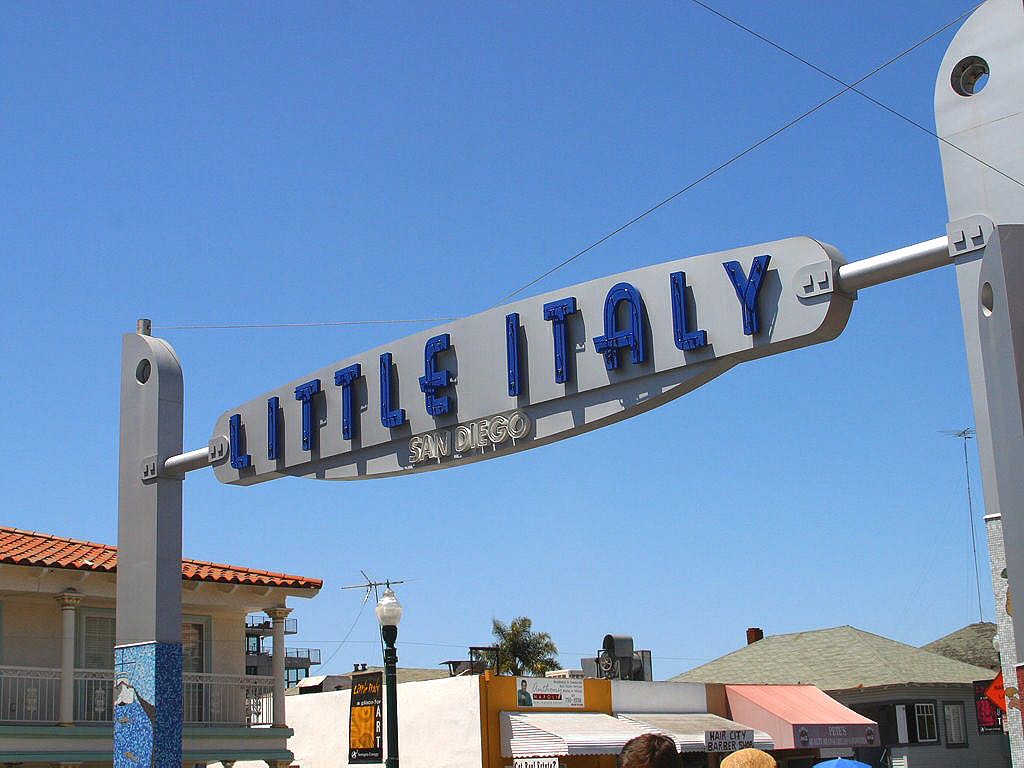
The Little Italy landmark sign, India Street at Date Street. The neon arch that frames India Street is younger than it looks. It was lit for the first time on the evening of October 8, 2000, at the seventh annual Festa, and it was built deliberately as a tribute to the fishing neighborhood. The nautical details are not decoration but memory: portholes on the pillars, blue neon lettering, mosaic tilework telling the story of a community tied to the bay, the church, and the old country.
Where the Little Italy Italians Came From
The community drew on two corners of Italy, both of them coastal and both of them fishing cultures. From the north came Ligurians off the Italian Riviera, from Genoa itself and the small towns near it such as Riva Trigoso, men who had grown up working the water and saw in San Diego Bay a familiar Mediterranean coast with a kinder climate. From the south came Sicilians, concentrated heavily in the fishing village of Porticello, with others from Mazara del Vallo.
What united them was the sea. These were not random emigrants seeking any work that paid. They were fishermen who crossed an ocean specifically to keep fishing, and San Diego let them do it. The Sicilian presence in particular ran so deep that an entire devotional society, the Madonna del Lume, was transplanted whole from Porticello to a church on State Street, and the link held for generations.
Little Italy Today
Little Italy is now widely called the most successful revival of any Little Italy in America, holding ground that older enclaves like Baltimore’s Little Italy have struggled to keep, and it did not happen by accident. In the mid-1990s the surviving property owners and family businesses, working with the organizer Marco Li Mandri, formed the Little Italy Association in 1996 and built it around a self-funded maintenance and assessment district. The model was simple and durable: property owners taxed themselves to keep the streets clean, landscaped, programmed, and safe, year after year, and let the investment follow. That blueprint has since been copied in dozens of neighborhoods across the country.
The results are visible on the ground. The neighborhood now holds more than seven thousand residents and hundreds of businesses, and the association has carved out a string of public piazzas where parking lots and dead space used to be. The largest, Piazza della Famiglia, opened in 2018 as a ten-thousand-square-foot European-style square running between India and Columbia streets, dedicated to the families of the neighborhood. On Saturdays the Mercato fills several blocks of West Date Street with more than two hundred vendors, the biggest farmers market in San Diego County. Every October the Festa draws crowds for food, bocce, and the Gesso Italiano street painters who turn the pavement into chalk frescoes.
The old families have not vanished into the new prosperity. Their names are set into the piazza pavers, their restaurants still trade on India Street, and every October the Madonna del Lume still travels from Our Lady of the Rosary down to the water to bless a fleet that is mostly memory now. The fishermen built a neighborhood at the edge of the bay, lost most of it to a freeway and a dying industry, and watched their grandchildren build it back. The boats are gone. The community they came for is still here.
Frequently Asked Questions
Why did Italians settle in Little Italy San Diego?
Italian fishermen settled the Little Italy San Diego waterfront because San Diego Bay offered a Mediterranean-like climate and coastline where they could keep fishing as they had at home. A small colony formed in the 1890s, and it grew sharply after the 1906 San Francisco earthquake pushed many Italian fishing families south to San Diego.
Is Little Italy San Diego still Italian today?
Little Italy San Diego is no longer a primarily Italian residential neighborhood, since the fishing industry that sustained it collapsed and freeway construction destroyed much of it. But the Italian institutions endure: family restaurants like Mona Lisa and Filippi’s still operate, Our Lady of the Rosary still holds its Madonna del Lume procession, and old family names are set into the piazza pavers.
What are the most famous landmarks in Little Italy San Diego?
The best-known landmark is Our Lady of the Rosary church on State Street, dedicated in 1925 and painted inside by the Venetian artist Fausto Tasca. Others include the neon Little Italy arch over India Street, the family-run Filippi’s Pizza Grotto and Mona Lisa, and Piazza della Famiglia, the public square that opened in 2018.
Where did the Little Italy San Diego Italians come from?
They came from two coastal regions of Italy. The first wave were Ligurians from the Italian Riviera around Genoa and towns like Riva Trigoso, and the second were Sicilians, drawn especially from the fishing village of Porticello and from Mazara del Vallo. Nearly all were fishermen who crossed the ocean to keep working the sea.
When did Italians first arrive in Little Italy San Diego?
Italians began gathering on the San Diego waterfront in the 1890s, but the neighborhood took its lasting shape after 1906, when survivors of the San Francisco earthquake relocated south. By the 1920s it was a settled Italian community of thousands of families anchored by the tuna fleet and the church.
If your family’s story passed through the bait boats and canneries of San Diego Bay, or any of the fishing neighborhoods Italians built along the California coast, the names and dates are still recoverable.