
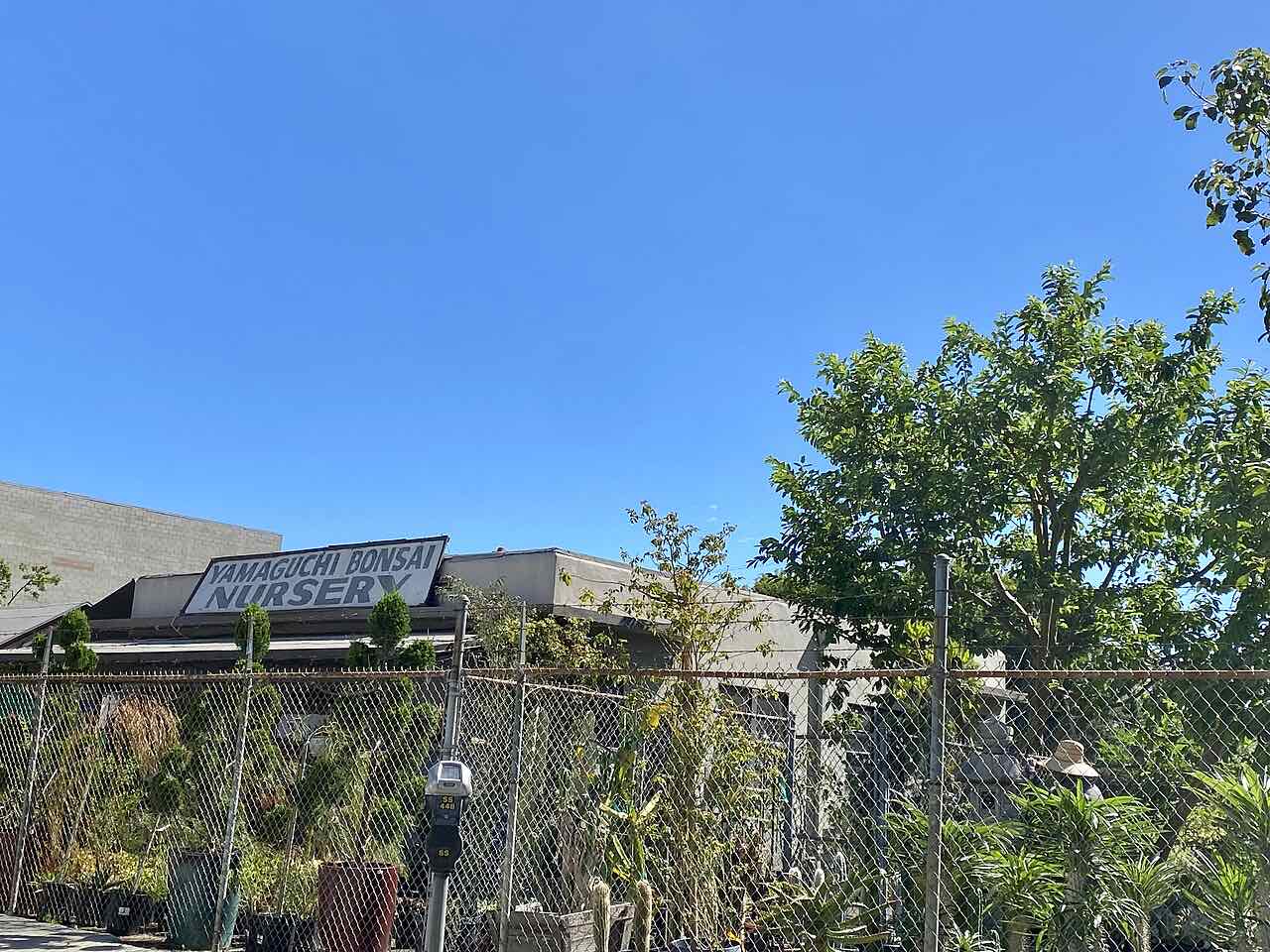
On a six-block stretch of Sawtelle Boulevard, the line for tonkotsu ramen forms before noon, and a block away an old hand-painted sign still reads Yamaguchi Bonsai Nursery above a lath house thick with potted maples. The boulevard runs between the 405 freeway and the mansions of Brentwood, and for more than a century it has belonged, in spirit and often in deed, to Japanese Los Angeles. The Japanese in Sawtelle built this place out of work nobody else wanted to give them: tending other people’s gardens, raising seedlings in backyard plots, boarding the next man off the boat. The nurseries are nearly gone now and the rents are brutal, but the language school still rings its bell on Saturdays, and the neighborhood wears its name in steel.
Sawtelle: The Place
Sawtelle is a compact district of West Los Angeles, roughly 1.48 square miles wedged between Santa Monica and Olympic boulevards, with the San Diego Freeway slicing its eastern edge. It was its own town until Los Angeles annexed it in 1922, and the city later folded it into the catch-all label of West LA. The housing is a tight mix of small single-family bungalows, postwar courtyard apartments, and newer mid-rise blocks, all within walking distance of the boulevard that gives the neighborhood its heartbeat.
How Sawtelle Became Japantown
Before the Japanese
Late nineteenth-century Sawtelle grew up around the Pacific Branch of the National Home for Disabled Volunteer Soldiers, the sprawling veterans’ grounds that still anchor the area off Wilshire. The town drew tradespeople and laborers to serve both the veterans and the wealthy estates rising across the Westside. Land here was cheaper than in the booming districts to the east, and the soil was good, two facts that would shape everything that came next.
The Japanese Arrive
Issei, the first generation of Japanese immigrants, began settling Sawtelle in the 1910s, pulled by mild coastal weather, fertile ground for growing flowers and produce, and the work waiting in the manicured yards of Brentwood, Bel-Air, and Beverly Hills. They could not become citizens, and California’s alien land law barred them from owning property, so the second generation, the American-born Nisei, often held title for their parents. Racial covenants locked Japanese families out of most Los Angeles neighborhoods; Sawtelle, unincorporated and unrestricted in pockets, was one of the few places that would have them. While downtown’s larger Japanese community in Little Tokyo grew up as a commercial and cultural capital, Sawtelle developed as something quieter and more residential: a gardeners’ town on the city’s western edge.
What grew there was a gardener’s economy, and it ran on chain migration. A man arrived from Japan, found a bed in a Sawtelle boarding house, and learned the trade from a more experienced countryman before going out on his own. By the eve of World War II just under half of the area’s employed Japanese American men worked as gardeners, tending the lawns and hedges of the Westside’s rich. The boarding houses were the engine of it all. Locals called them gardeners’ colleges, and at their peak Sawtelle had eight of them.
The best remembered is the Kobayakawa Boarding House on Sawtelle Boulevard, opened in the late 1920s by Riichi Ishioka, a Hiroshima immigrant, and his wife Wakano. At its height it housed as many as sixty men. A Westside housewife who needed a gardener could simply telephone the boarding house, and one would be dispatched. Kobayakawa kept its doors open into the mid-1970s, long after most of its peers had closed.
Sawtelle at Its Peak
By 1941 the district was a fully formed Japantown serving an immigrant world. A community count from that year tallied twenty-six nurseries and florist shops, eight boarding houses, eight gas stations, four churches, three grocery stores, several barbers and sewing schools, and a single Japanese language school. Roughly a thousand Nikkei lived in Sawtelle, and the businesses they built clustered along the boulevard so that a family could pass an entire week without leaving the neighborhood.
The nurseries were the visible signature of the place, rows of lath houses and seedling beds growing the stock that gardeners planted across the Westside. Tom Ikkanda opened an automotive repair shop in 1937 to keep their trucks running. Faith was organized early: the Sawtelle Howa Kai, the Buddhist congregation, took shape in 1926, and Issei pioneers founded a Japanese Methodist church in 1930. The community even built itself a garden, dedicating a Japanese landscape at Stoner Park in 1932 as a gift of goodwill, shaped by the same gardeners’ hands that groomed the estates up the hill.
The Change
The change came in a single spring. After the bombing of Pearl Harbor, FBI agents arrested community leaders, and Executive Order 9066 set in motion the removal of every person of Japanese ancestry from the West Coast. In April 1942, Sawtelle’s families were ordered to gather at the Japanese Institute on Corinth Avenue, the same hall where their children studied. From there, on April 27, buses carried them east to the Manzanar concentration camp in the Owens Valley. The same orders emptied Japantowns up the coast, scattering the Japanese community of Seattle’s Nihonmachi and dozens of other neighborhoods in a matter of weeks.
Sawtelle’s gardeners fared better than many. Because a number owned their homes, they could store tools in their garages and rent the houses out, leaving with something to return to. Others piled furniture to the ceiling inside the Methodist church for safekeeping. When the war ended, that foundation made all the difference: people came back.
The Landmarks of Sawtelle
Japanese Institute of Sawtelle, 2110 Corinth Avenue. It began in November 1925 when Gisuke Sakamoto, an immigrant from what is now Iwaki, Fukushima, started teaching four students Japanese in his own home. The school incorporated in 1929 and built a community hall in 1940, the same hall that became the assembly point for removal to Manzanar two years later. In February 2025 the Institute marked its centennial and dedicated a new building, still teaching the language to a new generation of children.
Hashimoto Nursery, 1935 Sawtelle Boulevard. Four Hashimoto brothers founded it in 1926 as the O.K. Nursery, a few blocks from its present site. Two of the brothers, Juro and Suehiko, were incarcerated at Manzanar; the family returned in stages after the war and rebuilt. Nearly a century on it is still family-owned and operated, one of the last working nurseries on a boulevard that once had dozens.
Yamaguchi Bonsai Nursery, 1905 Sawtelle Boulevard. George Yamaguchi opened it in 1949 near Sawtelle and Olympic, then moved it to its current corner in 1965, building a reputation for bonsai that drew collectors from across the city. When he died in 2005 he left behind a renowned private bonsai collection and a nursery now run by his daughter, Marianne. Its weathered sign and lath houses are the closest thing Sawtelle has to a monument.
West Los Angeles Buddhist Temple. The congregation organized in 1926 as a branch of the Los Angeles Hompa Hongwanji, holding early classes in a storefront and then at the Corinth Avenue school. Its activities went dark during the war and resumed in 1946. In 1950 it became independent and took the name it carries today, one of the oldest Buddhist temples in Southern California.
West Los Angeles United Methodist Church, 1913 Purdue Avenue. Six Issei pioneers established the congregation in 1930, and the church bought the Purdue Avenue site in 1936. When families were forced out in 1942, the building became a vault for their belongings, and when they returned it served as a hostel for those with nowhere to sleep. Its postwar role made it a literal homecoming for the neighborhood.
Stoner Park Japanese Garden, 1835 Stoner Avenue. Issei gardeners designed and dedicated this garden in 1932 as a gesture of cross-cultural goodwill, a piece of Japan rendered by men whose days were spent shaping other people’s grounds. It fell into neglect during the war years and was restored in the 1950s by the Bay Cities Gardeners Association. In 1994 the community planted a hundred cherry trees there.
Hide Sushi, 2040 Sawtelle Boulevard. Open since 1979, this no-frills counter has fed generations of Westside families without ever taking a reservation, a credit card, or a request for a rainbow roll. It predates the boulevard’s ramen fame by three decades. For many Angelenos it is the taste of Sawtelle before the lines.
Where the Sawtelle Japanese Came From
Sawtelle’s Issei came from across rural Japan, and prefecture of origin mattered enormously. Immigrants organized into kenjinkai, mutual-aid associations of people from the same home prefecture, and these networks decided who got a bed, a job referral, or a loan to start a nursery. The Kobayakawa boarding house family came from Hiroshima; the founder of the language school came from Fukushima; threads ran back to farming and fishing districts up and down the country.
The common denominator was agriculture. These were people who knew soil and seasons, and that knowledge translated directly into the gardening and nursery trades that built the neighborhood. Sawtelle did not draw merchants chasing a city; it drew growers who found, on the western edge of Los Angeles, ground that rewarded what they already knew how to do.
Sawtelle Today
The boulevard is busier than it has ever been, but the crowds come for dinner. Tsujita changed the city’s ramen map when it opened in 2011 and added its Annex across the street in 2013, and the strip now runs thick with izakaya, udon counters, dessert shops, and a Nijiya market stocked with Japanese groceries. Older spots like Hide Sushi and Asahi Ramen still hold their corners, and Giant Robot, the pop-culture shop and gallery founded by Eric Nakamura, keeps a creative outpost on the street.
The community’s hold is more contested than the food scene suggests. The nurseries that defined Sawtelle for a century are down to a handful, and proposals to add thousands of apartments to the residential core have alarmed residents who watched covenants and a war already scatter them once. The Sawtelle Japantown Association and the neighborhood council have pushed back, arguing that the very blocks Japanese families were once confined to deserve protection now, not erasure by density.
The fourth generation lives here lightly, scattered across a city that no longer fences them in, but the anchors hold. The Buddhist temple still gathers, the Methodist church still opens its doors, and the Japanese Institute, a century old and rebuilt, still teaches children to write their grandparents’ language. Like the surviving Japantown in San Jose, Sawtelle is proof that a community can be uprooted and still hold its ground. The signs at either end of the boulevard, installed in 2015, are not nostalgia. They are a claim, planted in the ground, that this place has a name and intends to keep it.
Frequently Asked Questions
Why did Japanese immigrants settle in Sawtelle?
The Japanese in Sawtelle came in the 1910s for fertile soil, a mild coastal climate, and gardening work on the wealthy estates of the nearby Westside. Racial covenants and the alien land law shut Japanese families out of most of Los Angeles, and unincorporated Sawtelle was one of the few areas open to them. A network of boarding houses then trained new arrivals in the gardening trade.
Is Sawtelle still Japanese today?
Yes, though it has changed. The Japanese in Sawtelle no longer dominate the population the way they did before the war, and most of the historic nurseries have closed. But the Buddhist temple, the Methodist church, the century-old Japanese Institute, and the Hashimoto and Yamaguchi nurseries still operate, and the city officially named the district Sawtelle Japantown in 2015.
What are the most famous landmarks in Sawtelle Japantown?
The best-known landmarks are the Japanese Institute of Sawtelle on Corinth Avenue, the long-running Hashimoto and Yamaguchi bonsai nurseries on Sawtelle Boulevard, the West Los Angeles Buddhist Temple, and the Japanese garden at Stoner Park. The boulevard itself is now a celebrated food destination anchored by ramen houses like Tsujita and Hide Sushi.
Where did the Sawtelle Japanese community come from?
Sawtelle’s first-generation immigrants came from rural prefectures across Japan, including Hiroshima and Fukushima, and most had farming backgrounds. They organized into kenjinkai, mutual-aid groups based on home prefecture, which helped newcomers find housing and work. That agricultural knowledge directly fed the neighborhood’s gardening and nursery economy.
When did Japanese people first arrive in Sawtelle?
Japanese immigrants began settling in Sawtelle in the 1910s, and the community was firmly established by the 1920s. By 1941 the district had around a thousand Japanese residents and twenty-six nurseries. After wartime incarceration at Manzanar, families returned, and Sawtelle reached its largest size in the 1950s.
If your family’s story passed through Sawtelle, through a boarding-house bunk, a nursery lath house, or a Saturday classroom on Corinth Avenue, the work of remembering it begins with a single thread.