
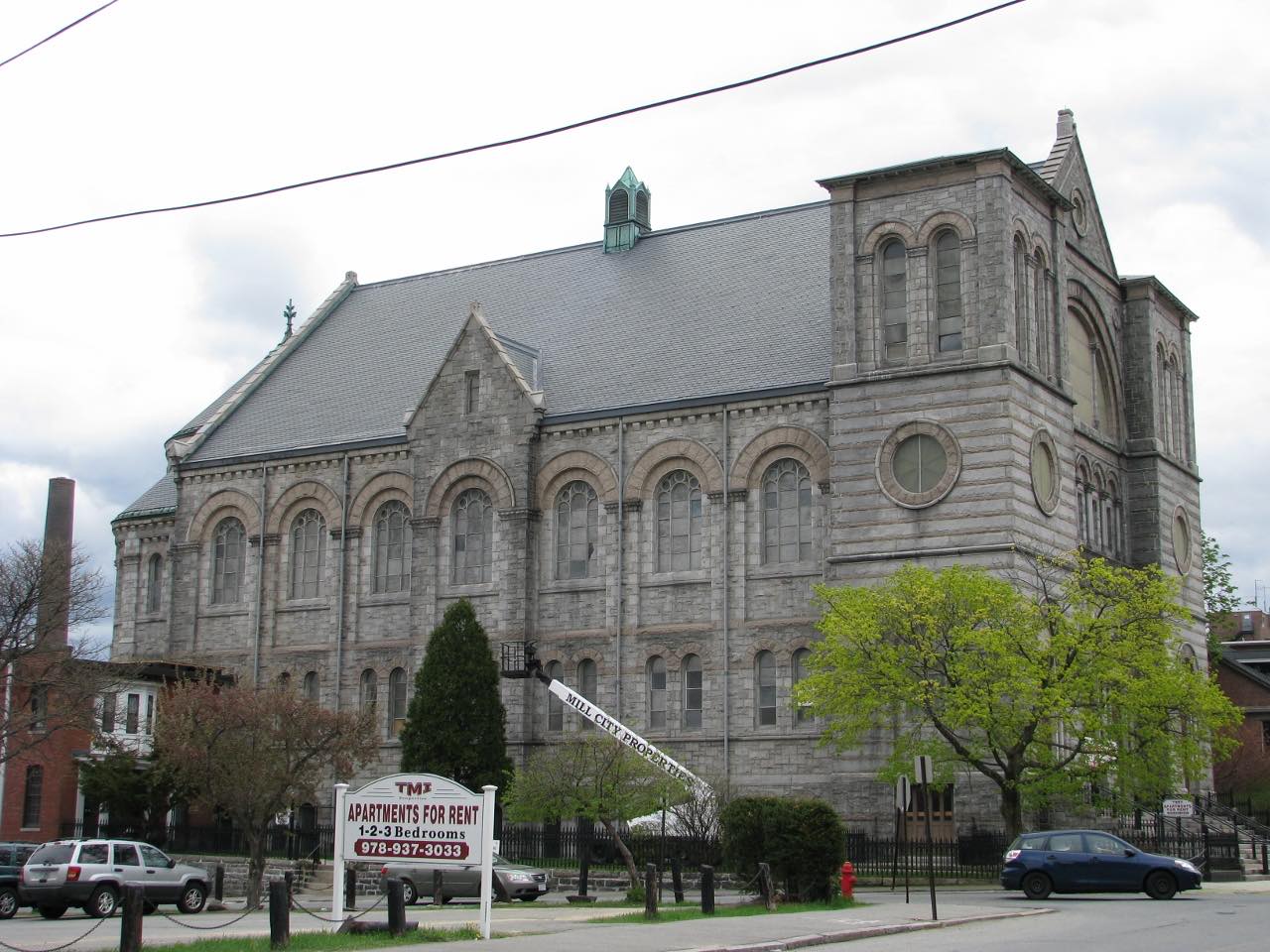
On a cold morning in October 1969, a granite church on Merrimack Street filled with mourners for a writer who had spent his fame fleeing the very streets outside its doors. The casket held Jean-Louis Lebris de Kerouac, known to the world as Jack and to his mother as Ti-Jean. Allen Ginsberg, Gregory Corso, and Peter Orlovsky stood among the pews where, four decades earlier, a French-speaking altar boy had learned his Latin responses before he could comfortably hold a conversation in English. The church was Saint-Jean-Baptiste, the parish heart of a vanished world the Francos of Lowell called Le Petit Canada.
The French Canadians in Lowell did not just pass through. For nearly a century they ran the looms, filled the tenements, built the steeples, and gave Lowell the writer who would carry its mill smell into American literature. Most of the neighborhood they made is gone now, scraped flat in a single brutal decade. What remains is in the surnames, the granite, and the books.
Lowell: The Place
Lowell sits where the Merrimack River drops over the Pawtucket Falls, about 30 miles northwest of Boston in northeastern Massachusetts. The waterpower of that fall is the reason the city exists at all. Canals thread the downtown like veins, and the red-brick mill blocks still line them, walkable from the train that runs to North Station. The housing the Francos knew was dense wooden tenement stock packed between the canals and the river; much of it is gone, replaced by parking, parkland, and university buildings.
How Lowell Became Little Canada
Before the French
Lowell was the first thing of its kind in America: a city invented on purpose. The Boston Associates, a syndicate of merchant investors, incorporated it in 1826 and named it for Francis Cabot Lowell, whose smuggled memory of British power looms had launched the whole enterprise. The Merrimack Manufacturing Company had already started spinning cotton there in 1823.
The first workforce was famous: the Yankee mill girls, unmarried farm women in their teens and twenties who lived in company boarding houses under strict curfews. By mid-century the city held more than thirty mills and roughly 33,000 people, the labor force about three-quarters female. Then the Great Famine drove the Irish across the Atlantic, and from the 1840s they took the harder, lower-paid jobs the Yankee women were leaving behind. The Irish were Lowell’s first immigrant tide. The French Canadians were the second, and the largest.
The French Arrive
When the Civil War ended and the looms needed bodies, Lowell’s mill agents looked north to Quebec, where rural Catholic families were running out of farmland to divide among too many sons. A French-Canadian pioneer named Samuel Marin, who had reached Lowell in 1857, was hired by the textile corporations around 1865 to go recruit. He came back with families, and the families wrote home, and the chain pulled tight.
That is the engine of the whole story. One cousin sent for another; a village in the Eastern Townships emptied a few households at a time into a few specific tenement blocks. Trainload after trainload came down through the 1870s and 1880s. Between 1860 and 1900 roughly 30,000 French Canadians settled in Lowell, part of a flood of more than half a million who poured into New England’s mill towns in the same span.
Marin developed a vacant tract near the Lawrence Mills, hemmed by the Northern Canal and the Merrimack River, and that low ground became the quarter. Its main arteries were Aiken and Moody Streets. The French called it Le Petit Canada, Little Canada, and they meant it almost literally: you could be born, baptized, schooled, employed, married, and buried without leaving its few blocks or speaking much English.
Lowell at Its Peak
At its height around 1900, Little Canada was one of the most densely populated neighborhoods in the United States, its three- and four-story wooden tenements crammed against the canal with shops at street level and families stacked above. Roughly 2,500 people lived in some 325 buildings, alongside 110-odd apartments, restaurants, and businesses run largely by Francos themselves. Children jumped from tenement roofs into the Northern Canal to cool off in the summer heat.
The binding idea was la survivance, the survival of language and faith on foreign soil. French was the language of the home, the parish, and the morning classroom. Social clubs anchored civic life: the Club Passe-Temps, the Club des Citoyens-Americains, the Club Lafayette. There were French bookstores and markets, a Franco credit union, and parochial schools where the Marist Brothers and teaching sisters drilled catechism and grammar in the mother tongue.
It was crowded, poor, and self-contained, and to the people who grew up there it was complete. The mills ran on their labor; by 1900 nearly half of Lowell was foreign-born, and the Francos were a defining share of that. This is the world Jack Kerouac was born into in 1922, a few streets north in Centralville, the son of Quebec-born parents, Leo and Gabrielle, who spoke joual at home. He learned English around age six and carried the accent into his teens.
The Change
The mills that built Lowell began drifting south for cheaper labor in the early twentieth century, and the Depression gutted what remained. But the blow that erased Little Canada was not economic decline. It was a bulldozer.
In 1964 the city, under a federally backed urban renewal program, demolished Little Canada outright. The tenements along the Northern Canal came down, the businesses with them, and thousands of residents were scattered across the city. The Northern Canal site where families had lived became, eventually, a parking lot. For the community it was a grief that did not have a name at the time, only a feeling, as one displaced resident later put it, of powerlessness almost impossible to overcome.
Charlie Gargiulo, who had moved to Austin Street as an eleven-year-old in 1963, watched it happen and spent the rest of his life answering it: he helped found the Coalition for a Better Acre to fight displacement, and in 2023 he published a memoir, Legends of Little Canada, to set down what the maps no longer show. The neighborhood that had survived a century of poverty did not survive its own city’s idea of progress.
The Landmarks of Little Canada
Saint-Jean-Baptiste Church, 741 Merrimack Street. The granite giant. The parish was founded in 1868 by Father Andre-Marie Garin, an Oblate missionary from France, as the first Franco-American parish in the Archdiocese of Boston; the great stone church rose between its 1888 cornerstone and an 1896 consecration by Archbishop John Williams. Fire gutted it in 1912 and the rebuilt church reopened in 1916. A young Kerouac served Mass here, and his funeral filled it on October 24, 1969.
Saint Joseph’s, Lee Street. Before the cathedral there was a converted Protestant meeting house, where Father Garin first gathered the French faithful. From the parish grew Saint Joseph’s schools: an elementary school in 1883, a boys’ academy staffed by Marist Brothers in 1892, and a girls’ high school by 1928. These were the classrooms where survivance was taught one verb at a time.
Saint-Louis-de-France, Centralville. As Francos spilled across the Merrimack into Centralville, twelve men petitioned the archdiocese in 1903 for a parish of their own, and parishioners John Beaulieu and Jacques Boisvert bought and donated the land for it near West Sixth and Victor Streets. This was Kerouac’s home parish ground; his family lived nearby, and his older brother Gerard, who died as a child, haunts the streets of Visions of Gerard.
The statue of Father Garin. Outside Saint-Jean-Baptiste stands a bronze of the founding priest, sculpted by Louis-Philippe Hebert and in place by 1896. For generations of mill families he was the face of the church that organized their whole week, and the statue has outlasted the neighborhood it watched over.
Kerouac’s birthplace, 9 Lupine Road. On the second floor of a modest two-family house in Centralville, Gabrielle Kerouac gave birth to Ti-Jean on March 12, 1922. The house still stands, privately owned, marked only by a plaque. From here the boy walked to French school in the morning and English class in the afternoon, the two halves of a divided tongue.
The Kerouac Commemorative, Bridge Street near French Street. In 1988, Lowell finally claimed its son in stone. The Texas sculptor Ben Woitena set eight pink granite columns, each eight feet tall, in a mandala plaza and etched them with passages from ten of Kerouac’s books, his Catholic and Buddhist halves held in one design. It was the city’s first official monument to the writer it had once been embarrassed by.
Kerouac’s grave, Edson Cemetery, 1375 Gorham Street. He lies in the Sampas family plot near Lincoln Avenue, under a flat stone that reads Ti Jean and He Honored Life. The clerk’s office once printed directions for the steady stream of visitors. Pilgrims still leave pens stuck in the dirt, notebooks, photographs, and small bottles of whiskey, in case Jack wakes up thirsty.
Where the Lowell French Came From
Almost all of them came from Quebec, and most from the rural parishes of the St. Lawrence valley and the Eastern Townships southeast of Montreal. These were farming families on land subdivided past the point of supporting the next generation, Catholics with large households and few options once the home farm was full. The mills offered a wage, however thin, that the countryside no longer could.
Because the migration ran on family and parish ties, the connection between specific Quebec villages and specific Lowell streets stayed remarkably tight. A recruiter like Samuel Marin could empty a few households from one township, and their letters home did the rest, so that a single Lowell tenement block might hold cousins, neighbors, and former parishioners from the same patch of Quebec. The Francos of Lowell shared this northern origin with their kin in the other great mill cities, a thread you can follow to the French Canadians of Manchester, New Hampshire and the famously Franco textile town of Woonsocket, Rhode Island.
Lowell Today
Little Canada is a memory marked by panels, not a place you can walk. The tenements are gone, the canal-side blocks given over to a university campus, a ballpark, and parking. But the French Canadians in Lowell never disappeared; they dispersed. Their surnames fill the phone book, the cemeteries, and the rosters of City Hall, and their parishes left granite behind even after the congregations thinned and Saint-Jean-Baptiste closed as a Catholic parish in 1993.
The city that once kept Kerouac at arm’s length now lives partly off his name. Every October the Lowell Celebrates Kerouac festival, running since 1985, fills the bars and the cemetery with readings, walking tours, and music. In May 2025 the country singer Zach Bryan bought the old Saint-Jean-Baptiste church, the very building where Kerouac was eulogized, to turn it into a Jack Kerouac Center. The Francos arrived alongside other newcomers and were followed by more; their story sits beside that of the Greeks of Lowell and, later, one of the largest Cambodian communities in America.
The neighborhood was bulldozed, but the thing the Francos most wanted to keep, the memory of who they were and where they came from, outlasted the buildings. It is carved into eight pink columns by the river and into a flat grey stone on Lincoln Avenue, and it is still being read aloud every autumn.
Frequently Asked Questions
Why did French Canadians settle in Lowell?
They came for the textile mills. After the Civil War, Lowell’s mill agents recruited workers from rural Quebec, where farm families had run short of land, and the French Canadians in Lowell built a self-contained neighborhood, Le Petit Canada, beside the canals so they could live and work close to the looms.
Is Lowell still a French-Canadian neighborhood today?
Not as a distinct neighborhood. Little Canada was demolished in 1964 by urban renewal, scattering its residents across the city. Franco-American surnames, parishes, and institutions remain woven through Lowell, but the French Canadians in Lowell no longer occupy one quarter the way they once did.
What are the most famous French-Canadian landmarks in Lowell?
The granite Saint-Jean-Baptiste church on Merrimack Street is the great survivor, where Jack Kerouac served as an altar boy and was later eulogized. Others include the Kerouac Commemorative on Bridge Street, his birthplace at 9 Lupine Road, and his grave at Edson Cemetery.
Where did the French Canadians of Lowell come from?
Almost entirely from Quebec, chiefly the rural parishes of the St. Lawrence valley and the Eastern Townships near Montreal. They were Catholic farming families pushed out by subdivided land and pulled south by mill wages, arriving through chain migration that linked specific Quebec villages to specific Lowell streets.
When did French Canadians first arrive in Lowell?
A trickle began in the 1860s, with recruiter Samuel Marin arriving in 1857 and gathering families from about 1865. The major waves came in the 1870s and 1880s, and between 1860 and 1900 roughly 30,000 French Canadians settled in the city.
If your family’s story passed through the tenements of Little Canada or any of New England’s mill towns, the names and parishes they left behind are the first thread back to Quebec.