
Stand on a corner of Social Street in Woonsocket in 1920 and you would have heard French. Not the textbook French of a classroom, but the worn, warm Quebec French of mill hands and shopkeepers, of grandmothers on triple-decker porches and priests at the altar rail. Storefront windows carried four small words that told you everything: Ici on parle francais. Here, French is spoken. For a stretch of decades, this small Rhode Island mill city on the Blackstone River was, by one common measure, the most French city in America.
The French Canadians in Woonsocket did not pass through. They built a parallel world inside an American city: their own churches, schools, newspapers, fraternal society, and union. Then they fought, sometimes bitterly, to keep it. The story runs from a Quebec farmhouse to a textile shop floor, through an excommunication and a riot, and ends in a museum that exists to make sure none of it is forgotten.
Woonsocket: The Place
Woonsocket sits in the far northern corner of Rhode Island, pressed against the Massachusetts line, where the Blackstone River drops fast enough to turn machines. The city covers under eight square miles, packed tight with mill complexes, church towers, and dense blocks of two- and three-family wooden houses. Its old commercial heart fans out from Main Street and Market Square, with the river and rail line threading through the middle. The water power is the whole reason any of it is here.
How Woonsocket Became the Most French City in America
Before the French Canadians
Woonsocket was an industrial town before it was a French one. Yankee and English mill owners harnessed the Blackstone in the early nineteenth century, and Edward Harris built his first textile mill here in 1831, the start of a woolen empire that gave the city its early shape. The mills needed water, which Woonsocket had, and then they needed hands, which it did not.
The first labor came from local New Englanders and from Irish immigrants who dug the canals and tended the early looms. By mid-century the looms were multiplying faster than the local population could fill them. The owners looked north.
The French Canadians Arrive
Just over the border, rural Quebec was running out of room. Farms divided among many sons could no longer feed the next generation, and a hard agrarian life offered little cash. Mill agents traveled up into Quebec parishes to recruit whole families, promising steady wages on the shop floor. The first French Canadian families came to Woonsocket’s mills in the 1840s, and after the Civil War the trickle became a flood.
The railroad made it possible. Woonsocket was a rail hub, and the lines ran straight back to the St. Lawrence valley, so a family could leave a farm near Trois-Rivieres or Sorel and be standing at a Woonsocket loom within days. This was chain migration in its purest form: one family wrote home, a cousin followed, then a brother, then a whole village seemed to reassemble itself street by street. People from the same Quebec parish often clustered on the same Woonsocket blocks and knelt in the same pews.
They carried a creed with them, summed up in three words: la langue, la foi, la patrie. The language, the faith, the homeland. Holding all three together against the pull of American life had a name, la survivance, survival, and in Woonsocket it became almost a civic religion.
Woonsocket at Its Peak
The numbers are startling. By 1900, around sixty percent of Woonsocket’s residents were French Canadian, and the city was already being called the most French in the United States. A 1913 survey ranked Woonsocket first among all American cities in the share of its population that spoke French, with nearly half the city French-speaking. The 1930 census counted more than ten thousand Woonsocket residents born in Canada alone.
At its height, around 1930, roughly seventy percent of the city’s fifty thousand people were of French Canadian stock, some thirty-five thousand people. They sustained an entire French-language press: by one count fifteen French newspapers were published in Woonsocket beginning in 1873, and the daily La Tribune and the Courrier du Rhode-Island reported the city’s life in French for decades. The dialect itself, shaped by the mills, was distinct enough that scholars labeled it New England French.
Daily life ran in French from cradle to grave. Children were baptized, taught, married, and buried in French-speaking parishes. The most prominent name the community produced was Napoleon “Nap” Lajoie, born in Woonsocket in 1874 to French Canadian parents, who became one of baseball’s greatest hitters and entered its first Hall of Fame class.
The determination to hold the line erupted into open warfare in the 1920s. The Catholic hierarchy in Rhode Island was Irish-led, and when Bishop William Hickey moved to tax the French parishes to fund English-language high schools, a Woonsocket lawyer named Elphege Daignault fought back. Through his newspaper La Sentinelle, founded in 1924, he and his followers attacked the diocese, sued in the state courts, and appealed to Rome to protect French schools and parish funds.
The courts rejected him and Rome turned against him. In 1928 the Vatican excommunicated Daignault and more than sixty of his supporters, and reading La Sentinelle was declared a sin. Facing exclusion from the Church, Daignault recanted before Easter 1929. The Sentinelle Affair was lost, but it remains the rawest expression of how fiercely Woonsocket fought to stay French.
The Change
What undid Little Canada was the same thing that built it: the mills. New England textile manufacturing began moving south in search of cheaper, non-union labor, and the Depression hollowed out what remained. The big Woonsocket woolen and rayon operations shrank, merged, or closed through the mid-twentieth century, and the steady jobs that had pulled families down from Quebec simply went away.
The language faded more slowly than the work. French was still heard on Main Street and in shops into the 1960s and 1970s, spoken by people who had grown up in it. But the parochial schools switched to English, television and radio came in English, and the children of the mill workers grew up American first. By 1980, around seventy percent of the city still claimed French Canadian descent, yet far fewer spoke the language. By the 2020 census, residents claiming French Canadian or French ancestry had fallen to roughly thirty percent combined.
The Landmarks of Little Canada
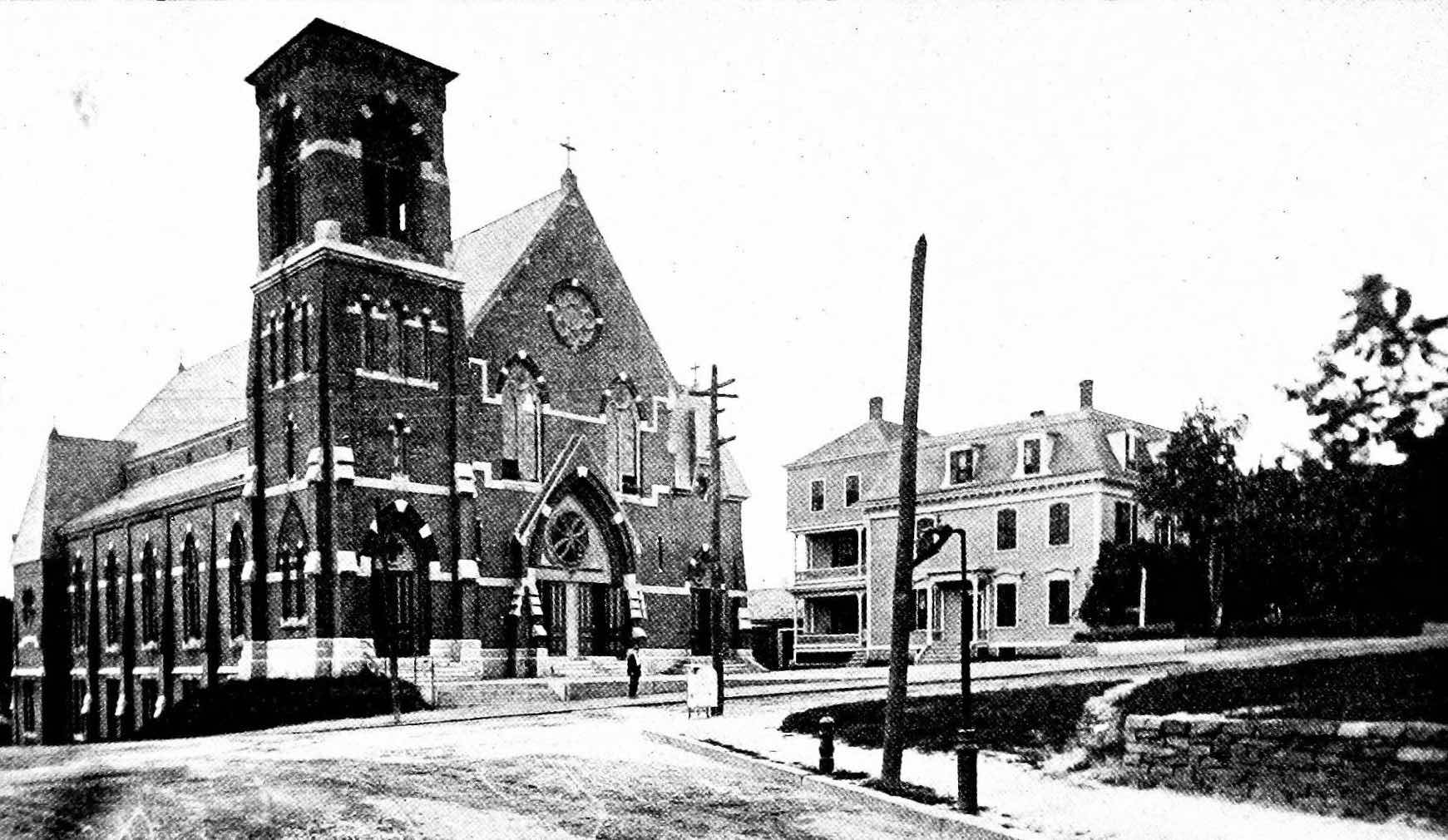
Precious Blood Church (L’Eglise du Precieux Sang), 94 Carrington Avenue. This is the mother church of Franco-American Catholicism. The parish was organized in 1872, and the great brick church rose between 1873 and 1881 to a design by the Worcester firm of Elbridge Boyden and Son. For generations of new arrivals from Quebec, registering at Precious Blood was the first act of becoming a Woonsocket family. In 2023 it marked its 150th anniversary.
St. Ann Arts and Cultural Center (formerly St. Ann’s Church), 84 Cumberland Street. The parish dates to the 1890s and the soaring church opened in 1918. Between 1940 and the late 1940s, the Italian-born artist Guido Nincheri covered its walls and ceiling in frescoes using Michelangelo’s technique, working under a $25,000 contract and painting hundreds of faces. Many were modeled on the parish’s own people: mill workers, children, and soldiers off to the Second World War. Yankee Magazine later called it the Sistine Chapel of America. The diocese closed the church in 2000, and a community nonprofit saved it, taking ownership in 2007 and reopening it as an arts center.
L’Union Saint-Jean-Baptiste d’Amerique, 1 Social Street. Founded in Woonsocket in 1900, this fraternal benefit society became the largest French Catholic organization of its kind in the country. It sold insurance to mill families and funded the fight to keep French alive in church and school. Its members moved into a purpose-built headquarters on Social Street in 1926, a concrete statement that the French had arrived to stay.
Our Lady of Victories Parish. Established in 1909 as the community kept multiplying, this was another of the national parishes where the Mass, the school, and the social calendar all ran in French. It served the neighborhood for three-quarters of a century before closing in 1984, one more parish folded as the French-speaking population thinned.
The Woonsocket Rayon plant and Social Square. In September 1934, during the national textile strike, this district became a battlefield. National Guardsmen sent to protect the rayon mill clashed with strikers, and on the night of September 12 a nineteen-year-old bystander named Jude Courtemanche was shot dead in the streets. The killing, under martial law and curfew, seared the strike into local memory.
The Museum of Work and Culture, Market Square. Opened in 1997 by the Rhode Island Historical Society in a former mill, this is the one landmark built to tell the whole story on purpose. Visitors walk from a recreated Quebec farmhouse through a tenement porch, a shop floor, a classroom, a church, and a union hall, the exact arc that French Canadian families lived.
Where the Woonsocket French Canadians Came From
They came overwhelmingly from rural Quebec, the farming parishes of the St. Lawrence lowlands between Montreal and Quebec City, places like the Trois-Rivieres region, Sorel, and the country south of the river. These were Catholic, French-speaking farm communities where land had been subdivided for generations until a younger son had no realistic future on it.
The pull was specific and economic. A spinner or weaver in a Woonsocket mill earned cash wages that a Quebec farm could not match, and the city already held aunts, uncles, and former neighbors who could find a newcomer a job and a room. Because recruitment and word of mouth followed family and parish lines, Woonsocket ended up not as a random scatter of Quebecers but as a transplanted patchwork of specific Quebec communities. The same families who tell this story echo across New England, from the French Canadians of Lewiston, Maine to the Acadians of the Madawaska valley on the northern border. They were also only one of the immigrant waves that remade Rhode Island, arriving in the same decades as the Italians of Federal Hill in Providence just down the Blackstone.
Woonsocket Today
The French surnames are still everywhere. They fill the phone book, the cemeteries, the rosters of the high school sports teams, and the names over a few old businesses. You can still eat the food the millworkers ate, the tourtiere meat pie at the holidays and the local dynamite, a spiced ground-beef sandwich on a torpedo roll that is beloved in Woonsocket and barely known twenty miles away.
But the living language has mostly gone quiet. A Mass in French is now a rarity rather than the default, several of the great parishes have closed or merged, and the children who grew up speaking it are elderly. At the same time, Woonsocket has become a new immigrant city again. A quarter of its residents are now Hispanic or Latino, and newcomers from Latin America, Asia, and Africa are writing the next chapter on the same dense streets.
The thread is held now by institutions rather than by everyday speech. The Museum of Work and Culture, the rescued frescoes at St. Ann, and societies like the American-French Genealogical Society keep the record open for the grandchildren and great-grandchildren who come looking. The French Canadians in Woonsocket are no longer the city, but the city is unmistakably still theirs, and that is a story their descendants are still living forward.
Frequently Asked Questions
Why did French Canadians settle in Woonsocket?
They came for mill jobs. The French Canadians in Woonsocket left overcrowded Quebec farms, beginning in the 1840s and surging after the Civil War, for steady wages in the city’s woolen and cotton mills, traveling down the rail lines that connected the city to the St. Lawrence valley. Mill agents recruited families directly, and chain migration along parish and family lines did the rest.
Is Woonsocket still a French Canadian city today?
In ancestry, largely yes, but far less in daily life. As recently as 1980 about seventy percent of residents claimed French Canadian descent, but by 2020 that figure had fallen to roughly thirty percent combined French Canadian and French. The French language is now rarely heard, and Woonsocket has become home to large new Hispanic and other immigrant communities.
What are the most famous landmarks of French Canadian Woonsocket?
The standouts are Precious Blood Church on Carrington Avenue, the Franco-American mother church, and St. Ann Arts and Cultural Center on Cumberland Street, whose frescoes earned it the nickname the Sistine Chapel of America. The Museum of Work and Culture in Market Square tells the full immigrant and labor story.
Where did the Woonsocket French Canadians come from?
Almost all came from rural Quebec, especially the farming parishes of the St. Lawrence lowlands between Montreal and Quebec City. Land in these Catholic, French-speaking communities had been subdivided across generations until many young people had no future on the farm, so they followed relatives already working in the New England mills.
When did French Canadians first arrive in Woonsocket?
The first French Canadian families were recruited to Woonsocket’s mills in the 1840s. Their numbers grew rapidly after the Civil War, and by 1900 the French Canadians in Woonsocket made up about sixty percent of the population, making it the most French city in the United States.
If your family’s story passed through the mills of Woonsocket, a name written into a parish register at Precious Blood or carried down from a farm in Quebec, that journey is worth tracing all the way back.