
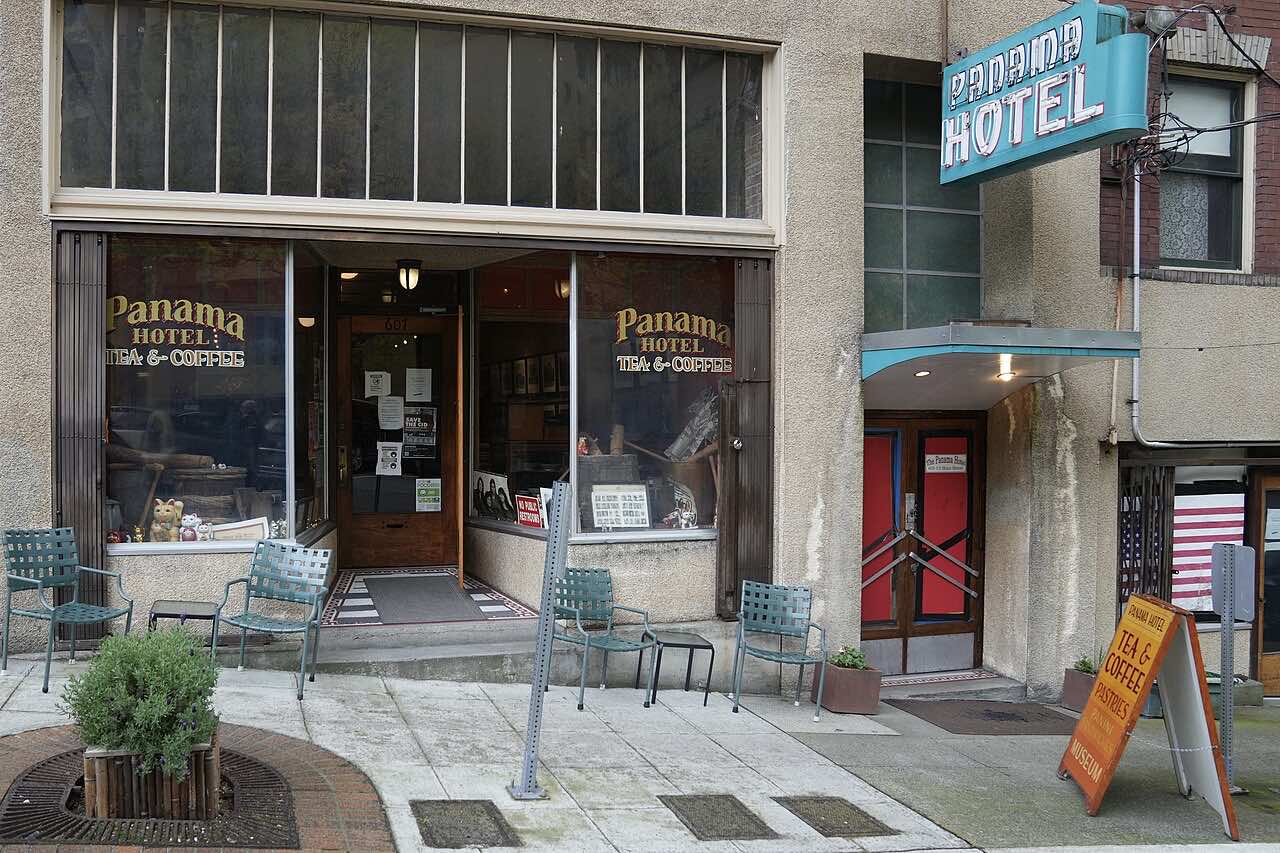
Walk down South Main Street toward Sixth Avenue and you reach a corner where a teal neon sign still spells out PANAMA HOTEL. Push open the door beside it and you step into a coffee room with brick walls papered in old photographs, and a square of glass set into the floor. Look down and you see a basement crowded with steamer trunks and suitcases, the belongings of families who packed in a hurry in 1942 and never came back for them. This was the heart of Nihonmachi, the Japantown that once held the largest community of Japanese in Seattle.
Nihonmachi: The Place
Nihonmachi sat on the southeastern edge of downtown Seattle, on filled tideflats and regraded slopes just below First Hill. At its peak the district ran roughly from Yesler Way south to Dearborn Street, and from Fourth Avenue east to Fourteenth, with Sixth Avenue South and Main Street as its crossroads. The housing was dense and low: brick single-room-occupancy hotels above ground-floor shops, with the steep streets sloping down toward the railroad yards and the waterfront. Today the same blocks form the core of the Chinatown-International District, a short walk from King Street Station.
How Nihonmachi Became Seattle’s Japantown
Before the Japanese
The blocks east of Pioneer Square were first home to a Chinese community drawn to the young port city in the 1860s and 1870s. That community was nearly erased by the Chinese Exclusion Act of 1882 and by the anti-Chinese riots that swept Seattle in 1886, when mobs forced hundreds of Chinese residents toward the docks to be expelled.
The exodus left the city’s hardest, lowest-paid work without enough hands to do it. Into that gap, in the closing years of the century, came the first Japanese arrivals, mostly young men with no intention of staying for good.
The Japanese Arrive
When the Nippon Yusen Kaisha steamship line began regular sailings between Japan and Seattle in 1896, fewer than 200 Japanese lived in the city. Labor contractors changed that fast. The Oriental Trading Company, run out of Seattle, recruited workers straight from branch offices in Hiroshima and Wakayama and fed them into railroad section gangs, sawmills, coal mines, and the salmon canneries of Alaska and Puget Sound.
Most arrived from the same handful of rural prefectures and pulled relatives and neighbors over behind them, the chain migration that built every block of Nihonmachi. A man would clear a debt, send for a brother, then for a picture bride, and a bunkhouse address would slowly turn into a family business. By 1910 roughly 5,000 Japanese lived in Seattle, and the district had its own banks, newspapers, bathhouses, and churches.
Many who started in the canneries and rail camps ended up in the soil. By the 1920s, farms worked by ethnic Japanese families were producing roughly three-quarters of the region’s vegetables and about half its milk, much of it sold through the Pike Place Market stalls run by Issei growers.
Nihonmachi at Its Peak
By the 1930s the district had become the second-largest Japantown on the West Coast, behind only Los Angeles. The 1930 census counted 8,448 people of Japanese ancestry in a city of 368,583, and the neighborhood they built was nearly self-contained. By 1919 Japanese proprietors ran more than 200 hotels and lodging houses across the city, many of them clustered in these few blocks.
Sixth and Main was the center of it all. There were grocers and tofu makers, a Japanese-language newspaper, the North American Post, founded in 1902, and four sento bathhouses where workers without plumbing soaked at the end of a shift. Issei parents sent their American-born children to public school by day and to the Japanese Language School in the afternoon, while the Issei generation leaned toward the Buddhist temple and many Nisei toward the Christian churches.
For a sense of how this immigrant world took root on the Pacific coast, the same pattern played out in San Francisco’s Japantown and, on a larger scale, in Little Tokyo in Los Angeles. Seattle’s version was the northernmost of the three, and in some ways the most intact.
The Change
In the days after the attack on Pearl Harbor in December 1941, the FBI arrested Seattle’s Japanese priests, language teachers, and community leaders, taking them from their homes without charge. On February 19, 1942, President Roosevelt signed Executive Order 9066, opening the door to the mass removal of Japanese Americans from the entire West Coast.
The first to go lived across Puget Sound. On March 30, 1942, the 227 Japanese Americans of Bainbridge Island were marched onto a ferry at Eagledale dock and sent away, the first community in the nation removed under the order. They went to Manzanar in California, and many later to Minidoka in Idaho.
Seattle’s turn came that spring. Families were given days to settle their affairs, store or sell what they owned, and report with what they could carry. They were taken first to Camp Harmony, a hastily built assembly center on the Puyallup fairgrounds, and then, in trains that ran through the late summer of 1942, to the Minidoka camp in the Idaho desert. Nearly the whole of Nihonmachi emptied in a matter of weeks.
The Landmarks of Nihonmachi
The Panama Hotel, 605 South Main Street. Built in 1910 to the design of Sabro Ozasa, the first Japanese American architect in Seattle, the Panama was a workingman’s hotel above a row of shops, with the Hashidate-Yu bathhouse in its basement, the last intact Japanese sento in the country. When families were removed in 1942, many left their possessions in that basement for safekeeping, and the trunks are still there. The building became a National Historic Landmark in 2006 and a National Treasure in 2015, and it inspired Jamie Ford’s novel Hotel on the Corner of Bitter and Sweet.
Maneki, 304 Sixth Avenue South. Opened in 1904 and once housed in a castle-shaped building seating 500, Maneki ran the first sushi bar in Seattle and is counted among the oldest Japanese restaurants in the United States. The Sato family, who took it over in 1923, returned from incarceration to find the old building looted, and reopened in the smaller space where the restaurant still serves. It is now run by Jean Nakayama, who started waiting tables there in the 1970s, and is owned by a nonprofit dedicated to the district’s survival.
Higo Variety Store, 604 South Jackson Street. The Murakami family opened Higo as a ten-cent store in 1907 and made it a gathering point for immigrants from Kumamoto, the prefecture they had left behind. While the family was imprisoned during the war, two of the building’s other tenants kept watch over the shop, and the Murakamis came back to reopen it. The storefront now holds KOBO at Higo, an art gallery that keeps the family’s name and a permanent exhibit on the wall.
Seattle Japanese Language School, 1414 South Weller Street. Founded in 1902, this is the oldest Japanese language school in the continental United States. Before the war it was the largest on the mainland, with close to 2,000 students filing in for two hours after their regular school day. Today it operates as part of the Japanese Cultural and Community Center of Washington.
Seattle Betsuin Buddhist Temple, 1427 South Main Street. Jodo Shinshu services began in Seattle in 1901, making this one of the oldest Buddhist congregations in the country. The present temple, designed by Kichio Arai, was completed in 1941, only months before its members were sent away. Each summer it fills the surrounding streets for Bon Odori, the festival that honors the dead with dance.
Uwajimaya, now on Fifth Avenue South. Fujimatsu Moriguchi started the business in Tacoma in 1928, selling fishcakes from a truck to Japanese laborers. After the family was released from the Tule Lake camp, they rebuilt in Seattle on South Main Street, and a booth at the 1962 World’s Fair carried the store to a wider city. It grew into the Northwest’s best-known Asian grocery and is still run by the Moriguchi family.
Kobe Terrace and the Danny Woo Community Garden. On the slope above the old Japantown sits a hillside park named for Seattle’s sister city Kobe, marked by a four-ton stone lantern sent from Japan. Below it, terraced garden plots founded in 1975 are still worked by the district’s elders, vegetables climbing the same ground that families once looked down on from their hotel windows.
Where the Nihonmachi Japanese Came From
The Issei who built Nihonmachi came overwhelmingly from a few rural prefectures in southwestern Japan. Hiroshima, Yamaguchi, and Okayama sent the largest numbers, with sizable groups from Wakayama, Kumamoto, and Fukuoka. These were farming and fishing districts where small holdings, heavy taxes, and a growing population pushed young people to look for work overseas.
Once a few men from a village had settled in Seattle, the rest tended to follow, which is why a single Seattle block could feel like an outpost of one home county. The kenjinkai, the prefectural associations that organized picnics, loans, and funerals, mapped that geography directly: Okayama, Hiroshima, Wakayama, and Kumamoto each had their own. Higo Variety Store, named for the old name of Kumamoto, drew its first customers from exactly that thread of the migration.
Nihonmachi Today
Only about 40 percent of Seattle’s prewar Japanese community came back after the camps closed, and the neighborhood that returned was a quieter one. In the postwar years the surrounding blocks drew Chinese, Filipino, and Vietnamese residents as well, and the area took the broader name it carries now, the Chinatown-International District. The Japanese presence is no longer dominant, but it is far from gone.
The Panama Hotel still rents rooms and pours tea above its untouched basement. Maneki still seats diners on Sixth Avenue, Uwajimaya still anchors the south end of the district, and KOBO keeps the Higo name lit on Jackson Street. The Japanese Cultural and Community Center runs classes and exhibits where the language school always stood, and every summer Bon Odori brings drums and lanterns back to the streets around the Betsuin temple.
What makes this place unusual among the country’s Japantowns is how much of it is still legible. Seattle’s, like the Scandinavian world a few miles north in Ballard, is a neighborhood you can still read on foot. The names on the buildings are the names of the families who carried them through, and the story they tell runs straight from a steamship dock in 1896 to a teapot in a glass-floored basement, waiting.
Frequently Asked Questions
Why did Japanese immigrants settle in Nihonmachi in Seattle?
The blocks southeast of Pioneer Square had cheap lodging and were close to the railroad yards, canneries, and docks where the first arrivals found work. After the Chinese community was driven out in the 1880s, Japanese immigrants filled the same neighborhood and the same jobs, and the area grew into a self-contained Japantown around Sixth and Main.
Is Nihonmachi still a Japanese neighborhood today?
Only about 40 percent of the prewar community returned after wartime incarceration, and the area is now the pan-Asian Chinatown-International District. Even so, the Japanese in Seattle left one of the most intact Japantowns in the country here, with the Panama Hotel, Maneki, Uwajimaya, and the Buddhist temple all still in place.
What are the most famous landmarks in Seattle’s Japantown?
The Panama Hotel of 1910, a National Treasure that still holds incarcerated families’ belongings in its basement, is the best known. Maneki, open since 1904, ran the city’s first sushi bar, and the Higo store building, the Seattle Japanese Language School, and the Seattle Betsuin Buddhist Temple all survive nearby.
Where did Seattle’s Japanese immigrants come from?
Most came from rural prefectures in southwestern Japan, above all Hiroshima, Yamaguchi, and Okayama, with many from Wakayama, Kumamoto, and Fukuoka. Labor contractors recruited directly from these districts, and chain migration meant later arrivals usually followed relatives and neighbors from the same home villages.
When did the Japanese first arrive in Seattle?
Japanese immigrants began arriving in the 1880s and 1890s, and a regular steamship line opened between Japan and Seattle in 1896. The Japanese community in Seattle grew quickly after that, reaching about 5,000 by 1910 and more than 8,000 by 1930.
If your family’s story passed through Nihonmachi or any of the immigrant neighborhoods that built the American West, their journey is worth tracing back to the village it began in.