
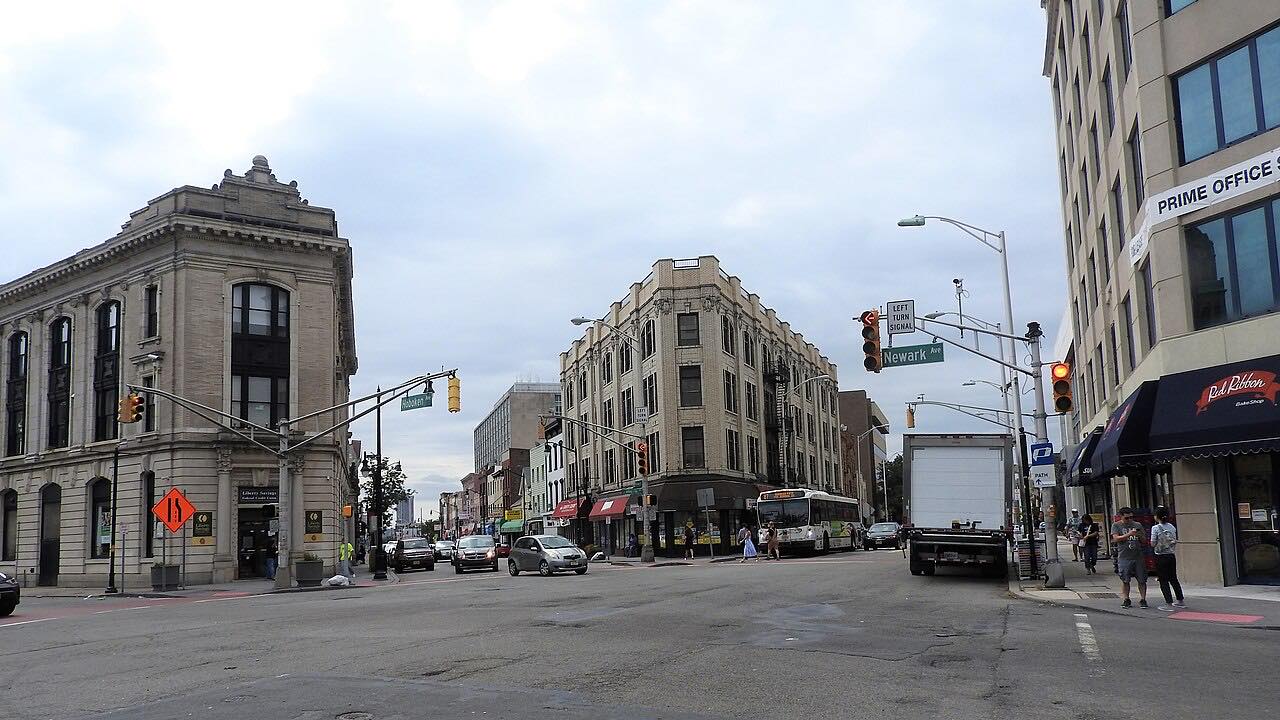
On the last Sunday of June, Newark Avenue near Journal Square fills with the brass of a marching band, the rustle of barong shirts, and the smell of lechon turning on spits behind folding tables. Children in butterfly-sleeved gowns wave small Philippine flags from the backs of convertibles. A grandmother who came to Jersey City in 1968 to take a night shift at the Margaret Hague Maternity Hospital watches from a lawn chair on the curb, the same curb she has claimed every June for half a century. This is the Philippine American Friendship Day parade, and it has been the loudest, proudest day on the Jersey City calendar for the Filipinos in Jersey City since 1990.
Jersey City: The Place
Jersey City sits on the west bank of the Hudson, a fifteen-minute PATH ride from Lower Manhattan, packed onto a peninsula between the river and the Hackensack meadows. The Filipino story plays out in three zones: the brownstone-and-rowhouse downtown around Grove Street, the busy commercial knot of Five Corners where Newark and Summit Avenues meet near Journal Square, and the West Side, a flatter grid of two-family houses off West Side Avenue. The transit spine is the PATH train and the buses that fan out from the Journal Square terminal, which is why nurses chose to live here in the first place.
How Jersey City Became Little Manila
Before the Filipinos
Jersey City was built by waves before this one. Irish dockworkers, German brewers, and Italian stonemasons filled the downtown wards in the nineteenth century, and the boss Frank Hague ran the whole machine from City Hall for thirty years. His great monument was medicine. In the 1930s Hague poured public money into the Jersey City Medical Center and the Margaret Hague Maternity Hospital, a towering complex on the hill that delivered hundreds of thousands of babies and trained generations of nurses.
By the 1950s the city was losing its factory jobs and its white working class to the suburbs. The hospitals, though, still needed staff, and American nurses were leaving the profession faster than the schools could replace them. The shortage was about to be filled from seven thousand miles away.
The Filipinos Arrive
The first arrivals were not laborers but professionals, and most of them were women. The United States had spent the first half of the twentieth century running the Philippines as a colony and had built its nursing schools in the American mold, with instruction in English. When postwar America ran short of nurses, that pipeline was already in place.
Phoebe C. Andes, R.N., reached Jersey City in 1957 to study maternity nursing. She stayed, taught nursing at Middlesex County College for more than two decades, helped found the Philippine Nurses Association of America, and was appointed to the New Jersey State Board of Nursing in 1993. She was the kind of first arrival who clears a path: a woman who came for a credential and ended up shaping a profession.
Two pieces of 1965 legislation turned the trickle into a flood. The Immigration and Nationality Act ended the old national-origin quotas and gave preference to skilled workers, and Medicare and Medicaid, signed the same year, sent demand for hospital staff through the roof. Earlier arrivals had often come on the postwar Exchange Visitor Program, a Cold War cultural-exchange scheme that by the late 1960s was filled overwhelmingly with Filipino nurses. A nurse could earn in a single year in Jersey City what would take more than a decade to earn at home.
Jersey City at Its Peak
Word traveled the way it always does, through families. A nurse who found a job at the Medical Center sponsored a sister, a cousin, a college roommate from back home. The newcomer slept on a pull-out couch, took the test, found a shift, and within a few years sent for someone else. By 1970 the census counted 5,623 Filipinos in Jersey City. Within a generation that number tripled.
The new arrivals planted businesses to feed themselves. In 1973 a family opened a small grocery, the first Filipino-owned grocery store on the East Coast, in a storefront on Newark Avenue. They imported bagoong, dried fish, and frozen banana leaves straight from home, and the shop became a clearinghouse for news, jobs, and apartments as much as for food. Restaurants and turo-turo steam-table counters followed, clustering around Five Corners and spreading down the West Side.
The community put down civic roots, too. In 1978 parishioners at St. Mary’s Church downtown organized the lay group Catholic Action of Mary and began holding the Santacruzan, the flower-strewn May procession that reenacts the finding of the Holy Cross. By the time the city renamed a stretch of Grove Street as Manila Avenue in the early 1990s, the Filipino presence was permanent and public, written onto the street signs.
The Change
The change came from money, not decline. As Jersey City’s downtown became a back office for Wall Street and a bedroom for Manhattan, rents climbed. Many of the nurses had always planned to buy houses, and as their American-born children grew up and became doctors, accountants, and lawyers, the families moved out to Bergen County and the New Jersey suburbs where the lawns were bigger.
The towers rising around Journal Square accelerated it. Longtime renters near Five Corners found themselves priced out, pushed up the hill to the Heights or out of the city entirely. The grocery that had anchored everything held on until 2020. By then the children of the first nurses were scattered across three counties, and the question was whether the neighborhood would hold its center.
The Landmarks of Little Manila
Phil-Am Food (later FilStop), 683 Newark Avenue. Opened in 1973 by the Santos family and run for decades by Erwin Santos, this was the first Filipino grocery on the East Coast and the unofficial town square of Jersey City’s Little Manila. Generations bought their Christmas hamon and their pancit noodles here and read the bulletin board for room rentals. It closed on February 9, 2020, after forty-six years, a casualty of the rising rents it had once helped a neighborhood survive.
Rizal Park, Brunswick Street and Christopher Columbus Drive. In 2000, members of the Order of the Knights of Rizal and the wider community dedicated a bronze statue of Jose Rizal, the writer and physician executed by Spain in 1896 whose novels helped spark the Philippine revolution. Former Philippine president Joseph Estrada attended the unveiling that October. The Knights refurbished the memorial and added an improved statue in 2016.
The Filipino American veterans memorial, Manila Avenue. A small square along the renamed street honors the Filipino American veterans of the Vietnam War, a reminder that this community’s service to the United States runs back generations, through the World War II veterans who fought under American command and spent decades fighting Washington for the equity and recognition they had been promised.
St. Mary’s Church, Second and Erie Streets. The spiritual home of the downtown Filipino community holds a Tagalog-language Mass, the Misang Pilipino, on the first Sunday of each month, and lights the dawn novena of Simbang Gabi before Christmas. Its Santacruzan, running since 1977, is billed as the longest-running and largest such festival on the East Coast.
Red Ribbon Bakeshop, 591 Summit Avenue. A branch of the Manila chain sits right at Five Corners, its cases full of ube cake, sans rival, and ensaymada. On a Sunday after Mass the line runs out the door for the mango bravo, and the shop is one of the clearest signs that the commercial heart of Little Manila is still beating.
Max’s of Manila, West Side Avenue. The Manila restaurant institution famous for its fried chicken opened a Jersey City outpost in 2010 and quickly became a fixture for christenings, debuts, and the long Sunday family lunch. It anchors the West Side stretch where so many of the nurses bought their first houses.
Where the Jersey City Filipinos Came From
The pull of the hospitals did the sorting. Because the migration ran through nursing schools, the early arrivals came disproportionately from the provinces with strong nursing colleges and a culture of sending graduates abroad, the Ilocano-speaking north of Luzon, the Visayan islands of the center, and the cities of Manila and its surrounding provinces. They were college-educated, English-speaking, and overwhelmingly Roman Catholic, which is why a parish became the community’s first institution.
Chain migration narrowed it further. Once a nurse from a particular town found a foothold, the people she sponsored came from that same town, so a single Jersey City block might hold a dozen households tracing back to the same province. The community that resulted was tightly knit, professional, and bound together as much by hometown ties and the parish calendar as by the shared label of being Filipino.
Jersey City Today
The Filipino population of Jersey City is still the largest of any city in New Jersey, roughly 7 percent of residents, somewhere around sixteen to eighteen thousand people. The center of gravity has shifted, though. The grocery that opened in 1973 is gone, the children of the first nurses own houses in Bergen County, and the glass towers of Journal Square keep climbing over Five Corners.
What holds is what was built on purpose. The Santacruzan still winds out of St. Mary’s every May, the Tagalog Mass still fills the pews on the first Sunday, and Red Ribbon still sells out of ube cake. Filipino Americans now sit on the City Council and the school board and wear the badges of the police department, a long way from the women who arrived alone with a nursing diploma and a two-year visa.
And every June the parade comes back to Newark Avenue, drawing the suburban grandchildren back to the streets their grandmothers settled. The neighborhood may be thinner than it was, but the day it claims each year is louder than ever, proof that a community can scatter across a region and still know exactly where home is.
Frequently Asked Questions
Why did Filipinos settle in Jersey City?
The Filipinos in Jersey City came first as nurses, recruited to fill a postwar shortage at the Jersey City Medical Center and the Margaret Hague Maternity Hospital. Once a few nurses found jobs and apartments here, they sponsored relatives and friends from home, and chain migration turned a handful of arrivals into one of the largest Filipino communities on the East Coast.
Is Jersey City still a Filipino neighborhood today?
Yes, though it is changing. Jersey City still has the largest Filipino population of any city in New Jersey, around 7 percent of residents, but rising rents and gentrification near Journal Square have pushed many families to the suburbs. The churches, restaurants, and the annual June parade keep the community’s identity firmly rooted downtown and at Five Corners.
What are the most famous Filipino landmarks in Jersey City?
The best-known sites are Manila Avenue downtown, Rizal Park with its statue of the Philippine national hero at Brunswick Street and Christopher Columbus Drive, and St. Mary’s Church, home of the East Coast’s longest-running Santacruzan festival. The Phil-Am Food grocery on Newark Avenue, the first Filipino-owned grocery on the East Coast, was a landmark for decades until it closed in 2020.
Where did the Jersey City Filipinos come from?
Most traced back to the provinces of Luzon and the Visayas and to metro Manila, regions with strong nursing schools that trained graduates for work abroad. Because the migration ran through nursing and through chain sponsorship, whole Jersey City blocks often share roots in a single Philippine town.
When did Filipinos first arrive in Jersey City?
The first Filipino nurses reached Jersey City in the mid-1950s, with Phoebe Andes arriving in 1957. The community grew quickly after the 1965 Immigration and Nationality Act and the launch of Medicare, and by 1970 the census counted more than five thousand Filipinos in the city.
If your family’s story passed through Jersey City, or through any of the hospitals and parishes that drew Filipino nurses across the Pacific, it is worth tracing. You can follow the same migration west to the Filipino heartland of Daly City, California, or south to the country’s original Historic Filipinotown in Los Angeles. Jersey City’s mix runs deep, too, sharing its streets with communities like the Coptic Egyptians of Jersey City who arrived on their own currents.