
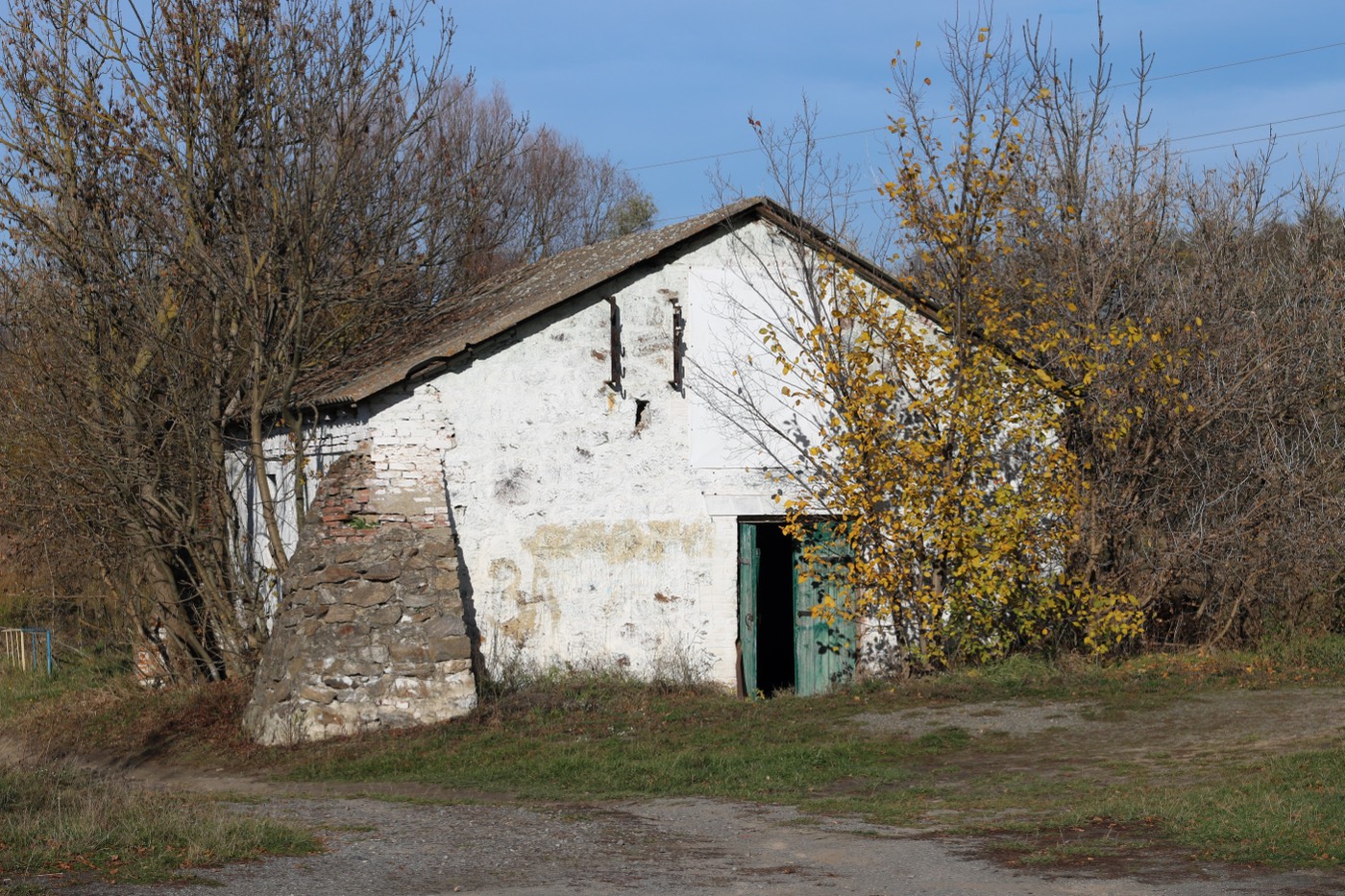
The Melnyk surname means “miller”, and it belongs to Ukraine more completely than almost any other name does to any other country. Written Мельник in Ukrainian and carried by roughly 174,000 people, it is the single most common family name in Ukraine.
What Does the Surname Melnyk Mean?
Melnyk means miller: the man who ran the village mill. It is an occupational surname, taken directly from the Ukrainian noun мельник, and it shares its root with млин (mlyn), the mill itself.
That root has travelled. Slavic mlyn is not native but a very old borrowing, reaching the Slavic languages through Germanic intermediaries from Late Latin molina, a mill, the ancestor behind French moulin too. Some dictionaries prefer to derive мельник from the Slavic verb for grinding instead. The two theories are not rivals. They meet in the same place: a man, a millstone and a river.
What matters for family history is what the job meant. In a village of forty households there was one mill and one man who worked it. He held the water rights, kept a share of every sack brought to him, and was usually the only person in the settlement with working capital. Nobody had to explain who the miller meant.
Where the Melnyk Name Comes From
Melnyk comes from Ukraine, and within Ukraine it clusters in the west and centre-west: Podillia and Galicia. Bearers are found in every oblast, but those two historic regions are where the density is highest.
Podillia and Galicia
Podillia is the rolling country between the Southern Buh and the Dniester, cut by deep river gorges. Galicia lies west of it, running up to the Carpathians. Both are river-rich and grain-growing, exactly the landscape that manufactures millers.
Hereditary family names were fixed comparatively late among the Ukrainian peasantry, largely through Austrian and Russian imperial administration in the eighteenth and nineteenth centuries. When the clerks came round asking, an occupational byname already in daily use was the obvious thing to write down.
Why the Name Formed So Many Times
Melnyk was not invented once and inherited outwards. It was coined independently in thousands of villages, because every village had a mill. Two Melnyk families a hundred kilometres apart are almost certainly unrelated. It is the same pattern that produced the Ukrainian smith name Koval, the other indispensable village trade.
The Miller Across Europe
After the smith, the miller was the craftsman no settlement could do without, and his trade became a common surname in nearly every European language on its own account. Müller is the commonest surname in Germany. Miller and Milner are English, Molnár Hungarian, Molinari and Molinaro Italian, Molina Spanish, Meunier and Munier French, Mlynář and Mlynár Czech and Slovak, Mlinar Slovene and Croatian, Młynarz and Młynarski Polish, Melnik Russian and Belarusian.
The argument for why this happens is set out in full on our page for the Schmidt surname. The short version: the same handful of jobs existed in every village in Europe, so the same handful of names formed everywhere, in parallel, without any contact between them.
Spelling Variants and Related Names
The most important variant is Melnik, and the difference between the two spellings is genuinely informative rather than cosmetic.
Ukrainian Мельник transliterates as Melnyk under the Ukrainian national romanisation system, official since 2010 and adopted by the United Nations, in which the letter и is rendered y. Russian Мельник gives Melnik, because Russian и is rendered i. Same word, same trade, same Cyrillic on the page. Different route into the Latin alphabet.
The tell is imperfect for older records: a family leaving Galicia in 1905 met clerks with no standard to consult, and the spelling that stuck was whatever was heard. But in modern paperwork an i usually means the record came through Russian, Belarusian or Soviet channels, and a y that it came through Ukrainian ones.
Related forms are numerous. Melnychuk (Мельничук) adds -uk, the suffix characteristic of Podillia, Volhynia and western Polissia, for “the miller’s lad”. Melnychenko (Мельниченко) adds -enko, the Dnipro-region suffix, for “descendant of the miller”. Melnykov and Russian Melnikov use the possessive -ov. Melnyczuk is the Polish-influenced spelling, Melnick the standard Americanised one.
Melnik is also an eastern Ashkenazi Jewish surname, from the same word, adopted by Jewish families across the Pale of Settlement when occupational names were assigned or chosen in the late eighteenth and early nineteenth centuries. Melnick and Melnikov carry the same Jewish usage. A Melnik in the records may be Ukrainian, Russian, Belarusian or Jewish, and the surname alone will not tell you which.
Finally, a great many American Melnyks are now called Miller. Translating rather than transliterating was a common choice in the first half of the twentieth century, and worth checking for in any line that appears to stop abruptly.
The Melnyks in America
Melnyks arrived in America in four distinct waves, and which wave a family belongs to shapes almost everything about it: the city, the church, the politics and the paperwork.
The first and largest ran from the 1880s to 1914, drawing overwhelmingly on Galicia and Bukovina, then Austro-Hungarian territory. Around 254,000 Ukrainians arrived between 1899 and 1914 alone, most of them landless peasants heading for the coal, steel and meat-packing towns. This is the wave that built the Ukrainian parishes of Philadelphia and filled Ukrainian Village on Chicago’s near north-west side. Many of these families were Greek Catholic and shared boats, parishes and neighbourhoods with Boykos and other Carpathian highlanders.
The second wave, smaller and far more educated, followed the collapse of the Ukrainian People’s Republic in the early 1920s: officers, intellectuals and political exiles. The third came after 1945, the displaced persons who would not return to a Soviet Ukraine. That generation is most visible in the East Village in Manhattan, with its Ukrainian bookshops, credit unions and Saturday schools, and it is the generation that made Parma, Ohio the densest Ukrainian suburb in the United States.
The fourth wave began with independence in 1991 and, for the first time, came from every part of Ukraine rather than the west alone. It is substantially Russophone and eastern, which is why post-1991 arrivals appear in American records as Melnik more often than as Melnyk. It reshaped Ukrainian Warren and Macomb County in Michigan.
In the 2010 US Census, 96.93 per cent of Melnyks self-identified as white, 1.74 per cent as Hispanic and 0.74 per cent as two or more races. These are self-identification proportions recorded on a census form, not a measure of ancestry, but the near-uniformity is what you would expect of a surname whose American presence is recent, European and concentrated in a few well-defined migrations.
Notable People Named Melnyk
Andriy Melnyk (1890–1964) was a colonel in the army of the Ukrainian People’s Republic and, from 1938, leader of the Organisation of Ukrainian Nationalists. The split with Stepan Bandera’s faction left him heading the OUN-M, whose members were known as Melnykites. He was imprisoned by the Gestapo in 1944 and died in exile in Luxembourg.
Faina Melnik (1945–2016) was born at Bakota in what is now Khmelnytskyi Oblast, in the heart of Podillia. She won Olympic discus gold at Munich in 1972, breaking the Olympic record three times in the final, and set eleven world records between 1971 and 1976.
Lubomyr Melnyk (born 1948) is a Ukrainian-Canadian composer and pianist, born in Munich to Ukrainian parents, and the originator of “continuous music”. He is widely described as the fastest pianist in the world, at nineteen notes per second in each hand.
Mykola Melnyk (1953–2013) was a helicopter pilot at Chernobyl in 1986, hovering directly over the ruined reactor on the clean-up’s most dangerous sortie. He flew 46 missions over the site and was made a Hero of the Soviet Union in 1987.
Eugene Melnyk (1959–2022) was a Canadian businessman of Ukrainian descent who founded the pharmaceutical company Biovail and owned the Ottawa Senators from 2003 until his death.
Andrij Melnyk (born 1975) is a Ukrainian diplomat, ambassador to Germany from 2014 to 2022, where his outspokenness made him a public figure, and Permanent Representative to the United Nations since December 2024.
How Common Is Melnyk Today?
Melnyk is the most common surname in Ukraine, borne by roughly 174,000 people, ahead of Shevchenko and Boyko. In America it is far rarer, ranking 18,478th in the 2010 Census with 1,496 bearers, though Melnik and the Americanised Melnick account for more.
| US rank (2010 Census) | #18,478 |
|---|---|
| Americans with the name | 1,496 |
| Origin | Ukrainian (occupational) |
| Meaning | Miller, from mlyn, a mill |
Frequently Asked Questions
What does the surname Melnyk mean?
Melnyk means “miller” in Ukrainian. It comes from мельник, the man who operated the village mill, and shares a root with млин (mlyn), the mill itself, ultimately from Late Latin molina.
Is Melnyk Ukrainian or Russian?
The word exists in Ukrainian, Russian and Belarusian alike, but the spelling Melnyk is specifically Ukrainian: it follows the Ukrainian romanisation of Мельник. The Russian and Belarusian form is normally spelled Melnik in English.
Where does the Melnyk family come from?
From Ukraine, with the greatest concentration in Podillia and Galicia in the west and centre-west. Because every village had a mill, the name arose independently in thousands of separate places, so there is no single Melnyk family of origin.
How common is the surname Melnyk?
It is the most common surname in Ukraine, with roughly 174,000 bearers. In the United States it ranked 18,478th in the 2010 Census, with 1,496 people recorded under that spelling.
Is there a Melnyk family crest or coat of arms?
No. In European heraldic tradition arms are granted to individuals and pass to their direct descendants, never to everyone sharing a surname. Any site selling a “Melnyk family crest” is selling a decoration, not a lineage, and for an occupational peasant name the claim is doubly hollow.
Are Melnychuk and Melnychenko related to Melnyk?
Yes, all three come from the same word. Melnychuk adds the -uk suffix typical of Podillia and Volhynia, and Melnychenko the -enko suffix of the Dnipro regions. Both mean the miller’s son or descendant.
If your family carries the Melnyk name, its route from Ukraine to America is traceable. Atlas of Home can follow it from a mill on a Podillian river to whichever port and parish your family landed in, and to wherever you are now.
Further reading: Melnik (surname) at Wikipedia; the Internet Encyclopedia of Ukraine.