
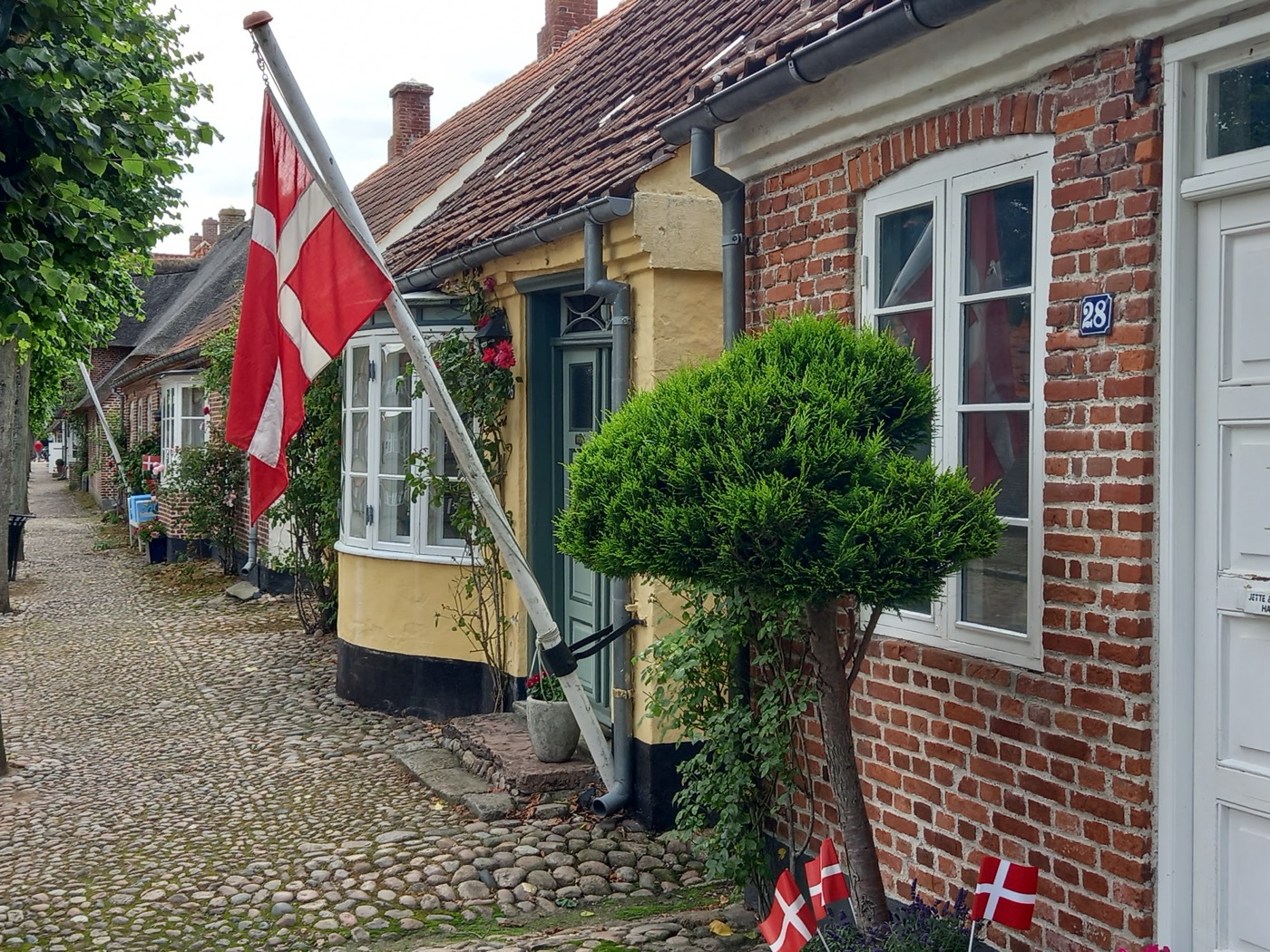
The Hansen surname means “son of Hans”, and it belongs above all to Denmark and Norway, where the -sen ending fixed a father’s name into a family name. It also belongs, more quietly, to the German side of the Jutland border.
What Does the Surname Hansen Mean?
Hansen means “son of Hans”. Hans is the Low German and Scandinavian short form of Johannes, the Latin form of John, so a Hansen is at one remove the son of a John.
Johannes descends from the Hebrew Yohanan, “God is gracious”. It arrived in the north with the church and was clipped almost at once into something shorter. Hans is what survived in Denmark, Norway and the whole North Sea coast of Germany, and from the late Middle Ages it was one of the most heavily used baptismal names in the region. A patronymic built on so common a first name was always going to end up numerous.
Hansen carries no trade, no farm, no village, no nickname. It records one fact about one man in one generation: his father was called Hans.
Where the Hansen Name Comes From
Hansen is chiefly Danish and Norwegian, with a second and genuinely separate homeland in German Schleswig-Holstein and along the Frisian coast. Both branches formed independently, the same way, from the same name.
Denmark and Norway
The two countries split the name unevenly. Denmark has roughly 200,000 Hansens, which puts it third behind Jensen and Nielsen. Norway has around 50,000, which puts it first. In the Faroe Islands it ranks second.
So Hansen is the most Danish of names by weight and the most Norwegian of names by rank. Guessing blind, Denmark is the likelier origin, simply because there were always more Danes carrying it.
Behind both figures sits a naming system that was not hereditary at all. A man called Hans Pedersen had a son called Jens Hansen, whose own son was Peder Jensen, and the surname changed with every generation. We have set out that system and the laws that eventually froze it, in Denmark in 1828 and 1856 and in Norway in 1923, on our page for the Olson surname.
One consequence matters for Hansen specifically. Danish and Norwegian used -sen; Swedish used -sson. That single letter is a reliable signpost: Hansen points to Denmark or Norway, Hansson to Sweden.
Schleswig-Holstein and the Frisian coast
Hansen is the third most common surname in Schleswig-Holstein and the fifth most common in Hamburg, and this is not simply spillover from Denmark. Patronymic naming was the ordinary practice in Schleswig, Holstein and East Frisia, and among North Frisian communities in particular.
The German territories fixed their names earlier than Denmark did. Decrees requiring permanent hereditary surnames were issued in Schleswig-Holstein in 1771, 1820 and 1822, and in East Frisia in 1811, a generation or more ahead of the Danish law of 1828.
Then there is the border, which moved repeatedly. The duchies were held by the Danish crown, lost to Prussia in 1864, and partly returned to Denmark by the plebiscite of 1920. A Hansen family from Tønder or Tondern can appear in Danish parish books in one generation and Prussian civil registers in the next without anybody moving house.
If your Hansen line runs into South Jutland or North Frisia, expect the paperwork to change language and jurisdiction under you. That is the history of the region, not an error in the record. The same habit reaches over the Dutch border, where Hansen and Hanssen appear in Limburg and the eastern provinces.
Spelling Variants and Related Names
The main variants are Hansen (Danish and Norwegian), Hanssen (chiefly Norwegian and German), Hansson (Swedish) and Hanson (the American simplification). Each says something about where a family’s spelling was last written down.
Hanssen keeps the doubled s of the genitive and is common enough in Norway and northern Germany to be worth searching separately. Hansson is the Swedish parallel and, in Iceland, a live patronymic still assigned at birth rather than inherited.
Hanson is the one that matters most to American families. English-speaking clerks, teachers, foremen and census takers had no use for the final e, and Swedish Hansson lost an s at the same door. The result is that an American Hanson may descend from a Danish Hansen, a Norwegian Hanssen or a Swedish Hansson, and the spelling no longer tells you which.
Older records also carry Hansdatter, “daughter of Hans”. Daughters were not Hansens until the fixing laws made one family name compulsory for the whole household.
Worth knowing too: Hansen has close cousins rather than rivals. Jensen, Johansen, Jansen and Hansen all descend from Johannes by way of different short forms, which is why they crowd the top of the Danish and Norwegian lists together. The same is true of the Peterson surname, built on Peder rather than Hans by exactly the same rule.
The Hansens in America
Hansens arrived mainly in the Scandinavian emigration of 1860 to 1914, entering at New York and Quebec, moving inland to farmland in the upper Midwest, and then carrying the name on to the Pacific Northwest.
Norwegian emigration came first and ran larger; Danish emigration peaked later, in the 1880s and after. Both funnelled into the same corridor of Iowa, Wisconsin, Minnesota, Nebraska and the Dakotas.
Western Iowa became the densest rural Danish settlement in the country. The neighbouring villages of Elk Horn and Kimballton, in Shelby and Audubon counties, still counted more than half their population as Danish American a century later. The urban counterpart was Racine, Wisconsin, where Danes went into factories rather than fields.
Norwegian Hansens settled a parallel map. Mount Horeb, Wisconsin was farm country in the Norwegian style, while the second move west put families in Ballard, Seattle and across Puget Sound in Poulsbo, Washington, where fishing and boatbuilding were work the immigrants already knew.
If your line runs Hanson in American records and Hansen on the ship manifest, nothing happened except a clerk writing what he heard.
Notable People Named Hansen
Gerhard Armauer Hansen (1841-1912) was a Norwegian physician in Bergen who identified the leprosy bacillus, Mycobacterium leprae, in 1873. It was the first proof that a microorganism could cause a chronic human disease, and leprosy is still called Hansen’s disease in his honour.
Emil Nolde (1867-1956) was born Hans Emil Hansen in the village of Nolde, then in Prussian Schleswig and now in Denmark, to Danish and Frisian farming parents. He took the village’s name in 1902 and became one of the founding Expressionist painters.
H. C. Hansen (1906-1960) rose through the Danish trade union movement to serve as Prime Minister of Denmark from 1955 until his death in office in 1960.
James E. Hansen (born 1941), born in Denison in the Danish belt of western Iowa, directed NASA’s Goddard Institute for Space Studies and told the United States Senate in 1988 that global warming had begun.
Ole Hanson (1874-1940), born in Racine County, Wisconsin to Norwegian immigrant parents, was Mayor of Seattle during the general strike of 1919 and later founded the California town of San Clemente.
Howard Hanson (1896-1981), born in Wahoo, Nebraska to Swedish immigrants, won the Pulitzer Prize for Music in 1944 and led the Eastman School of Music for forty years. His Hanson began as Hansson, which is the whole argument in one surname.
How Common Is Hansen Today?
Hansen is the 204th most common surname in the United States, carried by 137,977 people at the 2010 Census. Add Hanson, at 276th with 111,144 bearers, and the two spellings together account for roughly a quarter of a million Americans.
| US rank (2010 Census) | #204 |
|---|---|
| Americans with the name | 137,977 |
| Origin | Scandinavian (Danish and Norwegian), also German and Frisian |
| Meaning | “Son of Hans”, Hans being the short form of Johannes, John |
The same census recorded how Hansens described themselves. Of those bearers, 94.22 per cent self-identified as white, 2.54 per cent as Hispanic, 1.47 per cent as two or more races, 0.74 per cent as Asian or Pacific Islander, 0.53 per cent as Black and 0.49 per cent as American Indian or Alaska Native.
Those are self-identification proportions recorded on one form in 2010, not a measure of ancestry. The comparison with Hanson is telling all the same: Hanson’s Black share, at 2.85 per cent, is more than five times Hansen’s, as you would expect of the more anglicised spelling and its wider American life.
Frequently Asked Questions
What does the surname Hansen mean?
Hansen means “son of Hans”. Hans is the Low German and Scandinavian short form of Johannes, the Latin form of John, which comes from the Hebrew Yohanan, “God is gracious”. The name records a father’s given name and nothing else.
Is Hansen Danish or Norwegian?
Both, and the split is uneven. Denmark has about 200,000 Hansens, ranking third nationally, while Norway has around 50,000, ranking first. Denmark is the likelier origin by sheer numbers, but a Norwegian Hansen is entirely unremarkable.
Where does the Hansen family come from?
There is no single Hansen family. The name arose independently wherever men named Hans had sons: across Denmark, throughout Norway, in German Schleswig-Holstein and Frisia, and over the Dutch border. Two Hansen families are almost certainly unrelated.
How common is the surname Hansen?
Hansen is the 204th most common surname in the United States, with 137,977 bearers at the 2010 Census. In Denmark it is third and in Norway first, though the share of -sen surnames among Norwegian newborns has been falling for decades.
Is there a Hansen family crest or coat of arms?
No. In every serious heraldic tradition, arms are granted to an individual and pass to that person’s direct descendants, never to everyone who happens to share a surname. With hundreds of thousands of unrelated Hansen families, a single “Hansen crest” is impossible by definition. Sites selling one are selling a decoration, not a lineage.
Is Hansen a German surname as well?
Yes, genuinely so. Hansen is the third most common surname in Schleswig-Holstein and fifth in Hamburg, formed by the same patronymic habit and fixed by German decrees in 1771, 1820 and 1822. Because the Danish-German border moved in 1864 and again in 1920, a borderland Hansen family may be recorded as either.
If your family carries the Hansen name, its route from the North Sea coast to America is traceable. Atlas of Home can follow it from a Danish parish book or a Schleswig register to wherever your family landed, and to wherever you are now.