
The Sherman surname has two separate homelands and, remarkably, one shared idea. In England it meant a shearman, the craftsman who trimmed the nap from woollen cloth. Among Ashkenazi Jews it meant a tailor, from the Yiddish word for scissors.
What Does the Surname Sherman Mean?
Sherman means “shear man”. In English it is an occupational name from the Middle English shereman or sherman, the skilled worker who sheared the raised nap from finished woollen cloth. In its Ashkenazi Jewish form it means tailor, from the Yiddish sher, scissors, plus man.
Both readings are correct. The Dictionary of American Family Names lists Sherman as an English occupational name and, separately, as an Americanised form of the German and Jewish surname Schermann, alongside the North German Schürmann. Behind the Name keeps two entries under the same spelling for the same reason.
This is worth pausing on, because it is not the usual story of one root splitting in two. The English surname was coined in medieval cloth towns. The Jewish one was coined in central and eastern Europe centuries later, in a different language, by different families who had never met. That both landed on cutting cloth is coincidence, though not quite a random one: Old English sceran and the German Schere behind Yiddish sher both descend from the same ancient Germanic verb meaning to cut. Two peoples, two trades, one very old word for shears.
Where the Sherman Name Comes From
There is no single Sherman homeland. There are two, roughly a thousand miles and several centuries apart.
The shearmen of the English cloth towns
The older strand is English, and it is concentrated where England made cloth: the Essex and Suffolk border country, Norfolk, and the West Country broadcloth districts of Wiltshire, Somerset and Gloucestershire. Shearing was the finishing trade, the last and most delicate stage, and it paid accordingly. The shearmen of York held one of the city’s oldest guilds and admitted only proven craftsmen.
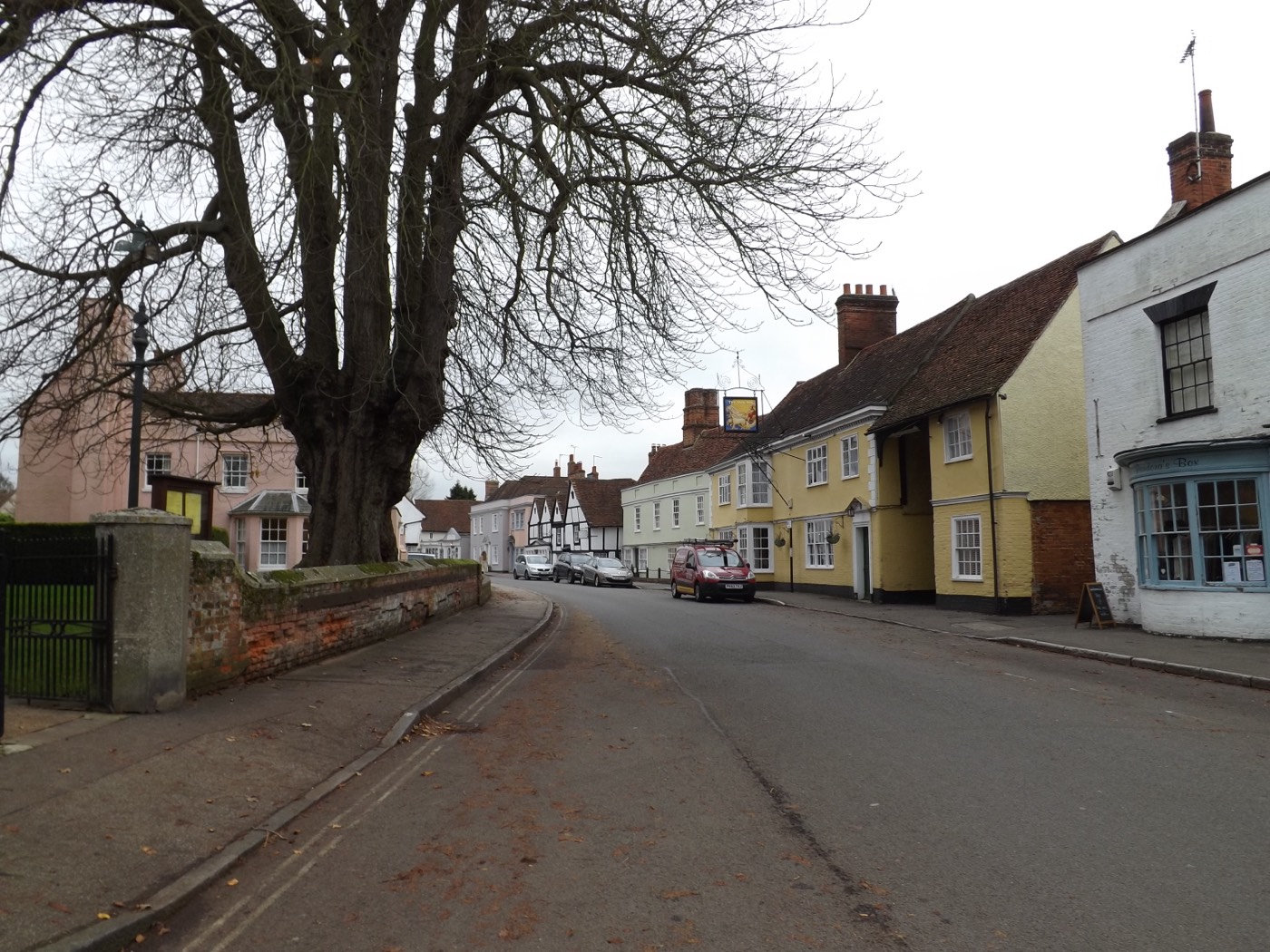
The Essex village of Dedham is the anchor for the American line. Henry Sherman, born around 1512, settled there in the 1530s as a clothier, and the building known as Sherman’s Hall still stands on the village street. His descendants left for New England a century later.
Sher, Scher and the Ashkenazi Shermans
The Jewish strand belongs to the Pale of Settlement and the German-speaking lands. Most Ashkenazi families had no fixed hereditary surname until they were compelled to register one, first under the Austrian decree of 1787 and then under Russian law in 1804 and 1845, a bureaucratic upheaval we describe in detail on the Cohen surname page.
Many chose or were assigned trades. Tailoring was among the most common Jewish occupations in the shtetlach, and the Yiddish sher gave a whole family of names: Sher, Scher, Sherman, Scherman, Schermann, Szerman in Polish orthography. In Hebrew characters the name is written שערמאַן.
A German strand as well
A smaller number of American Shermans descend from the North German Schürmann or the Dutch Schuurman, names that mean barn keeper rather than cloth cutter and were simply flattened into the familiar English spelling at some point after arrival.
Spelling Variants and Related Names
The English cognates are Sharman, Shearman and Shurman, and all three survive in Britain today, Sharman most strongly in the East Midlands. Shearman is the spelling closest to the original trade word.
On the Jewish side the cluster is wider: Sherman, Scherman, Schermann, Szerman, Sherrman, and the shorter forms Sher, Scher, Scherr and Sherr, which are the same scissors root without the man suffix. Related tailoring names include Schneider and Portnoy, which say the trade outright rather than naming the tool.
The German and Dutch look-alikes are Schürmann, Schuermann, Schuerman and Schuurman. Because Sherman absorbed all of these on arrival in America, the spelling on a US document is a poor guide to which family you belong to. The 2010 Census counted 2,687 Shers, 3,222 Schers and 528 Schermans still holding the unassimilated forms.
The Shermans in America
Both Sherman strands crossed the Atlantic, but two hundred and fifty years apart. The English one came first and small, the Jewish one came late and large.
John Sherman of Dedham sailed for Watertown, Massachusetts in 1634, part of the Puritan movement that had already been building along the coast since the first landings at Plymouth. His cousin Philip Sherman went south to Rhode Island and became the young colony’s first secretary. Their descendants produced Roger Sherman of Connecticut and, through the Ohio branch, the Civil War general.
The second wave arrived between roughly 1880 and 1924, when more than two million Jews left the Russian Empire, Galicia and Romania. Shermans and Schermans came through Castle Garden and Ellis Island into the garment districts of New York, Chicago, Philadelphia and Baltimore, where the tailoring skill the name recorded was still, usefully, the family trade.
Their children moved outward. Sherman is a common name in the settled Jewish neighbourhoods of the mid century: Squirrel Hill in Pittsburgh, Forest Hills in Queens, West Rogers Park on Chicago’s North Side, and Oak Park outside Detroit.
Which strand dominates? The English one, but not overwhelmingly. Consumer DNA data published by 23andMe puts British and Irish ancestry at 38.1 per cent among Sherman testers, French and German at 21.9 per cent, and Ashkenazi Jewish at 18.3 per cent. Roughly one American Sherman in five descends from the scissors rather than the shears. Anyone who assumes the name is simply Jewish, or simply Yankee, will be wrong about a large minority of the families carrying it. The same trap sits under Schwartz, another name split between German and Ashkenazi lines.
One more figure is worth reading honestly. In the 2010 Census, 11.57 per cent of Shermans self-identified as Black or African American, against 82.74 per cent white, 2.33 per cent Hispanic, 1.75 per cent two or more races, 0.98 per cent American Indian and 0.63 per cent Asian or Pacific Islander. Those are self-identification proportions, not measures of descent. But a figure that high is not explained by colonial English families alone, and the name of the Union general who marched through Georgia and issued Special Field Order No. 15 was among those taken up by freedpeople after 1865.
Notable People Named Sherman
Roger Sherman (1721 to 1793) is the only person to have signed all four founding documents of the United States: the Continental Association, the Declaration of Independence, the Articles of Confederation and the Constitution. A Connecticut shoemaker turned lawyer, he authored the Connecticut Compromise that produced the two-chamber Congress.
William Tecumseh Sherman (1820 to 1891) commanded the Union armies through the Atlanta campaign and the March to the Sea, and is often described as the first modern general. He descended from the same Dedham line as Roger Sherman.
John Sherman (1823 to 1900), the general’s younger brother, served as US Senator, Secretary of the Treasury and Secretary of State, and gave his name to the Sherman Antitrust Act of 1890.
Robert B. Sherman (1925 to 2012) and Richard M. Sherman (1928 to 2024), the Sherman Brothers, wrote the songs for Mary Poppins, The Jungle Book and Chitty Chitty Bang Bang. Their father Al Sherman was a Tin Pan Alley songwriter born to a Jewish family in Kyiv who reached New York in 1909.
Allan Sherman (1924 to 1973), the song parodist behind Hello Muddah, Hello Fadduh, was born Allan Copelon and took his mother’s maiden name after his parents divorced, a small reminder that surnames move sideways as well as down.
Cindy Sherman (born 1954) is among the most influential photographers of the past half century, best known for the Untitled Film Stills in which she photographed herself as invented characters.
How Common Is Sherman Today?
Sherman is the 469th most common surname in the United States, carried by 70,502 people at the 2010 Census. That puts it inside the 500 most common surnames in the country, comfortably ahead of Sharman or Shearman, neither of which ever reached comparable numbers.
| US rank (2010 Census) | #469 |
|---|---|
| Americans with the name | 70,502 |
| Origin | English occupational and Ashkenazi Jewish |
| Meaning | Shearer of cloth; tailor |
Frequently Asked Questions
What does the surname Sherman mean?
Sherman means shear man. As an English name it described the craftsman who sheared the nap from woollen cloth. As an Ashkenazi Jewish name it means tailor, from Yiddish sher, scissors.
Is Sherman Jewish or English?
Both, genuinely. The English occupational name is older and slightly more numerous in America; the Ashkenazi Jewish name accounts for roughly a fifth of US Shermans. Neither is the “real” origin, and a family’s spelling will not tell you which it is.
Where does the Sherman family come from?
The English Shermans come from the cloth-making counties, above all the Essex and Suffolk borders and the West Country. The Jewish Shermans come from the Pale of Settlement and the German-speaking lands, where the name was often registered as Scherman or Szerman.
How common is the surname Sherman?
Sherman ranks 469th in the United States with 70,502 bearers at the 2010 Census. It is far more common in America than in England, where the variants Sharman and Shearman took a larger share.
Is there a Sherman family crest or coat of arms?
No. In English heraldry arms are granted to an individual and pass to that person’s direct descendants, never to everyone who happens to share a surname. There is no Sherman family crest, and no Ashkenazi heraldic tradition at all. Sites selling one are selling a decoration, not a lineage.
Was General Sherman Jewish?
No. William Tecumseh Sherman descended from the English Shermans of Dedham, Essex, who reached Massachusetts in 1634. The confusion is common because the surname is now strongly associated with American Jewish families, but the two lines are entirely unconnected.
If your family carries the Sherman name, its route to America is traceable, whether it runs from an Essex cloth town or a shtetl tailor’s bench. Atlas of Home can follow it from the shears to wherever your family landed, and to wherever you are now.
Further reading: the shearman’s trade and the Sherman name on Wikipedia.