
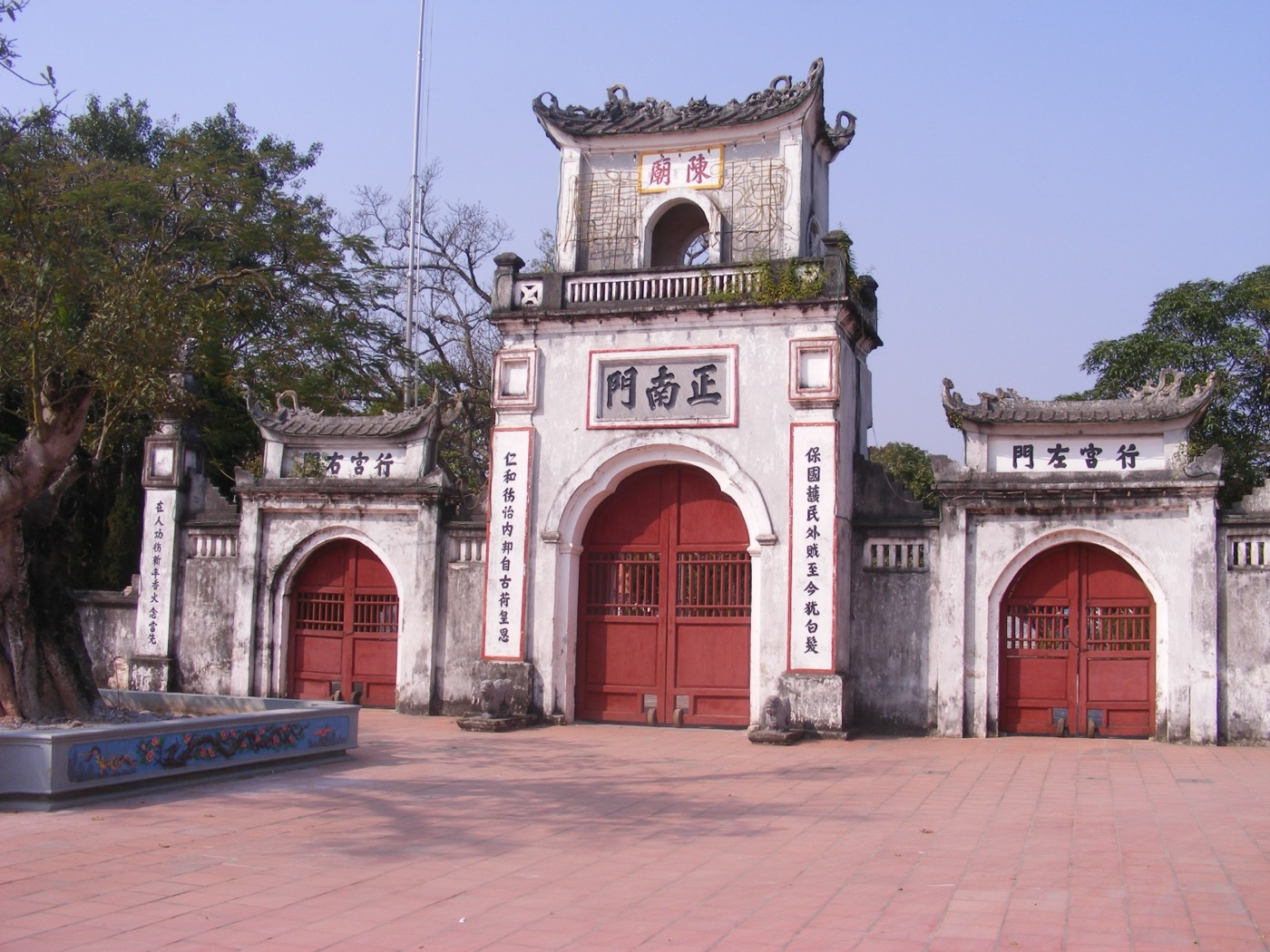
The Tran surname is Vietnamese, written Trần in full, and carried by roughly one in eight people in Vietnam. It belongs to a family of fishermen from the Red River delta who took a throne in 1225 and held it for 175 years.
What Does the Surname Tran Mean?
Trần is the Vietnamese reading of the Chinese character 陳. It is an ancient clan name rather than an ordinary word, so unlike Smith or Hill it does not translate into a trade or a landscape. It means, in effect, membership of a lineage.
The character arrived through a thousand years of Chinese administration, and Vietnamese reads it trần where Mandarin reads Chen and Hokkien reads Tan. Its deep origin lies in the ancient State of Chen, traced on the Chen surname page.
Note too that the name is not on its own evidence of Chinese descent. By the fourteenth century it was worn by a great many Vietnamese families with no connection to Fujian.
Where the Tran Name Comes From
The Trần clan’s homeland is Tức Mặc, a village in the Red River delta in what is now Nam Định province, southeast of Hanoi. Their ancestral temple, Đền Trần, stands there still.
A fishing family who took a throne
Chronicles record an ancestor, Trần Kinh, who moved from Fujian to Đại Việt in the early twelfth century and settled among delta fishing families. Within a few generations his descendants were wealthy landowners with river trade, boats and men.
The Lý dynasty was failing, and the Trần married into it. In late 1225 the clan’s strategist, Trần Thủ Độ, arranged a wedding between the child empress Lý Chiêu Hoàng and his seven-year-old nephew Trần Cảnh, then had her abdicate in her husband’s favour. The Lý dynasty’s 216 years ended in a fortnight. The boy became Emperor Trần Thái Tông, and Trần Thủ Độ ruled behind him, dealing with the surviving Lý princes with a thoroughness Vietnamese historians have never softened.
The general who beat the Mongols three times
The Mongol empire, which had swallowed China, invaded Đại Việt in 1258, in 1285, and again in 1287 to 1288. Each time it was thrown out.
The commander was Trần Hưng Đạo, born Trần Quốc Tuấn, a prince of the house. He refused to meet Mongol cavalry in open field. He emptied the capital, burned the food stores, let the invaders exhaust themselves in a country that offered nothing, then struck when they turned for home.
His masterpiece was the Bạch Đằng river in 1288. Iron-tipped stakes were driven into the riverbed at low water, a flotilla lured the Yuan fleet upstream, and as the tide fell the ships were impaled, burned and taken. Accounts put the fleet at around 400 craft. Almost none of it left.
Trần Hưng Đạo is among the most venerated figures in Vietnamese history, worshipped as a saint, with a street named for him in almost every town. The dynasty around him was a golden age: the emperor Trần Nhân Tông led the country through two invasions, then abdicated to become a monk and founded Vietnam’s Trúc Lâm school of Zen.
Why two Trầns are usually not related
This is the part that matters most for family history. Trần is common because it was a dynasty, not because it is one enormous family. Two Trầns who meet today are usually not related at all.
The clearest proof is what the Trần themselves did. In 1232 Trần Thủ Độ ordered the descendants of the deposed Lý to stop being Lý and become Nguyễn, partly for a naming taboo, the clan’s founding ancestor having been called Trần Lý, and partly because a restoration is harder to rally when there are no Lý left. That decree is a large part of why Nguyễn is now the most common name in Vietnam, a story the Nguyen surname page follows to the modern era.
The machinery ran the other way too. Under Trần rule the royal surname was granted as a reward and adopted for advantage, so households with no link to Tức Mặc became Trần. After Hồ Quý Ly deposed the last Trần emperor in 1400, and through the Ming occupation and the rise of the Lê, the fallen dynasty’s name became a liability and families quietly shed it. Hồ Quý Ly himself had lived most of his life under the adopted name Lê Quý Ly.
So a Trần line can begin with a grant, an adoption or an act of self-preservation, and often not with descent. Vietnamese genealogy is done through the gia phả, the written clan book, and through village records. The surname alone will not do it.
Spelling Variants and Related Names
The full Vietnamese spelling is Trần, where ầ carries a circumflex and the grave tone mark dấu huyền. American immigration paperwork, Social Security records and school registers stripped the diacritics, and Trần became Tran. Treat the two as one name and expect no accents before the 2000s. Watch also for a clerical Tram or Trans, and for the surname landing in the given-name column when a family’s name order was misread.
Because the name is 陳, its cousins abroad are the Chinese romanisations: Chen in Mandarin, Chan in Cantonese, Tan in Hokkien and Teochew, Chin in Hakka. Korean records read the character as Jin. Ethnic Chinese families who left Vietnam after 1975 sometimes hold two versions of one name, Trần on the Vietnamese papers and Tan or Chen on the older Chinese ones.
Pronunciation in America has splintered. Northern Vietnamese speakers say something close to chun on a low falling tone, southern speakers use a retroflex tr nearer trun, and American mouths produce TRAN to rhyme with ran, plus TRAHN, TRON and CHUN.
Vietnamese also puts the family name first, so Trần Hưng Đạo is a Trần, and Vietnamese speakers address people by the given name. A man called Trần Văn Hưng is Mr Hưng, never Mr Trần. Many families reverse the order for Western use, which is how one person appears as Trần Văn Hưng on one document and Hung Van Tran on the next.
The Trans in America
Almost every Tran family in the United States arrived after April 1975. There is no earlier Vietnamese immigration to speak of, making this one of America’s youngest large surnames.
The first wave, around 130,000 people, was evacuated in the spring of 1975 and processed through Camp Pendleton in California, Fort Chaffee in Arkansas and two other military bases. Sponsorship rules scattered them across all fifty states, and then they moved back together. The boat people followed from 1978, and the Orderly Departure Program, set up in 1979, brought a further 458,000 Vietnamese to the United States by 1997.
Orange County holds the largest concentration anywhere outside Vietnam, centred on Little Saigon and spreading through the Vietnamese community in Garden Grove and the quieter Vietnamese families of Fountain Valley, with a later generation moving on to Vietnamese Irvine for the schools.
Northern California is the second pole, where San Jose’s Vietnamese Evergreen and the engineering households of Vietnamese Milpitas grew with Silicon Valley. Elsewhere the Gulf Coast drew fishing families back to the water, including the Vietnamese Catholics of Versailles in New Orleans East, while Falls Church and Fields Corner anchor the East Coast.
Notable People Named Tran
Trần Hưng Đạo (c. 1228 to 1300) commanded Đại Việt against three Mongol invasions and destroyed the Yuan fleet at Bạch Đằng in 1288. He is venerated as a national saint.
Trần Thủ Độ (1194 to 1264) engineered the takeover of 1225 and ran the state for decades afterwards. Ruthless, indispensable, still argued about.
Trần Nhân Tông (1258 to 1308) was emperor through the second and third invasions, then gave up the throne for monastic life.
Trần Anh Hùng (born 1962), the Vietnamese-French director of The Scent of Green Papaya, won Best Director at Cannes in 2023 for The Taste of Things.
Kelly Marie Tran (born 1989), born in San Diego to refugee parents, played Rose Tico in Star Wars and voiced the title role in Raya and the Last Dragon.
How Common Is Tran Today?
Tran is the 132nd most common surname in the United States, carried by 188,498 people at the 2010 Census. In Vietnam it ranks second, behind Nguyễn.
| US rank (2010 Census) | #132 |
|---|---|
| Americans with the name | 188,498 |
| Origin | Vietnamese, from the character 陳 |
| Meaning | An ancient clan name, not an ordinary word |
The 2010 Census also recorded how Tran households described themselves, and the figures are unusually concentrated: 96 percent identified as Asian or Pacific Islander, 1.7 percent as two or more races, 1.35 percent as white and 0.81 percent as Hispanic. These are self-identification proportions from a single census, not a measure of ancestry. To climb to 132nd from effectively nothing in 1970 is a rate of growth no European surname in America has matched.
Frequently Asked Questions
What does the surname Tran mean?
Trần is the Vietnamese reading of the Chinese character 陳, an ancient clan name rather than a descriptive word. It does not translate to a trade, a place or a quality, and the identical-sounding Vietnamese words for bare and ceiling are unrelated to it.
Is Tran Vietnamese or Chinese?
It is Vietnamese. The character is Chinese and the founding clan is said to have come from Fujian, but Trần has been Vietnamese for nine hundred years and almost all bearers are Vietnamese. Chen, Chan and Tan are the Chinese readings of the same character.
Where does the Tran family come from?
The dynastic Trần clan came from Tức Mặc in the Red River delta, in modern Nam Định province, where their ancestral temple still stands. Most Trần families cannot trace a line there, because the name spread by grant and adoption, not descent.
How common is the surname Tran?
Tran ranks 132nd in the United States with 188,498 bearers at the 2010 Census, and second in Vietnam after Nguyễn, where roughly one person in eight carries it. It is common across the diaspora in Australia, France and Canada too.
Is there a Tran family crest or coat of arms?
No. Vietnam has no heraldic tradition of family arms, and in the European systems that do, arms are granted to individuals and their direct descendants, never to everyone sharing a surname. A site selling you a Tran coat of arms is selling a decoration, not a lineage.
Are all Trans descended from the Trần dynasty?
Almost certainly not. The royal surname was granted, adopted and imposed for political reasons throughout the dynasty’s rule, and abandoned by some real descendants after it fell in 1400. Establishing a line needs a gia phả clan book or village records, not the surname.
If your family carries the Tran name, its route from Vietnam to America is traceable. Atlas of Home can follow it from the Red River delta to the refugee camps and the Little Saigons, and to wherever you are now.
Further reading on Wikipedia: the Trần dynasty and the Mongol invasions of Vietnam.