
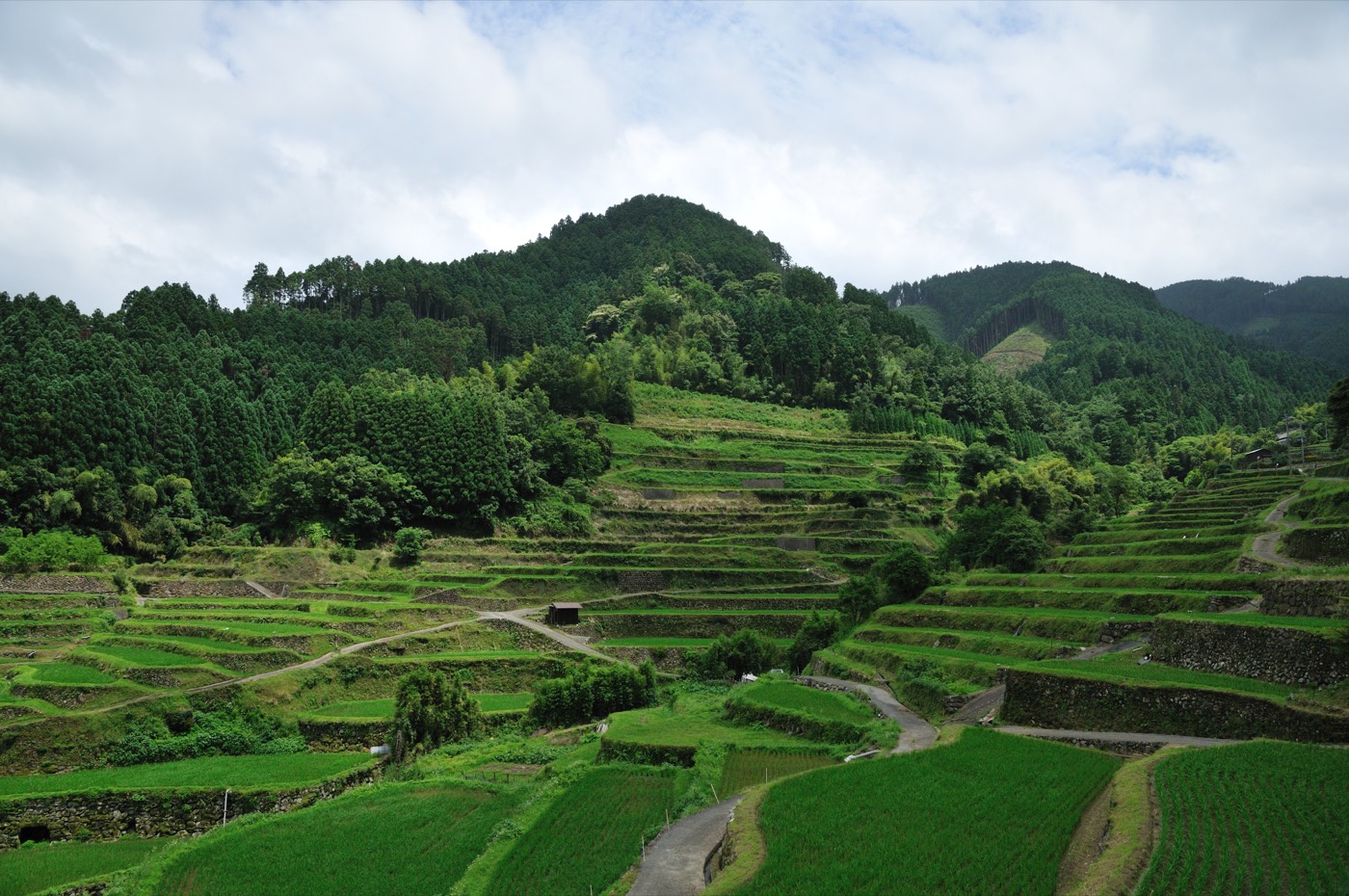
The Tanaka surname is Japanese and means “middle of the rice field”, from 田 (ta), a rice paddy, and 中 (naka), middle. It is the fourth most common family name in Japan, and it belongs above all to the west of the country.
What Does the Surname Tanaka Mean?
Tanaka means “in the middle of the rice field”, or “within the paddy”. It is written 田中, combining 田 (ta), a wet rice field, with 中 (naka), middle or within.
It is a topographic name. It records no ancestor, trade or title, only a position on the land: the household whose plot sat surrounded by paddy rather than at the village edge or up the slope.
That puts Tanaka in the largest family of Japanese surnames. Nakamura is “middle village”, Yamada “mountain field”, Yamamoto “base of the mountain”, Kawaguchi “river mouth”. These are not poetic inventions but plain descriptions of where somebody stood, and the reason so many Japanese people carry one is a single piece of nineteenth-century legislation.
Where the Tanaka Name Comes From
Tanaka comes from Japan, and from western Japan in particular. It is the single most common surname in Fukuoka, Osaka, Kyoto, Hyogo, Shiga, Fukui, Tottori, Shimane, Saga and Kumamoto prefectures.
A Country Where Most People Had No Surname
Under the Tokugawa shogunate, from 1603 to 1868, a surname was a privilege. Samurai, court nobility and a few village headmen and licensed merchants used one. The heimin, the commoners who made up the overwhelming majority, were generally barred from using a family name in public at all.
This reframes almost every search for Japanese ancestry. If your family were farmers, fishermen or artisans, and most were, then before the 1870s they had no hereditary surname to pass down. There is usually no medieval Tanaka lineage waiting to be found, because there was no medieval Tanaka surname to inherit.
The 1875 Law That Named a Nation
In 1870 the new Meiji government issued the Heimin Myoji Kyokarei, permitting commoners to adopt surnames. Very few bothered. Literacy was low, and there was a reasonable suspicion that a registered name was really a device for new taxes and conscription.
So on 13 February 1875 the government stopped asking. The Heimin Myoji Hitsusho Gimurei made a surname compulsory for every subject. The date is still marked in Japan as Surname Establishment Day.
Critically, the state did not hand out names. It required one for the household register and left the choice to the household. Millions of families, given no tradition to draw on, looked at the ground in front of them and described it. The field. The mountain. The middle of the paddy.
That is why Tanaka, Nakamura, Yamada and Yamamoto are so overwhelmingly common. They were the obvious answer to an unexpected question, reached independently by thousands of unrelated families. Two Tanaka households in one prefecture are usually not relatives. They simply lived in similar places and were asked the same thing in the same year.
Some Tanaka lines are genuinely older. The place name 田中 long predates 1875, and samurai and temple families held surnames throughout the Edo period. But for the large majority, 1875 is the horizon.
Why Western Japan
Wet rice cultivation entered Japan from the west and spread eastward, so paddy-derived place names are densest in Kansai, the San’in coast and northern Kyushu. Surname geography still follows that ancient map.
The concentration is striking. In Fukuoka Prefecture roughly 1.8 per cent of the population is named Tanaka, about one person in fifty. It ranks first outright across Kinki and Kyushu, second across Chugoku and Shikoku. If your Tanaka ancestors came from Japan, the odds favour the west and south.
Spelling Variants and Related Names
In Japan, Tanaka is almost always written 田中, but the same sound can be written with other characters, including 多中, 多仲, 他中, 棚下, 棚夏 and 多名賀. These are rare, and each is a genuinely separate surname.
This is what trips up English-speaking researchers. In Japanese the writing is the name. Two families both pronounced Tanaka but written with different kanji are no more related than Smith and Smyth. In the other direction, one character can carry several readings: 中 alone may be naka, chu or uchi.
For families in America this matters. Romanisation strips the characters away, so a ship manifest or wartime camp record showing “Tanaka” cannot tell you which kanji the family used. That detail normally survives only in the koseki, the household register held by the ancestral municipality and the most valuable document in Japanese genealogy.
Close relatives among the field names include Nakata and Nakada (中田), which reverse the very same two characters, along with Tanabe, Tamura, Ueda and Shimoda. Outside Japan the name travelled unchanged, and is common in the Nikkei communities of Brazil and Peru.
The Tanakas in America
Tanakas arrived in the United States chiefly between 1885 and 1924, when roughly 200,000 Japanese emigrated to Hawaii and about 180,000 to the mainland. Most came from the rural west and south, exactly where the name is thickest.
The first generation, the Issei, went to the Hawaiian sugar plantations and then to California, Oregon and Washington, into farming, fishing and small business. United States law barred them from naturalisation, and alien land laws barred them from owning the farms they worked. Their American-born children, the Nisei, were citizens from birth, which is why so many Issei farms stood in a teenager’s name.
Community life concentrated in dense urban quarters, above all Little Tokyo in Los Angeles, which by the 1930s supported Japanese-language newspapers, temples and produce markets. The Gentlemen’s Agreement of 1907 and 1908 curtailed labour migration, and the Immigration Act of 1924 ended it.
On 19 February 1942 President Roosevelt signed Executive Order 9066. Around 120,000 people of Japanese ancestry, roughly two thirds of them United States citizens, were removed from the West Coast and held in ten camps across seven states. Farms, businesses and homes were sold in days or simply abandoned. In Hawaii, home to more than 150,000 people of Japanese ancestry, no comparable mass removal took place. The Civil Liberties Act of 1988 issued a formal apology and redress payments.
The postwar story runs in two channels. Prewar families resettled and rebuilt, often away from the coast. Then, from the 1970s, a separate Japanese presence grew out of corporate postings and technology work, producing communities in places such as Greenwich, Connecticut and Scarsdale, New York near the New York corporate offices, and Bellevue, Washington, Cupertino, California and Irvine, California on the West Coast. A Tanaka family in Irvine today may descend from Meiji-era plantation labourers or from an engineer who arrived in 1985, and the two histories are not the same.
Notable People Named Tanaka
Tanaka Hisashige (1799 to 1881), born in Kurume, Fukuoka, made his name building karakuri mechanical dolls before turning to clocks, steam engines and warships. Called the Edison of Japan, he founded in 1875 the workshop that became Toshiba.
Kinuyo Tanaka (1909 to 1977), born in Shimonoseki, was a defining actress of Japanese cinema, with over 250 credits and fifteen films for Kenji Mizoguchi. With Love Letter in 1953 she became the second Japanese woman to direct a feature.
Togo Tanaka (1916 to 2009), born in Portland, Oregon, to Issei parents from Yamaguchi, edited the English section of the Los Angeles daily Rafu Shimpo in his twenties. Arrested days after Pearl Harbor and incarcerated at Manzanar, he went on to chronicle the incarceration from inside it.
Kakuei Tanaka (1918 to 1993), a builder’s son from Niigata with no university education, became Prime Minister in 1972 and normalised relations with China. He resigned in 1974 and was later convicted in the Lockheed bribery scandal.
Koichi Tanaka (born 1959), an engineer at Shimadzu Corporation in Kyoto, shared the 2002 Nobel Prize in Chemistry for the soft desorption ionisation methods that made it possible to weigh large biological molecules.
Masahiro Tanaka (born 1988) pitched the Tohoku Rakuten Golden Eagles to their first Japan Series title in 2013, then spent seven seasons with the New York Yankees.
How Common Is Tanaka Today?
Tanaka ranked 4,439th among United States surnames in the 2010 Census, carried by 7,994 Americans. In Japan it is the fourth most common family name of all, borne by roughly 1.33 million people, about one per cent of the population.
| US rank (2010 Census) | #4439 |
|---|---|
| Americans with the name | 7,994 |
| Origin | Japanese (田中), toponymic |
| Meaning | Middle of the rice field |
The gap tells its own story. Tanaka is a giant in Japan and a modest name in America, because Japanese immigration was cut off in 1924 and never resumed at the same scale.
Frequently Asked Questions
What does the surname Tanaka mean?
Tanaka means “middle of the rice field”, written 田中 from 田 (ta), a wet rice paddy, and 中 (naka), middle. It is a topographic surname describing where a household sat, not an ancestor or an occupation.
Is Tanaka Japanese or Chinese?
Tanaka is Japanese. The characters 田中 also exist in Chinese, where they would be read Tianzhong, but as a family name Tanaka is specifically Japanese. Outside Japan it points to Japanese, Japanese American or Nikkei ancestry.
Where does the Tanaka family come from?
From western Japan above all. Tanaka is the most common surname in Fukuoka, Osaka, Kyoto, Hyogo, Shiga, Fukui, Tottori, Shimane, Saga and Kumamoto, and the density follows the old rice-growing heartlands of Kansai and northern Kyushu.
How common is the surname Tanaka?
In Japan it is the fourth most common surname, with around 1.33 million bearers. In the United States it ranked 4,439th in the 2010 Census with 7,994 people: a giant at home, a small name abroad.
Is there a Tanaka family crest or coat of arms?
No, and be wary of anyone selling one. Japan has kamon, household crests, but these attach to specific families and were often shared or adopted freely, never owned by everyone with a surname. In European heraldry too, arms are granted to individuals and their direct descendants, not to a surname. There has never been a crest belonging to all Tanakas.
Why are so many Japanese surnames only 150 years old?
Because commoners were barred from surnames under the Tokugawa shogunate, and only in February 1875 did the Meiji government make one compulsory. Families chose their own, and enormous numbers picked simple descriptions of the land around them, which is why field and mountain names dominate the rankings.
If your family carries the Tanaka name, its route from western Japan to America is traceable. Atlas of Home can follow it from the paddies of Kansai and Kyushu to the plantation or farm where your family landed, and to wherever you are now.