
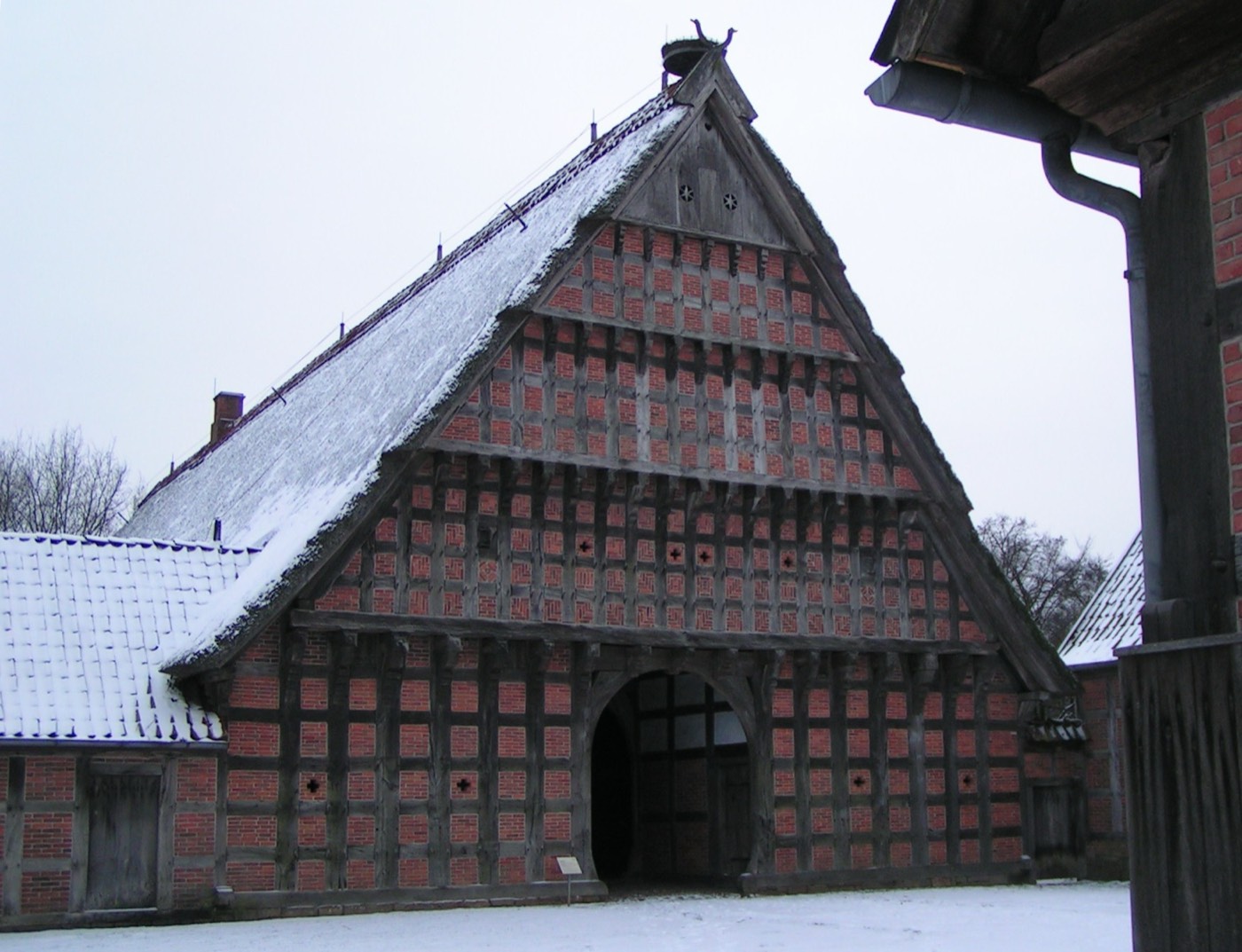
The Meyer surname is German, and it does not mean farmer. It comes from meier, the steward who ran a lord’s estate, and it belongs above all to the flat, fertile north of Germany.
What Does the Surname Meyer Mean?
Meyer means steward, bailiff or estate manager. It comes from Middle High German mei(g)er, itself from the Latin maior, meaning greater or superior, and it named the man a lord trusted to run his land, not the man who simply worked it.
The Latin trail is worth following. Maior domus, head of the household, was the title of the most powerful administrators of the early medieval Frankish world. Coming down into German speech, the word shed its grandeur but kept its sense: someone placed above others and answerable for an estate.
That is why so many pages get this name wrong. You will often see Meyer glossed as “farmer” or, stranger still, “dairyman”. Both are the end of the story rather than the beginning. Over several centuries the meier drifted from overseer to hereditary tenant to, in places, an ordinary farmer, and the modern German Meierei, a dairy, is a late offshoot of the same root.
In its own time the word carried weight. A meier collected rents, settled small disputes, answered to a monastery or a nobleman, and held a farm that passed to his son. He was a manager, not a labourer.
Where the Meyer Name Comes From
Meyer comes from German-speaking Europe, and it is thickest in the north: Lower Saxony, Westphalia, Schleswig-Holstein, Bremen and Hamburg, where the system of hereditary tenant farms that produced the name was most deeply rooted.
The Meierhof and the north German plain
A Meierhof was the farmstead attached to a noble or monastic estate and occupied by its meier. He paid an annual due in kind and owed labour on the lord’s own fields, and in return held a large working farm with real authority over the smallholders around him.
Crucially, the post became hereditary. When a family held the same Meierhof across generations, the district knew them by the office rather than by a father’s name, and the office hardened into a surname. Northern Germany held thousands of such farms, which is why Meyer is so common there.
South of the Main
Bavaria, Swabia, Austria and South Tyrol had their own version of the same arrangement, and their own spellings. Here the name is more often written Maier, Mayer, Mayr or Mair, and it frequently appears fused to a place word, because in a valley full of tenant farms you had to say which one you meant.
The Jewish Meyers: a second root entirely
A substantial number of Meyer and Meier families are Ashkenazi Jewish, and their name has two possible sources that land on the same spelling. Some are occupational, from the same German word, adopted when Jewish families across the Habsburg and Prussian lands were required to register fixed surnames from the 1780s onward.
Many others come from the Hebrew given name Meir (מֵאִיר), “one who shines” or “one who gives light”, borne by the second-century sage Rabbi Meir and common in Ashkenazi families for centuries. When surnames were imposed, Meir was routinely Germanised as Meyer, Meier or Mayer because it already sounded like a familiar German name.
Two unrelated roots, a Latin word for greater and a Hebrew word for shining, arriving at identical spellings. The name alone cannot tell you which one you descend from. Only the records can.
Spelling Variants and Related Names
Meyer, Meier, Mayer, Maier, Mair and Mayr are all the same name. As a rough rule, the -ey- and -ei- spellings dominate northern Germany and the Rhineland, while -ay- and -ai- dominate Bavaria, Swabia, Austria and Switzerland, with Mayr and Mair the most distinctly Bavarian and Tyrolean of the set.
These are conventions, not laws. Before the nineteenth century a parish clerk wrote what he heard, and one family can appear as Meier in one register and Mayer in the next. Emigration scrambled it further: a north German Meier could land in Ohio as Meyer or Myers.
The Dutch and Low German forms are Meijer, Meijers and Meyers, the final -s a genitive, “of the meier’s household”. In America you also meet Moyer, largely a Pennsylvania German respelling, and Myers and Myer, though Myers has independent English roots too and should not be assumed German.
Then there are the compounds, and they are where the name gets interesting. When half a parish answered to Meier, you distinguished them by position:
- Obermeier / Obermeyer: the upper farm.
- Niedermeier / Niedermeyer: the lower one, further down the slope or the valley.
- Bachmeier: the one beside the stream. Bergmeier and Bergmair: the one on the hill.
- Stallmeyer: responsible for the stables. Kirchmeyer: for church lands. Klostermeyer: for a monastery’s.
- Meyerhoff and Meierhoff: named directly for the farmstead itself.
Hofmeister belongs to the same world but is a different word: Hof plus Meister, the master of a court or great household, an office closer to the steward of a princely establishment than to a tenant farmer.
The Meyers in America
Meyers arrived mainly with the great German migrations of the nineteenth century, above all between the 1840s and the 1890s, landing at New York, Baltimore, New Orleans and Galveston and moving inland along the corridor of German settlement running from Pennsylvania to the Midwest and down into Texas.
An earlier wave matters too. Pennsylvania German families arrived from the Rhineland and the Palatinate from the 1710s onward, and it is among their descendants that the Moyer spelling took hold.
These Meyers went where German was still the language of the street. Texas took a remarkable share of them, in the cotton and dairy country around the German farming communities of Brenham, in the Alsatian-founded settlement at Castroville, and in the Hill Country town of New Braunfels, founded outright by a German emigration society in 1845.
Further north the pattern repeats. Meyer families turn up in the communal Amana Colonies of Iowa, in the Milwaukee and Cincinnati brewing trades, and later in the Bavarian-styled orchard town of Leavenworth, Washington. The same waves carried the other great German occupational names, which is why a Meyer, a Wagner and a Schmidt so often share a county register.
Jewish Meyers followed a partly separate route: Bavarian, Bohemian and Posen families in the 1840s and 1850s, then a far larger Eastern European movement after 1881, settling first in New York, Cincinnati and San Francisco, alongside neighbours called Schwartz and Cohen.
Notable People Named Meyer
Julius Lothar Meyer (1830 to 1895), born at Varel in Oldenburg, reached a periodic classification of the elements independently of Mendeleev, publishing his atomic-volume curve in 1870.
Conrad Ferdinand Meyer (1825 to 1898) of Zurich was one of the finest Swiss writers of the nineteenth century, remembered for tautly built historical novellas and for ballads such as Die Füße im Feuer.
Hannes Meyer (1889 to 1954), also Swiss, was the second director of the Bauhaus at Dessau from 1928 to 1930, and pushed the school towards architecture as social provision rather than aesthetics.
Eugene Meyer (1875 to 1959), an American financier of Alsatian Jewish descent, bought The Washington Post out of bankruptcy in 1933 and in 1946 became the first president of the World Bank.
Debbie Meyer (born 1952) became, at the 1968 Mexico City Olympics, the first woman to win three individual swimming golds at one Games, taking the 200, 400 and 800 metre freestyle.
Stephenie Meyer (born 1973), who carries the name by marriage, wrote the Twilight novels, among the best-selling books of the twenty-first century.
How Common Is Meyer Today?
Meyer ranked 183rd in the 2010 US Census, carried by 150,895 Americans. In Germany it sits around sixth on its own and roughly eighth in Switzerland, but that undercounts it badly: add Meier, Mayer, Maier and Mayr and the group becomes one of the largest surname families in the German language.
| US rank (2010 Census) | #183 |
|---|---|
| Americans with the name | 150,895 |
| Origin | German (also Ashkenazi Jewish) |
| Meaning | Steward or manager of a lord’s estate |
Frequently Asked Questions
What does the surname Meyer mean?
It means steward or estate manager, from Middle High German meier and ultimately Latin maior, “greater”. It described the man who ran a lord’s or monastery’s farm, collected its dues and held it as a hereditary tenant.
Is Meyer German or Jewish?
Both, and the two are separate. Most Meyers are German or Swiss and carry the occupational name. Many Ashkenazi Jewish Meyers took that same word, while many others Germanised the Hebrew given name Meir, “one who shines”. The spelling cannot tell them apart.
Where does the Meyer family come from?
There is no single Meyer family. The name arose independently on hundreds of estates across German-speaking Europe, most densely in Lower Saxony, Westphalia and the north German plain, with Maier and Mayr concentrated in Bavaria, Austria and Switzerland.
How common is the surname Meyer?
It is the 183rd most common surname in the United States, held by 150,895 people at the 2010 Census. In Germany it is a top-ten name, and counted together with its variant spellings it rivals Müller for the largest surname group in the country.
Is there a Meyer family crest or coat of arms?
No. In the German, Swiss and British heraldic traditions arms are granted to an individual and pass to his direct descendants, never to everyone sharing a surname. Since Meyer arose separately on countless estates, a single “Meyer crest” is a contradiction in terms. Sites selling one are selling a decoration, not a lineage.
What is the difference between Meyer, Meier, Mayer and Maier?
Nothing, in origin. They are regional and scribal spellings of one word, with -ey- and -ei- favoured in the north and -ay- and -ai- in the south. A single family can appear under two or three of them across a century of parish registers.
If your family carries the Meyer name, its route from the estates of German-speaking Europe to America is traceable. Atlas of Home can follow it from the Meierhof your ancestors held to wherever your family landed, and to wherever you are now.
Further reading: Meyer (surname) and Meierhof, Wikipedia.