
The Moore surname has two homelands and two meanings. In England it marked the family who lived by the moor, the open heath or bog; in Ireland it is the anglicised form of Ó Mórdha, “descendant of Mórdha”, from a byname meaning great, proud or stately.
What Does the Surname Moore Mean?
Moore means either “dweller by the moor” or “descendant of the stately one”, depending on which family carried it. The English name comes from Middle English mor, open heath or marshland. The Irish name comes from Gaelic mórdha, meaning noble, proud or majestic.
That double answer is not a hedge. It is what every serious reference work on the name finds, and it is the most important thing a Moore can know about their own surname.
The English route is topographic, the commonest kind of English surname there is. A man living at the edge of the moorland outside the village was John atte More, John at the moor. It needed no distinguished ancestor, only a house in a particular place, which is why the name arose independently across dozens of counties.
The Irish route is patronymic and aristocratic. Ó Mórdha means descendant of a man called Mórdha, and mórdha is a word of real weight: stately, proud, great-souled. It is the kind of byname given to a chief, and the family that carried it were chiefs.
A third strand accounts for the Anglo-Norman Moores: families styled de la More or de Mora, “of the marsh”, who carried a French-Latin version of the same idea into England and then into Munster.
Where the Moore Name Comes From
The Irish Moores come from County Laois in the midlands of Leinster, where the Ó Mórdha were the ruling sept. The English Moores come from no single place: the name arose wherever there was moorland, which in medieval England meant most of the north and west.
Laois and the Rock of Dunamase
The Ó Mórdha were the leading family of the Seven Septs of Laois, the confederation that also included the O’Lalors, O’Dorans, O’Dowlings, O’Kellys, McEvoys and O’Devoys, all six tributary to the O’Mores. Tradition traces the ancestor Mórdha back twenty-one generations to Conall Cearnach of the Red Branch warriors, which is a claim about status rather than a documented line.
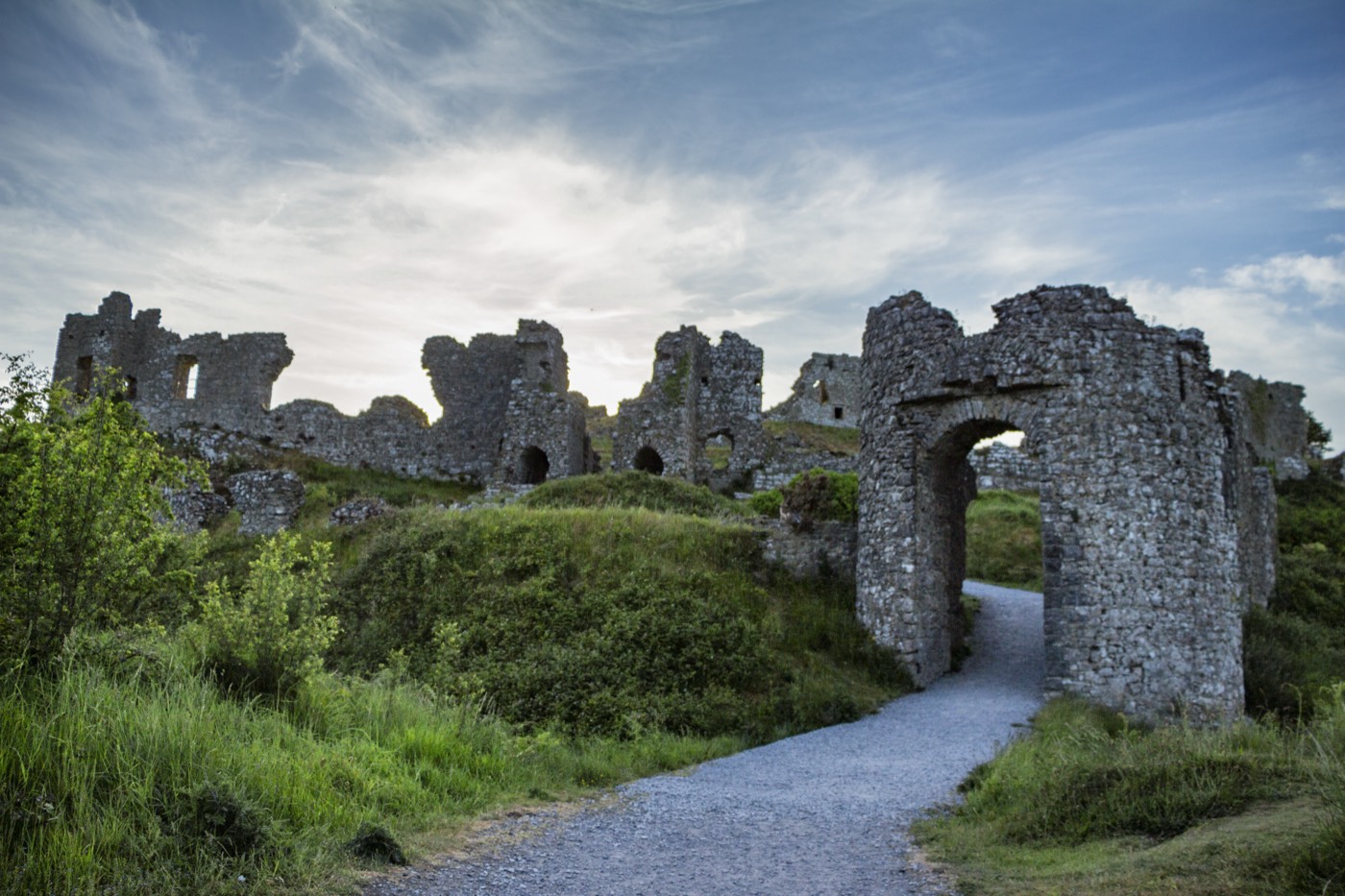
Their stronghold was the Rock of Dunamase, a limestone outcrop rising from the plain east of Portlaoise, crowned with a castle whose ruins still stand. Whoever held Dunamase held the road between Dublin and the south-west, which is why it changed hands so violently and so often.
The wars and the scattering
From 1549 the English crown attempted to plant Laois, renamed Queen’s County, with settlers. The O’Mores resisted for two generations. Rory O’More died in 1557; his son Rory Óg was killed in 1578 after a guerrilla campaign that terrified the Pale; Owny MacRory O’More, remembered as the last great lord of Laois, died in 1600, and with him the sept’s power ended.
What followed was one of the most consequential surname events in Irish history. Between 1607 and 1609 the planter Patrick Crosbie was granted land around Tarbert in north Kerry and moved close to three hundred members of the Seven Septs there. Laois names were deliberately transplanted to the far south-west. If your Moore line traces to north Kerry rather than the midlands, that removal is very likely why.
The English and Scottish arrivals
Meanwhile a completely different set of Moores came into Ireland as settlers. Sir Edward Moore, an English soldier of the Tudor period, was granted the dissolved Cistercian abbey of Mellifont in County Louth; his son Garret Moore hosted the Treaty of Mellifont in 1603 and was made Baron Moore of Mellifont in 1616. His descendants became Earls of Drogheda from 1661, and Mellifont stayed in the family until 1927.
Scottish and English planters brought the name to Ulster in the seventeenth century too, which is why the nineteenth-century distribution looks the way it does. In Griffith’s Valuation, taken between 1847 and 1864, Moore households clustered in Antrim, Down, Laois, Tyrone, Dublin and Derry. Laois is there, as you would expect. The Ulster counties above it are largely settler Moores, not Ó Mórdha at all.
Spelling Variants and Related Names
The main variants are More, Moor, Muir, Mure, O’More and O’Moore, with the Gaelic original written Ó Mórdha and the feminine form Ní Mhórdha.
The single o spellings are the older ones. More and Moor dominate English records until the eighteenth century, when the doubled vowel gradually won out. Sir Thomas More, executed in 1535, belongs to the same word-family as every modern Moore, though not to the same family tree.
In Scotland the equivalent topographic name settled as Muir or Mure, from Scots muir for moorland, and Scottish Muirs who emigrated frequently became Moores in American records. Scottish Gaelic also supplies mór, simply “big”. In Wales the epithet mawr, great or large, was anglicised to Moore in some families, giving a Welsh Moore closer in meaning to the Irish name than the English one.
The Isle of Man supplies its own, and it is a good one. Manx Moore derives from moar, the title of the officer who collected the lord’s manorial rents in a parish. Moore has been a leading Manx surname for centuries, and the antiquary Arthur William Moore documented the pattern himself in The Surnames and Place Names of the Isle of Man in 1890.
The Moores in America
Moores arrived in America in three waves: English colonists from the seventeenth century, Ulster Scots through the eighteenth, and Catholic Irish in the famine emigration of the nineteenth. All three ended up spelling the name the same way.
The English Moores were among the earliest, appearing in New England and the Chesapeake within a generation of the first landings, carried by ordinary farming families of the sort who had lived beside the moorland parishes of the English south-west and settled the Plymouth colony. Ulster Moores followed from the 1710s, down the Great Wagon Road into the Pennsylvania and Virginia backcountry.
Then came the Irish. And the Irish Moores have a claim on American immigration history that no other surname can match: on 1 January 1892, the first person processed through the newly opened Ellis Island station was Annie Moore, seventeen years old, off the Guion Line steamer Nevada from Queenstown in County Cork, travelling with her two younger brothers. An official handed her a ten dollar gold piece. Statues of her stand today at Cobh and at Ellis Island.
The famine and post-famine Moores went where the work was. A Moore family arriving in the 1850s was as likely to end up in the textile districts of Lawrence, Massachusetts or among the Irish of Worcester as anywhere else. Others followed the iron and steel trade to the Irish neighbourhoods of Pittsburgh, or the factories of New Haven, Connecticut.
Further west the pattern repeats. Irish Moores were part of the clay-mining community of Dogtown in St Louis and of Corktown in Detroit, that city’s first Irish quarter.
One more strand shaped the American Moores decisively. At the 2010 census, 200,941 Americans named Moore identified as Black, roughly twenty-eight per cent of all bearers. Many of those lines descend from enslaved people who took or were given a Southern household’s surname, which means a great many American Moore families reach the name through American history rather than through any moor or any sept.
Notable People Named Moore
Thomas Moore (1779 to 1852) was Ireland’s national poet before Yeats, a Dublin grocer’s son whose Irish Melodies gave the world “The Last Rose of Summer” and “The Minstrel Boy”.
Arthur William Moore (1853 to 1909) was the Isle of Man’s great antiquary, Speaker of the House of Keys, founder of the Manx Language Society and author of the standard work on Manx surnames.
Marianne Moore (1887 to 1972), born in Missouri, was a defining American modernist poet and won the Pulitzer Prize for Poetry in 1952.
Henry Moore (1898 to 1986), a Yorkshire miner’s son from Castleford, became the best known British sculptor of the twentieth century.
Gordon Moore (1929 to 2023) co-founded Intel and formulated Moore’s Law in 1965, the observation about transistor density that set the pace of the computing age.
How Common Is Moore Today?
Moore is the 18th most common surname in the United States, carried by 724,374 Americans at the 2010 census. It is also among the top forty surnames in England and one of the most common names on the Isle of Man.
| US rank (2010 Census) | #18 |
|---|---|
| Americans with the name | 724,374 |
| Origin | English and Irish, with Scottish, Welsh and Manx strands |
| Meaning | Dweller by the moor, or descendant of Mórdha, “the stately one” |
Frequently Asked Questions
What does the surname Moore mean?
It has two established meanings. In English it means “dweller by the moor”, from Middle English mor, open heath or bog. In Irish it is the anglicisation of Ó Mórdha, “descendant of Mórdha”, from a byname meaning great, proud or stately.
Is Moore Irish or English?
Both, genuinely. The Irish Ó Mórdha of Laois and the English topographic Moore are unrelated families who ended up sharing a spelling. Most British and American Moores descend from the English name, but Irish Moores are numerous and very well documented.
Where does the Moore family come from?
The Irish Moores come from County Laois, where the Ó Mórdha held the Rock of Dunamase, with a transplanted branch in north Kerry after 1609. English Moores come from moorland districts across England, and separate settler Moores are concentrated in Ulster, especially Antrim, Down and Tyrone.
How common is the surname Moore?
Moore ranks 18th in the United States with 724,374 bearers at the 2010 census. It sits inside the top forty in England, was among the twenty commonest names in Ireland in 1901, and is one of the commonest surnames on the Isle of Man.
Is there a Moore family crest or coat of arms?
No, and this matters. In English, Scottish and Irish heraldry arms are granted to an individual and descend to that person’s direct legitimate descendants, never to everyone sharing a surname. There is no such thing as “the Moore coat of arms”, and because Moore covers several unrelated families in at least four countries the idea is doubly meaningless. Sites selling you a Moore crest are selling a decoration, not a lineage.
Are Moore and Muir the same name?
They are the same word in different dialects. Muir is the Scots form of the moorland name and Moore the English form, so a Scottish Muir and an English Moore share an etymology without sharing a family. Many emigrant Muirs were simply recorded as Moore in American documents.
If your family carries the Moore name, its route from Laois, or from the English moorlands, to America is traceable. Atlas of Home can follow it from the Rock of Dunamase or an English heath parish to wherever your family landed, and to wherever you are now.
Further reading: Moore (surname) and Annie Moore.