
On a Saturday morning in April, the car park of a temple on King Arthur Court fills with folding tables, trays of sticky rice and buckets of scented water. Somebody’s grandmother ties a loop of white cotton around a stranger’s wrist and wishes them a year of health. This is Pi Mai, and the story of the Laotians in Elgin, Illinois does not begin here. It begins in a city council chamber, almost a decade before the first refugee family landed at O’Hare.
The Place
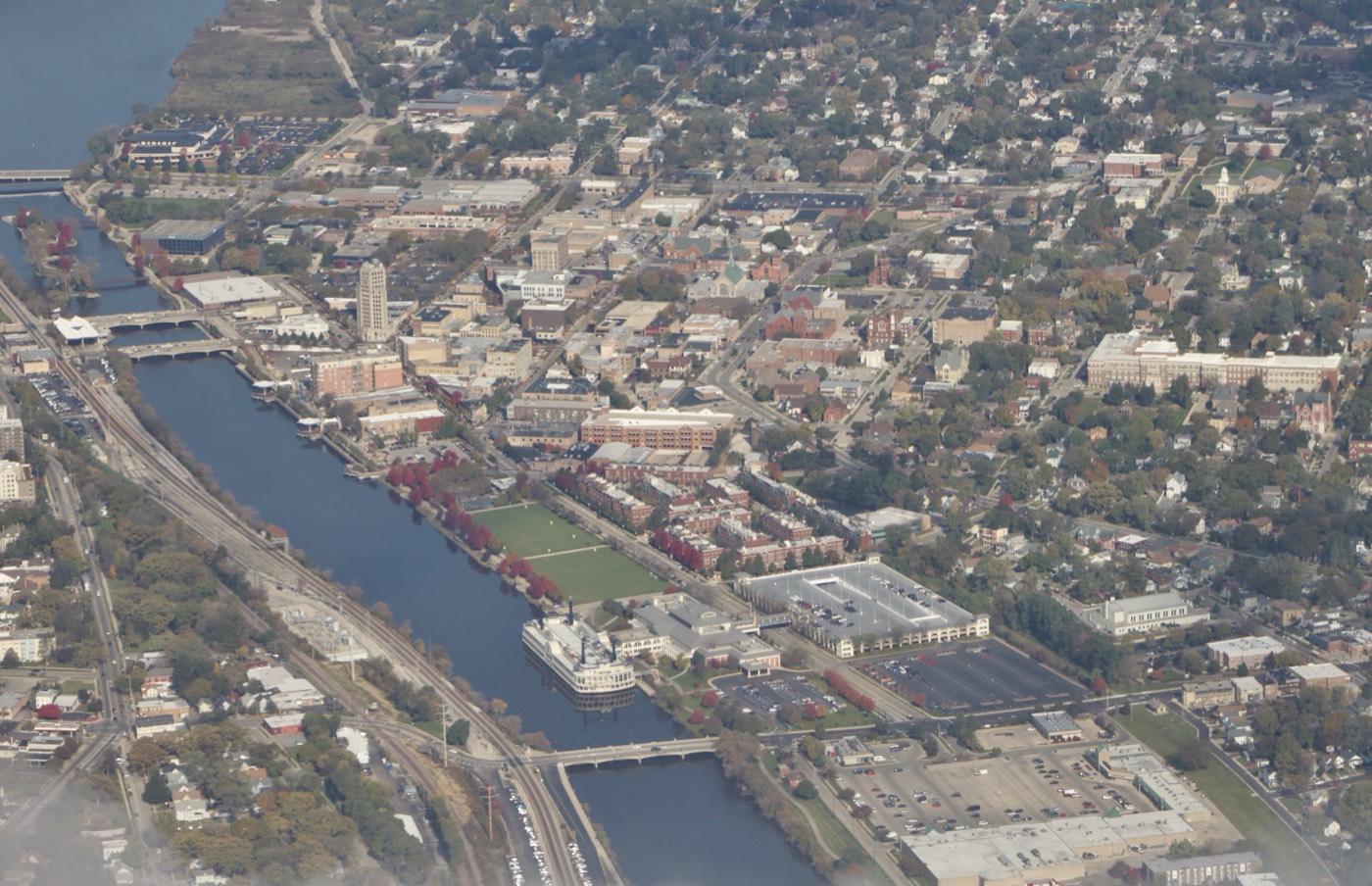
Elgin sits about 35 miles northwest of Chicago, straddling the Fox River across two counties, Kane and Cook. James T. and Hezekiah Gifford founded it in April 1835 and named it after a Scottish hymn tune, which is roughly the last quiet thing that happened here. It became a dairy centre, then a watch town, and the Elgin National Watch Company set the rhythm of local life for a century.
The 2020 census counted 114,797 residents, making Elgin the sixth most populous city in Illinois. Around 6.5 per cent are Asian, and a striking share of those trace their families to one small landlocked country in Southeast Asia. Elgin’s tie to it is older than the war that sent them here.
How It Became Laotian
The sister city that came first, 1966 to 1968
In the mid 1960s the U.S. State Department invited Elgin to adopt a sister city under its People-to-People programme of cultural exchange. The city suggested was Vientiane, the capital of Laos.
The delegation that came to look Elgin over in 1966 was serious: Vientiane’s mayor, the governor of Luang Prabang province and the inspector general of the ministry of the interior. Formal acceptance followed the next year, and books from Vientiane arrived at the Gail Borden Library. That autumn, photographs of Elgin and its city flag were displayed in Vientiane at the annual That Luang festival.
A civic banquet in Elgin in 1968 invited the Laotian students then at Southern Illinois University. Among them was Saysana Songvilay, who would go on to teach in Elgin Area School District U-46 and to head the Illinois Lao Association.
Then it stalled. Contact thinned to nothing, and the sister city arrangement, when it mattered most, had little to do with what came next.
January 1976: Phet, Sonsy and Bounnhasith
The Kingdom of Laos was torn apart by the war in Vietnam. The Royal Lao government held the Mekong region with American aid while the CIA recruited highland tribes, the Hmong prominent among them, to cut communist supply lines.
Late in 1975, shopkeepers in Vientiane began quietly closing their doors and slipping across the river into Thailand. After the Pathet Lao takeover, Laotians identified with American businesses and government agencies left in large numbers. They were crowded into Thai camps, where they were starved, robbed and assaulted while waiting for a sponsor.
The first refugees from Laos to reach Elgin arrived in January 1976: Phet Oudom, his wife Sonsy and their son Bounnhasith. He had been a district manager for Coca-Cola and an instructor for the U.S. Information Service. They and others were sponsored by seven area churches.
The college, the Y, and 565 names
Most of the first wave came under the aegis of Elgin Community College, which coordinated local resettlement through a federal grant. About 250 people had arrived by the time the YMCA took over late in 1979, and the college shifted to what it did best: English classes, drivers training, welding, machine tooling and plastics.
Three YMCA contracts with the State Department prepared for the resettlement of 565 people. Y representatives met them at O’Hare and furnished food, clothing, temporary housing and counselling. A YWCA project begun in 1979 added job placement.
Not everyone stayed. A substantial number were placed in Hanover Park. Between 1975 and 1983, more than 3,500 Laotian refugees were resettled in the Chicago area, most in Albany Park and Uptown, the rest spread across Aurora, Elgin, Joliet and Rockford.
The first arrivals were among the better educated and more highly skilled. Later waves were rural people, many unable to read or write in their own language. The contrast with Elgin’s earlier immigrants was sharp: previous waves had been led by young men chasing a fortune, while the Laotians came as extended families, children and grandparents together, dependent on public aid because they arrived with nothing.
Most were affected by malnutrition, disease and the trauma of the Thai camps. A shortage of low rent housing forced relatives to live apart, and the children learned American ways faster than their parents.
A grocery, a sack of rice, a social centre
In 1978, a small grocery opened. It sold rice in fifty-pound sacks and, without anybody planning it, became a social centre. This is how diasporas actually start: not with a cultural association or a grant, but with somebody stocking the right rice and letting people talk in the aisle.
The pattern repeats across the region, from the delis of Swedish Andersonville to the halal butchers of Bridgeview. Groceries come first, temples later.
The armoury, April 1981
The first public celebration of the Lao New Year in Elgin took place in April 1981 at the armoury. Guests were introduced to the ceremonies that anchor Pi Mai: the baci, in which cotton threads are knotted around the wrist to hold the soul in place for the year, and the pouring of scented water over Buddha images and the hands of elders. Five years after Phet Oudom stepped off a plane, the community was confident enough to invite the town in.
Counting the community, and testing its limits
The 1980 census reported 646 Asians inside the city limits, almost certainly an undercount. The school district’s bilingual census of February 1982 listed 500 Laotians, 42 Vietnamese, 23 Hmong and 24 Cambodians. Laotians were not merely the largest Southeast Asian group in Elgin. They were nearly all of it.
The welcome had edges. A study by the Elgin Area Chamber of Commerce suggested a saturation point in support services had been reached, and recommended future placements be limited to the immediate family of those already here.
From refugees to an organisation
The families stayed anyway, and the second generation went through U-46 and Elgin Community College. In 1996 the community formally established the Lao American Organization of Elgin, its board drawn from the families who had arrived twenty years earlier: Chanthabandith, Ramangkoun, Sotay, Siripanya, Rasavongxay, Thavisouk, Xayaseang, Mounivong.
By 2005 it was sponsoring the First International Conference on Lao Studies at Northern Illinois University, writing that several thousand Laotian refugees were by then living in Elgin and the cities around it. Its chairman was Thomas Chanthabandith, known to everyone as Khamta.
The Landmarks
Wat Lao Buddha Samaggi of Elgin, 50 King Arthur Court. A Lao Buddhist temple on a residential court, run by and for the community that built it. It anchors the Pi Mai celebrations each April, and it is where funerals and merit-making still happen in Lao.
Buddha’s Words Monastery USA, 779 Dixon Avenue. Also known as the Lao Buddhist Temple of Elgin, and evidence that a community of this size eventually needs more than one temple. Monastic communities multiply as they grow, usually along lines of village origin.
White Pearl Restaurant, 265 South McLean Boulevard. One of the few places in the region where Lao dishes appear under their own names rather than filed under Thai. The larb, effectively the national dish of Laos, arrives with the lime and fish sauce it is supposed to have.
Lucky Asian Market, 692 Villa Street. A neighbourhood grocery, descendant of that first small shop from 1978. Padaek, galangal, kaffir lime leaf, sticky rice by the sack, and the specific brands a Lao household will not substitute.
B & V Asian Market, 347 North McLean Boulevard. Known locally for the prepared Lao food it puts out on Fridays, a weekly community fixture as much as a lunch service. Arrive late and the good things are gone.
Lao & Thai Spicy Noodle, 612 South Randall Road, South Elgin. Out on the commercial strip at the western edge, Lao-owned and unapologetic about the heat. Papaya salad, sticky rice and fried wings in a suburban plaza.
Gail Borden Public Library, 270 North Grove Avenue. The library that received books from Vientiane in 1967, before anybody in Elgin could read them. The current building opened in 2003 on the Fox River.
Where They Came From
Almost everyone in Elgin’s Lao community traces back to lowland Laos, specifically the Mekong corridor. Vientiane supplied the first and most educated wave: civil servants, army officers, teachers, people who had worked for American agencies and whose names were on lists after 1975.
Behind them came the villages strung along the river, where the Mekong is both border and highway. Crossing it was the escape route, and almost every Elgin family over fifty has a river story.
They are ethnic Lao, lowland Buddhists, and the distinction matters. The Hmong, recruited by the CIA in the highlands, fled the same country in the same years and landed in a different set of American cities, above all in Wisconsin and Minnesota. The two share a homeland, a war and a refugee route, and very little else. Cambodians from the same camps ended up in Tacoma. After that the chain worked as it always does: one family sponsored a cousin, the cousin brought a brother-in-law, and a job at a plastics plant was worth telephoning California about.
Elgin Today
Elgin is now routinely described as home to more Laotian families than any city outside California, with estimates above 500 households. That claim comes from sister city materials rather than a census table, so treat it loosely. What is not loose is the visibility: two Lao temples, several markets, a handful of restaurants and a New Year celebration that pulls people from across the Midwest.
The city is also, and predominantly, Latino. Nearly half of Elgin identifies as Hispanic, and the Lao community lives inside a town whose main demographic story is a different one. This is not friction so much as scale. Lao families number a few thousand in a city of 114,000, and their institutions are modest to match: a temple in a converted house, a market in a strip of shops, a festival in a car park.
The generational arithmetic is doing its work. The people who crossed the Mekong are in their seventies and eighties now, and their grandchildren speak English first and Lao mostly at the temple. Something similar happened a generation earlier in the Polish parishes of Niles: some of it survives, transformed, and some does not. Meanwhile the sister city link with Vientiane, dormant for decades, has been revived, and it is the Lao American families of Elgin who now give it substance.
Frequently Asked Questions
When did Laotians first arrive in Elgin, Illinois?
The first Laotian refugee family reached Elgin in January 1976: Phet Oudom, his wife Sonsy and their son Bounnhasith, sponsored by seven local churches. Thousands followed over the next decade.
Why is Elgin a sister city of Vientiane, Laos?
The U.S. State Department invited Elgin to join its People-to-People exchange programme in the mid 1960s and suggested Vientiane. A Laotian delegation visited in 1966 and the partnership was accepted in 1967, nine years before the first refugees arrived and unconnected to them.
How many Laotians live in Elgin, Illinois?
Elgin’s school district counted 500 Laotians in a bilingual census in February 1982. Today the Laotians in Elgin, Illinois are estimated at more than 500 families, one of the largest Lao communities outside California, though no precise official figure exists.
Are there Lao Buddhist temples in Elgin?
Yes. Wat Lao Buddha Samaggi of Elgin at 50 King Arthur Court, and Buddha’s Words Monastery USA, also called the Lao Buddhist Temple of Elgin, at 779 Dixon Avenue. Both host merit-making, funerals and the Lao New Year.
When is the Lao New Year celebrated in Elgin?
Pi Mai Lao falls in mid April on the lunisolar calendar and runs about three days. The first public celebration in Elgin was held at the armoury in April 1981, where guests met the string-tying baci ceremony and the sprinkling of scented water.
Where can you eat Lao food in Elgin?
White Pearl Restaurant at 265 South McLean Boulevard serves Lao dishes including larb and Lao sausage, and Lao & Thai Spicy Noodle at 612 South Randall Road in South Elgin is Lao-owned. For ingredients, the Laotians in Elgin, Illinois shop at Lucky Asian Market on Villa Street and B & V Asian Market, which sells prepared Lao food Fridays.
If your family’s story passed through Elgin, or any of the places Laotians have made home in America, Atlas of Home can trace that journey. From a village on the Mekong to a temple car park on King Arthur Court, to wherever you are now.