
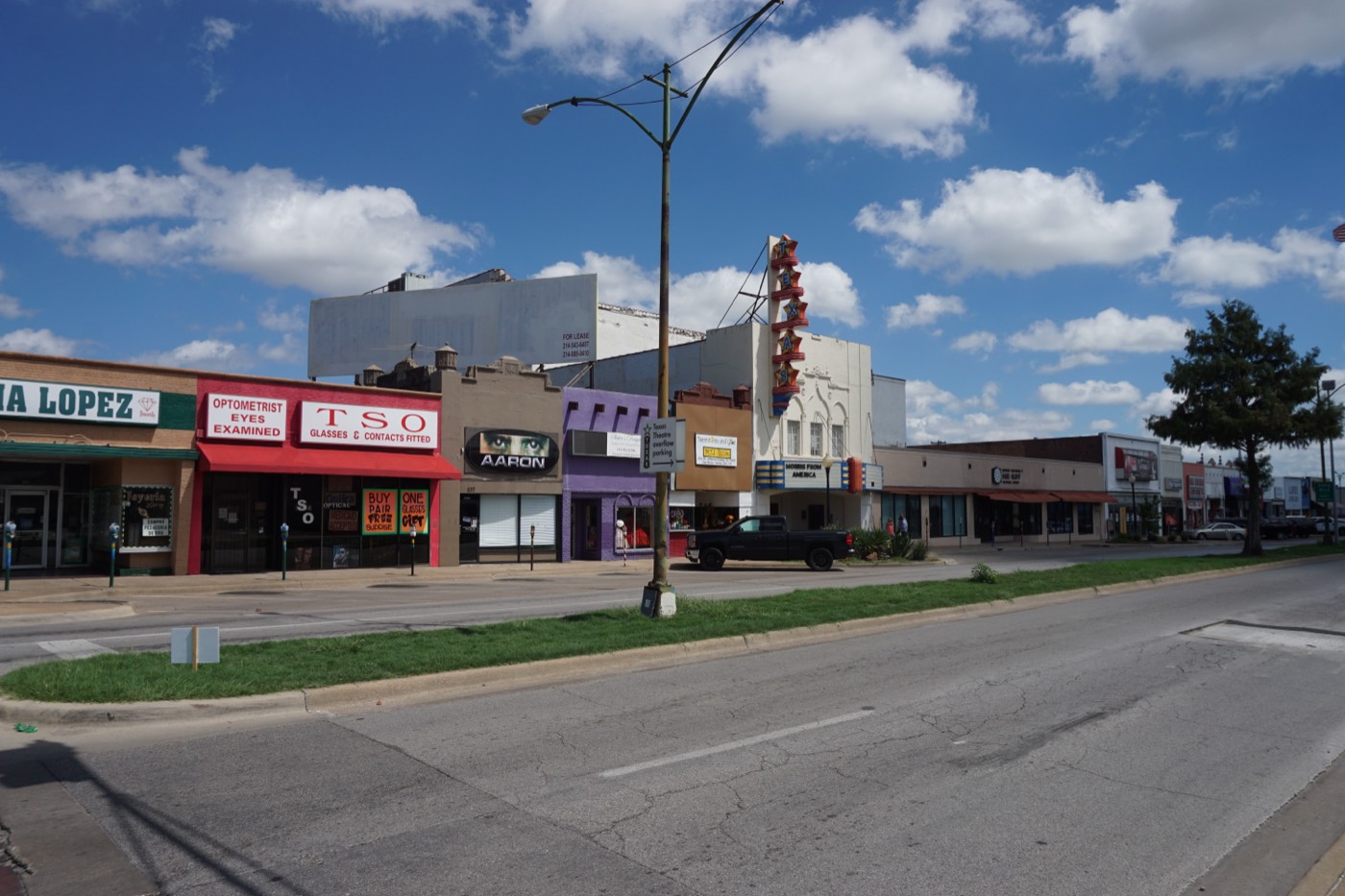
On a Saturday morning along Jefferson Boulevard in Oak Cliff, the storefronts spill colour onto the pavement: quinceanera gowns in tulle and lace, the steam of a taqueria griddle, a panaderia tray of conchas cooling in the window. This is the centre of gravity for Mexicans in Dallas, a community that did not simply arrive here but, decade by decade, built and rebuilt the city’s southern half in its own image.
The Place
Dallas sits in the flat blackland prairie of North Texas, a city raised on cotton, railroads, oil money and banking. For most of the twentieth century its prosperity was sorted by a hard colour line, and the Trinity River drew much of it: downtown and the affluent north on one bank, the working districts on the other.
The Mexican story in Dallas plays out across two neighbourhoods on opposite sides of that river. First came Little Mexico, just north-west of downtown. Then came Oak Cliff, the sprawling sector to the south-west, where today the majority of residents are Hispanic.
By the 2020 census, Hispanic residents made up 42.3 per cent of Dallas, the single largest group in the city, the overwhelming majority of Mexican origin. In Oak Cliff that share climbs higher still, and the neighbourhood comes close to being an ethnic enclave.
How It Became Mexican
Little Mexico and the Revolution
The community’s first home was Little Mexico, a district that grew up around the green of what is now Pike Park, just north-west of downtown. In the early decades of the twentieth century it became home to roughly 10,000 residents, many of them refugees from the violence of the Mexican Revolution after 1910.
They came for work on the railroads, in the brickyards and in the kitchens and gardens of a growing city, and they came because the chaos south of the border made staying unthinkable. Little Mexico became the entry point, the first Spanish-speaking quarter where a newcomer could find a room, a job and a familiar Mass.
The institutions followed quickly. Our Lady of Guadalupe Catholic church was built in the neighbourhood in 1925, and St Ann’s parochial school went up in 1927, anchoring the community in faith and schooling.
Pike Park and the colour line
Pike Park was the heart of Little Mexico, but for years it was a heart half closed. The City of Dallas bought the site in 1912 and 1913 for a neighbourhood park, first developed as Summit Play Park and renamed in 1927 for former park board member Edgar L. Pike.
The pool was reserved for white swimmers, and metal rails kept Mexican American and African American children out. The arrangement only began to soften in 1931, when residents appealed to the local Mexican consul and joint use of the pool was finally established. From then on the park became the true centre of the community, the place where fiestas patrias such as Diez y Seis de Septiembre and Cinco de Mayo were celebrated.
The tollway and the great move south
Little Mexico did not fade so much as it was dismantled. The construction of the Dallas North Tollway in the late 1960s sliced the historic neighbourhood in half and cut residents off from Pike Park, while rising land values north of downtown drew developers and pushed families out.
The community did not vanish. It moved, carrying its businesses, churches and customs across the Trinity River to Oak Cliff. The bridal and quinceanera trade made the journey too: Lizcano Bridal, one of the first quinceanera boutiques in Dallas, was among the businesses that relocated from Little Mexico to Jefferson Boulevard.
Saving Oak Cliff
Oak Cliff in the 1960s was a district in flight. As fear of integration spread, white residents left in large numbers, and the storefronts of once-grand Jefferson Boulevard, lined in the 1950s with department stores, banks and jewellers, began to empty out.
It was Mexican families and Mexican entrepreneurs who filled the vacuum. Through the lean decades of the 1970s and 1980s, when much of Oak Cliff was written off as dying, they kept Jefferson Boulevard and its surrounding blocks alive, opening restaurants, dress shops, groceries and bakeries in buildings their predecessors had abandoned.
The once-empty storefronts of Jefferson bloomed with tulle and lace, and the street became a regional destination for the wedding and quinceanera trade, drawing families from across North Texas. By the time Dallas as a whole began to notice Oak Cliff again, the Mexican community had already done the quiet work of saving it.
The Landmarks
Pike Park Recreation Center, 2807 Harry Hines Boulevard. The last green heart of Little Mexico still survives in the shadow of Uptown’s towers. Its mission-style recreation building and the marker that tells the neighbourhood’s story make it the one place where the community’s first chapter can still be walked.
El Ranchito, 610 W. Jefferson Boulevard. Laura and Oscar Sanchez, both from Monterrey in Nuevo Leon, opened this restaurant on Jefferson in 1983, specialising in comida nortena and Tex-Mex. It is among the few places in Dallas to serve cabrito, young goat, every day, and mariachi troupes play through the weekend. In 2026 the City of Dallas designated it a historical landmark.
Texas Theatre, 231 W. Jefferson Boulevard. The grand 1931 cinema is best known nationally as the place Lee Harvey Oswald was arrested in November 1963, but to Oak Cliff it is the boulevard’s anchor, a restored marquee glowing over the heart of the Mexican commercial district and now home to repertory film and community events.
El Fenix, 120 E. Colorado Boulevard. The Oak Cliff branch of the oldest Mexican restaurant chain in the United States, founded in Dallas in 1918. Its presence at Colorado and Zang ties the modern neighbourhood back to the very first generation of Mexican restaurateurs in the city.
Bishop Arts District, around 8th Street and Bishop Avenue. Once a streetcar stop fallen on hard times, this cluster of more than sixty independent businesses now mixes Mexican and Black-owned shops, taquerias and bakeries. Birrieria Aguinaga, a small family-run spot, opened a Bishop Arts location at 330 W. Davis Street.
El Oaxaqueno Taqueria y Panaderia, Oak Cliff. Run by Honorio Garcia, who carries the traditions of his indigenous Oaxacan town to the neighbourhood, the place pairs a taqueria with a panaderia and is a reminder that Dallas’s Mexican community draws on every corner of Mexico, not only its northern states.
Jefferson Boulevard itself. Each spring the mile-long Dallas Cinco de Mayo Parade and Fiesta, presented by the Oak Cliff Coalition for the Arts, fills the street with floats, folklorico dancers, lowriders, marching bands and towering mojiganga puppets. It has run for more than forty years and is billed as the longest-running parade in North Texas.
Where They Came From
The first Mexicans in Dallas were shaped by the Revolution, families fleeing north from the fighting that convulsed central Mexico after 1910. They arrived through the same overland routes that fed all of Texas, and they came to stay.
The later and larger waves followed the migration streams that run from central and northern Mexico into Texas. The state’s Mexican-origin population is concentrated in origins such as Tamaulipas, San Luis Potosi and Guanajuato, and San Luis Potosi in particular has long sent a substantial stream of migrants to the Dallas area.
Northern Mexico left its mark on the food and the families too. The Sanchez family who built El Ranchito came from Monterrey in Nuevo Leon, bringing the cabrito and asado of the north, while other arrivals brought the moles and tlayudas of Oaxaca far to the south. The result is a community that is unmistakably Mexican and, at the same time, drawn from nearly every region of the country, much as it is in Little Village in Chicago and the Segundo Barrio of El Paso.
Dallas Today
The Mexican story in Dallas is now the story of the city’s southern half. Oak Cliff is majority Hispanic, Jefferson Boulevard is its commercial spine, and the institutions the community built, from El Ranchito to the Cinco de Mayo parade, have crossed from neighbourhood custom into civic landmark.
That success has brought its own pressures. The Bishop Arts District, revived in large part by Mexican and Black-owned businesses, now draws investment and rising rents that test whether the families who saved it can afford to stay, the same dynamic that emptied Little Mexico a half-century earlier. In 2026 the Cinco de Mayo parade was paused for the first time in over forty years for want of funding, though the community pressed ahead with a street festival in its place.
Even so, the centre holds. The panaderias still open before dawn, the quinceanera shops still dress the daughters of Oak Cliff, and the El Ranchito mariachis still play on Jefferson Boulevard. A community that was moved once and refused to disappear has made the south side of Dallas indelibly its own. The same northern-Texas pull that drew Mexican families to Dallas shaped neighbours across the metro, from the Mexican community in San Antonio to the Indian families of Carrollton and the German settlers of New Braunfels.
Frequently Asked Questions
Where do most Mexicans in Dallas live?
The largest concentration of Mexicans in Dallas is in Oak Cliff, the sprawling neighbourhood south-west of downtown across the Trinity River, where Hispanic residents are the clear majority. Jefferson Boulevard and the Bishop Arts District are its commercial and cultural heart.
What was Little Mexico in Dallas?
Little Mexico was the city’s first Mexican neighbourhood, just north-west of downtown around Pike Park. It grew to about 10,000 residents, many of them refugees from the Mexican Revolution, before the Dallas North Tollway and rising land values largely dismantled it in the late 1960s.
Why did the Mexican community move to Oak Cliff?
When the Dallas North Tollway sliced through Little Mexico in the late 1960s and developers pushed families out, the community moved south across the Trinity River. Businesses such as Lizcano Bridal relocated to Jefferson Boulevard, and Mexican families filled the storefronts that white flight had emptied.
What is the Dallas Cinco de Mayo Parade?
It is a mile-long procession along Jefferson Boulevard in Oak Cliff, presented by the Oak Cliff Coalition for the Arts, with floats, folklorico dancers, lowriders and mojiganga puppets. Billed as the longest-running parade in North Texas, it has run for more than forty years, though it was paused in 2026 over funding.
Where did Dallas’s Mexican families originally come from?
The earliest arrivals fled the Mexican Revolution after 1910. Later waves followed migration streams from central and northern Mexico, with origins concentrated in states such as San Luis Potosi, Guanajuato and Tamaulipas, alongside northern families from Nuevo Leon and arrivals from as far south as Oaxaca.
Is Oak Cliff a good place to experience Mexican culture in Dallas?
Yes. Oak Cliff is the heart of Mexican American culture in Dallas, with Jefferson Boulevard’s taquerias, panaderias and quinceanera shops, landmark restaurants like El Ranchito, the historic Texas Theatre and the annual Cinco de Mayo festivities all within a short walk.
If your family’s story passed through Dallas, or any of the places Mexicans have made home in America, Atlas of Home can trace that journey. From the villages of San Luis Potosi and the ranches of Nuevo Leon to the storefronts of Jefferson Boulevard, to wherever you are now.