
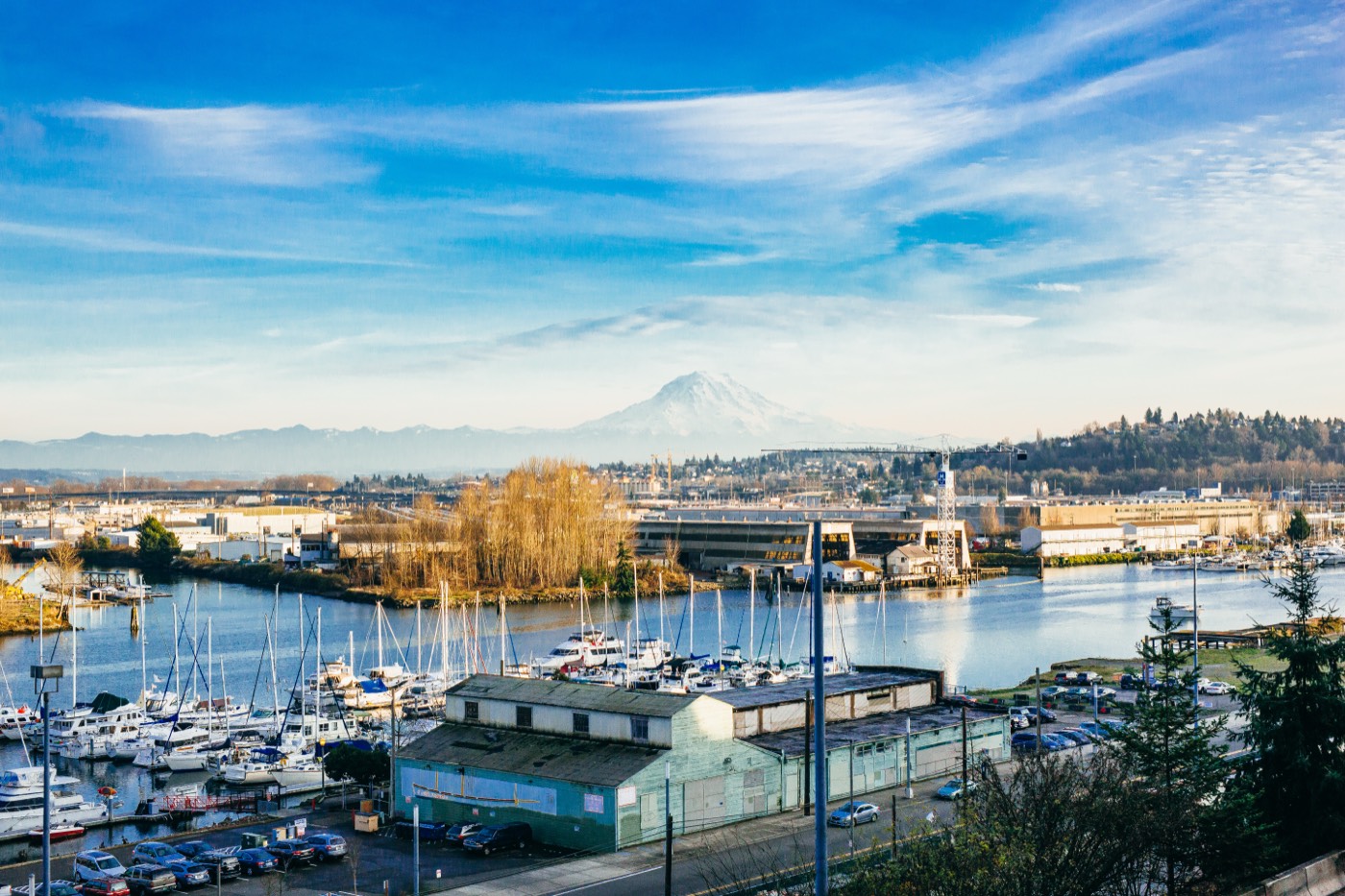
Drive east from downtown Tacoma, past the Foss Waterway and up over the hill, and you reach a part of the city that the postcards rarely show. Here, in the bungalows and apartment blocks of East Tacoma, the Cambodians in Tacoma, Washington, built a second homeland out of necessity. They arrived as refugees, carrying grief most of their neighbours could not imagine, and they made a place. Today a Cambodian American sits as Deputy Mayor, monks chant in temples on quiet residential streets, and every April the city pauses to remember what was lost.
The Place
Tacoma sits on Commencement Bay at the southern end of Puget Sound, a working port city of roughly 219,000 people in the shadow of Mount Rainier. For most of the twentieth century it was a town of timber, rail, and smelter smoke, more blue collar than its glossier neighbour Seattle to the north.
The Cambodian story plays out mostly on the city’s east side, in neighbourhoods like Salishan and along the arterials that climb away from the bay. These are not affluent districts. They are the parts of Tacoma where rents were low and the welcome, for a time, was uncertain.
What the east side offered, and still offers, is space to begin again. The temples and grocers and dance schools that anchor Cambodian life sit not in a single tidy quarter but scattered across the residential grid, knitted together by family and faith rather than by a main street.
How It Became Cambodian
No Cambodian chose Tacoma the way a settler chooses a frontier. They came because the killing at home left no choice, and because the American resettlement system sent them here.
The flight from the Killing Fields
On 17 April 1975, Khmer Rouge soldiers entered Phnom Penh and emptied the city at gunpoint. Over the next four years, the regime’s forced labour, starvation, and executions killed somewhere between 1.5 and 3 million people, a fifth or more of the entire population. The scale of the Cambodian genocide is hard to grasp even now.
Those who survived often did so by walking, for weeks, toward the Thai border. The refugee camps that formed there became the waiting rooms of a diaspora. From those camps, beginning in the late 1970s and accelerating through the 1980s, families were resettled across the United States, in mill towns like Lynn, Massachusetts, in California farm cities, and in Puget Sound ports like Tacoma.
Why the Pacific Northwest
Washington State became one of the principal destinations for Southeast Asian refugees who arrived between 1975 and the 1990s, fleeing the upheavals in Cambodia, Laos, and Vietnam. Voluntary agencies and church sponsors handled the placements, and once a few Cambodian families had settled in the Puget Sound region, others followed to be near them.
This is the quiet engine of chain migration. A cousin in Tacoma meant a phone number, a sofa, a person who could translate at the welfare office. Families who had first been scattered to colder, lonelier corners of the country secondary-migrated to Tacoma to rejoin their own, much as Cambodians clustered in Providence, Rhode Island and the Central Valley town of Modesto, California.
Salishan, the first foothold
Much of that early settlement concentrated in Salishan, a sprawling public housing project in East Tacoma. It had been built in 1942 as wartime housing for shipyard and factory workers, 2,000 units spread across several hundred acres between South 38th Street and South 54th Street, deliberately racially integrated from the start, as the Tacoma Housing Authority records.
By 2000, on the eve of its demolition, Salishan’s residents were roughly a quarter Cambodian and a quarter Vietnamese, with Russian, African American, and other families making up the rest. For a generation of Cambodian children, Salishan was simply home, the place where they learned English, kept the Khmer language alive at the kitchen table, and grew up between two worlds.
Salishan’s reputation in the 1980s and 1990s was rough, and the families who lived there knew it. Beginning in 2001, the Tacoma Housing Authority razed and rebuilt the project as a 225-million-dollar mixed-income development, completed by 2011. Many Cambodian families stayed in the neighbourhood through the transformation, or moved a few blocks to buy the modest homes that surround it.
Building the institutions
Refugees do not only need housing. They need somewhere to grieve, to marry, to mark the turning of the year. The first task, after survival, was rebuilding the temple.
Across the Puget Sound region, Cambodian Buddhists pooled what little they had to found pagodas, the earliest of them established in the early 1980s. In Tacoma, that impulse produced a cluster of Khmer temples on the east and south sides of the city, monasteries carved out of ordinary houses and lots, where saffron-robed monks anchor the spiritual life of the community.
The cultural life grew alongside the religious. Dance teachers reconstructed the classical Khmer repertoire from memory, training a new generation in the slow, precise gestures that the Khmer Rouge had tried to erase. Language academies opened so that children born in Tacoma would not lose the words their grandparents spoke.
The second generation steps forward
The children of those refugees came of age as Americans, and some entered public life. In 2021 Chanjolee “Joe” Bushnell, the son of a Cambodian refugee mother and a white father, was elected to the Tacoma City Council, becoming the first Cambodian American to serve on the council and, his colleagues say, the first in Washington State. His fellow members later chose him as Deputy Mayor.
A lifelong Tacoman and a 2008 graduate of Stadium High School, Bushnell spent more than a decade in the Marine Corps before entering politics. He represents District 5, which takes in the South End and East Tacoma where so many Cambodian families settled. His rise marked a generational shift, from refugees rebuilding to citizens governing.
The Landmarks
Khmer Theravadin Buddhist Temple, 1420 E 44th St. This east-side monastery brings traditional Cambodian architecture and ritual to a residential Tacoma street. It hosts the blessing ceremonies, alms-givings, and New Year gatherings that hold the community’s calendar together, and its monks are figures of quiet authority across the neighbourhood.
Wat Chantarangsey Khmer Krom, 7912 Golden Given Rd E. A pagoda serving the Khmer Krom, ethnic Cambodians whose ancestral homeland lies in the Mekong Delta. As Khmer New Year approaches, the temple fills with blessing ceremonies, folk games, alms-givings, and demonstrations of Lbokator, the ancient Cambodian martial art.
Asia Pacific Cultural Center, 4851 South Tacoma Way. Founded in 1996 to bridge communities and generations through arts and education, the centre stages the region’s largest pan-Asian New Year celebration, which has drawn more than 10,000 people to the Tacoma Dome and spotlights Cambodia among the cultures it honours. Under longtime executive director Lua Pritchard, it has become a hub for the city’s Khmer events.
Tacoma City Hall, 747 Market St. Each April since 2022 the council has gathered here to proclaim Cambodian Genocide Remembrance Week, an observance Deputy Mayor Bushnell helped create. The 2026 ceremony, on 14 April, marked the fifth anniversary, bringing survivors and their grandchildren into the seat of city government.
Salishan, between South 38th and South 54th Streets, East Tacoma. The rebuilt public housing district where so many Cambodian families first made landfall. Swan Creek Park wraps its eastern edge, and the streets around it remain one of the densest pockets of Cambodian settlement in the city.
Lincoln International District, centred on South 38th Street and Yakima Avenue. Tacoma’s east-side commercial spine, a corridor of family-run Southeast Asian restaurants and grocers including the long-running East Asia Supermarket at 602 S 38th St. Though its businesses are predominantly Vietnamese, the district is where Cambodian families too shop for lemongrass, fish sauce, and the ingredients of home.
Happy Asian Fast Food, 1901 S 72nd St. One of the city’s Cambodian kitchens, serving Khmer dishes like beef skewers and lot cha alongside the fried rice that keeps the lunch crowd coming. It is the kind of unassuming counter where the diaspora’s food quietly persists, plate by plate.
Where They Came From
Tacoma’s Cambodians trace their roots to a country roughly the size of Oklahoma, and to a catastrophe that touched every family. Most arrived not directly from Cambodia but by way of the refugee camps along the Thai border, where they had waited months or years for resettlement.
Among them are the Khmer Krom, ethnic Cambodians from the Mekong Delta region of southern Vietnam, whose distinct community is reflected in temples like Wat Chantarangsey. Their presence is a reminder that the Cambodian diaspora was never a single uniform wave but a gathering of regions and histories.
What nearly all of them share is the experience of having lost almost everything. Survivors recount families decimated to a single member, childhoods spent as forced labourers or child soldiers, and the long psychological aftermath that the community is only now learning to name and treat.
Tacoma Today
The Cambodian community in Tacoma is no longer defined solely by what it fled. The refugees who arrived in the 1980s are grandparents now, and their American-born descendants run businesses, sit on the council, and teach the dances their elders salvaged.
The work of healing is ongoing and deliberate. Organisations such as the Tacoma Healing Awareness Community, founded by survivor Vanna Sing, exist to help a population carrying deep generational trauma. The annual Genocide Remembrance Week is part of that work, a public acknowledgement that what happened in Cambodia happened to Tacomans too.
It is not a wealthy community, and it does not pretend to be. But it is a rooted one. In the temples on E 44th Street and Golden Given Road, in the New Year processions, in the Khmer spoken in east-side kitchens, the Cambodians of Tacoma have made a place that holds. Their story sits alongside those of the Cambodians in Stockton, California and the Cambodians of Lynn, Massachusetts as another chapter in how a scattered people rebuilt itself across America.
Frequently Asked Questions
How many Cambodians live in Tacoma, Washington?
Tacoma has one of the larger Cambodian communities in the Pacific Northwest, though exact figures are hard to pin down. Census data has placed Cambodians at a small but distinct share of the city’s Asian population, concentrated on Tacoma’s east and south sides. The community is significant enough that Tacoma elected the first Cambodian American to its City Council.
Why did so many Cambodians settle in Tacoma?
The Cambodians in Tacoma, Washington, arrived chiefly as refugees fleeing the Khmer Rouge genocide of 1975 to 1979. Washington State was a major resettlement destination, and voluntary agencies placed families in affordable East Tacoma neighbourhoods such as Salishan. Chain migration then drew relatives to the area to reunite with family already there.
Where do Cambodians worship in Tacoma?
Several Khmer Buddhist temples serve the community, including the Khmer Theravadin Buddhist Temple at 1420 E 44th Street and Wat Chantarangsey Khmer Krom at 7912 Golden Given Road East. These pagodas anchor the religious calendar, hosting blessing ceremonies, alms-givings, and the Khmer New Year festivities each April.
When is Khmer New Year celebrated in Tacoma?
Khmer New Year falls in mid-April, traditionally from the 14th to the 16th. Tacoma’s temples mark it with processions, traditional dance, food, and folk games, and the Asia Pacific Cultural Center stages a large pan-Asian New Year celebration that features Cambodia among its honoured cultures.
What is Cambodian Genocide Remembrance Week in Tacoma?
It is an official city observance, first declared in 2022 at the urging of Deputy Mayor Chanjolee “Joe” Bushnell. Held each April, it gathers survivors and their descendants at Tacoma City Hall to honour the lives lost under the Khmer Rouge. The 2026 ceremony marked its fifth anniversary.
Who is the first Cambodian American on Tacoma’s City Council?
Chanjolee “Joe” Bushnell, elected in 2021, is the first Cambodian American to serve on the Tacoma City Council and is widely cited as the first in Washington State. The son of a Cambodian refugee mother, he was later chosen as Deputy Mayor and represents District 5, which includes much of East Tacoma.
If your family’s story passed through Tacoma, or any of the places Cambodians have made home in America, Atlas of Home can trace that journey. From the refugee camps of the Thai border to the temples of East Tacoma, to wherever you are now.