
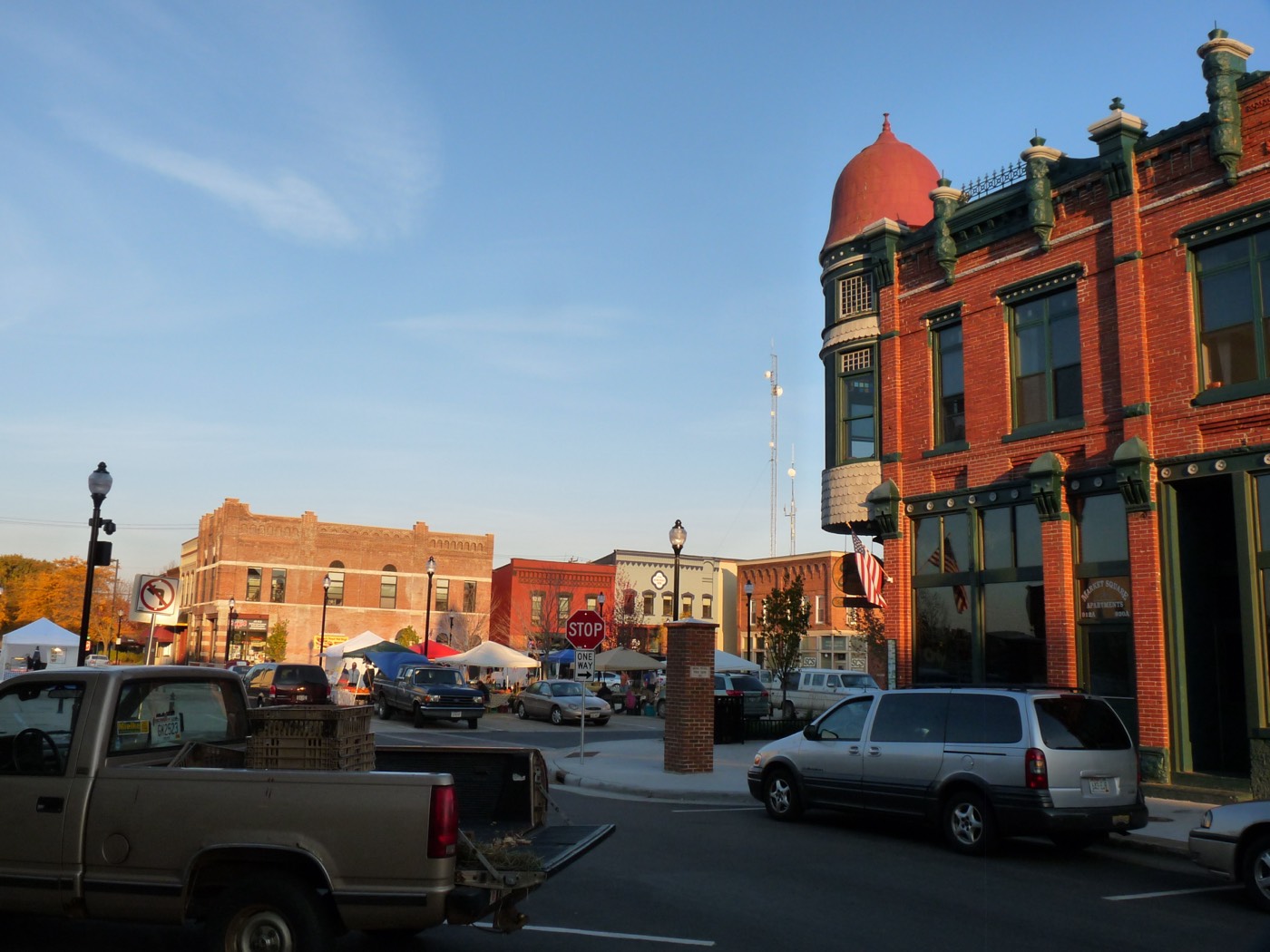
On the first Saturday morning of autumn, the Mathias Mitchell Public Square in downtown Stevens Point fills the way it has filled for more than a century and a half, with growers hauling potatoes and squash and cabbage from farms east of town. The market was started in 1870 by Polish farmers, and it never stopped. To understand the Polish in Stevens Point, Wisconsin, you start here, at the oldest farmers market in the state, then follow the wagon trail out into the rolling countryside where the largest rural Polish settlement in America took root.
The Place
Stevens Point sits on the Wisconsin River in the centre of the state, the seat of Portage County. It was platted in 1847 and incorporated in 1858, first as a logging and river town where craftsmen, businessmen and loggers gathered before their journeys downstream.
Today it is a small city of roughly 26,500 people, home to the University of Wisconsin-Stevens Point and its more than 7,000 students. It is also one of the most thoroughly Polish places in the United States, a fact written into its parishes, its surnames and its harvest festival.
How It Became Polish
The story does not begin in the city. It begins in the sandy farm townships ringing it, in the years just before the Civil War, when land in central Wisconsin was cheap and a Polish peasant could own outright what he could never have owned at home.
The first families, 1855 to 1857
Around 1855, six Polish families came down from Canada to the north-eastern part of Portage County, settling about eight miles east of Stevens Point near the Plover River. The corner they founded was first called Poland Corner, and it would become Polonia, the oldest Polish parish and settlement in Wisconsin.
In 1857 the man often remembered as the patriarch arrived. Michael Von Koziczkowski came with his wife and their nine children, drawn by the promise of inexpensive farmland near the Wisconsin River. A year after he settled, three more Polish families he had written to back home decided to follow.
That was the pattern: a letter, a name, a place to aim for. Chain migration carried family after family across the Atlantic to the same few townships, until the countryside east of Stevens Point spoke Polish.
Land and the dream of owning it
The pull was land, plain and simple. The men and women who came wanted to own a farm, something all but impossible for a peasant under Prussian rule in partitioned Poland. Affordable acreage in the towns of Sharon and Stockton drew them, and there they formed a colony where they could be neighbours to one another.
After 1860, more than half of all immigrants arriving in the area were Polish. Out of that nucleus grew what historians call the most important Polish-American agricultural settlement in Wisconsin, and one of the first large Polish communities anywhere in the United States. Where industrial cities drew Poles into factory wards, as they did with the Polish community on Milwaukee’s South Side, Portage County drew them onto the land.
The church follows the plough
Where the farmers went, the parish followed. In 1871 Father Joseph Dabrowski moved his congregation from Ellis to a new site he named Polonia, away from the rowdy saloons of the old location. The parish eventually took the name Sacred Heart.
It grew into the largest rural Catholic parish in Wisconsin. Dabrowski wrote to the Felician Sisters, a young order founded in Krakow, and in 1874 five of them arrived to open a parish school and teach the Polish children in their own language. According to historical records of Polonia, the settlement became a self-sustaining Polish world of its own. By 1907 the parish counted 320 families, the school taught 200 students, and the complex included an orphanage for 46 boys.
This was how the community held together: not only by land and language but by the rhythms of a Polish Catholic year, the feast days, the harvest blessing, the funerals that filled the country cemeteries with names ending in -ski and -czyk.
Into the city
For decades the heart of Polonia was rural. Then the Poles came into Stevens Point itself, and by the early twentieth century there were enough of them on the east side to want a parish of their own.
In 1916 Bishop Paul Peter Rhode bought land on the east side of the city for a community of about 150 Polish immigrant families. They chose as their patron Saint Stanislaus Kostka, a sixteenth century Polish novice, and built their church. The first parish picnic, held in the summer of 1918 at what was then Waterworks Park, now Bukolt Park, cleared a remarkable profit of $3,000.
By then the Polish presence in Portage County was no longer a frontier curiosity. At the turn of the twentieth century more than a third of the county was of Polish descent, the largest rural Polish population in the state. Stevens Point would come to claim one of the highest per-capita concentrations of Polish Americans in the country.
The Landmarks
Mathias Mitchell Public Square, downtown Stevens Point. The square was part of the original 1847 plat of the city, and in 1870 Polish farmers began selling crops, eggs, animals and vegetables here. The market they started is Wisconsin’s longest-running farmers market, still trading on the same ground, as the Stevens Point Area visitor office documents. The surrounding Mathias Mitchell Public Square-Main Street Historic District was added to the National Register of Historic Places in 1986.
Sacred Heart of Jesus Parish, Polonia. About eight miles east of the city, this is the mother church of Wisconsin Polonia, founded when Father Dabrowski moved the parish to its new site in 1871. It grew into the largest rural Catholic parish in the state, with a Felician school from 1874 and, by 1907, an orphanage attached. The settlement around it gave its name to the unincorporated community of Polonia.
St Stanislaus Kostka Parish, east side of Stevens Point. Built from 1916 onward for some 150 Polish families on land purchased by Bishop Rhode, the parish marked 100 years of worship in 2018. Named for a sixteenth century Polish Jesuit novice, it remains a centre of east-side parish life, with a tradition of picnics that reaches back to that first 1918 gathering at Bukolt Park.
Pacelli Catholic Schools, north side of Stevens Point. Pacelli High School was founded in 1955 and in the early 1970s merged with the all-girls Maria High School to become co-educational. For generations of Polish Catholic families the Pacelli system has carried forward the schooling tradition the Felician Sisters began in the country parishes.
Polish Heritage Trail, Stevens Point Area. A self-guided driving route through the rolling rural countryside east of the city, the trail threads together the churches, cemeteries and crossroads of the first Polish rural settlement in Wisconsin and the second in the United States. Interpretive markers at McGlachlin Park in town help tell the same story for visitors who stay closer to downtown.
Heritage Park and the Portage County Historical Society. The historical society preserves and interprets local history, including the Polish farming heritage, through Heritage Park and its collection of historic buildings. It is the institutional keeper of the documents, photographs and family papers that trace the colony from the 1850s forward.
Casimir Pulaski monument, Stevens Point. The city honours the Polish-born Revolutionary War cavalry general Casimir Pulaski with a public bust, a small civic nod to the wider Polish story that the local community grafted onto its own. It is a reminder that this Polonia saw itself as part of a national Polish-American narrative, not only a Wisconsin one.
Where They Came From
Most of the Poles who reached Portage County before the Civil War came from one region: Kaszuby, the area of West Prussia that is now part of northern Poland. The Kashubians were a distinct people with their own dialect, devoutly Catholic, accustomed to poor sandy soils not unlike the land they found in central Wisconsin. The same West Prussian and Kashubian origins shaped Polish enclaves far from the farm, from the Polish community in Erie, Pennsylvania to the Polish parishes of South Bend, Indiana and the mill towns where Toledo’s Poles settled.
That match mattered. The townships of Sharon, Stockton and Hull were not prime farmland, but to families used to scratching a living from thin Baltic ground, the chance to own that ground was everything. They planted potatoes and the other hardy crops that have defined Portage County agriculture ever since.
The migration moved in tight chains. One family wrote home, named the place, and kin and neighbours followed to the same parish, the same crossroads, sometimes the same road. It is why the surnames in the country cemeteries cluster so closely, and why the dialect and customs of a corner of West Prussia survived for generations in the woods of Wisconsin.
Stevens Point Today
The farms are still there, and so is the market. Each September the city throws the Dozynki Harvest Festival, organised by the Polish Heritage Awareness Society of Central Wisconsin. Dozynki is the Polish word for a harvest celebration, held to mark the end of the farming season, and the two-day event downtown brings food, dancing, music and history, along with the Dozynki scholarships the society awards to local students.
The Polish ancestry has not faded into abstraction. In the city’s north neighbourhoods roughly three in ten residents still report Polish descent, among the highest concentrations of any neighbourhood in the country. Polish is consistently one of the most distinctive ancestries in Stevens Point when measured against the national average. It is a different kind of Polonia from the dense urban blocks of Polish Wallington, New Jersey, and a reminder that Wisconsin’s Polish story sits alongside the state’s many other heritage towns, from German Milwaukee to the Danish and Norwegian settlements further south.
It is an honest kind of heritage now, less a living immigrant culture than a deeply rooted inheritance, kept up through parishes, the historical society, the heritage trail and one stubborn autumn festival. The Felician school in Polonia and the farm wagons at Mathias Mitchell Square belong to the same long story, and in Stevens Point that story is still, quietly, being told.
Frequently Asked Questions
When did the Polish first settle in Stevens Point, Wisconsin?
The first Polish families settled in the Stevens Point area in the mid-1850s, with six families arriving from Canada around 1855 to found what became Polonia east of the city. Michael Von Koziczkowski brought his family in 1857, and chain migration accelerated through the 1860s.
Why did so many Polish immigrants come to Stevens Point?
They came for cheap farmland near the Wisconsin River and the chance to own land outright, which was nearly impossible for peasants in partitioned Poland. Most came from the Kaszuby region of West Prussia, and once a few families settled, relatives and neighbours followed in tight migration chains.
How Polish is Stevens Point today?
Stevens Point remains one of the most Polish places in the United States. In the city’s north neighbourhoods around 30 percent of residents report Polish ancestry, and the wider county holds one of the highest per-capita Polish-American populations in the country. The Polish in Stevens Point are woven into the city’s parishes, surnames and traditions.
What is the Dozynki Harvest Festival?
Dozynki is the Polish word for a harvest festival, and the Stevens Point Dozynki is an annual September event run by the Polish Heritage Awareness Society of Central Wisconsin. Held downtown to mark the end of the farming season, it features Polish food, dancing, music, history and family activities.
What is Polonia, Wisconsin?
Polonia is an unincorporated community about eight miles east of Stevens Point, home to Sacred Heart parish, which grew from a settlement Father Joseph Dabrowski founded in 1871. It became the largest rural Catholic parish in Wisconsin and is regarded as the oldest Polish parish and settlement in the state.
Where can I learn about Polish heritage in Stevens Point?
Start with the self-guided Polish Heritage Trail through the rural townships, the interpretive markers at McGlachlin Park, and the Portage County Historical Society’s Heritage Park. The Mathias Mitchell Public Square farmers market, started by Polish farmers in 1870, and the annual Dozynki festival are living parts of the same story.
If your family’s story passed through Stevens Point, or any of the places Polish immigrants have made home in America, Atlas of Home can trace that journey. From a Kaszubian village in West Prussia to a potato farm in the town of Sharon, to wherever you are now.