
On the corner of Granby and Fife Streets, a domed cathedral has anchored the Greeks in Norfolk for seven decades, but the story begins much earlier, in 1898, when a single immigrant named John Gretes stepped off into a port city that ran on ships, sailors and the steady rhythm of the harbour. What followed was a community built one confectionery counter, one coffeehouse and one baptism at a time.
The Place
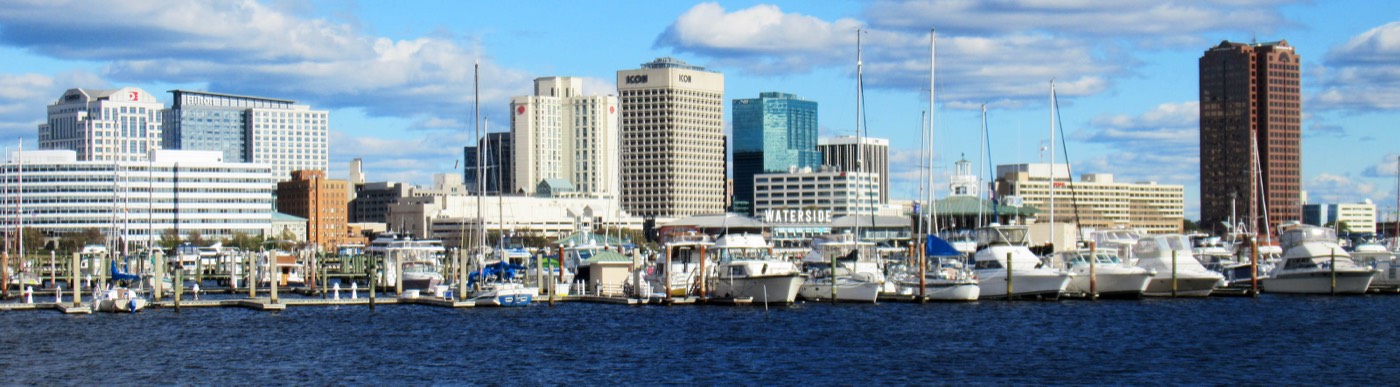
Norfolk sits at the mouth of the Chesapeake Bay, on one of the world’s largest natural deep-water harbours. The town was incorporated in 1705, burned almost to the ground during the War of Independence, and rebuilt itself into a transport hub once the railways arrived in the 1870s.
The First World War brought the naval base that would define everything after. Naval Station Norfolk grew into the largest naval installation in the world, and the city’s economy has been tied to the port and to defence work ever since.
It is a place of arrivals and departures by nature. For an immigrant community, that constant traffic of people and goods was both an opportunity and a backdrop, and the Greeks who came here learned to read it well.
How It Became Greek
The Greek presence in Norfolk did not arrive in a wave. It accumulated, family by family, in the years on either side of 1900, when southern Greece was emptying out and American port cities were filling up.
The First Arrivals
John Gretes is remembered as Norfolk’s first Greek immigrant, settling in the city in 1898. Shortly after came George Christopoulos and his wife Paraskevi, names that recur again and again in the early parish records as founding parishioners.
For a few years the community was too small to support a priest of its own. Their spiritual needs were met on an irregular basis by a clergyman who travelled down from Baltimore to serve the Liturgy, borrowing the facilities of a local Episcopal church when he came.
That arrangement could not last. As the community’s leader, George Christopoulos pulled together a small committee and raised three hundred dollars, enough to appoint a priest and begin a building fund. On 3 March 1911, the first Divine Liturgy was celebrated by the Rev. Fr. George Smyrnakis, and the Annunciation parish was born.
A Congregation Takes Shape
In 1913 the parish held its first general assembly and elected George Christopoulos as its first board president. The community was now formally organised, with officers, a treasury and ambitions beyond a borrowed sanctuary.
In 1919 the parish purchased a church building at Freemason and Cumberland Streets, in what is today Norfolk’s Freemason Historic District. For the first time the Greeks of Norfolk had a home of their own, a place to baptise children, marry couples and bury their dead according to the rites they had carried across the Atlantic.
The interwar years were not easy ones for Greek immigrants in the American South. In the 1920s the Ku Klux Klan turned its hostility on Americans of Greek heritage, and Greek-owned confectioneries and restaurants in several states were boycotted, some sold off at sacrificial prices. It was in part as a response to that climate that a fraternal order took root in Norfolk.
The AHEPA Years
On 2 November 1926, twenty-six Americans of Greek extraction met in the old Eagle Hall on Church Street and formed Chapter 122 of the American Hellenic Educational Progressive Association. Sam Douros was elected first president, and George Pahno became first secretary, a post he would hold for almost fifty years.
The chapter became one of the engines of the community. Over the decades it raised tens of thousands of dollars for the church, much of it by selling Greek food at Norfolk’s annual Harborfest, and it awarded more than four hundred thousand dollars in scholarships to local young people.
Several of its members rose to prominence well beyond the parish hall. Gus James II went on to become Supreme President of the national order. Peter Babalas, the son of Greek immigrants, served in the Virginia Senate from 1968 until his death in 1987, and John Joanou sat in both the House of Delegates and the State Senate.
The Cathedral on Granby Street
By the 1940s the Freemason Street church could no longer hold a growing congregation. A building fund drive began in 1943, and in 1947 the general assembly authorised the purchase of a parcel of land at Granby and Fife Streets, the parish’s present location.
Construction of the new church began in 1952. Groundbreaking ceremonies followed in 1953, the cornerstone was laid in 1954, and on 27 March 1955 the first services were held in the new Annunciation church on Granby Street. The Hellenic Center, the social and cultural heart of the community, opened on 8 March 1959.
The campus kept growing. On 14 December 2003, Saint Theodore’s Chapel was consecrated, and at some point the parish was elevated to cathedral status, a recognition of its standing in the Greek Orthodox Archdiocese of America. The story of the Greeks in Norfolk is, in large part, the story of this one corner growing outward across a century.
The Landmarks
Annunciation Greek Orthodox Cathedral, 7220 Granby Street. The spiritual centre of the community since 1955, this is where Norfolk’s Greeks have worshipped, married and mourned for three generations. The cathedral sits within a campus that includes the Hellenic Center and Saint Theodore’s Chapel, and it remains the gravitational pull of Greek life across Hampton Roads.
The Norfolk Greek Festival, 7220 Granby Street. Held each year in May on the cathedral grounds, the festival opens the campus to the wider city for four days of food, dance, church tours and fellowship. Its proceeds support food banks, shelters and youth programmes, turning a celebration of heritage into a gift back to the neighbours who come to share it.
Orapax Restaurant, 1300 Redgate Avenue. In 1966 Louis Seretis bought a small confectionery and named it Orapax, after the street its front door opened onto. In 1973 he replaced the sandwich menu with his own original Greek pizza, his son Nick joined the business in 1982, and Nick’s daughter Nicole now works the same floors, three generations into a Hampton Roads institution.
The Freemason Historic District. The Greek community’s first church of its own, purchased in 1919, stood in this district at Freemason and Cumberland Streets. Walking these cobbled streets today is a way of standing where the congregation first put down roots before the move to Granby Street.
The Hellenic Center, 7220 Granby Street. Opened in 1959, this is the hall where the community dances, eats, debates and raises its children in the Greek tradition. Festivals are staged here, Greek school is held here, and the AHEPA and Philoptochos ministries do much of their work within its walls.
Saint Theodore’s Chapel, 7220 Granby Street. Consecrated on 14 December 2003, the chapel is the newest addition to the cathedral campus, a quiet space that marks the community’s continued investment in its spiritual home well into the twenty-first century.
Where They Came From
The Greeks who settled Norfolk were part of one of the great emigrations of the modern Mediterranean. Heavier emigration from the Peloponnese began in the 1870s and peaked between 1890 and 1910, when an estimated three-quarters of the young men of the Sparta region left for the United States.
The catalyst was economic. The collapse in the price of currants, Greece’s principal export crop, devastated the rural Peloponnese in the 1890s, and in the period from 1890 to 1911 the region accounted for well over half of all Greek emigrants. Where one villager went, others followed, in the classic pattern of chain migration that carried whole hometowns across the ocean.
Many of these men arrived without families, without English and without capital, and they gravitated to a familiar set of trades. Across the country in the 1920s, Greeks owned thousands of confectionery shops and the candy factories that supplied them, and when that business faltered they moved into restaurants. Norfolk’s Greek immigrants followed the same arc, from coffeehouse to confectionery to the diner counter, building livelihoods one storefront at a time, much as the Greeks of Salt Lake City and the Greeks of Peabody did in their own corners of the country.
Norfolk Today
The Greek community in Norfolk is no longer a colony of new arrivals. It is a settled, multi-generational presence, its families woven into the professional, civic and commercial life of a city of more than 230,000 people.
The cathedral remains the centre of gravity, and the Greek Festival each May is one of the few moments when the whole of Hampton Roads is invited inside. The food is still made by hand, the dances are still taught to children, and the proceeds still flow outward to the city’s hungry and its young. It is heritage performed in public, and it draws crowds.
What has changed is the texture of daily life. The confectionery counters and coffeehouses of the early years have largely given way to fewer, longer-lived institutions like Orapax, now half a century old and run by the founder’s granddaughter. The community is smaller and more dispersed than it once was, but its anchor on Granby Street is unmistakably permanent, and its story sits alongside those of other long-established Greek communities, from the Greeks of Pittsburgh to the Greeks of Charlotte, as a southern chapter of a national diaspora.
Frequently Asked Questions
When did the Greeks first settle in Norfolk, Virginia?
John Gretes is remembered as Norfolk’s first Greek immigrant, arriving in 1898. The Greeks in Norfolk grew steadily over the following decade, and the Annunciation parish was formally founded with its first Divine Liturgy on 3 March 1911.
Where do the Greeks in Norfolk worship?
The community worships at the Annunciation Greek Orthodox Cathedral at 7220 Granby Street, which has been its spiritual home since the first services there on 27 March 1955. The campus also includes the Hellenic Center and Saint Theodore’s Chapel.
When is the Norfolk Greek Festival held?
The Norfolk Greek Festival is held each year in May on the grounds of the Annunciation Greek Orthodox Cathedral on Granby Street. It features Greek food, traditional dancing, church tours, and its proceeds support local food banks, shelters and youth programmes.
Where did Norfolk’s Greek immigrants come from?
Most early Greek immigrants to the United States, including those who settled in southern cities like Norfolk, came from the Peloponnese in southern Greece, especially the Sparta region of Laconia and the province of Arcadia. Emigration surged after the collapse of the currant trade in the 1890s.
What is AHEPA Chapter 122 in Norfolk?
AHEPA Chapter 122 is a chapter of the American Hellenic Educational Progressive Association, founded in Norfolk on 2 November 1926 by twenty-six men meeting in the old Eagle Hall on Church Street. It has raised funds for the cathedral and awarded more than four hundred thousand dollars in scholarships over the decades.
Are there historic Greek businesses still operating in Norfolk?
Yes. Orapax Restaurant at 1300 Redgate Avenue began as a Greek-owned confectionery purchased by Louis Seretis in 1966 and is now run by his granddaughter, more than fifty years on. It is one of the longest-running Greek family businesses serving the Greeks in Norfolk and the wider Hampton Roads area.
If your family’s story passed through Norfolk, or any of the places Greeks have made home in America, Atlas of Home can trace that journey. From a village in the Peloponnese to a confectionery counter on Granby Street, to wherever you are now.