
Stand on Dithridge Street in Oakland on a Sunday morning, and the chant carrying out of a 1904 sandstone portico will tell you something the census almost hides. The Greeks in Pittsburgh never built a single neighbourhood you could draw a line around. They built a faith, a few institutions, and a handful of family businesses, and then they scattered across the river valleys and held the whole thing together by showing up.
The Place
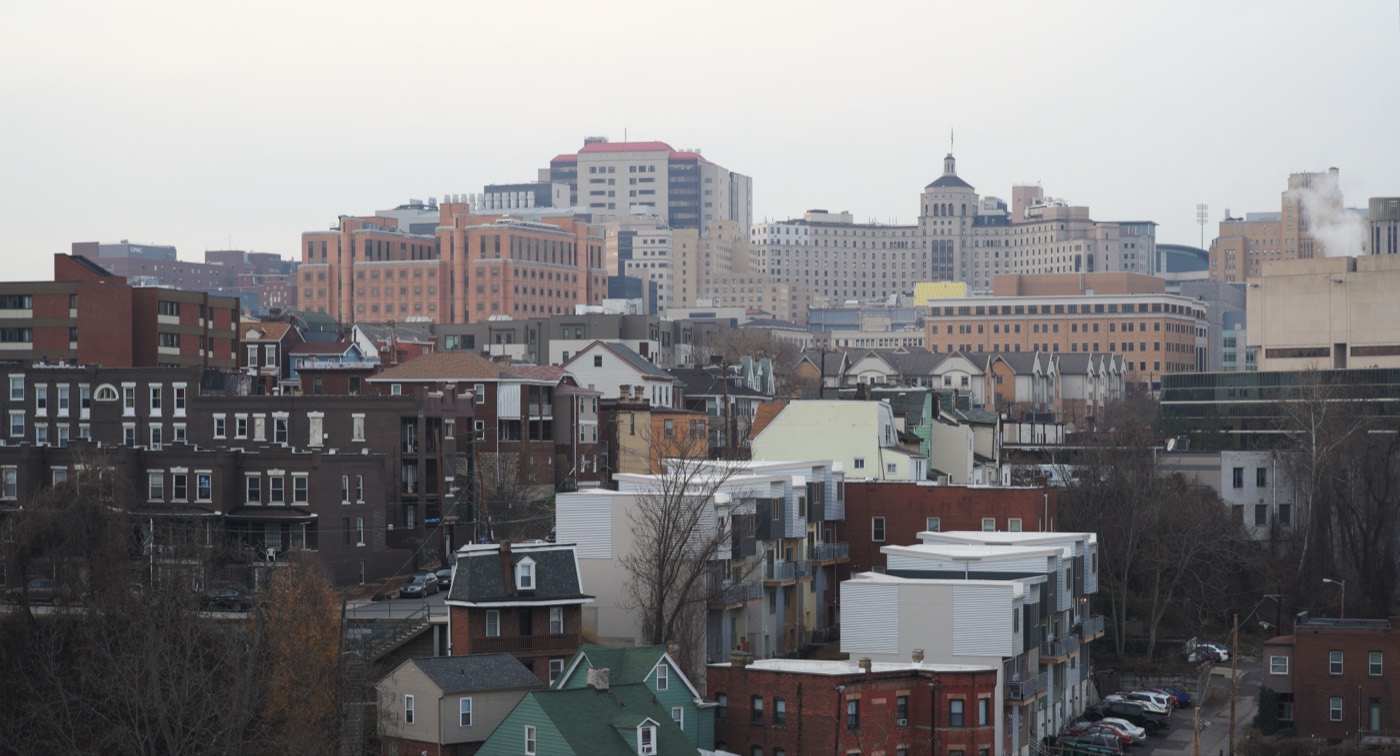
Pittsburgh is a city of hills, hollows and confluence, where the Allegheny and the Monongahela meet to form the Ohio. For a century its identity was iron and steel, and its mills drew immigrants from across southern and eastern Europe to a landscape of smokestacks and incline railways.
Oakland, a few miles east of downtown, became the city’s cultural acropolis: home to the University of Pittsburgh, the Carnegie museums, and the soaring Cathedral of Learning. It is here, on a quiet residential street beside the university, that the Greek community planted its spiritual seat. The South Hills, the North Side and the Strip District fill out the rest of the story.
How It Became Greek
The Greeks did not arrive in Pittsburgh in a wave. They arrived in a trickle that never quite stopped.
The first arrivals
By 1893 there were roughly fifty Greeks in Allegheny County, most of them young men from the islands and the mainland who had come to work and, they assumed, to leave. Some were enlisted by the city’s early industrialists for a specific and dangerous task: painting the buildings and smokestacks of the iron and steel mills.
An estimated three to four hundred Greek men had settled before the first Greek women arrived around 1903. That imbalance shaped the early years. Many men intended to earn quickly and sail home, and in 1912 roughly a fifth of Pittsburgh’s Greek male population returned to Greece to fight in the Balkan Wars.
A community that refused to cluster
Unlike the Poles of Polish Hill or the Italians of Bloomfield, the Greeks did not settle into one large enclave. They spread across the city, which made community life harder to assemble. Women in particular often remained isolated, with fewer Greek neighbours nearby and little chance to learn English.
What held them together was not geography but the church and the shop counter. Early Greeks moved quickly from manual labour into business, opening restaurants, confectionaries and coffee houses across the downtown and the Lower Hill.
The first church, and its move uphill
The earliest Greek Orthodox parish in Pittsburgh, St. Nicholas, began downtown on Wiley Avenue, in the Lower Hill District where Greeks, Italians, Jews and others lived shoulder to shoulder. When the congregation moved east to the then distant district of Oakland, it left a gap in the densely Hellenic North Side that a second parish would have to fill.
In 1923 the Greek Orthodox Church acquired a Classical Revival building at 419 South Dithridge Street in Oakland, a structure designed by architect Thomas Hannah and completed in 1904 for the First Congregational Church. It became, and remains, the seat of the Greek Orthodox Metropolis of Pittsburgh. In 1982 it was named a Pittsburgh History and Landmarks Foundation Historic Landmark.
The North Side answers back
That same year, 1923, the Greeks of the North Side founded Holy Trinity Greek Orthodox Church at the corner of Sandusky Street and Stockton Avenue. The first services were performed by Rev. Nicholas Papavasilis in April 1923.
The early years were lean. A dues collector named Peter Angelakos went door to door gathering monthly contributions of twenty-five cents. Men carried sand up from the nearby Ohio River to fill the stands that held the candles, and families took turns cooking meals for priests who often had no regular salary. By 1931 the parish had moved to 606 Sandusky Street.
Out to the South Hills
Around the Second World War, Pittsburgh’s immigrants began leaving the crowded river flats for the suburbs, and a sizeable Greek population settled in the South Hills. For them, the journey to Oakland or the North Side for worship was simply too far.
In the spring and summer of 1950, a group began meeting to plan a Greek Orthodox church of their own. A series of coffee hours grew into a general meeting at the American Legion Hall in Brookline that November, with ninety families in attendance. They held their first open house at Brookline Junction in 1952 and opened in a purchased Lutheran church in Mt. Lebanon in 1954. This was the parish that became Holy Cross.
A room in the Cathedral of Learning
The community’s confidence had a permanent home long before that. The idea for a Greek Nationality Room inside the University of Pittsburgh’s Cathedral of Learning began with a group of Greek-American Pitt students in 1928, who enlisted the small but growing Greek community of Western Pennsylvania to fund it.
Its Pentelic marble columns were shipped from Greece in a rush, reaching America before the war closed the Mediterranean to American shipping in 1940. The room was dedicated on 7 November 1941 before 1,500 people, with Archbishop Athenagoras, later the Ecumenical Patriarch, presiding. It remains one of the original Nationality Rooms honouring the immigrant groups of Western Pennsylvania.
The Landmarks
St. Nicholas Greek Orthodox Cathedral, 419 South Dithridge Street, Oakland. The mother church of Greek Pittsburgh, set behind a Grecian Ionic portico of sandstone. Inside, a dome painting of Christ Pantocrator rises against gold leaf, above an ornate iconostasis worked with mosaic and peacock imagery. It has been the seat of the Pittsburgh Metropolis since the 1920s.
Holy Trinity Greek Orthodox Church, originally Sandusky Street and Stockton Avenue, North Side. Born in 1923 of necessity, when the North Side’s Greeks were left without a parish of their own. Its early story, of door-to-door collections and river sand for candle stands, is the unromantic truth of immigrant institution-building. The congregation later moved north to McCandless, opening a new church in June 2013.
Holy Cross Greek Orthodox Church, 123 Gilkeson Road, South Hills. The suburban heart of the community, its gold dome completed in 1977 and now a recognised South Hills landmark. The current church was blessed in 1969 and consecrated by Archbishop Iakovos in 1971. Its annual Greek Food Festival, first held in 1972, has grown into the largest annual event in the South Hills.
Stamoolis Brothers, 2020 Penn Avenue, Strip District. A Mediterranean grocery founded in the early 1900s by five brothers who came over from Greece. More than a century on it still trades in feta and olives, fillo dough and spanakopita, baklava and Greek pastries, supplying both home cooks and the city’s restaurants.
The Greek Nationality Room, Cathedral of Learning, University of Pittsburgh, Oakland. A classroom built as a love letter to the Greek Golden Age, its columns patterned after the Acropolis and carved from marble shipped before the war. Dedicated in 1941, it teaches the city’s students inside a small piece of Athens.
The Greek Orthodox Metropolis of Pittsburgh, Ellsworth Avenue. The administrative centre of Greek Orthodoxy across Western Pennsylvania and beyond, overseeing nearly a dozen parishes in and around the city. From here the calendar of feasts, festivals and Greek-language education radiates out across the region.
The Holy Cross Greek Food Festival, Gilkeson Road, South Hills. Each June the parish hall and grounds fill with the smell of lamb, the rhythm of dancing and trays of pastry, drawing Pittsburghers of every background. For many in the city it is the most reliable annual encounter with Greek heritage, food first.
Where They Came From
The earliest Greek arrivals in Pittsburgh were drawn heavily from the islands. Positively Pittsburgh records that many of the first immigrants were sailors from the Greek islands, men accustomed to leaving and returning, who treated the industrial city as a place to earn rather than to stay.
They came from a Mediterranean world that could hardly have contrasted more sharply with the smoke and steel of the Monongahela valley. That contrast, and the early intention to go home, is why so many returned for the Balkan Wars in 1912, and why the community grew slowly and steadily rather than all at once.
Chain migration did the rest. A brother already painting smokestacks or running a confectionary would sponsor the next, and a family business in the Strip or a coffee house downtown became the anchor that turned sojourners into settlers. The same pattern played out wherever Greeks landed in America, from the mill town of Lowell, Massachusetts to the sponge docks of Tarpon Springs, Florida.
Pittsburgh Today
The numbers are modest and honest. In the Pittsburgh metropolitan area about 14,653 people report Greek ancestry, and the great majority of them, roughly 12,820, live in the suburbs rather than the old city neighbourhoods. The community that once clustered downtown and on the North Side now lives mostly in the South Hills and the spreading townships beyond.
That dispersal is the modern shape of an old pattern. The Greeks of Pittsburgh never had a Greektown to lose, the way Baltimore or Detroit did, so they did not lose one. What they kept instead were the institutions: the cathedral in Oakland, the suburban parishes, the festivals, the marble room in the Cathedral of Learning.
You feel it most in June, when the Holy Cross festival turns a South Hills parish into a fairground of food and folk dancing, and in the Strip, where Stamoolis Brothers still slices feta from the same family that started a hundred years ago. The community is small, scattered and quietly durable. It survives the way it began, around a church door and a shop counter.
Frequently Asked Questions
Where do the Greeks in Pittsburgh live?
The Greeks in Pittsburgh have never concentrated in a single neighbourhood. The spiritual centre is St. Nicholas Cathedral in Oakland, but today most of the roughly 14,653 people of Greek ancestry in the metro area live in the suburbs, particularly the South Hills, rather than the city core.
When did Greeks first settle in Pittsburgh?
Greek immigrants began arriving in Allegheny County in the 1890s, with about fifty recorded by 1893. Most were young men, often sailors from the Greek islands, who came to work in the mills and as painters of the city’s smokestacks before women began arriving around 1903.
What is the main Greek Orthodox church in Pittsburgh?
St. Nicholas Greek Orthodox Cathedral at 419 South Dithridge Street in Oakland is the seat of the Greek Orthodox Metropolis of Pittsburgh. The Greek community acquired the 1904 Classical Revival building in 1923, and it was named a Pittsburgh History and Landmarks Foundation Historic Landmark in 1982.
Is there a Greek festival in Pittsburgh?
Yes. The Holy Cross Greek Food Festival in the South Hills, first held in 1972, has become the largest annual event in the area, and several other Greek Orthodox parishes hold their own festivals through the year. They are among the most popular ways Pittsburghers encounter Greek food and culture.
Why didn’t Pittsburgh develop a Greektown?
Unlike many other immigrant groups, the Greeks in Pittsburgh did not settle into one large area but scattered across the city. They built community through the church, family businesses and institutions like the Greek Nationality Room rather than through a single residential enclave.
Where can I buy Greek food in Pittsburgh?
Stamoolis Brothers at 2020 Penn Avenue in the Strip District is a long-standing Greek and Mediterranean grocery, founded in the early 1900s by five brothers from Greece. It still sells feta, olives, fillo dough, baklava and other Greek staples to home cooks and restaurants alike.
If your family’s story passed through Pittsburgh, or any of the places Greeks have made home in America, Atlas of Home can trace that journey. From the islands of the Aegean to a sandstone cathedral on Dithridge Street, to wherever you are now.