
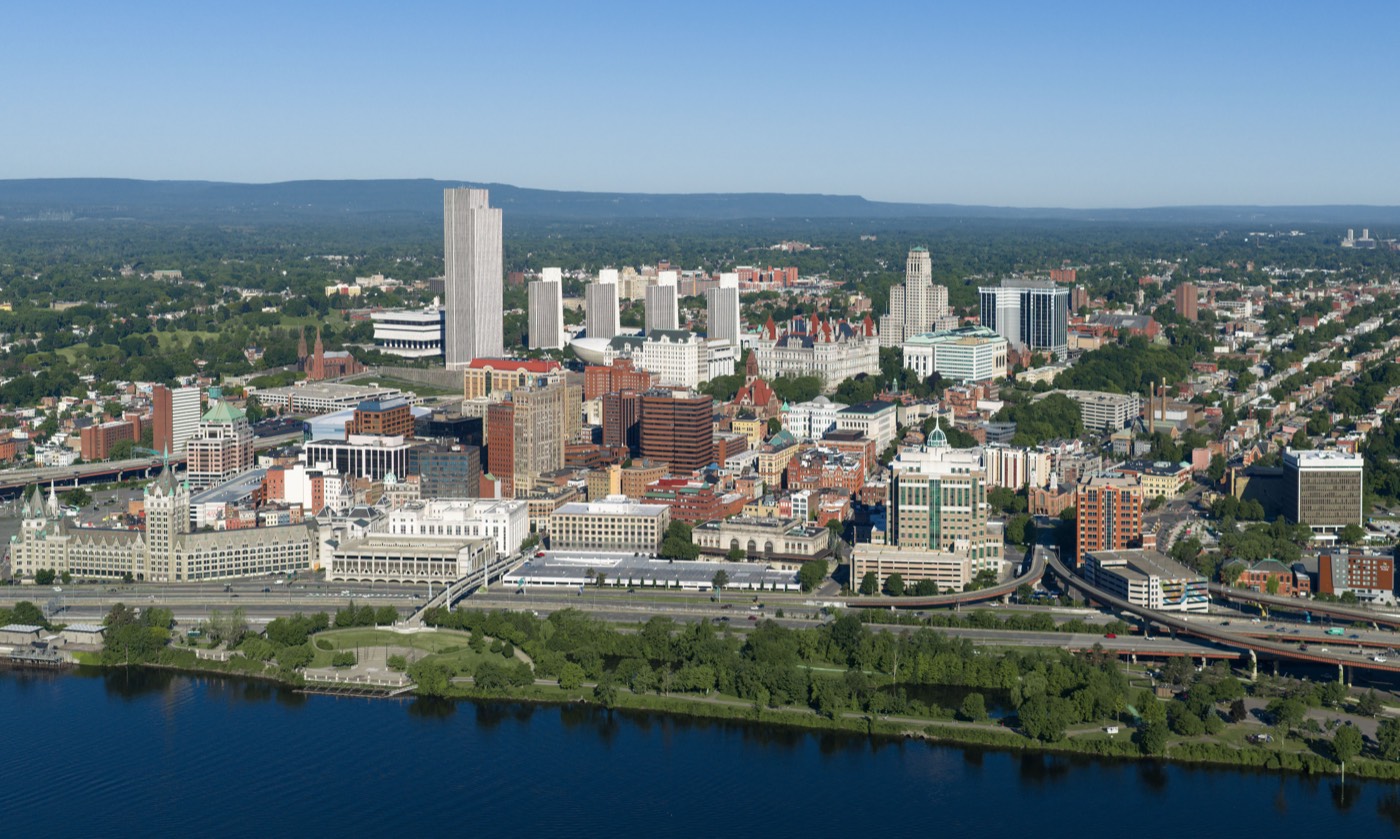
Stand at the foot of State Street on a grey March morning, watch the parade banners climb the hill toward the Capitol, and you are looking at a city the Irish helped invent. The story of the Irish in Albany is not a footnote to the city’s history. For a century and a half it was the city’s history, written in canal mud, church stone, and the ledgers of a political machine that ran the state capital from a clubhouse rather than City Hall.
The Place
Albany sits on the west bank of the Hudson River, roughly 150 miles north of New York City, and it has been a place of consequence far longer than most American cities. Chartered in 1686, it became the capital of New York State in 1797 and grew into a river port where everything moving between the Atlantic and the Great Lakes had to pass.
That geography is the whole story. When the Erie Canal opened its eastern terminus here, Albany turned almost overnight into a funnel for goods, timber, and labour. The labour, in large part, was Irish.
Today the skyline is dominated by the marble slabs of the Empire State Plaza and the spires of a cathedral built by famine refugees. Both belong to the same long arc.
How It Became Irish
The Irish did not arrive in Albany as a single wave. They came in stages, each tied to the work the city happened to be offering.
The canal years
The first significant influx followed the digging of the Erie Canal, begun in 1817 and reaching Albany in the 1820s. The canal needed men to break ground with shovels and barrows, and it found them among the Irish already drifting up the Hudson from the port of New York.
The work was brutal and badly paid, and it was performed in conditions that killed many. But it put down roots. Men who came to dig stayed to load barges, stack lumber, and stoke the iron foundries that opened at both ends of the city.
The Irish settled first in the low ground near the water. The neighbourhood around the canal’s entrance was known simply as The Basin, a crowded riverside quarter of boarding houses, taverns, and labourers’ families.
Famine and the great surge
The decisive change came with the Great Famine. From the mid 1840s, Irish men, women, and children fleeing starvation poured into Albany in numbers that reshaped the city’s character. By the middle of the nineteenth century the Irish had become Albany’s largest immigrant group.
They were overwhelmingly Catholic, and they arrived in a city whose institutions were Dutch and Protestant in origin. The friction was real, but so was the sheer weight of numbers, and the Irish built their own world in response.
The Cathedral of the Immaculate Conception, raised on Eagle Street at Madison Avenue between 1848 and 1852, was the most visible answer. Designed by the Irish American architect Patrick Keely in the Gothic Revival style, it rose to serve a Catholic population swollen by famine refugees. Many of its first parishioners had survived the crossing only a year or two before.
North Albany and Limerick
As the city grew, the Irish spread north. The Albany Lumber District, fed by canal traffic, became by the 1870s the largest lumber market by value in the United States, and the Irish who worked it gave their corner of North Albany a name that stuck: Limerick.
It was a tight, self contained district of mill hands and dock workers, anchored by Sacred Heart Church, built on Walter Street in 1876 to serve the growing congregation. Limerick kept its identity long after the lumber piles were gone. North Albany held its first St Patrick’s Day parade in 1950, a year before the citywide parade began, and it has run ever since, famously refusing to cancel even when more than twenty inches of snow fell in 1993.
From numbers to power
Numbers became votes, and votes became office. In May 1878 Albany elected Michael Nicholas Nolan as mayor. Born in County Carlow in 1833 and brought to Albany as a boy of ten, Nolan was an Irish Catholic immigrant and a partner in the Beverwyck Brewery, trading as Quinn and Nolan. He is frequently cited as among the earliest Irish born Catholics to lead a major American city, and he served until 1883, sitting in the United States House of Representatives at the same time.
Nolan was a sign of things to come. The Irish were no longer simply the men who dug and hauled. They were learning to govern, and in the next century one Irish family would govern Albany more completely than almost anyone has governed an American city before or since.
The machine
That family was the O’Connells. Daniel Patrick O’Connell, born in Albany in 1885, a fifth grade dropout who had worked as a bricklayer and bartender, helped engineer a Democratic upset in the 1921 mayoral election that broke a long Republican grip on the city.
For the next fifty six years, until his death in 1977, Dan O’Connell controlled the political life of Albany. He rarely held office himself. He ran the Democratic Party, and through it the patronage, the jobs, the tax assessments, and the favours that bound a city of voters to a clubhouse.
His chosen mayor, Erastus Corning 2nd, held office from 1942 until 1983, longer than any mayor of any American city. But the real power sat with O’Connell. It was a machine in the old sense, run on loyalty and the small daily transactions of an Irish ward politics that had crossed the Atlantic and thrived. For Albany’s Irish, it proved that the people once kept at the bottom of the city could end up holding all of it.
The Landmarks
Cathedral of the Immaculate Conception, Eagle Street at Madison Avenue. Built between 1848 and 1852 to Patrick Keely’s Gothic Revival design, this is the mother church of the Diocese of Albany and the spiritual heart of the city’s Catholic Irish. Its twin spires rose later, the north tower finished in 1862 and the south in 1888. Most of its first worshippers were famine survivors.
St Mary’s Church, Lodge Street. The congregation dates to 1797, making it the second oldest Catholic parish in New York State after St Peter’s in Manhattan, and the first in upstate New York. As Irish immigration swelled through the nineteenth century, St Mary’s became one of the community’s oldest and most beloved anchors.
Irish American Heritage Museum, 21 Quackenbush Square. The only museum of its kind in the region tells the story of the Irish in America from a 10,000 square foot home in one of Albany’s oldest surviving buildings. It moved here after outgrowing a space on Broadway, and now shares a courtyard with a neighbouring pub, which feels about right.
McGeary’s Irish Pub, 4 Clinton Square. A downtown fixture pouring more than two dozen beers on tap, McGeary’s is the kind of pub where the St Patrick’s season runs long and the music is live. It carries forward a tavern tradition as old as the Basin itself.
Sacred Heart Church, Walter Street, North Albany. Built in 1876 to serve the lumber district Irish of Limerick, Sacred Heart was for generations the parish that defined the neighbourhood. As the old congregation thinned, it became, by 1999, the first Catholic church in Albany to be led by a deacon, a quiet marker of how much had changed.
St Peter’s Hospital, founded 1869. Opened with thirty three beds after the widow of Peter Cagger funded the conversion of an orphan asylum, St Peter’s grew out of the same Catholic charitable impulse that built the parishes. It began as a refuge for an immigrant community that had nowhere else to turn when sickness came.
The North Albany Limerick St Patrick’s Day Parade. Not a building but a ritual, this neighbourhood march has run every March since 1950, older than the citywide parade and prouder of its endurance. In 1993 it stepped off through a blizzard rather than break the streak.
Where They Came From
Albany’s Irish came, like so many, from the rural west and south of Ireland, the counties hit hardest by the collapse of the potato in the 1840s. Michael Nolan’s County Carlow, in the southeast, was one thread among many.
What pulled them specifically to Albany was work, and the chain that work created. A man who found a place loading lumber or laying brick wrote home, and a cousin or a brother followed to the same yard, the same boarding house, the same parish pew. Migration ran in human channels, family by family, townland by townland.
By the time the famine generation had children and grandchildren, the connection to specific Irish places had softened into a broader sense of being Albany Irish, a thing made in the city rather than carried whole from across the sea.
Albany Today
The Basin is gone, its canal filled and built over. Limerick is a name remembered more than a place inhabited, its lumber piles long vanished and its parish diminished. The O’Connell machine is history, studied now as a case in how American cities were once run.
Yet the Irish thread has not disappeared. It has dispersed into the suburbs and the wider Capital Region, the way ethnic neighbourhoods everywhere eventually loosen. The cathedral still holds Mass. McGeary’s still pours. The heritage museum still gathers the records of a community that, for much of the nineteenth and twentieth centuries, was Albany as much as Albany was anything.
And every March the parades still climb the hills, downtown and in old Limerick, a city remembering out loud where it came from. The Albany Irish were never only a community within the city. They were one of the forces that made the modern city exist.
The same pattern of Irish labour, faith, and politics shaped other northeastern mill and canal towns, from the textile cities of the Irish in Lowell, Massachusetts and the Irish in Holyoke, Massachusetts, to the Irish in Worcester, Massachusetts and the Irish in Braintree, Massachusetts. Read together, they trace how the famine generation built the Catholic Northeast.
Frequently Asked Questions
When did the Irish first settle in Albany?
The first significant Irish settlement in Albany followed the construction of the Erie Canal, begun in 1817 and reaching the city in the 1820s. Irish labourers dug the canal and worked the foundries, settling in a riverside quarter known as The Basin. A far larger wave arrived during and after the Great Famine of the 1840s.
Why did so many Irish come to Albany?
Work drew them. As the eastern terminus of the Erie Canal, Albany offered canal digging, lumber handling, brickmaking, and foundry jobs that suited newly arrived labourers. The Irish in Albany grew through chain migration, with each settled worker drawing relatives from the same Irish counties to the same yards and parishes.
What was North Albany’s Limerick?
Limerick was the nickname for the heavily Irish section of North Albany, named for the Irish who worked the Albany Lumber District, which by the 1870s was the largest in the United States by value. It was anchored by Sacred Heart Church, built in 1876, and is still home to a St Patrick’s Day parade that has run every year since 1950.
Who was Albany’s first Irish Catholic mayor?
Michael Nicholas Nolan, born in County Carlow in 1833 and brought to Albany as a boy, was elected mayor in May 1878 and served until 1883. An Irish Catholic immigrant and brewer, he is frequently cited as among the earliest Irish born Catholics to lead a major American city, and he also served in Congress.
What was the O’Connell machine?
The O’Connell machine was the Democratic political organisation that controlled Albany from 1921 onward, led by Daniel P. O’Connell until his death in 1977. It exemplified Irish American ward politics, governing through patronage and personal loyalty, and kept its chosen mayor, Erastus Corning 2nd, in office from 1942 to 1983.
Can I still see Irish Albany today?
Yes. The Cathedral of the Immaculate Conception and St Mary’s Church still stand, the Irish American Heritage Museum at Quackenbush Square preserves the community’s records, and pubs like McGeary’s keep the tavern tradition alive. Each March, parades downtown and in old Limerick mark the Irish in Albany in the most public way the city knows.
If your family’s story passed through Albany, or any of the places the Irish have made home in America, Atlas of Home can trace that journey. From a townland in County Carlow or the famine roads of the west, to a boarding house in the Basin or a parish pew in Limerick, to wherever you are now.