
On a July evening in Springfield’s South End, a marching band turns onto Winthrop Street, a statue of the Madonna sways on the shoulders of men in dark suits, and the smell of meatball grinders drifts from a folding table. The Italians in Springfield, Massachusetts have been staging some version of this scene since 1897, and after a twenty-year silence, they are staging it again. The neighbourhood around them has changed almost beyond recognition. The procession has not.
The Place
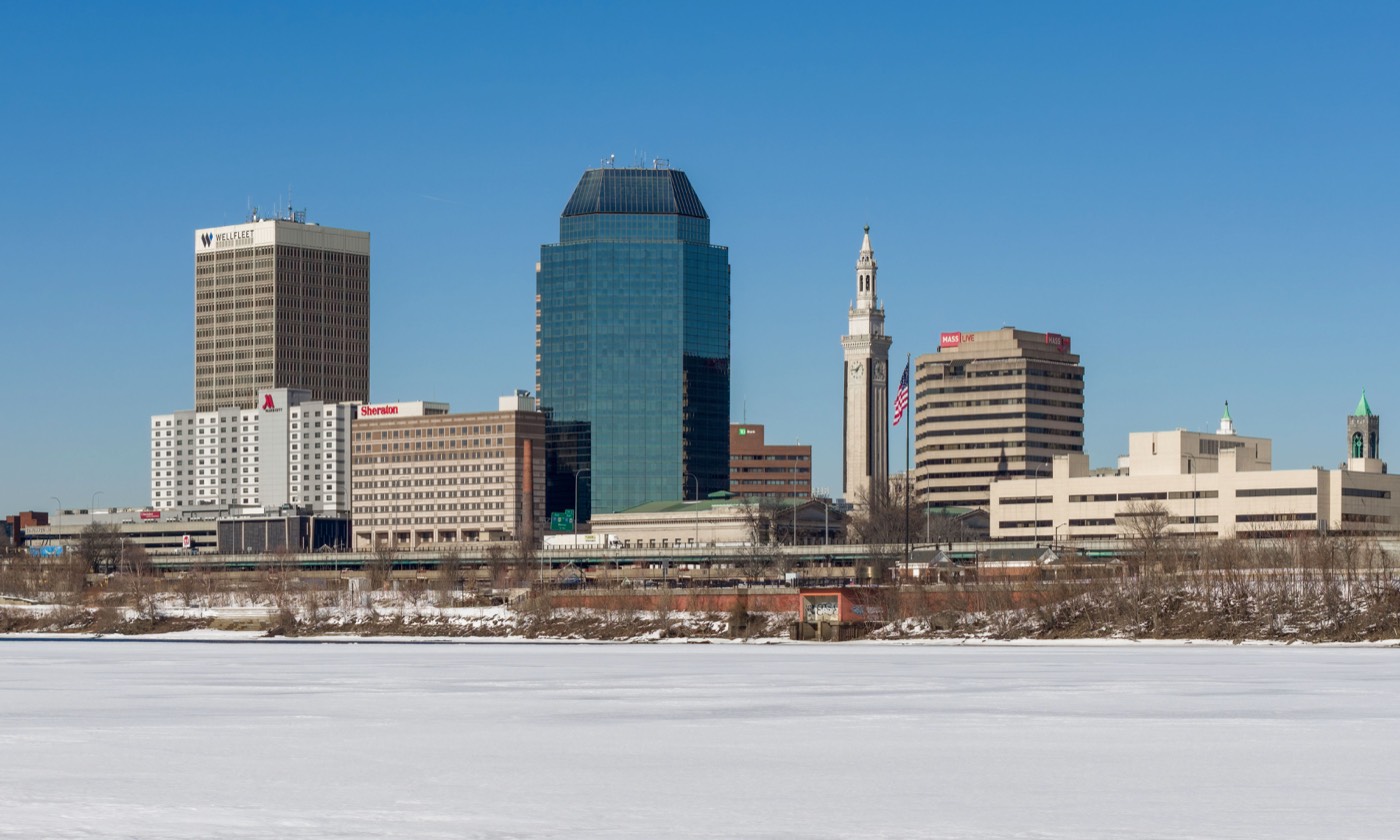
Springfield sits on the east bank of the Connecticut River in the far west of Massachusetts, founded in 1636 by the English Puritan William Pynchon as a fur-trading post he first called Agawam. It grew into one of the great workshops of nineteenth-century America, home to the federal Springfield Armory, to Smith & Wesson, and to a run of inventions that included the first American-built gasoline car by the Duryea brothers in 1893.
This was a city built on precision manufacturing and rail, and it pulled in labour from across Europe to feed it. The South End, a low-lying wedge of streets near the river and the railroad, became the place where the city’s Italians put down roots.
Today Interstate 91 runs between that neighbourhood and the river it once looked out on. The highway is part of the story too, but the older story begins with a trolley track and a parish.
How It Became Italian
The first arrivals
Italians came to New England in waves between the mid-1860s and the First World War. The earliest were often northerners, displaced by the upheavals of Italian unification after 1861. The far larger second wave, beginning in the 1880s, came from the south: from regions where the collapse of the old feudal order, repeated crop failures and grinding poverty pushed millions onto westbound ships.
Some of these new arrivals found their way to Springfield, where industry was hungry for hands. Around 1900 Italian labourers were laying trolley track along Maple Street, and the work was hard, badly paid and often dangerous.
The jobs they took read like a catalogue of the immigrant economy: railroad and construction work, fruit-selling and bootblacking, barbering, candy-making, organ-grinding and music teaching. From these beginnings a recognisable colony formed in the South End, the same tight-knit grid of streets that would hold the community for the next century.
A neighbourhood takes shape
By the early twentieth century the South End had become one of New England’s several Little Italys, named in the same breath as Front Street in Hartford, the Central End in Bridgeport, and Shrewsbury Street in nearby Worcester. It belonged to the same upstate and inland network of industrial Little Italys as Waterbury, Connecticut and Rochester, New York, each its own world of dialect, parish loyalty and home-region ties.
The institutions arrived quickly. A social club was founded in 1897, the same year the community began its feast in honour of Our Lady of Mount Carmel. An Italian-language newspaper, L’Eco Coloniale, started up in 1913 and pushed its readers towards naturalisation and American citizenship.
The Catholic parish of Our Lady of Mount Carmel anchored the spiritual life of the neighbourhood, and its summer feast became the year’s great gathering. Families who had crossed the Atlantic carried the procession of the Madonna with them, and they rebuilt it street by street in their new country.
The hard decades
The community was never far from the wider drama of Italian America. Bartolomeo Vanzetti, of the Sacco and Vanzetti case that gripped the nation in the 1920s, had once worked as a labourer in Springfield before his arrest and execution in Massachusetts in 1927. The case fell hard on Italian immigrants everywhere, a reminder of how easily suspicion attached to the accent and the name.
Even so, the South End worked. Bakeries, groceries and delis opened along Main Street and William Street. Men joined the social clubs, women ran the kitchens that fed the feast, and a parochial school and a community park gave the children a world of their own within walking distance of home.
Many families eventually followed the well-worn path out to the suburbs: to East Longmeadow, to Agawam and Feeding Hills, and to Ludlow, the mill town just east of the city that drew Italian and Portuguese workers alike. The move outward was a mark of arrival, but it slowly thinned the old neighbourhood.
The highway years
The hardest blow was not emigration but construction. In the early 1960s a vast urban-renewal programme tore through Springfield, levelling block after block along the Main Street and Chestnut Street corridors and rearranging or erasing whole streets. Interstate 91 was driven down the riverfront, cutting the South End off from the Connecticut River, and Interstate 291 was punched through to meet it.
For a neighbourhood whose life was lived on its streets, this was an amputation. Buildings came down, residents scattered, and the feast that had run since 1897 eventually fell silent. For roughly twenty years there was no Festa of Our Lady of Mount Carmel in the South End at all.
The Landmarks
Our Lady of Mount Carmel Church, 123 William Street. The spiritual anchor of Italian Springfield and the parish from which the great summer feast takes its name. For generations the procession of the Madonna has set out from here, carried through the streets of the South End behind a traditional Italian marching band.
La Fiorentina Pastry Shop, 883 Main Street. Family-owned since 1946, La Fiorentina is the South End’s most famous bakery, a counter of cannoli, sfogliatelle and ricotta pie that has long since spread its reputation across western Massachusetts. For many local Italian families it is simply where the holidays come from.
Frigo’s Foods, 90 William Street. An Italian deli and market founded in 1950 that began life serving the immigrants of the South End and is now run by the third and fourth generations of the same family. Its Italian sandwiches and imported goods made it a neighbourhood institution long before it expanded out to East Longmeadow.
Mom & Rico’s Specialty Market, 899 Main Street. A fixture of the South End since 1976, built by Rico Daniele and his sisters Gina and Rosamaria. The shop turns out homemade pasta and sauce alongside a buffet table and sandwiches stacked with Italian meats and cheeses, the kind of place where the recipes are not written down.
Red Rose Pizzeria, 1060 Main Street. Opened in 1963 by Nicola and Edda Caputo, who had come to Springfield from Naples in 1958, Red Rose began as a fifteen-seat room run on family recipes. It now seats more than four hundred and remains family-owned, a Springfield landmark for Neapolitan pizza and pasta. Nicola Caputo died in 2022.
Casa Italiana, in the South End. The restored home of the social club founded in 1897, reopened in the mid-2020s as the base of the St. Padre Pio Sons & Daughters of Italy and the Societa della Madonna del Carmine. Its revival brought the historic Italian Feast back to the neighbourhood after its long absence.
Winthrop Street. The heart of the Festa. Each July the street fills with food stalls, processions and a greased-pole contest, the public face of a community that has gathered here since the nineteenth century. It is the one address in the South End where the old neighbourhood reassembles itself in full.
Where They Came From
The Italians who built the South End came overwhelmingly from the Mezzogiorno, the long-suffering south of Italy that sent the bulk of the great migration to America. The Caputo family, who founded Red Rose, came specifically from Naples, and Naples and its Campanian hinterland were a common origin for the families of western Massachusetts.
Like most Italian American neighbourhoods, the South End grew through chain migration. One relative or paesano established a foothold, found work and lodging, and then sent for others from the same town or province, so that streets and clubs often clustered people from a handful of home villages.
The push factors were brutally consistent: the failure of southern agriculture, the absence of land and the absence of hope. The pull was a city that needed muscle for its railroads, its construction sites and its factories, and that offered, for all its hardships, a future the old country could not.
Springfield Today
The South End is no longer an Italian neighbourhood in the way it once was. Springfield as a whole is now a majority-Hispanic city, with people of Latino heritage forming close to half the population, and the streets that once held Italian groceries now carry many other stories. This is the honest present tense, and it sits beside the older one rather than erasing it.
Yet the Italian thread has not broken. La Fiorentina still draws queues, Frigo’s and Mom & Rico’s and Red Rose are still in business on Main and William Streets, and the bakeries still sell the pastries that mark the Italian calendar. The institutions outlasted the demographic shift.
The clearest sign of life is the feast itself. After two decades of silence, the restoration of the 1897 social club as Casa Italiana brought the Festa of Our Lady of Mount Carmel back to the South End in the mid-2020s, with its Mass, its procession of the Madonna, its marching band and its greased-pole contest intact. The neighbourhood that built it had largely moved away, and it came back anyway, for a weekend in July, to carry the statue through the old streets one more time.
Frequently Asked Questions
Where did the Italians in Springfield, Massachusetts settle?
The Italians in Springfield, Massachusetts settled in the South End, a low-lying neighbourhood near the Connecticut River and the railroad. From the late nineteenth century it became one of New England’s Little Italys, centred on Main Street and William Street and the parish of Our Lady of Mount Carmel.
When did Italians arrive in Springfield?
Italians came in the great migration between the mid-1860s and the First World War, with the largest wave arriving from southern Italy after the 1880s. A social club and the Feast of Our Lady of Mount Carmel both began in 1897, marking the colony as well established by then.
What is the Italian Feast in Springfield?
It is the Festa of Our Lady of Mount Carmel, a summer celebration begun in 1897 that features a Mass, a procession of the Madonna through the South End behind a marching band, Italian food and a greased-pole contest. It lapsed for about twenty years and returned in the mid-2020s.
What happened to Springfield’s Little Italy?
Urban renewal in the early 1960s and the construction of Interstate 91 along the riverfront cut the South End off from the Connecticut River and demolished large parts of the surrounding area. Combined with suburban migration, this thinned the neighbourhood and eventually silenced the feast for two decades.
Are there still Italian businesses in Springfield’s South End?
Yes. La Fiorentina Pastry Shop on Main Street, Frigo’s Foods on William Street, Mom & Rico’s on Main Street and Red Rose Pizzeria on Main Street all remain in business, several of them run by the third or fourth generation of their founding families.
Where in Italy did Springfield’s Italians come from?
The Italians in Springfield, Massachusetts came overwhelmingly from southern Italy, the Mezzogiorno, including Naples and the surrounding Campania region. They arrived largely through chain migration, with families sending for relatives and neighbours from the same home towns.
If your family’s story passed through Springfield, or any of the places Italians have made home in America, Atlas of Home can trace that journey. From a village in the Campanian hills to a feast-day procession on Winthrop Street, to wherever you are now.