
On the first weekend of September, a statue of Our Lady of Fatima is carried by candlelight through the streets off Winsor Street, hundreds following behind with rosaries in hand. It is the surest sign that the Portuguese in Ludlow, Massachusetts are not a footnote to this old mill town. They are its heart. A community that once worshipped in a borrowed church and saved for thirty years to build its own has turned a former jute town into the place locals nicknamed Mini Portugal.
The Place
Ludlow sits in Hampden County, just across the Chicopee River and northeast of Springfield. It was settled in 1751 as Stony Hill Parish and incorporated on 23 August 1775, taking the name Ludlow from Governor Thomas Hutchinson, possibly after the English town of Ludlow in Shropshire.
For most of its early life it was farmland. That changed around the time of the Civil War, when the mills arrived and turned a quiet agricultural settlement into an industrial one.
The 2020 census recorded 21,002 residents. By the most commonly cited ancestry figures, Portuguese Americans make up roughly 21 percent of the town, a share that explains the town’s other nicknames: Soccer City, Jute Town, and Mini Portugal.
How It Became Portuguese
To understand the Portuguese in Ludlow, you have to start with jute, the coarse plant fibre spun into twine, webbing, and burlap. In 1868 the largest mill in town opened under the Ludlow Manufacturing Associates, and the company became the engine that pulled immigrants in from across the Atlantic.
The mill that built the town
Ludlow Manufacturing Associates did not just employ people. It built around them. The company provided housing, a library, schools, playgrounds, and a clubhouse, the paternalistic model common to nineteenth century New England mill towns.
Into those mills came workers from Portugal, Poland, Ireland, and Italy. The Portuguese arrived to spin jute, and many of them did not come straight from the islands. They came second-hand, from Providence and the surrounding Rhode Island communities where Portuguese immigrants had already put down roots.
That detail matters. Ludlow’s Portuguese story is partly a story of internal migration within New England, of families chasing steadier mill work up the line from Rhode Island into the Pioneer Valley.
Worshipping in a borrowed church
For the first generation, faith had no building of its own. Portuguese Catholics in Ludlow worshipped at St. John the Baptist Church, the existing parish, where they were taken in as guests for more than thirty years.
One man made that arrangement bearable. Father Chabot of St. John’s learned Portuguese so he could celebrate Mass for the newcomers in their own language, a small act of welcome that the community never forgot.
All the while they were saving. For three decades the Portuguese of Ludlow raised money for a church they could call their own, attending Mass in a borrowed building and putting aside what little the mills paid them.
The Depression and the return
The path was not straight. During the Great Depression the Portuguese population of Ludlow actually shrank for a time, as families returned to Portugal to ride out the worst of the hard years where the cost of living was lower.
Most came back. When work returned to the mills and the economy steadied, the families resettled in Ludlow, and the community resumed its long campaign for a parish.
A parish of their own
The breakthrough came after the Second World War. In 1948 Bishop O’Leary granted the Portuguese community its own parish, the reward for those thirty years of saving and waiting.
The first Masses were held not in a church but in the hall of the Grémio Lusitano Club, the Portuguese social club that had been founded in 1922 and had become the centre of immigrant life in town. On Labour Day, 5 September 1949, Our Lady of Fatima Parish was formally inaugurated.
Its first administrator, Father Manuel Rocha, came visiting from Portugal and stayed. He served as pastor for more than thirty years, long enough to baptise, marry, and bury two generations of the community he helped found.
Soccer as a second faith
If the church gave the community its soul, the soccer club gave it its swagger. The Grémio Lusitano, a name that translates roughly as Portuguese Union, was founded in 1922 in a garage on Franklin Street.
In 1938 the club bought Franklin Park across the road. The Portuguese of Ludlow built a footballing tradition strong enough that the town became one of only three communities recognised in the National Soccer Hall of Fame’s history display, added in 1996. The park’s name was officially changed to Lusitano Stadium in 1997.
The waves kept coming. After the Second World War, Ludlow saw a resurgence of Portuguese arrivals, many of them from the Azores, who joined the existing community and deepened it. Over the following decades the Portuguese intermarried with their Polish, Irish, and Italian neighbours, but they never dissolved. They set the tone of the town instead.
The Landmarks
Our Lady of Fatima Parish, 438 Winsor Street. This is the church the community spent thirty years saving to build, inaugurated on Labour Day 1949. Its annual Festa, run each year over the long weekend at the end of August, is described as one of the most significant cultural events for Portuguese Americans anywhere in the country.
Grémio Lusitano Club, 385 Winsor Street. Founded in 1922 and relocated to Winsor Street in 1924, the club hosted the first Masses of Our Lady of Fatima before the parish had a building. Today it runs youth soccer for hundreds of children and keeps Portuguese heritage alive through scholarships and recreational leagues.
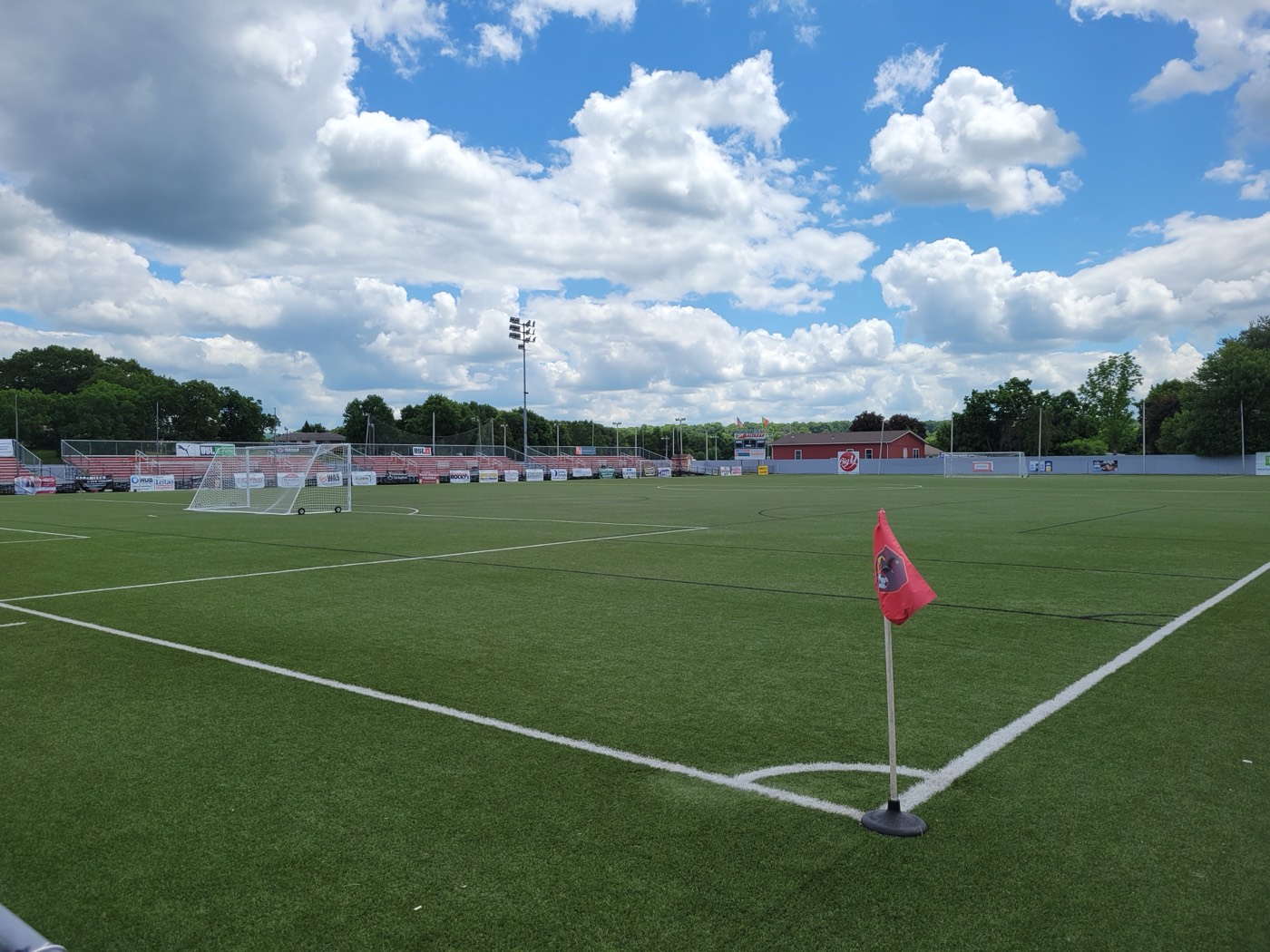
Lusitano Stadium, 400 Winsor Street. The 3,000-seat ground that the club purchased as Franklin Park in 1938 and renamed in 1997. It is home to the Western Mass Pioneers, the professional soccer team the club created in 1997, and it sits a short walk from both the parish and the clubhouse, the three pillars of Portuguese Ludlow within sight of one another.
Ludlow Central Bakery, 270 East Street. For more than four decades this family bakery has turned out Portuguese breads, pastries, and cakes. Call before the weekend and you can order malassadas, the yeasted Azorean doughnut that turns up at every Ludlow celebration.
Primavera Café Restaurant, 257 East Street. A Portuguese kitchen on the same East Street stretch that locals associate with the community’s food, taking its inspiration from the hilltop town of Óbidos and staying close to the traditions of the mainland.
Tony & Penny’s Restaurant, 18 Canterbury Street. A Ludlow institution specialising in homestyle Portuguese cooking, the kind of place where grilled sardines and bacalhau read as comfort food rather than novelty.
Mill’s Tavern & Grille, 14 Worcester Street. Opened in 2017, its very name nods to the jute mills that drew the Portuguese here, and its menu pairs Portuguese dishes with American ones. It is a reminder that this is a living community, still opening new doors, not a museum piece.
Where They Came From
Like most Portuguese American communities in New England, Ludlow’s roots run heavily to the Azores, the volcanic mid-Atlantic archipelago whose people emigrated in successive waves through the nineteenth and twentieth centuries.
The pull factors were specific. New England’s mills wanted labour, and the Azores, with limited land and frequent hardship, sent it. The Portuguese who came to Ludlow were often experienced at hard, repetitive work, and the jute mills offered exactly that.
The post-war wave that arrived after 1948 was strongly Azorean, and it is that generation, alongside its children, that built the Festa, the soccer dynasty, and the bakeries into what they are now. The food gives the origins away: malassadas, linguiça, and bacalhau are island staples, carried across the ocean and kept on the table.
Ludlow Today
Ludlow is not a wealthy suburb dressed up in heritage. It is a working town of about 21,000 that happens to wear its Portuguese identity more openly than almost anywhere else in America. East Street is the everyday face of it, lined with bakeries and restaurants where Portuguese sandwiches and Azorean pastries are simply lunch.
The Festa remains the high point of the year. In 2024 the parish marked its 76th annual Festa over the long weekend, and organisers expected tens of thousands of visitors across the five days of music, food, and the candlelit procession through the streets around Winsor Street.
Soccer still binds the place together too. Generations of Ludlow children have come up through the Grémio Lusitano’s youth programmes, and the Western Mass Pioneers keep professional football at Lusitano Stadium. The town’s nickname, Soccer City, was earned, not invented.
What makes Ludlow unusual is that the community did not fade into general whiteness the way many ethnic enclaves did. The Portuguese here intermarried and assimilated, yet the church, the club, and the Festa held. The result is a town where a fifth of residents trace their line to Portugal, and where that line is something you can still see, taste, and walk through.
For more on how Portuguese mill and port communities spread across the region, the story echoes from the Portuguese in Taunton to the Portuguese in Fall River and New Bedford, the great whaling and textile centres of the Portuguese diaspora.
Frequently Asked Questions
Why is Ludlow, Massachusetts called Mini Portugal?
The Portuguese in Ludlow, Massachusetts make up roughly 21 percent of the town’s residents, one of the highest concentrations in the country. That density, combined with Portuguese restaurants, bakeries, a major Catholic Festa, and a famous soccer club, earned the town nicknames including Mini Portugal and Soccer City.
When did Portuguese immigrants first settle in Ludlow?
Portuguese Catholics arrived around the Civil War era to work for Ludlow Manufacturing Associates in the jute mills, many relocating second-hand from Providence and other Rhode Island communities. A larger Azorean wave followed after the Second World War, deepening a community that had been worshipping in town since the nineteenth century.
What is the Our Lady of Fatima Festa?
The Festa is the annual feast of Our Lady of Fatima Parish on Winsor Street, held over the long weekend at the end of August. It features Portuguese music, dancing, and food across five days, culminating in a Mass and a candlelit procession with a statue of Our Lady carried through the surrounding streets. The 2024 edition was the 76th annual Festa.
What is the Grémio Lusitano Club?
The Grémio Lusitano, whose name translates roughly as Portuguese Union, is a Portuguese social and soccer club founded in Ludlow in 1922. It hosted the first Masses of Our Lady of Fatima before the parish had a building, and today it runs youth soccer for hundreds of local children and owns Lusitano Stadium.
Where did the Portuguese in Ludlow come from?
Most of Ludlow’s Portuguese families trace their roots to the Azores, the Atlantic archipelago that sent successive waves of emigrants to New England’s mill towns. The post-war wave that arrived from 1948 onward was strongly Azorean, and Azorean staples like malassadas and linguiça remain central to the community’s food.
Where can you find Portuguese food in Ludlow today?
East Street is the centre of Portuguese dining in Ludlow, with Ludlow Central Bakery at 270 East Street and Primavera Café at 257 East Street. Tony & Penny’s on Canterbury Street and Mill’s Tavern & Grille on Worcester Street round out the Portuguese kitchens that keep the Azorean table alive in town.
If your family’s story passed through Ludlow, or any of the places Portuguese immigrants have made home in America, Atlas of Home can trace that journey. From the volcanic farmland of the Azores to the jute mills of Winsor Street, to wherever you are now.