
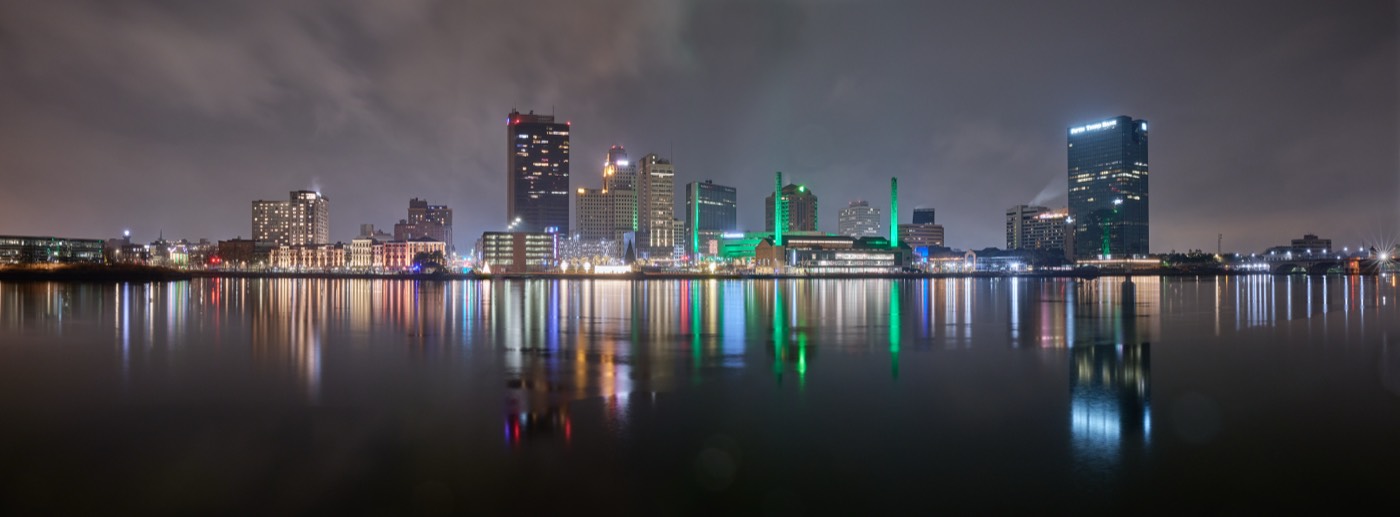
Say “Lagrinka” out loud and you are already speaking Polish Toledo. The word is what immigrants did to Lagrange Street, the long north-side thoroughfare they could not pronounce in English and would not surrender in Polish. They folded the street into their own tongue, and in doing so they laid claim to it. For more than a century, the Polish in Toledo, Ohio have been the city’s largest immigrant story, told in bluestone churches, in four-to-a-pound pierogi, and in a festival that for thirty-three summers closed the street that named them.
The Place
Toledo sits at the western tip of Lake Erie, where the Maumee River empties into the lake and where, in the late nineteenth century, railroads and glassworks and metal foundries needed hands faster than the city could grow them. It was a working town that built its wealth on industry, and it imported the workers to match.
The Polish settled in two pockets, both on the edges. One was north, along Lagrange Street, which they renamed Lagrinka. The other was south, a district they called Kuschwantz. Between them ran a single thread: a Catholic church at the centre of each, with a school beside it and a butcher down the block.
How It Became Polish
The first Polish families reached Toledo in the early 1870s, and they came overwhelmingly from one corner of a partitioned country: the Prussian province of Posen, the German name for Poznań.
Leaving Posen
Poland did not exist as a state when these families left. It had been carved up by Prussia, Austria, and Russia in the partitions completed in 1795, and Posen had fallen to Prussia. After German unification in 1871, the province became part of the new German Empire, and its Polish Catholics found themselves the target of Kaiser Wilhelm’s Kulturkampf, the campaign of 1871 to 1878 that persecuted Catholics and tried to force Poles to become German.
To be Polish in Posen in those years was to watch your language pushed out of the schools and your church set against the state. Emigration was both an economic decision and a refusal. Families came to America to earn, and to remain Polish while doing it.
They did not scatter randomly. The earliest Toledo families came from a tight band of villages in Poznania, the country between Poznań and Inowrocław, and word travelled back along the chain. A cousin who found work sent for a brother. A village emptied a few households at a time into the same few streets in Ohio.
The first parish
Father Vincent Lewandowski, a Franciscan, arrived in October 1874 and within a year had founded St. Hedwig Parish, the first national parish in Toledo built for Polish Catholics. The first Mass was said on 16 October 1875, in a red brick building thirty-three feet by eighty-three on Lagrange Street.
The parish grew faster than its walls. A fire gutted the interior in February 1886, and the rebuilt church was rededicated that June. By 1892 the congregation had outgrown brick entirely, and built a second church of Sandusky bluestone in what the parish called the Polish Gothic style, a hundred and sixty feet long, seating more than 1,265. It was dedicated in April 1893. By 1903 the parish school enrolled over a thousand children.
St. Hedwig still stands at 2916 Lagrange Street, the anchor of Lagrinka. Around it, the neighbourhood thickened. By 1907 a second Polish parish, St. Adalbert, opened just five blocks north, because one church on Lagrange could no longer hold the people of one street.
The southern settlement
Toledo’s other Polish district lay to the south, on what was then the rural edge of the city. The Poles called it Kuschwantz, a name often glossed as “cow’s tail,” a joke about the place’s farmland fringe. Polish families had begun settling there in 1871, literally at the city limits.
In 1882 they got their own church. St. Anthony Parish was founded for the Poles near Nebraska and Junction Avenues, who did not want to walk all the way to St. Hedwig. It became the second Polish church built in Toledo and, in time, the “mother” church of the southern community, serving as many as 8,000 parishioners before the 1970s.
Work and wealth
The men found work in Toledo’s metalworks, its railroads, and the glass industry that would give the city its nickname. The women kept boarders, ran the corner shops, and held the parishes together. The neighbourhoods filled with Polish bakeries, butchers, taverns, and benefit societies.
The numbers tell the climb. In 1900 the census counted 4,475 Toledo residents born in Poland. By 1920 that figure had more than doubled to 10,283, and the Polish-born were the single largest immigrant group in the city. In the city’s fourth ward, more than twenty-three per cent of the 22,000 residents had been born in Poland.
The Landmarks
St. Hedwig Church, 2916 Lagrange Street. The cornerstone of Lagrinka and the first Polish parish in Toledo, its Sandusky bluestone walls have stood since 1893. The final Sunday Mass was offered here on 26 August 2012, after which the church was given oratory status, but its twin towers still mark the skyline of the Polish north side.
St. Anthony Church, 1416 Nebraska Avenue. The mother church of the southern Polish district once held 8,000 parishioners. When the diocese moved to demolish it, the surrounding community fought to keep it standing. In October 2025 the Lucas County Land Bank broke ground on a six-million-dollar project to turn the church into a youth recreation centre, preserving its original artwork and painted glass.
Stanley’s Market, 3302 Stickney Avenue. A Polish butcher and bakery making kielbasa in the Lagrange Street village since 1932. Its pierogi are famously oversized, four to a pound rather than the supermarket dozen, and around Christmas the queue for placek and golabki and czarnina stretches out the door.
St. Adalbert Parish. Opened in 1907 just five blocks north of St. Hedwig, founded because a single Lagrange Street parish could no longer hold the neighbourhood. The two parishes are now joined as Saints Adalbert and Hedwig.
The Lagrange Street Polish Festival. Beginning in 1983, the festival closed five blocks of Lagrange Street each July for polka bands, dance troupes, beer, and food, becoming the last great public gathering of the old community. It ran for thirty-three years before its sponsor announced there would be no festival in 2017.
The Northwest Ohio Polish Cultural Center. Toledo Polish organisations joined forces in 2015 to build a permanent home for the community’s heritage, on donated land at 1600 Front Street. It is the modern attempt to gather under one roof what the closing parishes once held.
The Toledo-Poznań sister city alliance. Established in 1990 at the urging of Congresswoman Marcy Kaptur, herself a daughter of Toledo Polonia, the alliance formally bound the city to the very province most of its Polish families had left. The mayors signed the documents in 1991.
Where They Came From
Almost all of Toledo’s founding Polish families traced back to the Prussian partition, and within it to the province of Posen, the Poznań region of western Poland. The first Toledo families came from a defined stretch of Poznania, roughly the country between Poznań and Inowrocław, with the chain reaching north toward Kamień Krajeński.
This was not a random spread of a nation but the emptying of specific villages into specific streets. The Prussian Poles who came first had endured the Kulturkampf, and they carried with them a fierce Catholicism that explains why the first thing they built in Toledo was not a hall or a club but a church.
Their roots run parallel to other Prussian-Polish settlements across the industrial belt, from the Poles of Slavic Village in Cleveland to the Poles of Cheektowaga, New York, and the great Polish enclaves of New Jersey at Wallington and Garfield. The same villages of Posen seeded factory towns across America, and Toledo was among the largest.
Toledo Today
The old Polish Toledo has thinned. The majority of the Polish-American population that once packed Lagrinka and Kuschwantz has moved out to the suburbs, the parishes have closed or merged, and many of the businesses that lined Lagrange Street are gone. St. Hedwig no longer holds regular Mass. The Lagrange Street festival, the last great annual gathering, did not run in 2017.
Yet the bones remain, and they are being repurposed rather than erased. St. Anthony, slated for the wrecking ball, was saved by its neighbours and is becoming a recreation centre for the children of the Junction district. Stanley’s Market still cuts kielbasa where it has since 1932. The Northwest Ohio Polish Cultural Center is building a new home, and the sister-city bond with Poznań keeps the line open to the province the families left.
What endures most plainly is the name. Lagrinka is still Lagrinka, a Polish word for an American street, spoken by people whose great-grandparents could not say “Lagrange.” Toledo’s Polish heritage is no longer measured in thousands of parishioners. It is measured in the things too stubborn to leave: a name, a recipe, a bluestone tower, a butcher’s counter at Christmas.
Frequently Asked Questions
Where did the Polish in Toledo, Ohio settle?
The Polish in Toledo, Ohio settled in two neighbourhoods. The northern one, along Lagrange Street, was called Lagrinka, a Polish rendering of the street’s name. The southern one, near Nebraska and Junction Avenues at the old city edge, was called Kuschwantz.
Why did Polish immigrants come to Toledo?
Most came from the Prussian province of Posen, the Poznań region of partitioned Poland, in the 1870s and after. They left to escape the Kulturkampf, the German campaign of 1871 to 1878 against Catholics and Polish identity, and to find industrial work in Toledo’s railroads, metalworks, and glass factories.
What is Lagrinka?
Lagrinka is the historic Polish neighbourhood of north Toledo, centred on Lagrange Street. The name is a Polonised version of “Lagrange,” the main thoroughfare running through the area, coined by immigrants who reshaped the English street name in their own tongue.
What is the main Polish church in Toledo?
St. Hedwig, at 2916 Lagrange Street, was the first Polish national parish in Toledo, founded in 1875. Its bluestone church dates to 1893. St. Anthony on Nebraska Avenue, founded in 1882, served as the mother church of the southern Polish community.
Is there still a Polish community in Toledo?
Yes, though it has dispersed from the original neighbourhoods to the suburbs. The Polish in Toledo, Ohio remain visible through institutions like Stanley’s Market, the Northwest Ohio Polish Cultural Center, the Saints Adalbert and Hedwig parish, and the city’s sister-city alliance with Poznań.
What happened to the Lagrange Street Polish Festival?
The festival ran each July from 1983 for thirty-three years, closing five blocks of Lagrange Street for Polish food, polka, and dance. Its sponsoring organisation announced there would be no festival in 2017, citing a lack of funds.
If your family’s story passed through Toledo, or any of the places Poles have made home in America, Atlas of Home can trace that journey. From a village in the province of Posen to a bluestone church on Lagrange Street, to wherever you are now.