
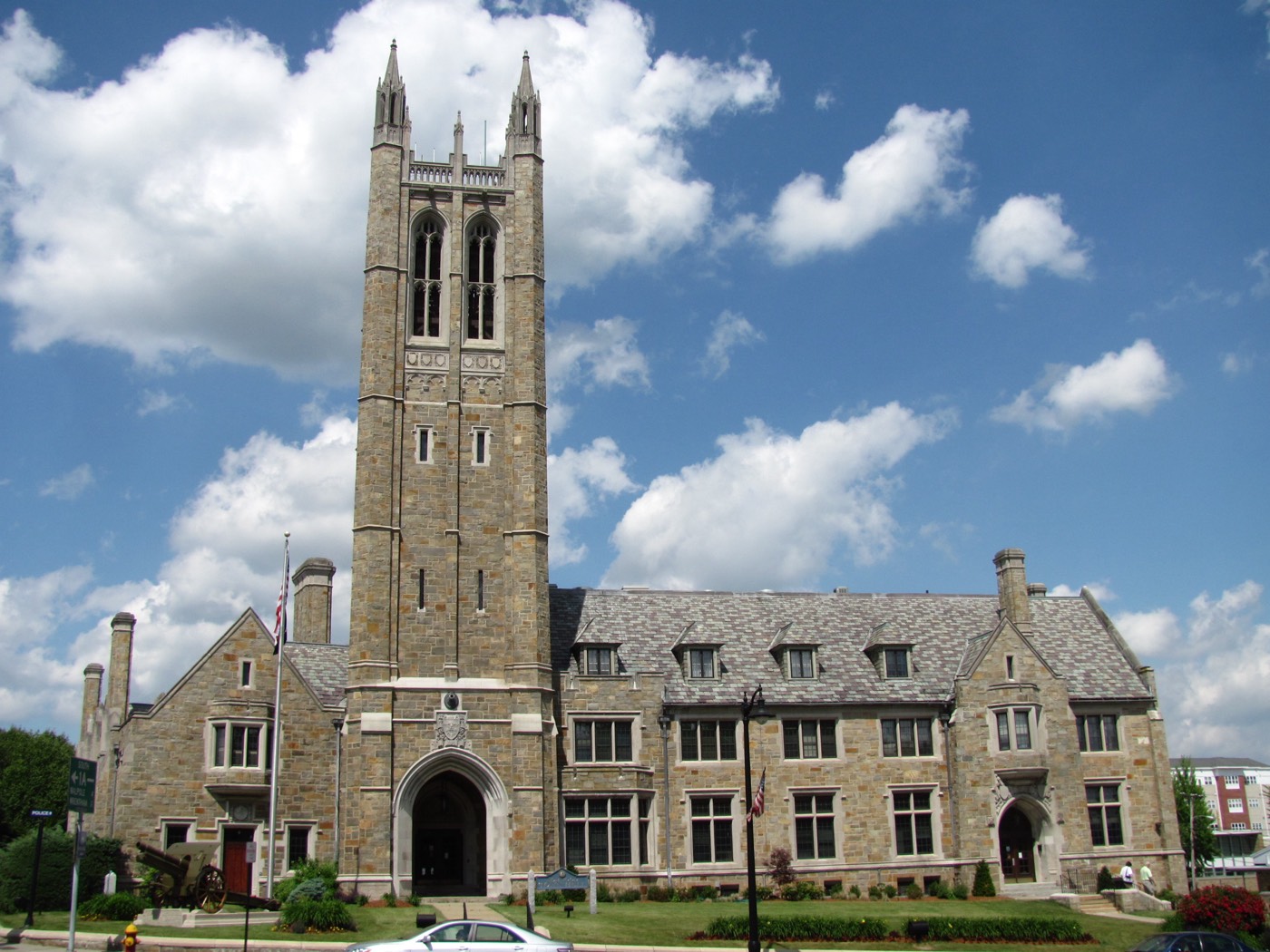
The Irish in Norwood, Massachusetts arrived not as gentry but as labourers, swinging picks along a railroad bed in 1849 when the place was still called South Dedham. They came with the smell of fresh-turned earth on their boots and the memory of famine behind them. A century and a half later their descendants run the town meeting, fill the pews at St. Catherine of Siena, and gather under the carillon that rings out over Washington Street. Norwood did not merely absorb the Irish. It was, in many ways, built by them.
The Place
Norwood sits about fourteen miles south-west of Boston, a compact town of roughly thirty-one thousand people pressed against the Neponset River in Norfolk County. It is the kind of New England suburb where a Gothic town hall faces a green common and the high street still carries the name Washington Street.
For most of its early life it was simply the southern part of Dedham, the colonial settlement known as the mother of towns. South Dedham broke away and incorporated as Norwood in 1872, taking its name, it is said, from Norwood in England rather than from a local reverend named Balch who was nearly its namesake.
What gave the place its shape was industry: tanneries, ink, and above all printing. By the early twentieth century Norwood was a factory town with a green at its heart, and the people who worked those factories were drawn from across Europe. The Irish got there first.
How It Became Irish
The railroad and the first arrivals
The Irish story in Norwood begins with a railroad bed. The Norfolk County Railroad was chartered in 1847 and pushed its line through South Dedham by 1849, and the men who graded the cuttings and laid the iron were overwhelmingly Irish Catholic immigrants, many of them fleeing the Great Famine then emptying the Irish countryside.
These were the first Roman Catholics most of South Dedham had ever seen. They worked with pick and shovel for wages that local farmers thought generous and that the men themselves thought meagre, and when the line was finished a good number of them simply stayed.
They stayed because there was work. The tanneries along the river, the older of which traced their leather trade back to the eighteenth century, needed strong backs. So did the growing town itself, with its roads to build and its houses to frame.
The pattern was a familiar one across Irish New England. The same famine-era currents that filled Boston neighbourhoods also seeded the suburbs, from the Irish enclaves of Milton to the coastal lanes of the Irish Riviera at Scituate. Norwood was the inland, industrial version of that story.
Building a parish
A Catholic community needs a church, and for decades the Irish of South Dedham had to make do with missions and visiting priests. Mass was said in homes and hired halls long before there was an altar to call their own.
That changed in 1890, when St. Catherine of Siena was established as a separate parish to serve roughly fifteen hundred Catholics, the overwhelming majority of them Irish or the children of Irish parents. The parish historians are candid about its roots, tracing its deepest origins to the pioneer Catholics who had settled in South Dedham in the mid-1840s.
For the first generation, the parish was more than a place of worship. It was a registry of births and deaths, a marriage market, a relief society and a social club rolled into one. To be Irish in Norwood at the turn of the century was, very nearly, to be St. Catherine’s.
The great printing boom
While the Irish were laying their spiritual foundations, Norwood was becoming a printing capital. The Berwick and Smith press was dedicated in 1891, the Plimpton Press followed in 1897, and together with the type-founders and binders they made the town a centre of American book manufacturing.
The presses and tanneries drew a second wave of immigrants from Lithuania, Poland, Syria and Italy, men who sometimes arrived with their employer’s address pinned to their coats. The Irish, already a generation or two established, often found themselves as foremen, clerks and skilled hands rather than raw labour.
That seniority mattered. As newer arrivals filled the cheapest jobs and the most crowded streets, the Irish moved up and out, into trades, into the police and fire departments, into the civic life of the town. The immigrant of 1849 had become, by 1909, a respectable Norwood citizen.
A church that announced their arrival
Nothing made that arrival plainer than the church the parish built. On 25 April 1909, with The Boston Globe reporting it the following day, Bishop John J. Brady laid the cornerstone of a grand new St. Catherine of Siena before a crowd that filled the unfinished building and spilled across the surrounding lawns.
Some eighteen hundred people pressed inside, with perhaps two thousand more outside, and a choir of around a hundred and twenty-five singers from Boston and Norwood sang to organ and orchestra. The architects were the prominent Boston firm of Maginnis and Walsh, and the design was sixteenth-century English Gothic in grey brick and limestone, seating a thousand worshippers.
It was, deliberately, a statement. A community that had begun with a pick and a shovel could now raise a cathedral-scale church in the heart of the town. The Protestant gentry of old South Dedham came to watch, and the town selectmen sat on the platform.
From newcomers to townsfolk
By the time Norwood built its magnificent Gothic town hall in 1928, the Irish were no longer outsiders petitioning for a foothold. They were the foothold. Irish surnames ran through the rolls of the town meeting, the school committee and the parish societies.
Like much of Irish Catholic Boston, Norwood’s Irish carried their identity quietly into the middle of the twentieth century: in the parish, in the union hall, in the politics of the Democratic ward and in the names they gave their children. The famine refugees of 1849 had, within a hundred years, become the establishment of a prosperous New England town.
The same upward arc played out wherever the Irish gathered in numbers, whether in the leafy commuter towns of Greenwich, Connecticut or the railroad villages of Rockaway, New Jersey. Norwood simply ran the cycle a little earlier and a little harder than most.
The Landmarks
St. Catherine of Siena Church, 547 Washington Street. The spiritual heart of Irish Norwood, established as a parish in 1890 and rebuilt on a grand scale in English Gothic after 1909. Generations of Norwood Irish have been baptised, married and buried from this church, and it remains an active parish on the town’s main street.
Norwood Memorial Municipal Building, 566 Washington Street. Dedicated on Armistice Day in 1928, this Late Gothic Revival town hall of Weymouth granite dominates the common. Its tower houses the Walter F. Tilton Memorial Carillon, fifty bells cast by Gillett and Johnston of Croydon, England, given to honour the town’s war dead.
Napper Tandy’s, 46 Day Street. Opened in 2003 and named for the 1798 United Irishman James Napper Tandy, this is Norwood’s best-known Irish pub. With its oak bar and traditional fittings, it has become a gathering place for a town that still counts the Irish as its largest single ancestry.
Norwood Theatre, 109 Central Street. Opened on 31 August 1927 and designed by Norwood native William G. Upham, the theatre faces the common in a Spanish Romanesque style that echoes the Gothic town hall. Restored and reopened in the 2010s, it anchors the same town centre the Irish helped fill.
Morrill Memorial Library, 33 Walpole Street. Given to the town by the printing magnate George H. Morrill and opened at the close of the 1890s, the library served generations of Irish-American children climbing into the professional classes their grandfathers could not have imagined.
Norwood Common. The green at the centre of town, framed by the town hall, the theatre and the churches. It is the stage for the carillon concerts, civic ceremonies and the ordinary comings and goings of a town whose civic life the Irish helped to build.
Norwood Depot. The railroad station district recalls the very reason the Irish came: the Norfolk County Railroad that cut through South Dedham in 1849 and brought the first Catholic labourers to the place that would become Norwood.
Where They Came From
The Irish who came to Norwood were, overwhelmingly, refugees and economic migrants of the Great Famine era and the decades after it. The Famine that began in 1845 drove more than a million people out of Ireland, and the cheap labour of railroad construction was one of the first doors open to them in America.
Like most famine-era emigration, the flow drew heavily on the rural west and south of Ireland, the counties hardest hit by the failure of the potato. Specific origin parishes for Norwood’s earliest arrivals are not well documented, and rather than guess at counties the record does not support, it is enough to say they came from the Ireland the Famine had broken.
What is clear is the mechanism. Once a handful of families were established around the railroad and the tanneries, they sent for relatives, and chain migration did the rest. A cousin’s letter and a tannery wage were enough to pull the next family across the Atlantic to the same few streets.
Norwood Today
Norwood remains, by the plain arithmetic of the census, an Irish town. Across recent counts, Irish ancestry is consistently the most commonly reported in Norwood, a fingerprint left by that first generation of railroad men and tannery hands.
The town itself has moved on from leather and books. The factory that once defined it has given way to a more varied economy, and in recent years Norwood has become better known as the home of a large pharmaceutical manufacturing operation than for any tannery. Newer communities, from Latin America and Asia, now add their own names to the school rolls beside the Murphys and Sullivans, much as the growing South Asian communities of nearby Westborough and Shrewsbury are reshaping the towns west of Boston.
Yet the Irish imprint is not hard to find. It is in the carillon that rings English-cast bells over Washington Street, in the Gothic bulk of St. Catherine’s, in the pub on Day Street and in the simple fact that more Norwood residents trace their roots to Ireland than to anywhere else. The town the famine refugees helped build is still, recognisably, theirs.
Frequently Asked Questions
When did the Irish first come to Norwood, Massachusetts?
The Irish in Norwood, Massachusetts first arrived in 1849, when the Norfolk County Railroad was built through what was then South Dedham. Many of the Irish Catholic labourers who laid the track settled permanently and formed the nucleus of the town’s Catholic community.
Why did so many Irish settle in Norwood?
They settled because there was steady work. After the railroad came the tanneries and, later, the great printing presses, all of which needed labour. Once the first families established themselves, chain migration brought relatives from Ireland to the same neighbourhoods.
What is the main Irish Catholic church in Norwood?
St. Catherine of Siena at 547 Washington Street is the historic Irish Catholic parish, established in 1890 and rebuilt on a grand English Gothic scale after the cornerstone was laid in 1909. It has long been the spiritual centre of the Irish in Norwood, Massachusetts.
How Irish is Norwood today?
Very. Irish ancestry is consistently the most commonly reported ancestry in Norwood across recent census counts, a direct legacy of the railroad and factory workers who arrived in the nineteenth century. The town’s largest single heritage remains Irish.
Is there an Irish pub in Norwood?
Yes. Napper Tandy’s at 46 Day Street, opened in 2003 and named after the 1798 Irish revolutionary James Napper Tandy, is the town’s best-known Irish pub, with a traditional oak bar and pub fittings.
What was Norwood called before it became a town?
Before incorporating as Norwood in 1872, the area was the southern part of Dedham and was known as South Dedham. It was during this South Dedham period, in 1849, that the railroad and its Irish labourers first arrived.
If your family’s story passed through Norwood, or any of the places the Irish have made home in America, Atlas of Home can trace that journey. From a famine-emptied parish in the west of Ireland, to a railroad cutting in South Dedham, to wherever you are now.