
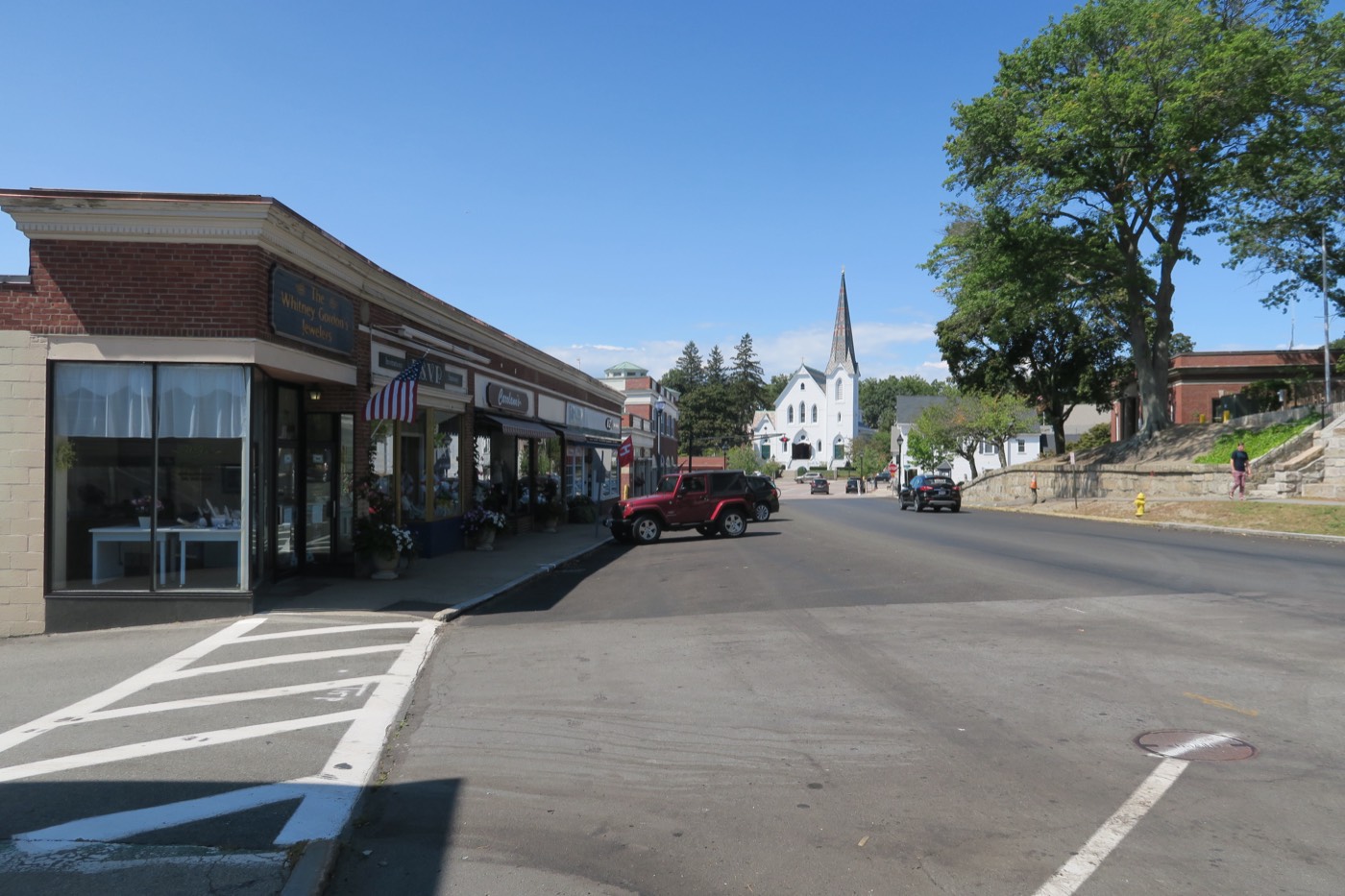
On a bright Saturday in March, leprechauns hide twenty pots of gold in the shop windows along Main Street, and half of Hingham seems to be hunting for them. The town is one of the wealthiest on Boston’s South Shore, all white clapboard and brick storefronts, yet its calendar bends toward Dublin. To understand the Irish in Hingham, Massachusetts, you have to look past the colonial postcard and find the labourers and parish families who, over a century and a half, quietly made this Puritan town their own.
The Place
Hingham sits on the southwestern shore of Boston Harbour, roughly fourteen miles southeast of downtown Boston. English settlers led by the Reverend Peter Hobart incorporated it in September 1635, naming it after Hingham in Norfolk, and it became one of the earliest Puritan towns in the Massachusetts Bay Colony.
It is also, by almost any measure, affluent. The 2020 census counted about 24,284 residents, and recent figures put the median household income above $180,000. Its Main Street, lined with colonial-era buildings and independent boutiques, is regularly named among the most beautiful in America.
That prosperity has deep roots in shipbuilding, farming, and trade. But the families who keep the parishes full and march on St Patrick’s Day arrived later, and they came with far less than the town has now.
How It Became Irish
Hingham is part of a stretch of coast that locals call the Irish Riviera. The South Shore, running south and east from Boston, holds one of the highest concentrations of Irish Americans in the country, and the descendants of those immigrants are said to make up around forty per cent of the region’s population. Hingham is one of nine towns on the South Shore Irish Heritage Trail, alongside Weymouth, Hull, Cohasset, and others, a route formalised in 2022 with grant support from the Irish government’s Emigrant Support Programme.
The first arrivals, 1850s to 1870s
The Irish came to Hingham in earnest between the 1850s and 1870s, in the long aftermath of the Great Famine that emptied much of rural Ireland between 1845 and 1849. The largest number came from County Cork, with Tipperary and other counties also represented.
These were not wealthy settlers. Most had little formal education, and they chose Hingham for the work, much of it in the town’s factories and yards. They arrived in a town built by Congregationalists, whose Old Ship Meeting House of 1681 still stands on Main Street as the oldest church in continuous ecclesiastical use in the country. For Catholic newcomers, there was, at first, no church of their own.
Building St Paul
The Catholics of Hingham had organised themselves by around 1850, and in 1866 their society bought land for a parish for $1,700. Construction of St Paul Church began in November 1869 with the digging of the cellar, and the building opened in 1870 at the corner of North and Fearing Streets.
The church was the work of Patrick Charles Keely, an Irish-born architect who had emigrated from Ireland at twenty-five and went on to design hundreds of Catholic churches across America. Its early construction was overseen by Father Hugh Smythe, an Irish immigrant from County Meath who had come to the South Shore after fire destroyed his church in nearby Weymouth.
St Paul began as a mission of Weymouth and became an independent parish in 1877, serving the Catholics of Hingham along with Cohasset and Scituate. The Archdiocese of Boston’s records for St Paul, now digitised, run from 1876 to 1920 and hold more than 7,700 entries and over 26,700 names: baptisms, marriages, confirmations, and first communions that read, page after page, like a register of South Shore Irish life.
The mossing coast nearby
The Hingham story belongs to a wider Irish economy along this coast. A few towns over in Scituate, an Irish immigrant named Daniel Ward is credited with discovering that the local Irish moss, a red seaweed the Irish had long harvested at home, could be gathered commercially around 1847. Famine refugees flocked to Scituate to work the mossing trade, and the town became known as the most Irish in America, with nearly half its residents claiming Irish ancestry.
Hingham did not live on seaweed, but it shared the same tide of arrivals. The labourers, domestic servants, and tradespeople who filled its boarding houses and its new parish were part of the same migration that built the Irish character of the whole shoreline.
The shipyard generation
The Second World War transformed Hingham and drew working families to it in numbers the town had never seen. Within weeks of Pearl Harbour, in December 1941, the Bethlehem Steel Company began clearing 150 acres at the site of a former airfield to build destroyer escorts for the Navy.
At its peak the Bethlehem-Hingham Shipyard employed more than 23,500 people a day, more than the entire population of the town then and now, including over 2,700 women. In roughly three and a half years it launched 227 ships. Many of those welders, riveters, and fitters came from the Irish Catholic neighbourhoods of Boston and the South Shore, and a good number stayed, putting down roots in Hingham and filling its pews after the war.
When the yard shut soon after the war, its piers and warehouses were left to decay for half a century. The families it had brought to town, however, did not leave. They raised children who went to the parish schools, joined the parade in Scituate, and watched Hingham grow from a working harbour into one of the most desirable suburbs in Massachusetts.
The Landmarks
St Paul Church, corner of North and Fearing Streets, Hingham. The Gothic wooden church that the town’s Catholics opened in 1870 remains the spiritual centre of Irish Hingham. Designed by Irish-born architect Patrick Keely and shepherded by County Meath’s Father Hugh Smythe, it has christened and married South Shore Irish families for a century and a half.
The Snug, 116 North Street, Hingham. Hingham Square’s Irish pub opened in January 2003, when Ed and Ellen Brown bought the former Colonial Lunch in a building dating to the 1820s. Dark wood, a deep whiskey list, and live music make it the first place locals picture on St Patrick’s Day, though it is a year-round gathering spot in the heart of town.
Old Ship Meeting House, 90 Main Street, Hingham. Built in July 1681, it is the only surviving 17th-century Puritan meetinghouse in the United States and the oldest church in continuous use in the country. It is the Protestant Hingham the Irish arrived into, and the landmark against which their own St Paul, built two centuries later, defined itself.
Hingham Heritage Museum, 34 Main Street, Hingham. Run by the Hingham Historical Society, the museum is the starting point for the town’s leg of the South Shore Irish Heritage Trail. Its self-guided brochure, authored by local historian Eileen McIntyre, walks visitors through the sites of Irish settlement.
Hingham Shipyard, on the harbour off Lincoln Street. The 150-acre yard that built 227 warships in the Second World War is now a waterfront district of shops, restaurants, a cinema, and the commuter ferry to Boston. It stands as a monument to the wartime working families, many of them Irish Catholic, who reshaped the town.
Loring Hall, 65 Main Street, Hingham. Built in 1852 and a cinema since 1936, this Main Street fixture anchors the downtown where, each March, the St Patrick’s Day Scavenger Hunt hides twenty pots of gold among the shops and restaurants.
Sons of Italy Lodge, 39 Kilby Street, Hingham. A reminder that Hingham’s heritage is shared: the lodge hosts a St Patrick’s Day bash of traditional Irish music, dance, and food, one of the town’s clearest signs that its calendar still turns toward Ireland each spring.
Where They Came From
The Irish who built Catholic Hingham came overwhelmingly from the south and west of Ireland, with County Cork supplying the largest share and Tipperary close behind. They were part of the post-Famine exodus, families who left a countryside hollowed out by hunger and emigration in the 1850s, 1860s, and 1870s.
They followed work and faith. The factories, farms, and grand houses of the South Shore needed hands, and the growing Catholic parishes of Weymouth and then Hingham gave the newcomers a centre. The mossing boom in neighbouring Scituate pulled others to the same coast, so that a chain of Cork and Tipperary families came to define a whole stretch of shoreline.
Their story rhymes with Irish settlement across the region. The same currents shaped the Irish in Scituate, Massachusetts, just down the coast, and the Irish in Milton, Massachusetts, on the inland edge of the South Shore. Further afield, families with the same County Cork roots helped build the Irish in Greenwich, Connecticut, and the Irish in Rockaway, New Jersey.
Hingham Today
Hingham in 2026 is, on the surface, a town that has left its labouring past behind. The shipyard is a marina and a row of restaurants, the harbour is full of pleasure boats, and Main Street’s colonial storefronts hold boutiques and cafes rather than the boarding houses of the 1870s. The median household income is among the highest in the state.
Yet the Irish thread runs unbroken. Census ancestry responses still place Irish among the most commonly reported heritages in town, alongside Italian, English, and German. St Paul Parish remains active, more than a century and a half after its founding, and the South Shore Irish Heritage Trail brings visitors to its door.
Each March the town leans into it. The Snug fills, the scavenger hunt sends families through Hingham Square, and the lodge on Kilby Street hosts its bash while neighbouring Scituate stages the parade that draws the whole South Shore. The labourers who arrived with little would not recognise the wealth of the town they helped to build. They would, though, recognise the parish, the names in the register, and the pull of County Cork that still runs beneath one of America’s prettiest Main Streets.
Frequently Asked Questions
When did the Irish first settle in Hingham, Massachusetts?
The Irish in Hingham, Massachusetts, arrived in significant numbers between the 1850s and 1870s, in the aftermath of the Great Famine. They organised a Catholic society by around 1850 and bought land for St Paul Parish in 1866, building their church by 1870.
Where did Hingham’s Irish immigrants come from?
The largest share came from County Cork, with County Tipperary and other Irish counties also represented. They were part of the post-Famine emigration that filled the whole South Shore, the stretch of Massachusetts coast nicknamed the Irish Riviera.
What is St Paul Church in Hingham?
St Paul Church, at the corner of North and Fearing Streets, is the town’s Catholic parish, opened in 1870 and designed by Irish-born architect Patrick Keely. It became an independent parish in 1877 and remains the spiritual centre of the Irish in Hingham, Massachusetts.
Why is the South Shore called the Irish Riviera?
The South Shore drew so many Irish immigrants that their descendants are estimated to make up around forty per cent of the region’s population, one of the highest concentrations in the country. Hingham is one of nine towns on the South Shore Irish Heritage Trail.
How did the Hingham Shipyard shape the town’s Irish community?
During the Second World War the Bethlehem-Hingham Shipyard employed more than 23,500 people a day and launched 227 warships. Many workers came from Irish Catholic neighbourhoods in Boston and the South Shore, and a good number stayed, deepening Hingham’s Irish roots after the war.
Is Hingham still an Irish town today?
Yes. Irish remains among the most commonly reported ancestries in Hingham, St Paul Parish is still active, and the town celebrates each St Patrick’s Day with a downtown scavenger hunt, Irish pubs like The Snug, and ties to the wider South Shore Irish Heritage Trail.
If your family’s story passed through Hingham, or any of the places Irish families have made home in America, Atlas of Home can trace that journey. From a Famine-era townland in County Cork to a pew at St Paul on North Street, to wherever you are now.