
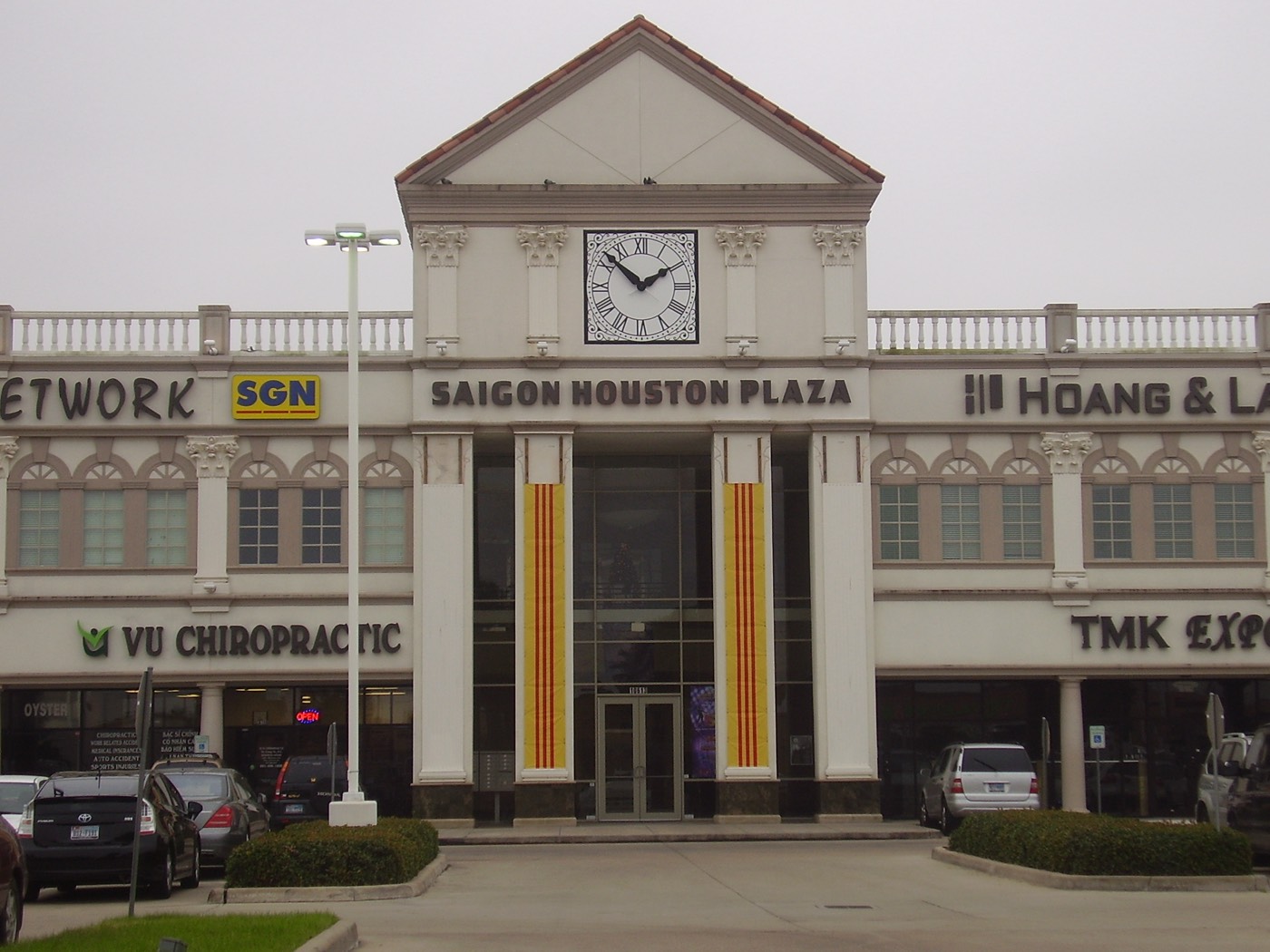
Drive west along Bellaire Boulevard, past Beltway 8, and the strip malls begin to speak Vietnamese. The signage shifts from English to a forest of red and gold lettering, the air outside the pho houses carries star anise and charred lemongrass, and somewhere a copper soldier stands frozen at attention beside a granite wall. This is the heart of the Vietnamese in Houston, Texas, a community that has grown into one of the largest of its kind in the United States, built almost entirely in the half century since a single April morning in 1975.
The Place
Houston sprawls. It is the fourth-largest city in America, a flat, humid expanse with no zoning laws to speak of, where neighbourhoods bleed into one another along arterial roads rather than tidy grids. That openness, and the cheap land that came with it, turned out to matter enormously for the people who arrived here as refugees.
The Vietnamese story in Houston is really the story of two places. First came Midtown, just south of downtown, where the earliest businesses clustered in the 1980s. Then came the long migration southwest to Bellaire Boulevard, the eight-mile commercial corridor now widely known as Asiatown, where most of the community’s restaurants, temples and grocers stand today.
How It Became Vietnamese
For most of the twentieth century there was almost no Vietnamese presence in Texas at all. The change came suddenly, and it came because of a war that ended badly.
1975: The First Wave
When Saigon fell on 30 April 1975, hundreds of thousands of South Vietnamese fled. Many were processed through American military bases in Arkansas, California, Florida and Pennsylvania, then resettled wherever sponsors and charities could place them. This first wave was, in large part, the educated members of the old Saigon elite: officers, civil servants, professionals.
Public opinion was not welcoming. Surveys at the time found Americans opposed to accepting the refugees by margins of more than ten to one. The new arrivals scattered thinly across the country, often far from anyone who shared their language.
Then they began to move again.
The Secondary Migration to Texas
Texas pulled hard. The climate along the Gulf Coast felt closer to home than the snows of the Midwest. The economy was booming on oil. And as small clusters of Vietnamese families established themselves, relatives followed, drawn by the simple promise of neighbours who understood them.
By 1981, Houston held more Vietnamese residents than any American city outside California. Texas had become the second-largest Vietnamese population centre in the nation, with roughly forty thousand people, a figure widely thought to have been undercounted even then. Only the older Californian enclaves, the Vietnamese communities of San Jose and Garden Grove, ran larger.
The Boat People
A second great wave arrived in the late 1970s and through the 1980s. These were the boat people, the ones who escaped by sea in overcrowded fishing vessels, surviving pirates and storms and refugee camps across Southeast Asia. They were a broader cross-section than the first wave, and a higher share had Chinese-Vietnamese heritage.
Many had been farmers and fishermen, and along the Texas coast a number turned naturally to shrimping and fishing, work that echoed the lives they had left behind. Those who reached Houston itself more often went into blue-collar jobs and, very quickly, into small business ownership, much as their counterparts did in the original Little Saigon in Westminster, California.
Vietnamtown in Midtown
The first visible Vietnamese commercial district grew up in Midtown in the 1980s, centred on Milam Street and the blocks around it. Grocers, pharmacies, jewellers and restaurants opened in the older buildings south of downtown, and the area earned the nickname Vietnamtown. In 2004 the city formally recognised the district, and Vietnamese-language street signs marked the streets.
But the recognition arrived just as the district was emptying out. Through the 1990s and 2000s, rising property values and the steady gentrification of inner Houston pushed Vietnamese businesses to look elsewhere. They found their answer to the southwest.
The Move to Bellaire Boulevard
Southwest Houston had been knocked flat by the 1980s oil bust, leaving acres of cheap commercial space along Bellaire Boulevard. Vietnamese and other Asian entrepreneurs bought in through the 1990s, and the corridor west of Beltway 8 filled with plazas, supermarkets and restaurants. What had begun as scattered shops became, over two decades, one of the largest Vietnamese commercial enclaves in the country, woven into the broader area now called Asiatown.
In 2015, city council members led by Richard Nguyen formalised the identity in signage. The stretch of Bellaire Boulevard between Beltway 8 and Eldridge Parkway was designated Saigon Boulevard, and the intersecting streets took Vietnamese names. The district that Midtown had lost was reborn, larger, a few miles down the freeway. The history of Houston’s Little Saigon is, in a sense, a history of the city’s own restless growth.
The Landmarks
Vietnam War Memorial, 11360 Bellaire Boulevard. In the Universal Shopping Center stands a twenty-seven-foot copper sculpture of a South Vietnamese soldier and an American soldier, raised on an oval pedestal atop nine steps, nine being a lucky number. It was sculpted by the late Houston artist Thong Pham and built by architect Nghiep Nguyen, who raised $350,000 in six months for the project. It debuted on 11 June 2005, with senators, generals and the mayor in attendance, on land donated by State Representative Hubert Vo. The story of how the memorial came to a shopping plaza is one of the community’s proudest.
Vietnamese Buddhist Center, 10002 Synott Road, Sugar Land. Just beyond the southwest edge of the city, this temple is anchored by a seventy-two-foot statue of Quan Am, the bodhisattva of compassion, sculpted by Mai Chi Kim and completed between 1998 and 2000. It is among the tallest statues in the United States, and on Buddhist holy days the grounds fill with thousands of worshippers.
Crawfish & Noodles, 11360 Bellaire Boulevard. Chef Trong Nguyen opened this restaurant in 2008 and helped invent a genre: Viet-Cajun crawfish, boiled with lemongrass, garlic and butter, eaten with bare hands at paper-covered tables. The James Beard Foundation named him a Best Chef Texas finalist in 2020 after several years as a semifinalist, and the dish has become one of Houston’s defining flavours.
Hong Kong City Mall, 11205 Bellaire Boulevard. Anchored by the cavernous Hong Kong Food Market, this is the unofficial town square of Asiatown. Despite the name, the grocery leans heavily Vietnamese while carrying goods from across Asia. Each Lunar New Year its parking lot becomes a flower market, stacked with potted blooms, banh tet sticky-rice cakes and the auspicious fruit families buy for luck.
Vietnamese Martyr Church, 10610 Kingspoint Road. Catholicism arrived with the refugees, and this parish in southeast Houston celebrates Mass in Vietnamese for one of the city’s large Catholic congregations. Its feast days and processions remain among the most attended events on the community calendar.
Saigon Plaza and Radio Saigon Houston, Bellaire Boulevard. Among the corridor’s busiest plazas, Saigon Plaza is also home to Radio Saigon Houston, a Vietnamese-language AM station that has kept the community connected in its own tongue for years, carrying news, music and the voices of home across the airwaves.
Lee’s Sandwiches, Bellaire Boulevard. The banh mi chain, with its crisp baguettes and Vietnamese iced coffee, sits alongside dozens of independent pho houses and bakeries that line the boulevard. Together they make the strip a destination for eaters from across the metropolitan area, Vietnamese or not.
Where They Came From
The first wave that reached Houston came overwhelmingly from in and around Saigon, the southern capital that gives the community’s many plazas and boulevards their name. They were the people most tied to the old South Vietnamese government and its institutions, and the most exposed when it collapsed.
The boat people who followed came from a wider geography, including the Mekong Delta and the coastal provinces, and a notable share were ethnic Chinese-Vietnamese who had built lives in commerce before the war upended them. That mercantile background helps explain the speed with which Houston’s Vietnamese turned to shopfronts and restaurants.
What unites them is loss and exile rather than a single home province. The name they chose again and again, Saigon, is a name for a city that no longer officially exists, kept alive in copper, in signage and in conversation across southwest Houston.
Houston Today
The Houston metropolitan area is now home to the second-largest Vietnamese population in the United States, behind only Southern California. Census estimates put more than forty thousand Vietnamese within the city of Houston itself and several hundred thousand across Texas, though community leaders have long argued the real numbers run higher.
The generation that arrived as refugees is ageing, and their children and grandchildren are American-born, college-educated and increasingly dispersed across the suburbs of Sugar Land, Katy and Pearland rather than concentrated on Bellaire. It is a familiar arc in Vietnamese America, mirrored in the suburban prosperity of Irvine and Milpitas, and in the way Texas itself has drawn new waves of skilled migrants to towns like Frisco and Celina to the north. Some worry that the corridor will follow Midtown’s path, that rents will rise and the next generation will drift away from the old enclave.
Yet the boulevard endures. New restaurants still open. The Vietnam War Memorial still draws veterans on its anniversaries, and the temples still fill on holy days. Half a century after the fall of Saigon, the Vietnamese in Houston have not simply survived in Texas. They have built something permanent, and they have named it after the home they lost.
Frequently Asked Questions
How large is the Vietnamese community in Houston?
The Houston metropolitan area holds the second-largest Vietnamese population in the United States, after Southern California. Census estimates count more than forty thousand Vietnamese within the city of Houston, with several hundred thousand across Texas, though many community leaders believe the true figure is higher.
Why did so many Vietnamese settle in Houston?
The first refugees arrived after the fall of Saigon in 1975 and were resettled across the country, but a secondary migration drew them to Texas. The Gulf Coast climate resembled Vietnam, the oil economy was booming, and cheap land allowed the Vietnamese in Houston to open businesses and reunite extended families quickly.
Where is Houston’s Little Saigon?
The original Vietnamese district grew up in Midtown along Milam Street in the 1980s and was officially recognised in 2004. As rents rose, businesses moved southwest to Bellaire Boulevard, now known as Asiatown, where the city designated the stretch between Beltway 8 and Eldridge Parkway as Saigon Boulevard in 2015.
What is Viet-Cajun crawfish?
It is a Houston invention: crawfish boiled in butter, garlic and lemongrass, blending Vietnamese flavours with Gulf Coast Cajun tradition. Chef Trong Nguyen of Crawfish & Noodles on Bellaire Boulevard helped popularise the dish and earned James Beard recognition for it.
What are the main Vietnamese landmarks in Houston?
They include the Vietnam War Memorial on Bellaire Boulevard, dedicated in 2005, the seventy-two-foot Quan Am statue at the Vietnamese Buddhist Center in Sugar Land, the Hong Kong City Mall food market, and Vietnamese Martyr Church. Together they mark the religious, commercial and memorial life of the community.
When do Houston’s Vietnamese celebrate Tet?
Tet, the Vietnamese Lunar New Year, falls in late January or February depending on the year. In Houston the celebration centres on the plazas of Bellaire Boulevard, where shoppers buy potted flowers, banh tet sticky-rice cakes and auspicious fruit, and families gather to honour their ancestors and welcome the spring.
If your family’s story passed through Houston, or any of the places Vietnamese have made home in America, Atlas of Home can trace that journey. From the streets of Saigon to a plaza on Bellaire Boulevard, to wherever you are now.