
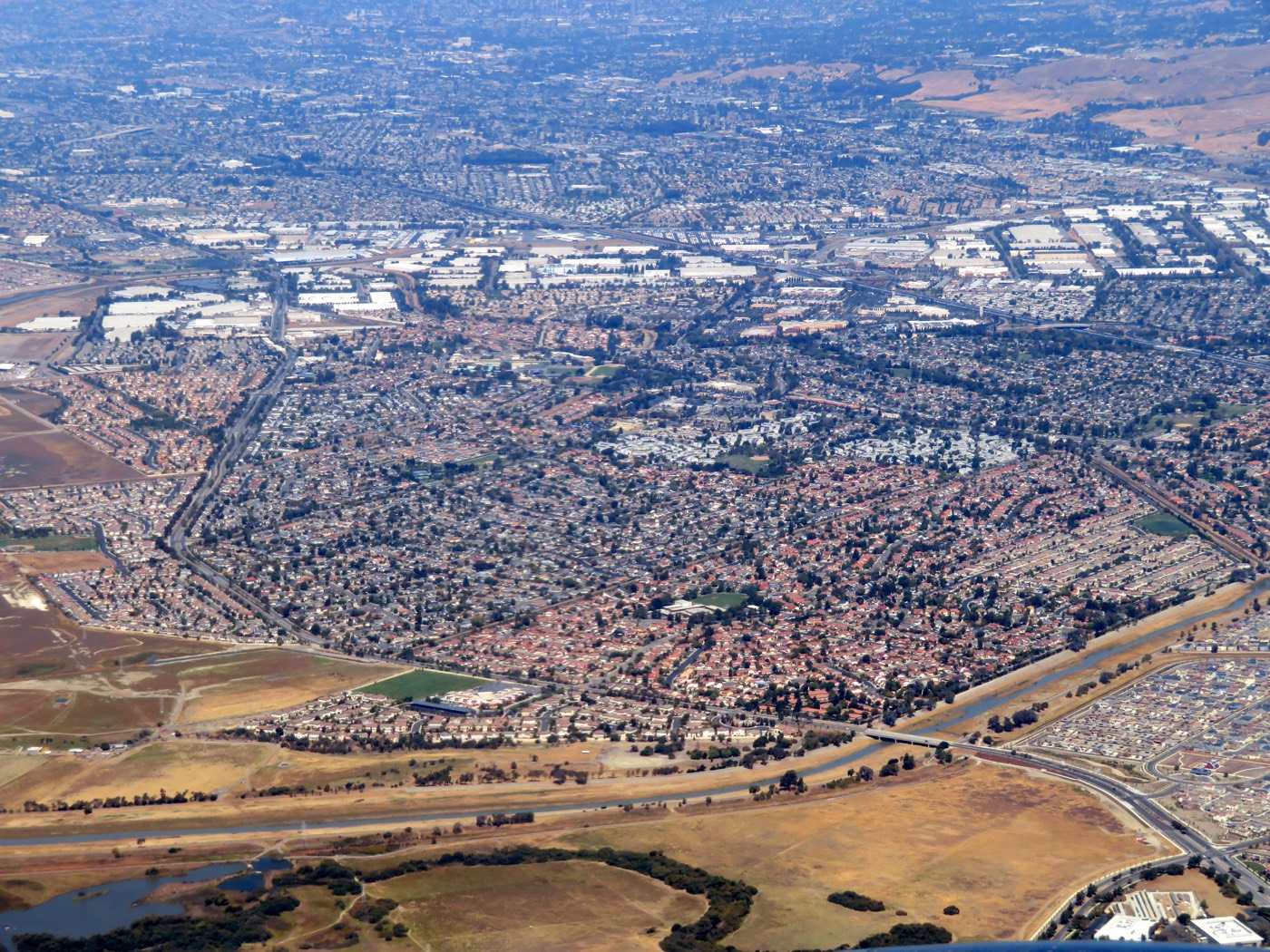
Drive down Decoto Road on a Sunday and the city tells on itself. The smell of garlic rice drifts from a turo turo counter, a banner outside Our Lady of the Rosary advertises a fiesta Mass, and the middle school down the boulevard carries two Filipino names on its sign. The Filipinos in Union City did not arrive as a footnote to this Alameda County suburb. For decades now they have been close to its centre of gravity.
The Place
Union City sits in the East Bay, nineteen square miles of valley floor wedged between Hayward to the north and Fremont and Newark to the south, the cluster locals call the Tri-Cities. It is not a famous town. It has no bay frontage and no skyline, just a grid of mid-century tract homes, light-industrial parks and a BART station that empties commuters toward San Francisco and San Jose each morning.
The city was stitched together in 1959 from two older settlements: Alvarado on the west, a former county seat dating to the 1850s, and Decoto on the east, a railroad town founded in 1870 along the first transcontinental line. For most of the twentieth century it was farmland and canneries, a chapter the local historical record still keeps in view.
What it became is one of the most Asian cities in California. By the 2020 census Union City counted 70,143 residents, more than 57 per cent of them Asian, and within that figure Filipinos form one of the largest single groups.
How It Became Filipino
The Filipino presence here is older than the city itself. To understand it you have to follow three distinct waves, each one leaving a different sediment.
The first arrivals, 1920s to 1930s
Filipinos were working the land around Alvarado and Decoto by the 1920s, when the area was still all orchards and row crops. They came after stints in the Hawaiian sugar plantations, or straight from the Ilocos provinces, and took the jobs the valley offered: apple picking, vegetable harvesting, dishwashing, domestic work, berths in the Merchant Marine and the U.S. Navy.
They arrived as American nationals, since the Philippines was then a U.S. territory, yet they could not own land, marry whom they pleased, or vote. They lived in labour camps and bunkhouses and moved with the crops, part of the same migrant generation that built Filipino California from Stockton to the Salinas Valley.
The professionals, after 1946
The second wave followed Philippine independence in 1946 and accelerated after U.S. immigration reform in 1965 lifted the old national-origin quotas. These were not field hands but doctors, engineers, nurses and teachers, many of them recruited directly to fill American labour shortages.
They could buy houses now, and they did. As the canneries closed and tract developers carved the orchards into subdivisions through the 1960s and 1970s, Union City offered exactly what a young professional family wanted: a new home, a decent school district, and a short drive to the jobs of the booming Peninsula.
The Navy generation, 1970s to 1980s
The third wave is the one that truly tipped the balance. Through the 1970s and 1980s a large number of new arrivals came by way of the U.S. Navy, men who had enlisted or worked at the American bases in the Philippines, especially around Subic Bay, and who mustered out in the Bay Area.
The East Bay, with Naval Air Station Alameda still in full operation and Naval housing scattered across the region, was a natural landing point. Union City, Fremont, Hayward and Newark filled with Navy families, and through the patient mathematics of chain migration, each settled household sponsored siblings, parents and cousins.
By the 1990 census Filipinos numbered 9,850 in Union City, about 18.3 per cent of the population, a figure that has only grown since. Around the old Alvarado district the concentration runs higher still: by the time the local middle school was renamed in the 2010s, roughly 38 per cent of households in its attendance zone were Filipino-American.
This was the period when the wider region’s Asian character set hard. Indians clustered in Fremont’s tech corridors, Chinese families filled the cul-de-sacs of San Jose down the freeway, and Koreans pushed south toward Orange County suburbs like Anaheim Hills. Within that mosaic Union City became, unmistakably, a Filipino town, the place an East Bay family would name first if you asked where the Filipinos lived.
The Landmarks
Island Pacific Supermarket, 4122 Dyer Street. One of the largest Filipino grocery branches in northern California, this is the community’s pantry. The aisles carry Goldilocks cakes and Manila Sunrise goods, the seafood counter runs to bangus and tilapia, and an M Lhuillier remittance desk near the front lets shoppers wire money home to the provinces between errands.
Itliong-Vera Cruz Middle School, 31600 Alvarado Boulevard. In December 2015 the New Haven Unified School District renamed Alvarado Middle School after Larry Itliong and Philip Vera Cruz, the Filipino organisers who launched the 1965 Delano grape strike alongside Cesar Chavez. It was the first public school in the United States named for Filipino-Americans, and the campaign that won the change was led in part by the district’s own high schoolers.
Our Lady of the Rosary Church, 703 C Street. The Catholic parish in old Alvarado anchors the religious life of many Filipino families, who brought with them the deep Catholicism of the Spanish-era Philippines. Fiesta Masses, Santo Nino devotions and the pre-dawn Simbang Gabi novena before Christmas mark the parish calendar.
Nayong Filipino, 1796 Whipple Road. Open since 2003, this restaurant takes its name from the cultural park in Manila and serves the homestyle plates that define the cuisine: kare-kare in its peanut sauce, sizzling sisig, lumpiang Shanghai, pancit bihon and leche flan. It is the kind of place where a Sunday lunch stretches into the afternoon.
Manila Turo Turo. Turo turo means “point point,” the steam-table style where you choose your dishes by pointing at them, and the format is itself a small lesson in how Filipino food travels. For workers and families it is the everyday counterpart to the sit-down restaurants, fast, cheap and unfussy.
Jollibee. The Filipino fast-food giant, with its beaming bee mascot, planted a branch in Union City to serve the homesick and the curious alike. Chickenjoy fried chicken, sweet Filipino-style spaghetti, palabok noodles and the Peach Mango Pie draw queues that tell you exactly how large the local market is.
Old Alvarado and Decoto. The two original townsites still read differently on the ground. Decoto, on the east side near the BART station, holds much of the older working-class housing where the Navy generation first settled, while Alvarado to the west keeps its small-town main-street bones. Both are now thoroughly Filipino in their everyday rhythm.
Where They Came From
The earliest field hands were overwhelmingly Ilocano, from the dry, hard-farming northern provinces of Luzon, the same region that fed the labour camps of Hawaii and the Central Valley. Thrift, endurance and a willingness to follow the harvest were the Ilocano migrant’s stock in trade, and that first generation set the pattern.
The later waves drew more broadly. Professionals came from Manila and the larger provincial cities, and the Navy generation reflected the recruiting reach of the American bases around Subic Bay and Cavite, pulling in families from across the Tagalog-speaking heartland and the Visayas.
What knits them together in Union City is less a single home province than a shared sequence: a foothold won by one relative, then the slow sponsorship of the rest, until an entire extended family had reassembled itself in the East Bay.
It is the same mechanism that built Filipino enclaves on the other side of the country, from the historic Little Manila in Queens to the suburban clusters of southern California. The difference in Union City is scale and timing. The Navy pipeline ran straight into the East Bay, and it ran for two solid decades, so the community thickened faster here than almost anywhere outside the old Manilatown of San Francisco.
Union City Today
Today Union City wears its Filipino identity plainly, without spectacle. It is in the remittance desks and the bakeries, the basketball leagues, the karaoke nights and the fiesta banners outside the churches. It is in a school district that teaches its students who Itliong and Vera Cruz were.
It shows up in the small annual rituals too: the Simbang Gabi novena Masses that fill the parishes before Christmas, the Santacruzan processions in May, the Filipino American History Month events each October that the wider Bay Area marks and Union City quietly leans into. None of it is staged for outsiders. It is simply how a large share of the town lives.
It is not a Filipinotown in the way San Francisco’s SOMA Pilipinas or Stockton’s vanished Little Manila were, neighbourhoods born of segregation and confined to a few blocks. Union City’s Filipino life is suburban and dispersed, woven through ordinary cul-de-sacs rather than concentrated on one strip. That is its own kind of arrival, the move from the labour camp to the homeowners’ association.
The pressures are familiar Bay Area ones. Housing costs have climbed steeply, pushing some younger families toward cheaper inland suburbs, the same outward drift that has carried Filipino communities to places like Eastvale in the Inland Empire and to settled enclaves such as Cerritos and West Covina in greater Los Angeles. Yet the institutions here, the churches, the supermarket, the named school, hold the centre. They are not going anywhere, and neither, for the most part, are the families who built them.
Frequently Asked Questions
Why are there so many Filipinos in Union City, California?
The Filipinos in Union City built up over three waves: farm and cannery labour from the 1920s, professional families after the 1965 immigration reforms, and a large U.S. Navy generation in the 1970s and 1980s who settled in the East Bay near bases such as Naval Air Station Alameda. Chain migration then drew in their extended families.
What percentage of Union City is Filipino?
The 1990 census counted 9,850 Filipino residents, about 18.3 per cent of the city, and the share has grown since. Around the old Alvarado district the concentration is higher: roughly 38 per cent of households near Itliong-Vera Cruz Middle School are Filipino-American. Overall the city is more than 57 per cent Asian.
Where can I find Filipino food and groceries in Union City?
Island Pacific Supermarket at 4122 Dyer Street is the main Filipino grocer, one of the largest in northern California. For dining, Nayong Filipino on Whipple Road has served homestyle dishes since 2003, turo turo counters offer point-and-choose meals, and a local Jollibee serves Filipino fast food.
What is Itliong-Vera Cruz Middle School?
In December 2015 the New Haven Unified School District renamed Alvarado Middle School after Filipino-American labour leaders Larry Itliong and Philip Vera Cruz, organisers of the 1965 Delano grape strike. It was the first public school in the United States named in honour of Filipino-Americans, a recognition the Filipinos in Union City had long sought.
Is Union City a Filipinotown like Stockton’s Little Manila?
Not in form. Stockton’s Little Manila and San Francisco’s SOMA Pilipinas were dense urban enclaves. Union City’s Filipino community is suburban and spread across ordinary neighbourhoods, especially the older Decoto and Alvarado districts, rather than concentrated on a single commercial strip.
When was Union City founded?
Union City was incorporated on 13 January 1959, combining the older communities of Alvarado, founded in the 1850s, and Decoto, a railroad town founded in 1870. Filipino agricultural workers were already present in the area well before the city itself existed.
If your family’s story passed through Union City, or any of the places Filipinos have made home in America, Atlas of Home can trace that journey. From the Ilocos provinces and the Navy years at Subic Bay, to a tract house off Decoto Road, to wherever you are now.