
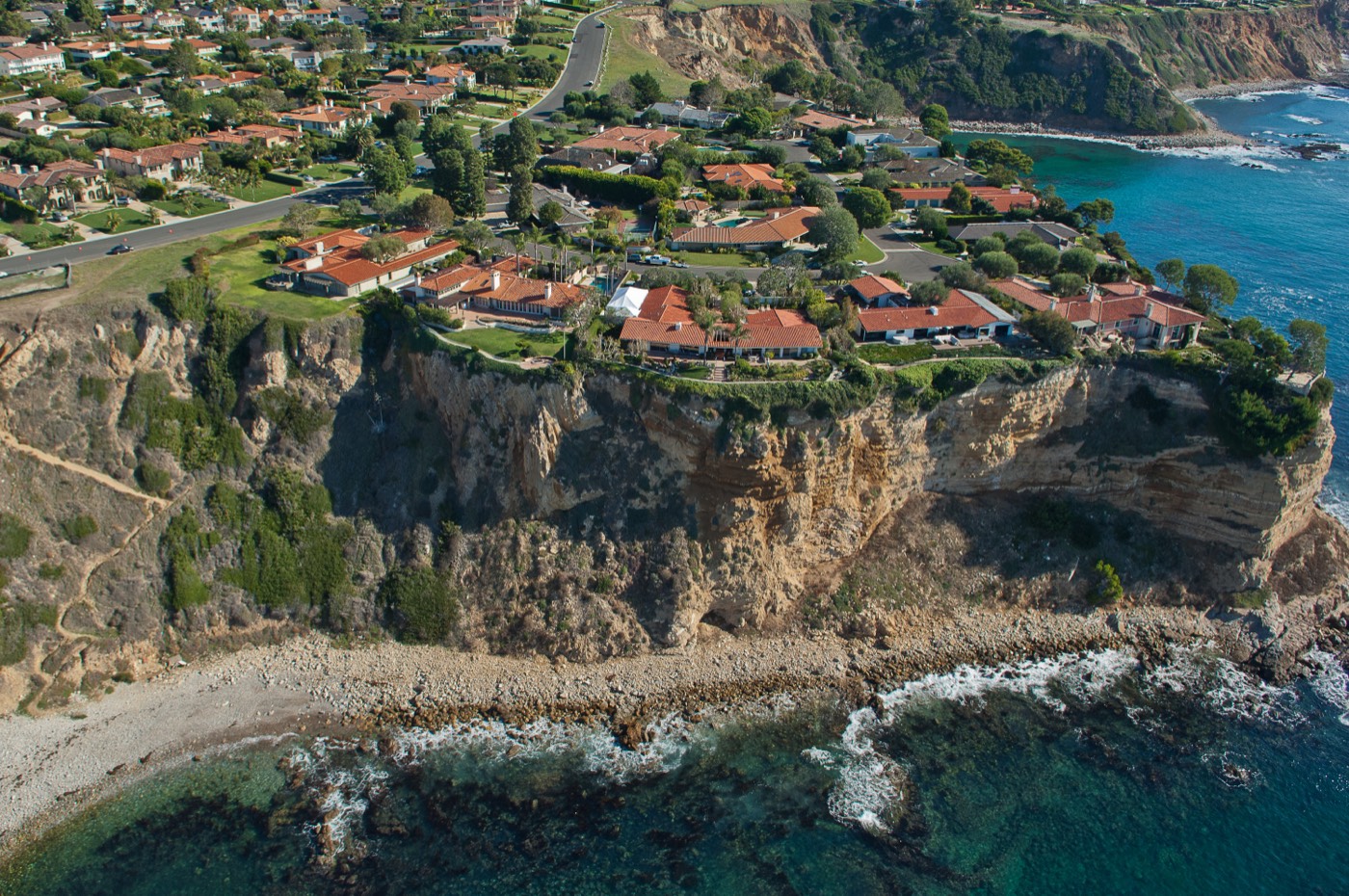
The cliffs at Lunada Bay drop straight into the Pacific, and on a clear morning you can see the whole Queen’s necklace of the South Bay coastline curving north. It is one of the most expensive views in America. A century ago, the gentler slopes behind those bluffs were planted with strawberries, garbanzo beans and gladiolas, tended by Japanese families who had walked, leased and bargained their way onto the peninsula. The story of the Japanese in Palos Verdes Estates begins not in the gated streets of today but in the furrows that came before them.
The Place
Palos Verdes Estates sits on the seaward edge of the Palos Verdes Peninsula, a green headland that juts into the ocean below the flat sprawl of Torrance and Gardena. It was master-planned in 1923, carved from the old Rancho Palos Verdes by Frank A. Vanderlip and laid out by the Olmsted Brothers, the firm founded by the designer of Central Park.
The result is a city of red-tiled Mediterranean houses, cliffside parkland and curving roads, with no neon and almost no commerce outside a handful of small plazas. In 2025 it was ranked California’s richest suburb. The population at the 2020 census was 13,347, and roughly a quarter of residents are Asian, with Japan and Taiwan the most common birthplaces among the foreign-born.
How It Became Japanese
To understand why Japanese families settled here, you have to go back before the Estates existed, to a time when the peninsula was farmland and the ocean view was worth nothing.
The land nobody wanted, 1900s to 1910s
In the early 1900s the Bixby family, who held the 16,000-acre Rancho de los Palos Verdes, decided the steep ground was better leased than grazed. They rented parcels to farmers for about ten dollars an acre a year. The hills were dry, wind-scoured and far from town. The people willing to take them on were largely Issei, first-generation Japanese immigrants shut out of better land.
Kumekichi Ishibashi was among the first. He had landed in San Francisco in 1895 and walked south to Los Angeles, working for years as a houseboy before leasing his first peninsula farm from Bixby in 1906, near what is now the Trump National Golf Club. In 1910 he brought his younger brother Tomizo to join him, and other families from Okayama and beyond followed.
A farming community takes root, 1910s to 1920s
The Japanese farmers of the peninsula were extraordinarily good at what they did. They grew garbanzo beans, barley, tomatoes and strawberries, and above all flowers: poppies, snapdragons, pansies and the gladiolas the Ishibashis cut two days before bloom and shipped by air to New York, where they fetched high prices.
The numbers tell the story. Across the West Coast in this period, Japanese farms averaged about 280 dollars of value per acre against 38 dollars for farms generally. In Los Angeles County, Japanese American growers produced the larger share of the cut-flower trade.
By the 1920s roughly 40 Japanese families farmed the peninsula, and on 24 November 1923 they gathered to mark the completion of an agricultural society hall built to host meetings, Japanese language classes, judo lessons and social events. A panoramic photograph taken that day captured 184 people, the entire community standing together in their best clothes.
California’s land laws and the citizen children
Their success drew a backlash. California’s Alien Land Law of 1913 barred immigrants ineligible for citizenship, which meant Japanese immigrants, from owning farmland or signing leases longer than three years. Families worked around it the only way they could: by putting land in the names of their American-born children, the Nisei, who were citizens by birth.
It was a precarious arrangement, dependent on the goodwill of landlords and the patience of children too young to understand what they held. For a generation it held. Then in 1942 it collapsed entirely.
Removal and the empty fields, 1942 to 1945
After Executive Order 9066, the Japanese and Japanese American community of the peninsula was forced out and incarcerated. Some landlords evicted their Japanese tenants before the official order, forcing them off the land before the harvest they had planted could be picked.
On 1 February 1942 Kumekichi Ishibashi and his wife Take were taken to a detention site in Bismarck, North Dakota. That July the rest of the family, including their son Mas, his wife Miye and their children, were sent to the camp at Poston, Arizona. Across the peninsula the fields went quiet.
The five families who came back
When the war ended, of the dozens of families who had farmed the peninsula, only about five returned. Most had lost everything: the leases, the equipment, the trust that had let them build a life on borrowed ground.
The Ishibashis were among those few. In 1949 Richard Ishibashi leased 150 acres near the Torrance Airport, just off the peninsula, and for decades the strawberry rows were visible from Crenshaw Boulevard. The family farmed on into the 21st century, finally closing operations around 2005 and holding a last sale in 2012. With it ended the longest-running Japanese farm on the peninsula.
The Landmarks
Malaga Cove Library, 2400 Via Campesina. The Mediterranean Revival building by architect Myron Hunt opened in 1930 as the peninsula’s first public library. It is now the keeper of Japanese memory here: the 40 Families History Project was launched at this library in the 2000s by reference librarian Marjeanne Blinn, after she saw the 1923 group photograph.
Peninsula Center Library, Rolling Hills Estates. Just inland from the Estates, an enlarged print of the 24 November 1923 panorama hangs on the wall. Volunteers identified more than 100 of the 184 people in it using draft and alien-registration records and interviews with descendants, recovering names that had nearly vanished.
Malaga Cove Plaza. The only one of the city’s five planned business centres ever fully built, with red tile roofs, arcades and a Neptune fountain imported from Italy and dedicated in 1930. It was added to the National Register of Historic Places in 2021, and remains the social centre of the older part of town.
Lunada Bay Plaza, around Yarmouth Road. The small plaza at the heart of Lunada Bay, built around an Italian fountain, is the closest the city comes to a daily high street. Black Bamboo Sushi has long operated here, one of the few Japanese restaurants serving residents on the bluff.
The Portuguese Bend slopes. The original Ishibashi farm sat near here on a five-acre parcel, on land now occupied by the Trump National Golf Club. The exact site of the 1923 community hall, in a section of Portuguese Bend, has been swallowed by the active landslide that has reshaped this stretch of coast.
La Venta Inn, above Malaga Cove. The 1920s hilltop inn, with its sweeping view of the coastline, was one of the first structures built to sell the new Estates to wealthy buyers. It stands as a reminder of the moment the peninsula’s value flipped from soil to scenery.
Lunada Bay bluffs. The cliffs above Malaga Cove are also one of the most important Tongva archaeological sites in the region, marked by a plaque honouring the Chowigna village that stood here long before any farm or estate. The peninsula has held more than one people who were later pushed aside.
Where They Came From
The founding farm families of the peninsula came overwhelmingly from rural Japan, and Okayama Prefecture on the Inland Sea recurs again and again in their histories. The Ishibashis were an Okayama family, and chain migration drew relatives and fellow villagers to the same ground, a pattern repeated across Japanese farming communities in California. The same Okayama and rural-prefecture roots run through the families who built Gardena’s Japanese American community on the flatlands below the peninsula.
These were people from agricultural districts who arrived with farming knowledge but no land of their own, and the leased hills of Palos Verdes offered the rare chance to put that knowledge to work. The later Japanese presence in Palos Verdes Estates has different roots: postwar professionals and corporate families, many connected to Japanese firms in the Los Angeles region, drawn by the schools and the coast rather than the soil.
Palos Verdes Estates Today
The farms are gone, and the families who tend strawberries here now do so as a memory rather than a living. What endures is a quieter Japanese presence woven into one of the wealthiest towns in California. Roughly a quarter of the city is Asian, and in the wider Palos Verdes Peninsula Unified School District around a third of students are Asian, in a district that ranks among the very best in the state.
That ranking is much of the reason families come. Japanese and Japanese American households, like Taiwanese and Korean ones, are drawn to schools where math proficiency runs near 74 per cent and reading near 80 per cent, far above the California average. The community here is professional and dispersed rather than concentrated, distinct from the dense Japanese American neighbourhoods down the hill in Gardena and Torrance. For all their differences, these communities share a lineage that also runs through the older urban cores of Japanese Los Angeles, from Little Tokyo in downtown Los Angeles to the Sawtelle Japantown on the Westside.
The honest present is one of remembrance more than residence. The story of the Japanese in Palos Verdes Estates lives now in a library photograph, a few place names, and the green slopes where the gladiolas once grew, as much as in the families who chose the peninsula again, two generations after their predecessors were forced to leave it.
Frequently Asked Questions
Who were the first Japanese settlers in Palos Verdes?
The first were Issei farmers who leased land from the Bixby ranch in the early 1900s, when the peninsula was farmland rather than a wealthy suburb. Kumekichi Ishibashi leased his first farm near present-day Trump National Golf Club around 1906, and by the 1920s roughly 40 Japanese families farmed the peninsula.
Why is there a Japanese community in Palos Verdes Estates today?
The historic Japanese in Palos Verdes Estates were farmers, but most were forced out during World War II internment and never returned. Today’s Japanese presence is largely postwar professional and corporate families drawn by the top-ranked schools and the coastal setting, distinct from the older farming community.
What happened to the Japanese farmers during World War II?
After Executive Order 9066 in 1942, the peninsula’s Japanese and Japanese American families were forcibly removed and incarcerated, some sent to Poston, Arizona and detention sites elsewhere. Of the dozens of farming families, only about five returned to the area after the war.
What is the 40 Families History Project?
It is a community history effort launched at Malaga Cove Library to document the vanished Japanese farming community of Palos Verdes. It centres on a panoramic photograph of 184 people taken on 24 November 1923, and volunteers identified more than 100 of them using historical records and interviews with descendants.
What did the Japanese farmers grow on the peninsula?
They grew garbanzo beans, barley, tomatoes and strawberries, and were especially renowned for flowers, including poppies, snapdragons, pansies and gladiolas. The Ishibashi family air-shipped cut gladiolas to New York, where they commanded high prices.
How is Palos Verdes Estates different from Gardena for Japanese Americans?
Gardena and nearby Torrance have dense, long-established Japanese American neighbourhoods with grocers, temples and community institutions, much like San Jose’s Japantown in the north of the state. Palos Verdes Estates is an affluent hilltop enclave where the Japanese presence is professional and dispersed, centred on schools and ocean views rather than a commercial Japanese district.
If your family’s story passed through Palos Verdes Estates, or any of the places Japanese Americans have made home in America, Atlas of Home can trace that journey. From an Okayama farming village to a five-acre parcel above Portuguese Bend, to wherever you are now.