
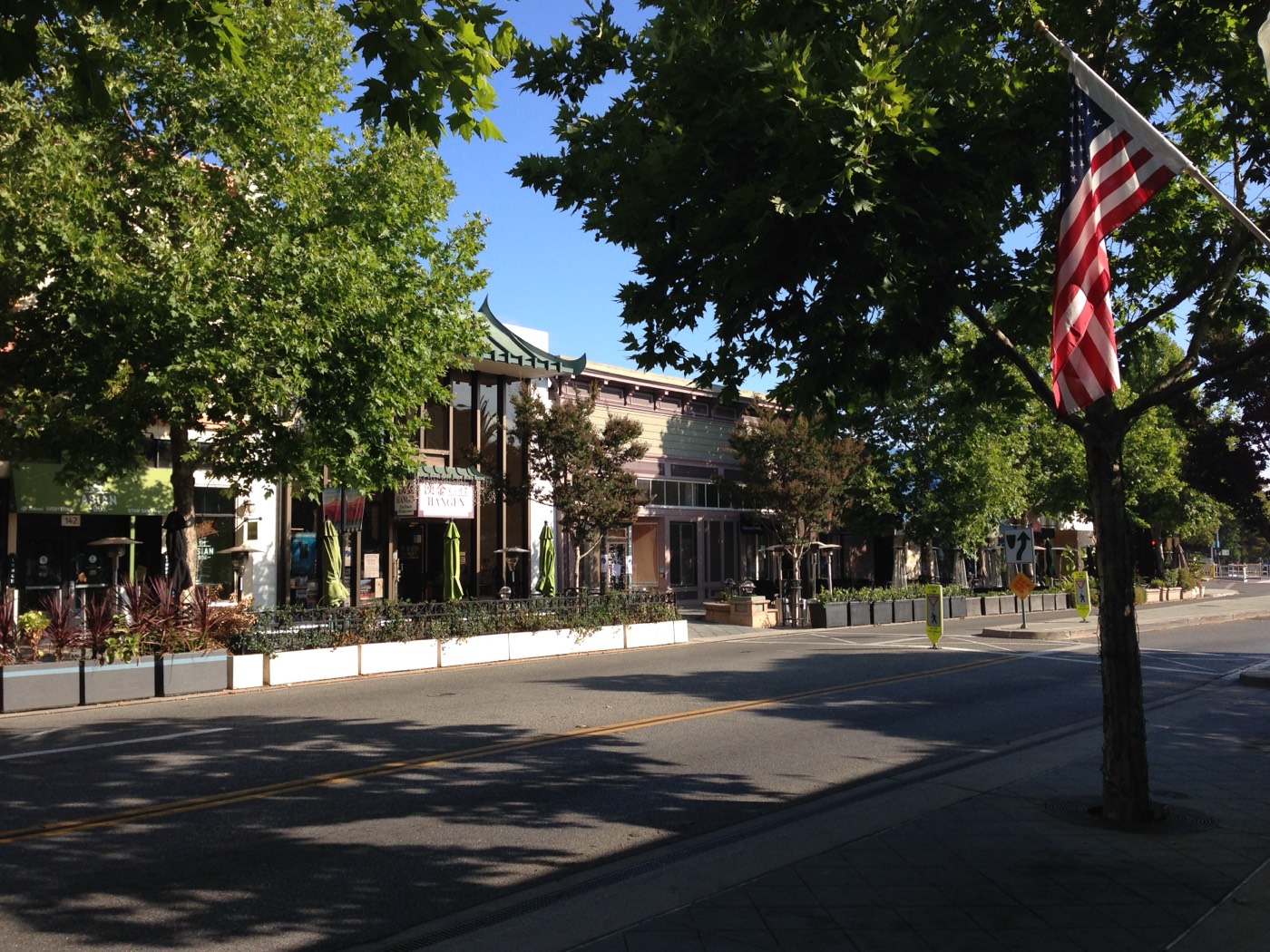
On a weekday morning the queue outside Kirin on Castro Street is mostly engineers, and a good share of them are speaking Mandarin between bites of har gow. The Chinese in Mountain View are not tucked into a single enclave the way they are in older Chinatowns. They are woven through the city that builds the software the rest of the world runs on, from the Googleplex on Amphitheatre Parkway to the townhouses going up near the Caltrain line, ordering dim sum within walking distance of their desks.
The Place
Mountain View sits in the heart of Santa Clara County, on the San Francisco Peninsula between Palo Alto and Sunnyvale. It was incorporated on 7 November 1902 with roughly 600 residents, a railway town stitched into the orchards that once earned the region the name Valley of Heart’s Delight.
Today it is the headquarters of Alphabet, Google’s parent company, and home to more than 82,000 people. The fruit-drying sheds are long gone. In their place stand low glass campuses, a downtown that fills at lunchtime, and a population that is now more than a third Asian.
How It Became Chinese
The Chinese presence in Mountain View is, at its core, a story about work. Specifically, the kind of work that the rest of the Peninsula came to be known for: chips, then software, then the machine-learning systems that now sit inside everything.
From orchards to silicon
For its first half-century Mountain View grew and dried fruit. The Southern Pacific Railroad had arrived in the 1860s, and the town that formed around Castro Street shipped apricots, prunes and wine north to San Francisco.
The orchards gave way to electronics after the Second World War. Defence contractors and semiconductor firms spread across the flat land near Moffett Field, and by the time the personal-computer era arrived, Mountain View was already a working address in what people had started calling Silicon Valley.
That shift mattered for who came next. A town built on canneries and packing sheds had drawn one kind of labour. A town built on research laboratories drew another: graduate-trained, internationally recruited, and increasingly Asian. The orchards never came back, and neither did the old workforce.
The Taiwanese engineers came first
The earliest wave of Chinese settlement here came not from the mainland but from Taiwan. Through the 1970s and 1980s, graduate students arrived at American universities, took degrees in electrical engineering and computer science, and stayed.
By one careful study of the regional workforce, more than a third of Silicon Valley’s Chinese immigrant engineers in those decades were from Taiwan. They were the founders and the senior staff, and they set a pattern: arrive young, work in the labs along the Peninsula, raise a family near a good school.
Mountain View, central and well connected by Caltrain and El Camino Real, was a natural place to land. It was less expensive than Palo Alto and closer to the work than the suburbs further south.
The mainland surge
The composition shifted sharply after 1990. As China opened and the American technology sector boomed, the number of mainland Chinese engineers in the valley rose dramatically. Many came on H-1B visas to fill posts that local hiring could not, then settled into green cards and citizenship.
Researchers found that 41 per cent of the Chinese working in Silicon Valley high-technology industries in 1990 had arrived in the United States only after 1980. The next two decades poured fuel on that figure. Mountain View, with its expanding campuses, absorbed a steady share.
The arrival of Google sealed it. The company moved into the former Silicon Graphics campus at 1600 Amphitheatre Parkway, restructured itself under the holding company Alphabet on 2 October 2015, and grew to occupy more than twenty buildings around the city. Each expansion drew engineers, and a large and growing number of them were Chinese, many recruited directly out of universities in Beijing, Shanghai, Hsinchu and Taipei.
Growth you can count
The change shows clearly in the census. Between 2010 and 2020 the city’s Asian population rose from 19,232 to 28,891, a jump that, in the words of the local Mountain View Voice, largely made up the city’s growth over the entire decade.
White residents ceased to be a majority. By recent American Community Survey estimates, about 43 per cent of all Mountain View residents are foreign born, and well over half of them were born in Asia. Of the city’s Asian residents, the single largest group is Chinese.
The Landmarks
Kirin, 485 Castro Street. A long-running Cantonese dining room in the middle of downtown, where the dim sum carts and the shrimp dumplings draw a lunch crowd that spills out of the nearby office buildings. It is the kind of place where a table of engineers will argue over a design document in two languages without anyone breaking stride.
Fu Lam Mum, 153 Castro Street. A few doors down, an old-guard Chinese restaurant in the heart of Old Mountain View, with a long menu and a steady following for its dim sum. Between Kirin and Fu Lam Mum, Castro Street carries more serious Chinese cooking than a town this size has any right to.
99 Ranch Market, 1350 Grant Road. The Mountain View branch of the largest Asian supermarket chain in the United States opened in 2008 near the San Antonio shopping district. Its hot-foods counter sells rotisserie duck and self-serve dim sum, and on a Saturday it is the closest thing the city has to a Chinese town square.
Castro Street downtown. The half-mile from El Camino Real to the Caltrain station is the social spine of the city. Bakeries selling Hong Kong-style buns sit beside ramen shops and boba counters, and the street fills at lunch and again after work with the people who keep the campuses running.
The Googleplex, 1600 Amphitheatre Parkway. Not a Chinese landmark in any obvious sense, but the gravitational centre of the whole story. The campus that drew so many engineers to Mountain View shaped where they bought homes, where their children went to school and which restaurants survived.
Mountain View Community Center, 201 South Rengstorff Avenue. Each winter the city stages a Lunar New Year celebration here, with performances, crafts and food, an official acknowledgement that the holiday now belongs to Mountain View as much as to any city on the Peninsula.
Chef Chu’s, El Camino Real, Los Altos. Just over the city line, the restaurant that Lawrence C. C. Chu opened in 1970 became one of the Peninsula’s most famous Chinese kitchens and a fixture for Mountain View families. It is the older generation’s special-occasion table, a short drive from the new campuses.
Where They Came From
There is no single village of origin here, no chain of cousins from one county the way there is in some American Chinese communities. The Chinese in Mountain View came along the routes that technology cut.
The first cohort was largely Taiwanese, arriving through graduate programmes in the 1970s and 1980s and moving into the valley’s engineering ranks. The larger second wave came from the mainland after 1990, from the universities of Beijing, Shanghai and the coastal cities, drawn by the same firms.
What they shared was credentials and a willingness to cross an ocean for a job. They are, on the whole, an immigrant elite: engineers, researchers and founders, many holding advanced degrees, which is why Mountain View’s Chinese community looks so different from the laundry-and-restaurant origins of older Chinatowns.
Mountain View Today
The Chinese community in Mountain View is prosperous, dispersed and quiet. There is no gate, no formal quarter. Families cluster instead around the good public schools, sending their children into the Mountain View-Los Altos high school district, whose campuses send graduates to the most selective universities in the country.
The pressures are the ones the whole region feels, only sharper. Housing is brutally expensive, and even two strong tech salaries can struggle against the price of a single-family home. Many Chinese families live in the newer townhouse and condominium developments near downtown and the rail line, or look south and east to Sunnyvale, Cupertino and the Chinese community in Fremont when they want a yard.
For all the wealth, the community carries the familiar strains of first-generation immigration. Parents who arrived as students navigate American schools without having attended them. Grandparents fly in from Beijing or Taipei for months at a time to help raise children, then return home, leaving households that stretch across the Pacific. The pressure to justify the journey, to themselves and to the families they left, sits behind a great deal of the ambition you see in Mountain View’s schools.
What endures is the everyday texture: the Mandarin in the queue at 99 Ranch, the dim sum on Castro Street, the city’s own Lunar New Year stage, the WeChat groups that organise everything from carpools to college-admissions advice. It is a community defined less by a place on the map than by a shared arrival, and by the campuses that made the arrival worth it.
Frequently Asked Questions
How many Chinese people live in Mountain View, California?
Of roughly 28,891 Asian residents counted in the 2020 census, the Chinese are the single largest group, numbering in the low five figures. The Chinese in Mountain View make up a substantial share of a city that is now more than a third Asian.
Why did so many Chinese settle in Mountain View?
The short answer is work. The Chinese in Mountain View came largely as engineers and researchers, first from Taiwan in the 1970s and 1980s and then from mainland China after 1990, drawn by Silicon Valley’s technology firms and, later, by Google’s enormous campus in the city.
Is there a Chinatown in Mountain View?
No. Unlike San Francisco or Oakland, Mountain View has no designated Chinatown. The community is dispersed across the city, with its commercial heart on Castro Street downtown and at 99 Ranch Market on Grant Road.
Where do Chinese families in Mountain View shop and eat?
The 99 Ranch Market at 1350 Grant Road is the main Asian grocer, while Castro Street offers Cantonese dining at restaurants such as Kirin and Fu Lam Mum, plus Hong Kong-style bakeries and boba shops.
Are most Chinese residents from Taiwan or mainland China?
Both, in waves. The earlier generation that arrived in the 1970s and 1980s was heavily Taiwanese, while the larger more recent influx has come from mainland China since 1990.
How does Mountain View compare to Cupertino or Palo Alto?
All three are Peninsula tech towns with large Chinese populations, but Mountain View is more mixed and more central than the others. Families often weigh it against neighbouring cities, as you can see in the stories of the Chinese in Cupertino, the Chinese in Palo Alto and the Chinese in Sunnyvale.
If your family’s story passed through Mountain View, or any of the places Chinese people have made home in America, Atlas of Home can trace that journey. From the universities of Taipei and Shanghai to a townhouse near Castro Street, to wherever you are now.