
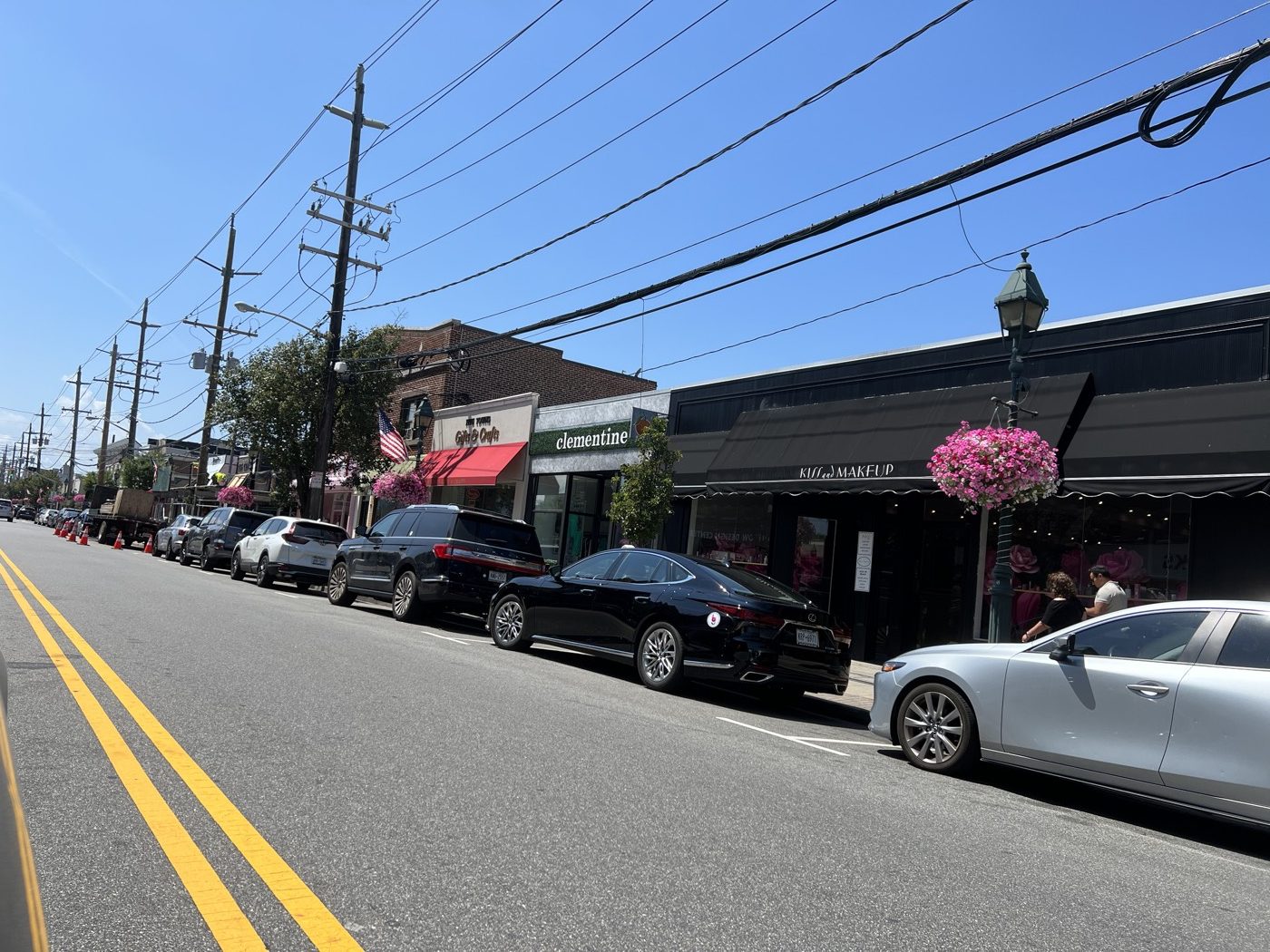
On a Friday afternoon in Cedarhurst, the kosher bakeries on Central Avenue run out of challah by three o’clock, the parking spots vanish, and a quiet settles over the village as Shabbat approaches. This is the rhythm of the Jews in the Five Towns, a cluster of villages and hamlets on Long Island’s South Shore that has become one of the most concentrated Modern Orthodox communities in America, where more than half the residents are Jewish and the calendar runs on the Hebrew week.
The Place
The Five Towns is an unofficial name for a string of communities in the Town of Hempstead, in Nassau County, just east of the Queens line. Despite the name, none of them are actually towns: Lawrence and Cedarhurst are incorporated villages, Woodmere and Inwood are hamlets, and “the Hewletts” take in several small villages plus the hamlet of Hewlett.
The label came from the railway. Each community sits on a consecutive stop of the Long Island Rail Road’s Far Rockaway Branch, and in 1931 a Five Towns Community Chest pooled their charity efforts under the shared name. It stuck.
The area has long been affluent, with Lawrence in particular ranking among the wealthier addresses on Long Island. Inwood, at the edge nearest the bay, has always been the more modest and more diverse of the group.
How It Became Jewish
The Jewish story here did not begin in the Five Towns proper. It began a short distance away, in Far Rockaway, on the Queens side of the line.
A Torah suburb by the sea
Jews began settling in Far Rockaway in the second half of the nineteenth century, drawn at first by the ocean air and the summer resorts. By around 1910 some 200 Jewish families lived there year round, with thousands more arriving each summer. The early settlers were largely Reform, but a steady arrival of Orthodox families over the following decades turned Far Rockaway into what locals came to call a Torah suburb by the sea.
That Orthodox momentum spilled north and east into the Five Towns. The communities were genteel and largely gentile in the early twentieth century, the kind of place where summer homes and country clubs set the tone. Lawrence had grown up as a planned resort village in the late nineteenth century, its grand houses and golf links a world away from the tenements that most of New York’s Jews then called home.
For decades the few Jewish families who did settle were the exception, not the rule. The shift from a handful of observant households to a self-sustaining Orthodox world took the better part of a century, and it happened in distinct generations, each adding a layer of institutions the next could build upon. As the Jewish Telegraphic Agency has chronicled, the result is now sometimes called the Greater Five Towns, a single continuous belt of observance rather than five separate stops.
A storefront in Cedarhurst
The Orthodox community in the Five Towns itself traces its origin to a handful of families who gathered in a Cedarhurst storefront in 1928. It was a small beginning, a minyan rather than a movement, but it planted the institutional seed from which everything else grew.
Congregation Beth Sholom in Lawrence, the oldest congregation in the Five Towns, became an early anchor. Its long-serving rabbi, Gilbert Klaperman, helped lay the communal foundation in the mid-twentieth century, building the kind of institutions a permanent, year-round Orthodox population would need.
The Young Israel generation
The post-war decades brought the next layer. Rabbi Yaakov Kamenetzky took up the pulpit at the Young Israel of Woodmere in 1956 and helped seed Young Israel congregations in Lawrence and Cedarhurst as well. The Young Israel movement, with its blend of strict observance and an American, English-speaking sensibility, suited the suburb perfectly.
The community remained a minority within the wider Five Towns for decades. The decisive shift came in the late 1980s, when Orthodox families began moving in from Brooklyn and Queens in significant numbers, looking for space, schools and a lawn without leaving observance behind.
The arithmetic of Orthodox family life drove the change. Large families needed more bedrooms than a Brooklyn walk-up could offer, and the cost of a house in the Five Towns, while never cheap, was within reach for a generation that had built careers in Manhattan and the professions. A family could move out and still daven in a shul of the same character, send children to a yeshiva of the same standard, and shop for the same kosher products they had always bought. Suburbia, in other words, did not require any compromise of observance.
The tipping point
By 2000, Orthodox Jews made up roughly 30 percent of the total Five Towns population. In Woodmere, Lawrence and Cedarhurst, they had become by far the largest single bloc of residents. The infrastructure followed the people: an eruv was strung up to permit carrying on Shabbat, a mikvah was built, kosher supervision was organised, and the day schools multiplied.
By 2010 the area counted 53 Orthodox synagogues. The Greater Five Towns had become shorthand for an even wider belt of observance, reaching back into Far Rockaway and North Woodmere and out toward Lawrence’s edges, a continuous Orthodox geography rather than five separate dots on a railway map.
The Landmarks
Young Israel of Woodmere, 859 Peninsula Boulevard, Woodmere. The largest Orthodox congregation in the Five Towns, and in many ways the flagship of the community. Rabbi Yaakov Kamenetzky’s arrival in 1956 helped turn the shul into an engine for the wider neighbourhood’s growth.
Congregation Beth Sholom, 390 Broadway, Lawrence. The oldest congregation in the Five Towns. Under Rabbi Gilbert Klaperman it became the bedrock on which much of the later Orthodox expansion was built, a synagogue whose history runs alongside the whole community’s.
Central Avenue, Cedarhurst. The commercial spine of Jewish Five Towns. Bakeries, Judaica shops, boutiques and kosher restaurants line the street, and on a Friday afternoon it becomes the staging ground for the entire community’s Shabbat preparation.
Gourmet Glatt, Cedarhurst. The premium kosher supermarket that anchors much of the area’s food shopping, with fresh meat, dairy, prepared foods and catering. For thousands of households it is simply where the week’s groceries come from.
Hebrew Academy of the Five Towns and Rockaway (HAFTR), 389 Central Avenue, Lawrence. A Modern Orthodox day school running from preschool through twelfth grade. It is one of the defining institutions of the community, the kind of school families weigh when they decide to move in.
Davis Renov Stahler Yeshiva High School for Boys (DRS), 700 Ibsen Street, Woodmere. A Modern Orthodox boys’ yeshiva high school founded in 1997, serving grades nine through twelve. Its appearance in the late 1990s is itself a marker of how mature the community had become.
Rambam Mesivta, 284 Mott Avenue, Lawrence. A boys’ Jewish high school that adds to the dense layer of secondary yeshiva education in the Five Towns, part of the reason families rarely need to send children outside the area to learn.
Where They Came From
The Jews of the Five Towns did not arrive from a single foreign village the way some immigrant communities did. They arrived, overwhelmingly, from the next neighbourhood over.
The great wave of the late 1980s and beyond came out of Orthodox Brooklyn and Queens: families from Flatbush, Borough Park, Kew Gardens Hills and especially neighbouring Far Rockaway, trading apartment living for South Shore lawns while staying within reach of the same religious world. The community shares its character with other Modern Orthodox suburbs that drew the same population, from the Jews of Teaneck, New Jersey across the Hudson to the older Long Island enclaves at Great Neck and Roslyn.
Further back, the roots run to the same places most Ashkenazi American Jews trace: the towns and cities of Eastern Europe, Poland, Lithuania, Hungary and the lands of the former Russian Empire, by way of an earlier generation’s arrival on the Lower East Side and the dense Orthodox heartland of Borough Park. The Five Towns is, in that sense, a third or fourth American address rather than a first.
The Five Towns Today
The numbers tell the story plainly. A UJA-Federation community study counted roughly 24,000 Jewish adults and 15,000 Jewish children across about 10,000 households, with the Five Towns more than half Jewish overall. Among Jewish adults, around 69 percent identify as Orthodox, a higher Modern Orthodox share than almost anywhere else in the New York region.
This is a young, engaged community by Nassau standards. The average adult age in Jewish households sits around 43, lower than the county figure, and the day school enrolment is striking: the great majority of households with school-age children send at least one to a Jewish day school. Synagogue membership runs high, and nearly everyone surveyed said being Jewish matters deeply to them.
What that produces, on the ground, is a place that runs on Jewish time. Central Avenue empties before sundown on Friday and the streets fill with families walking to shul. The schools, the kosher supermarkets, the eruv and the mikvah are not curiosities here but the ordinary plumbing of daily life.
The density brings its own pressures, as it does in any community that grows this concentrated. Housing prices have climbed steadily, day school tuition is a constant strain on household budgets, and the question of how to absorb a still-growing population presses on the schools and shuls alike. The community has had to think hard about expansion into the Greater Five Towns, and about the towns at its edge, such as Inwood, which retain a more diverse and modest character than the Orthodox heartland of Lawrence and Woodmere.
Yet the through line holds. From the storefront minyan of 1928 to the dozens of synagogues today, the Jews in the Five Towns have built something unusual in American life: a suburb where observance is not a private matter carried into a secular setting, but the public texture of the place itself. For all its lawns and its comfort, the Five Towns is in the end defined less by its real estate than by its calendar.
Frequently Asked Questions
Which towns make up the Five Towns in New York?
The Five Towns are Hewlett, Woodmere, Cedarhurst, Lawrence and Inwood, on Long Island’s South Shore in Nassau County. Lawrence and Cedarhurst are incorporated villages, while Woodmere and Inwood are hamlets, so despite the name none of them are technically towns.
How large is the Jewish community in the Five Towns?
A Jewish community study counted roughly 24,000 Jewish adults and 15,000 Jewish children in about 10,000 households, with the Five Towns more than half Jewish overall. The Jews in the Five Towns form one of the largest concentrated Modern Orthodox communities in the United States.
Why did so many Orthodox Jews move to the Five Towns?
Orthodox families began arriving in large numbers in the late 1980s, mostly from Brooklyn, Queens and neighbouring Far Rockaway. They were drawn by suburban space and strong Jewish day schools while staying within reach of the religious institutions of New York City.
Is the Five Towns mostly Modern Orthodox?
Yes. Around 69 percent of Jewish adults in the Five Towns identify as Orthodox, and the area has one of the highest shares of Modern Orthodox Jews anywhere in the New York region. There are also smaller Conservative and Reform populations.
What is on Central Avenue in Cedarhurst?
Central Avenue is the commercial heart of Jewish life in the Five Towns, lined with kosher bakeries, restaurants, Judaica shops and boutiques. Kosher supermarkets such as Gourmet Glatt anchor the area’s food shopping for thousands of observant households.
Does the Five Towns have an eruv and Jewish schools?
Yes. The community maintains an eruv and a mikvah, and supports many Jewish day schools, including HAFTR, Davis Renov Stahler and Rambam Mesivta. By 2010 the area counted 53 Orthodox synagogues, reflecting how deep the institutional infrastructure runs.
If your family’s story passed through the Five Towns, or any of the places Jews have made home in America, Atlas of Home can trace that journey. From a storefront minyan in Cedarhurst in 1928 to the synagogues and schools of Lawrence and Woodmere today, to wherever you are now.