
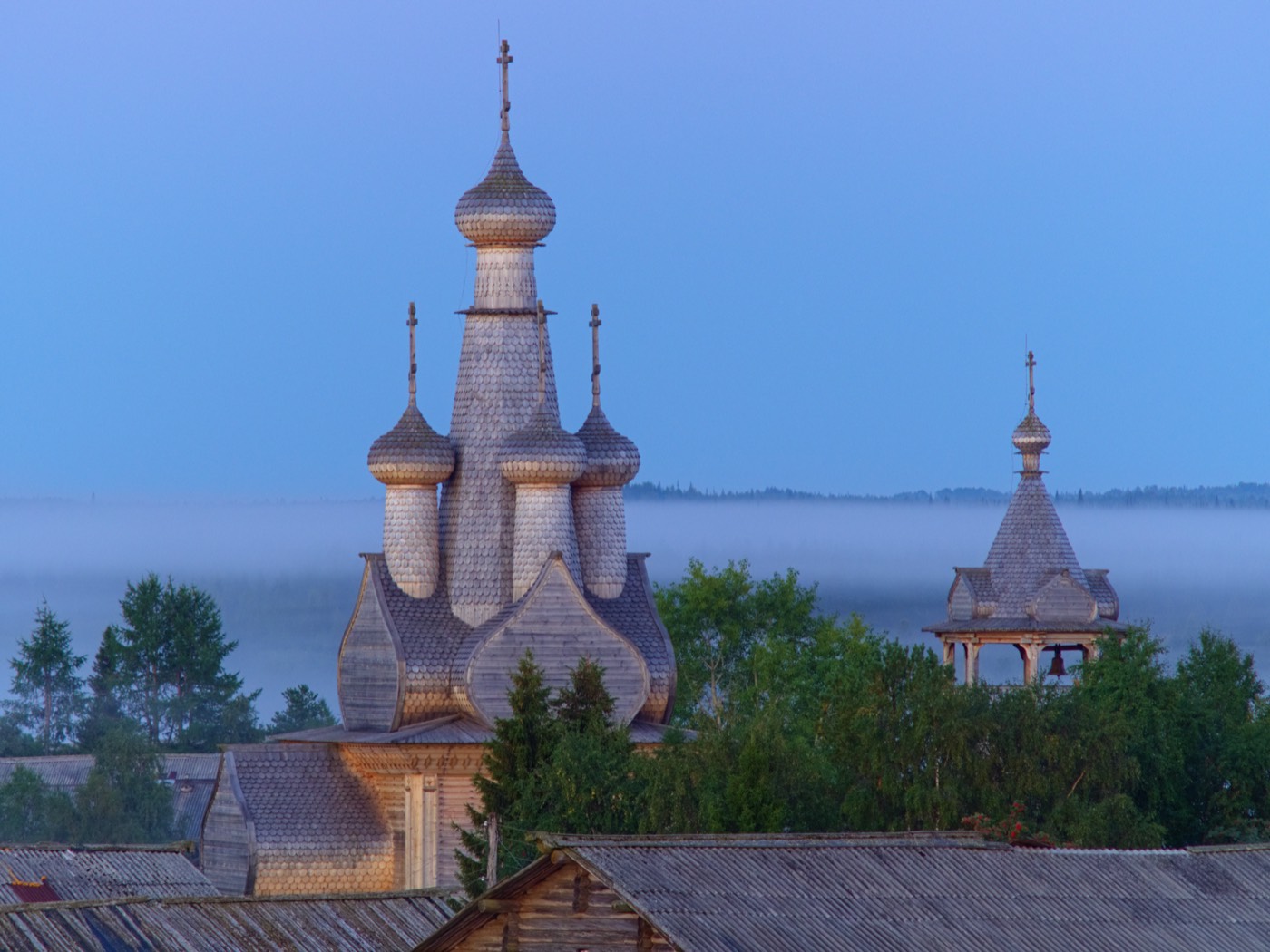
The Popov surname means “the priest’s” in Russian, from pop, the ordinary word for an Orthodox parish priest. It is one of the ten most common names in Russia, and it belongs to the whole Orthodox Slavic world.
What Does the Surname Popov Mean?
Popov (Cyrillic Попов) means “the priest’s”. It is built from pop, an Orthodox parish priest, plus the Slavic possessive ending -ov, so the name literally says “belonging to the priest”.
The root word is not Slavic at all. Pop was borrowed into Church Slavonic from the Greek pappas, “father”, travelling north with Byzantine Christianity along with the alphabet, the liturgy and the calendar. The same Greek word sits inside the Greek surname Papadopoulos.
What the possessive actually meant in any given family is worth being careful about. Because Orthodox parish clergy marry and only bishops are celibate, a priest had children, and “the priest’s” most often meant the priest’s son. But the standard reference works, including Boris Unbegaun’s study of Russian surnames, caution that in many Russian cases the name says no more than “of the priest” and could equally have marked a servant, a workman or a household attached to the parish.
Where the Popov Name Comes From
Popov is overwhelmingly Russian. Of roughly 474,000 bearers worldwide, about 366,000 live in Russia, where the name occurs in about one person in 394. Ukraine, Kazakhstan, Bulgaria, Serbia, Belarus and Moldova hold most of the rest.
The Russian North
Within Russia the name is reckoned especially dense in the north, in Arkhangelsk, Vologda and the old Perm lands, where scattered villages were organised around wooden parish churches and the priest was often the only literate man for a day’s travel in any direction.
That density has a structural cause. Imperial Russia recognised a hereditary clerical estate, and a parish frequently passed from father to son or to a son-in-law across several generations. A family that stayed in the priesthood stayed “the priest’s” family, and the label hardened into a surname.
Bulgaria and the Balkans
Bulgaria is the second true homeland, not a footnote. About 14,450 Bulgarians carry Popov, roughly one person in 483, a density close to Russia’s, and the same mechanism produced it under Ottoman rule, where the parish priest was one of the few surviving Bulgarian institutions.
Serbia has close to 6,900 Popovs, mostly in Vojvodina, although the usual Serbian form of the idea is Popović. Macedonia prefers Popovski, Moldova and Transnistria show the highest density of Popov anywhere on earth, and Ukraine holds more than 31,000.
Names handed out at seminary
Russian clergy surnames have a second, stranger source. From the late seventeenth century and for about two hundred years afterwards, heads of theological schools simply assigned surnames to students who arrived without one, or whose existing name was thought too coarse for a future priest.
The invented names were drawn from church feasts, saints, birthplaces and classical learning: Voznesensky from the Ascension, Rozhdestvensky from the Nativity, Uspensky from the Dormition, Vvedensky from the Presentation. Because those students married and had children, the names spread out of the clergy and across Russia. Popov is the plain, unliterary member of the same family, the one that came from the village rather than the registrar.
Spelling Variants and Related Names
The main variants are Popov and the feminine Popova in Russian and Bulgarian, Popović in Serbian and Croatian, Popovski in Macedonian, Popovici and Popescu in Romanian, and Popoff or Popow in older Western transliterations.
Popovich is the form to watch, because it does double duty. In Russian it is a patronymic, “son of Popov”, and in America it is also the standard anglicisation of the Serbian Popović, which is why the two communities meet under one spelling in US records. Popa and Pop, common in Romania and among Romanians in Serbia, mean the priest himself rather than his household, and Raspopov marks a defrocked one.
Popescu, one of the most common surnames in Romania, means exactly what Popov means, assembled from the same Slavic popă with the Romanian suffix -escu.
That is the genuinely interesting part. Because Eastern and Oriental Orthodox parish clergy marry, every Orthodox language eventually produced a hereditary surname meaning “the priest’s family”, and they are cognates in idea rather than in sound. The Greek Papadopoulos, literally the son of the papás, is the Hellenic version. The Arabic Khoury, from khūrī, priest, is the version carried by Levantine Christians in Lebanon, Syria and Palestine. Western Europe, where Catholic clergy were celibate, produced almost nothing equivalent.
The -ov ending itself is the ordinary Russian possessive, and it works the same way in Ivanov, “Ivan’s”. What changes is the word in front of it: a first name in Ivanov, an occupation in Popov.
The Popovs in America
Popovs reached America in four distinct waves: Slavic labour migration before 1914, White émigrés after the Russian Revolution, displaced persons after 1945, and the very large Soviet and post-Soviet emigration from the 1970s onwards.
The earliest arrivals were mostly Balkan. Bulgarians and Macedonians left the Ottoman provinces after the failed Ilinden rising of 1903 and went to work in the mills and rail yards of the Midwest, which is why the story of the Bulgarian community in Chicago begins in the same decade. Serbs, carrying Popović and Popovich, settled alongside them, building the parishes described in our account of Serbs in Chicago and in the steel and brewing towns further north.
Russian Popovs came later and clustered differently. The post-Soviet wave made Brighton Beach in Brooklyn the best known Russian-speaking neighbourhood in the country, while an older and quieter settlement grew around the Orthodox cathedral in the Richmond District of San Francisco. The most recent arrivals, engineers and software workers rather than refugees, have gathered around Bellevue, Washington.
American records also flattened the name. Russian and Bulgarian surnames are grammatically gendered, so a wife and daughter of a Popov are Popova, but the 2010 Census counts 1,728 Popovs against only 435 Popovas. Families arriving at an English-speaking clerk’s desk simply levelled everyone to the masculine form, exactly the pattern the Petrov surname counts show.
Notable People Named Popov
Alexander Stepanovich Popov (1859 to 1906) was the Russian physicist credited in Russia with inventing radio, demonstrating a receiver in St Petersburg in May 1895. He was born in a mining settlement in Perm Governorate as the son of a parish priest and was schooled at a seminary, which makes him the surname’s literal meaning walking around in a lab coat.
Lyubov Popova (1889 to 1924) was one of the outstanding painters of the Russian avant-garde, moving from Cubism through Suprematism to Constructivist textile and stage design before dying of scarlet fever at 35.
Duško Popov (1912 to 1981) was a Serbian lawyer who became the Second World War double agent codenamed Tricycle by MI5 and Ivan by the Abwehr. Ian Fleming, who observed him, is widely said to have drawn on him for James Bond.
Dimitar Popov (1927 to 2015) was a Bulgarian judge who served as prime minister from 1990 to 1991, the country’s first head of government after the fall of communism and a deliberately non-party choice.
Alexander Popov (born 1971) is the Russian sprint swimmer who won the 50 and 100 metre freestyle at both the 1992 and 1996 Olympic Games, an achievement no man has repeated.
How Common Is Popov Today?
Popov is the 16,593rd most common surname in the United States, carried by 1,728 Americans in the 2010 Census, but worldwide it is far larger, with roughly 474,000 bearers and a place among the ten most common surnames in Russia.
The American figure is small because Popov arrived late and in modest numbers, not because the name is rare. Of those 1,728 Americans, 97.22 per cent selected white on the 2010 Census form and 1.27 per cent selected Hispanic, figures that record how people described themselves rather than where their families came from.
| US rank (2010 Census) | #16,593 |
|---|---|
| Americans with the name | 1,728 |
| Origin | Russian, Bulgarian, Serbian and Macedonian |
| Meaning | “The priest’s”, from pop, an Orthodox parish priest |
Frequently Asked Questions
What does the surname Popov mean?
Popov means “the priest’s”, from the Slavic pop, an Orthodox parish priest, plus the possessive ending -ov. It most often indicated a priest’s son, since Orthodox parish clergy marry, but it could also mark someone in a priest’s service or household.
Is Popov Russian or Bulgarian?
Both, genuinely. About 366,000 of the world’s Popovs are Russian and around 14,450 are Bulgarian, but the Bulgarian density of roughly one person in 483 is close to the Russian rate. The name arose independently wherever Orthodox Slavs spoke of “the priest’s” family.
Where does the Popov family come from?
There is no single Popov family. The name was created many times over in Russian, Bulgarian, Serbian, Macedonian and Ukrainian villages. Within Russia it is thought to be densest in the north, around Arkhangelsk, Vologda and the old Perm lands.
How common is the surname Popov?
Worldwide it is around the 1,100th most common surname, with roughly 474,000 bearers, and it sits among the ten most common names in Russia. In the United States it is much rarer, ranked 16,593rd with 1,728 bearers in 2010.
Is there a Popov family crest or coat of arms?
No. In every serious heraldic tradition, arms are granted to an individual and pass to that person’s direct descendants, never to everyone who happens to share a surname. Since Popov was invented independently in thousands of unrelated villages, a single “Popov crest” is impossible. Sites selling one are selling a decoration, not a lineage.
Why is the feminine Popova so much rarer than Popov in America?
Russian and Bulgarian surnames change form by gender, so the women of a Popov family are Popova. English-speaking clerks and immigration records rarely preserved that, and families usually levelled to one spelling. The 2010 Census counts 1,728 Popovs and only 435 Popovas, a gap real Slavic populations do not show.
If your family carries the Popov name, its route from an Orthodox parish to America is traceable. Atlas of Home can follow it from a village church in the Russian North or the Bulgarian countryside to wherever your family landed, and to wherever you are now.