
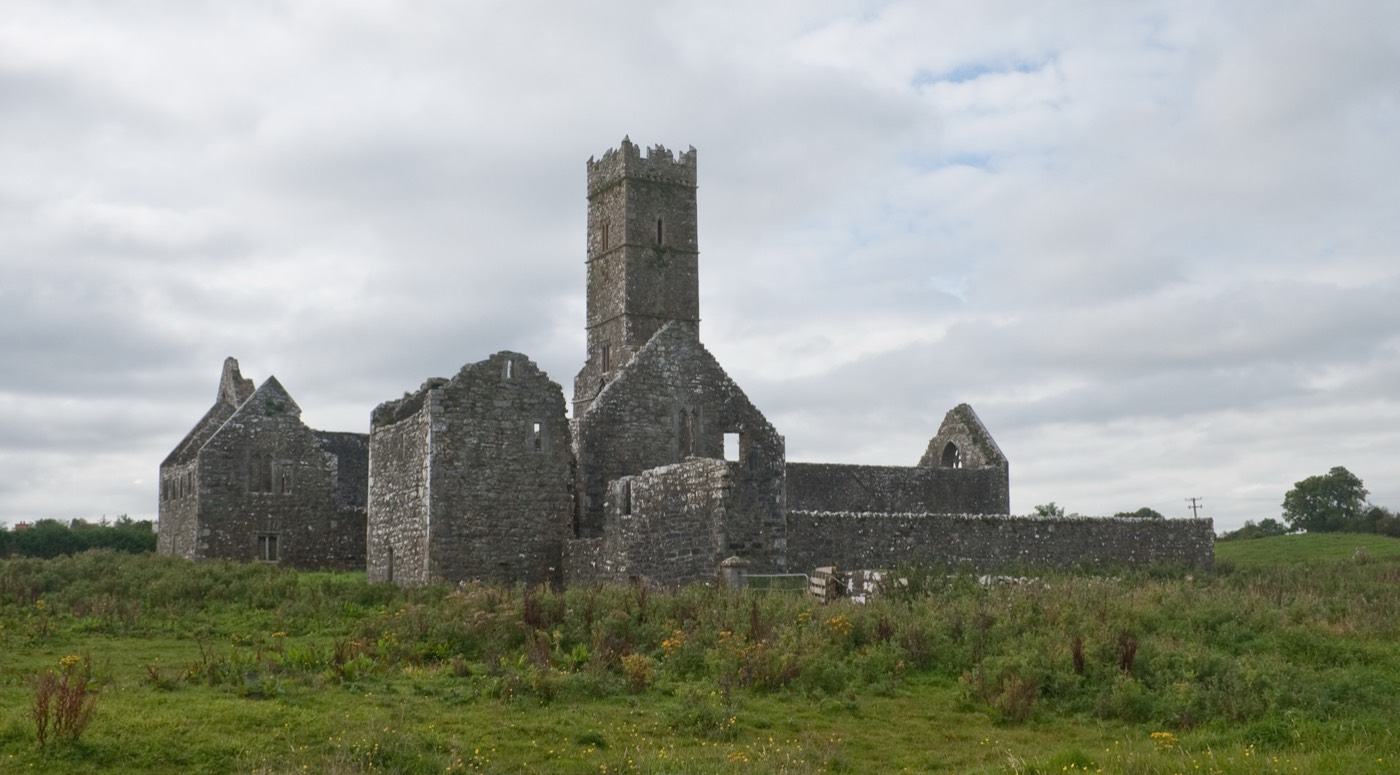
The Kelly surname is an anglicisation of the Irish Ó Ceallaigh, “descendant of Ceallach”, and it belongs not to one family but to at least seven unrelated ones, the greatest of them the kings of Uí Maine in east County Galway.
What Does the Surname Kelly Mean?
Kelly means “descendant of Ceallach”. What Ceallach itself meant is genuinely disputed, and there are three serious readings: “bright-headed”, “strife” or “contention”, and something to do with a church.
The oldest reading is “bright-headed”, carried through most twentieth-century Irish name books and still the one you will hear in Galway. It treats the name as a nickname for a fair or striking man that hardened into a personal name.
The second treats ceallach as an ordinary Irish noun meaning strife or contention. Behind the Name and several Irish-language scholars prefer this reading, and early Irish naming was fond of martial words.
The third is the newest and now carries the most academic weight. It derives the name from ceall, the Irish for a church or monastic cell, borrowed from the Latin cella, giving a sense of “church-frequenting”. This is the reading favoured in recent surname scholarship and in the Oxford dictionaries of family names.
No source settles it. Anyone who tells you flatly that Kelly means “warrior” or “bright-headed” is choosing one theory and hiding the other two.
Where the Kelly Name Comes From
Kelly comes from Ireland, but from several parts of it at once. At least seven separate Ó Ceallaigh families adopted the name independently, in east Galway and south Roscommon, Meath, Antrim and Derry, north Wicklow, Laois, Sligo, north Down and Kilkenny.
The Uí Maine, the great sept
The most powerful Ó Ceallaigh family ruled Uí Maine, sometimes written Hy Many, a kingdom covering east Galway and south Roscommon that was known for centuries simply as O’Kelly’s Country. They traced themselves to Cellach mac Fíonachta, who died around 874, the twelfth chief of the line.
Their first great figure in the record is Tadhg Mór Ó Ceallaigh, lord of Uí Maine, killed at the Battle of Clontarf in 1014 fighting for Brian Boru. The family held the titles of King and later Prince of Uí Maine, and built to match: Kilconnell Friary, Clontuskert Priory, Garbally and Monivea castles.
Anglo-Norman pressure eroded the kingdom from the thirteenth century and the seventeenth-century confiscations finished it. The name stayed exactly where the kingdom had been, which is why Galway and Roscommon still carry more Kellys per head than anywhere else in Ireland.
The other Ó Ceallaigh families
The Meath sept descended from Cellach mac Congalach and held land in Brega, counted among the Four Tribes of Tara. A smaller Wicklow line came from Cellach Cualann mac Gerthidi, a king of the Uí Máil. In Laois, the O’Kellys were one of the Seven Septs transplanted to Kerry by government order in 1609.
Add the Antrim and Derry Kellys, the Sligo line, the north Down one and the Kilkenny one, and the consequence is blunt. Two Kellys from different provinces are almost certainly not related. They share a word, not a grandfather.
It is the same problem that makes the Murphy surname so hard to trace: a common personal name fixed into a hereditary surname in a dozen places at once, with no single stem to climb.
Scotland and the Isle of Man
There is a Scottish Kelly that owes nothing to Ireland. It is territorial, from the lands of Kelly near Wemyss Bay in Renfrewshire and from Kellie in Fife and Angus, including the Kelly near Arbroath recorded in 1373. The root there is Gaelic coille, a wood or grove. These Kellys were never a clan, but they are a documented medieval Scottish line. Most Kellys in Scotland today, though, descend from nineteenth-century Irish migration into Glasgow and the west, not from those lands.
The Manx Kelly is different again, and it is the leading surname on the Isle of Man. It comes from Mac Ceallaigh, son rather than descendant of Ceallach. MacKelly appears on the island in 1429, and John McKelly, recorded in 1511, was forebear of the Kellys of Ballabrew. The Mac prefix, almost universal in Manx names by the early sixteenth century, had worn away by the seventeenth, leaving the plain Kelly still standard there.
Spelling Variants and Related Names
The main variants are O’Kelly, Kelley and Kellie, alongside the Irish Ó Ceallaigh and the Manx Mac Ceallaigh. Kelly itself is the dominant form in every country where the name is found.
The O prefix was stripped during the anglicising of Irish names in the seventeenth and eighteenth centuries, when clerks and landlords wrote names to suit English ears. It came back during the Gaelic revival of the late nineteenth and early twentieth centuries, when resuming the O was a deliberate political act. Seán T. O’Kelly, later President of Ireland, is the clearest example.
That resumption largely did not cross the Atlantic. American Kellys had already been written down as plain Kelly on ship manifests, parish registers and ward rolls, and the name stayed that way.
Kelley, with the e, is chiefly an American spelling concentrated in New England. It records the same families, split by a clerk’s preference and then frozen by paperwork. A few Irish Kellys also come from Ó Cadhla, more usually anglicised Kiely or Queally, and there is a separate English Kelly from the Devon place name, where the Brythonic celli again means grove. Like the Collins surname, Kelly is a case of an Irish name and an unrelated British one arriving at the same spelling and being mistaken for each other ever since.
The Kellys in America
Kellys came to America in every Irish wave, but overwhelmingly in the famine emigration of the 1840s and 1850s, landing at New York, Boston and Philadelphia and largely staying in the port cities that took them in.
They settled where Irish labour settled: Dorchester in Boston and the shipyard streets of Quincy, the stockyard parishes of Bridgeport in Chicago, the rail yards of South Buffalo, and later Woodlawn in the Bronx, still the most Irish neighbourhood in New York City.
Philadelphia produced the most famous American Kellys of all. John Henry Kelly left Newport, County Mayo in 1869 and worked in the city as a bricklayer, the trade of the Irish river wards like Pennsport. His son John B. Kelly, known as Jack, took up the same trade, built it into a construction fortune and won three Olympic golds in rowing. Jack’s daughter Grace was born in East Falls in 1929 and married the Prince of Monaco in 1956. Two generations from a Mayo bricklayer to a principality is not typical, but it is real.
The 2010 Census also records how Kellys identified themselves. Of the 267,394 Americans with the name, 78.09 per cent recorded themselves as white, 16.22 per cent as Black, 2.69 per cent as Hispanic and 1.81 per cent as two or more races. Those are self-identification proportions, not measures of ancestry. The substantial Black share reflects names taken and carried in the American South, a reminder that a surname records history rather than descent.
Notable People Named Kelly
Tadhg Mór Ó Ceallaigh (died 1014), lord of Uí Maine, was killed at the Battle of Clontarf fighting alongside Brian Boru. He is the earliest Kelly the annals name directly.
Ned Kelly (1854 to 1880), the Australian bushranger, was the son of a transported Tipperary convict. Hanged in Melbourne at twenty-five, he remains the most argued-over figure in Australian folk history.
Seán T. O’Kelly (1882 to 1966) was the second President of Ireland, from 1945 to 1959. His restored O prefix was itself a statement of the revival politics he came from.
Gene Kelly (1912 to 1996), born in Pittsburgh to an Irish-American family, remade screen dance in Singin’ in the Rain.
Grace Kelly (1929 to 1982) won an Academy Award for The Country Girl in 1955, then left Hollywood the following year to become Princess of Monaco.
Petra Kelly (1947 to 1992) co-founded the German Green Party and sat in the Bundestag. Born Petra Lehmann, she took the surname of her American stepfather, a reminder that not every Kelly inherited the name.
How Common Is Kelly Today?
Kelly is the 74th most common surname in the United States, carried by 267,394 Americans at the 2010 Census. In Ireland it ranks second, behind only Murphy, and it is among the commonest surnames on the Isle of Man.
| US rank (2010 Census) | #74 |
|---|---|
| Americans with the name | 267,394 |
| Origin | Irish (Ó Ceallaigh) |
| Meaning | Descendant of Ceallach, a name of disputed meaning |
Frequently Asked Questions
What does the surname Kelly mean?
Kelly means “descendant of Ceallach”, from the Irish Ó Ceallaigh. The meaning of Ceallach is disputed between “bright-headed”, “strife” or “contention”, and a sense connected with churches from the Irish ceall. No reading has been settled on.
Is Kelly Irish or Scottish?
Overwhelmingly Irish. There is a genuine Scottish Kelly taken from place names in Renfrewshire, Fife and Angus, and a distinct Manx Kelly from Mac Ceallaigh, but the great majority of Kellys everywhere descend from the Irish Ó Ceallaigh septs.
Where does the Kelly family come from?
There is no single Kelly family. At least seven unrelated Ó Ceallaigh septs took the name, the greatest being the Uí Maine of east Galway and south Roscommon, with others in Meath, Antrim and Derry, Wicklow, Laois, Sligo and Kilkenny.
How common is the surname Kelly?
Kelly is the 74th most common surname in the United States, with 267,394 bearers recorded in the 2010 Census. It is the second most common surname in Ireland and a leading surname on the Isle of Man.
Is there a Kelly family crest or coat of arms?
No. In Irish, British and most other heraldic traditions arms are granted to individuals and pass to their direct descendants, never to everyone who shares a surname. The Ó Ceallaigh of Uí Maine chiefs bore arms, but those belong to that line, not to all Kellys. Sites selling a “Kelly family crest” are selling a decoration, not a lineage.
Why are there so many Kellys in Ireland?
Because Ceallach was a very common personal name in early medieval Ireland, it hardened into a hereditary surname in seven or more separate places at roughly the same time. Common names produce common surnames, which is why Kelly is so hard to trace past the nineteenth century without documents.
If your family carries the Kelly name, its route from Ireland to America is traceable. Atlas of Home can follow it from the sept country your line actually left, whether Uí Maine or another corner of Ireland, to wherever your family landed, and to wherever you are now.