
The Guerra surname means war. It began as a nickname for a fighting man in medieval Spain, Portugal or Italy, and it is now carried by more than three quarters of a million people, most of them in the Spanish speaking Americas.
What Does the Surname Guerra Mean?
Guerra means “war” in Spanish, Portuguese and Italian, and as a surname it started as a nickname for a soldier or for a notably belligerent man. It is descriptive rather than patronymic: it named a person by reputation, not by father or by farm.
The word itself is not Latin. Classical Latin used bellum, but the early medieval world borrowed the Germanic werra, meaning discord or strife, instead. Late Latin absorbed it, and the Romance languages turned it into guerra in Spanish, Portuguese, Italian and Catalan, and guerre in French.
The Dictionary of American Family Names glosses Guerra plainly: a nickname for a belligerent person, or for a soldier. Spanish scholarship adds a warmer reading, that the byname could mean combative in the admiring sense, strong and hard to beat.
Where the Guerra Name Comes From
Guerra has three homelands at once. Spain, Portugal and Italy each produced the surname independently from the same Romance word, which is why it is old and widespread in all three countries rather than radiating from one village.
Spain and Portugal
In Spain, Guerra is one of the older Castilian surnames, and unusually it is not concentrated in one province. It is recorded across the peninsula from the medieval period onward, in Castile, León, Andalusia, Galicia and the Canaries, exactly what you would expect of a nickname any community could coin on its own.
Genealogical literature often repeats a tidier story: that the family began in Asturias, or in the mountains of Santander in what is now Cantabria, and spread from there. Treat that carefully. It circulates as family tradition, but no documentary chain proves a single Asturian root, and a nickname surname almost never has one. Spain today counts roughly 36,000 Guerras.
Portugal produced its own Guerras, alongside the related Guerreiro, meaning warrior. They appear mainly in the north and centre, and the name travelled with Portuguese settlement to the Azores, Madeira and Brazil, where more than 50,000 people now carry it.
Northern Italy
The Italian Guerras are a genuinely separate stock. Distribution data puts roughly three fifths of Guerra households in the north, above all in Veneto, Emilia-Romagna and Lombardy, with smaller clusters in Abruzzo, Campania, Friuli and Sicily.
Medieval Italy shows the nickname doing its work in the open. The Tuscan magnate Guido Guerra, of the Conti Guidi, was called Guerra because he spent his life at war, and the byname stuck hard enough to turn hereditary in that branch. He fathered only a fraction of Italy’s Guerras, but he shows how the name was made.
A Basque exception
One group of Spanish Guerras may have nothing to do with war at all. The Dictionary of American Family Names notes that Guerra can also be the Castilianised spelling of Basque Gerra, a topographic name from gerri, waist, for someone living at a saddle in a mountain ridge. Two names, one spelling.
Spelling Variants and Related Names
Guerra is spelled the same in Spanish, Portuguese, Italian and Catalan, so unlike Gaelic or Slavic names it barely varies. What it has instead is a wide circle of relatives built on the same root:
- Guerrero (Spanish) and Guerreiro (Portuguese), both meaning warrior. These are parallel formations, not spellings of Guerra, and the families are usually unconnected.
- Guerri, Guerrini, Guerrieri, Guerriero, Guerrera and Guerrazzi, the Italian derivatives. Guerrieri and Guerriero cluster in central and southern Italy, mirroring the northern Guerra.
- De la Guerra, Della Guerra, Da Guerra, La Guerra and Laguerra, the forms carrying an article. Santa Barbara’s Californio branch used De la Guerra throughout the Spanish and Mexican periods.
- Gerra, the Basque form described above, and the French cognates Guerre and Laguerre.
American records rarely mangled Guerra, because it is short, phonetic and easy for an English speaking clerk to write. The commonest error is a single r, giving Guera. Very few Guerras anglicised the name outright, which is one reason it stays easy to trace.
The Guerras in America
Guerras reached America in three waves: Spanish colonial settlers in Texas and California from the 1700s, Italian labour migrants between 1880 and 1924, and twentieth century arrivals from Mexico, Cuba and the Caribbean.
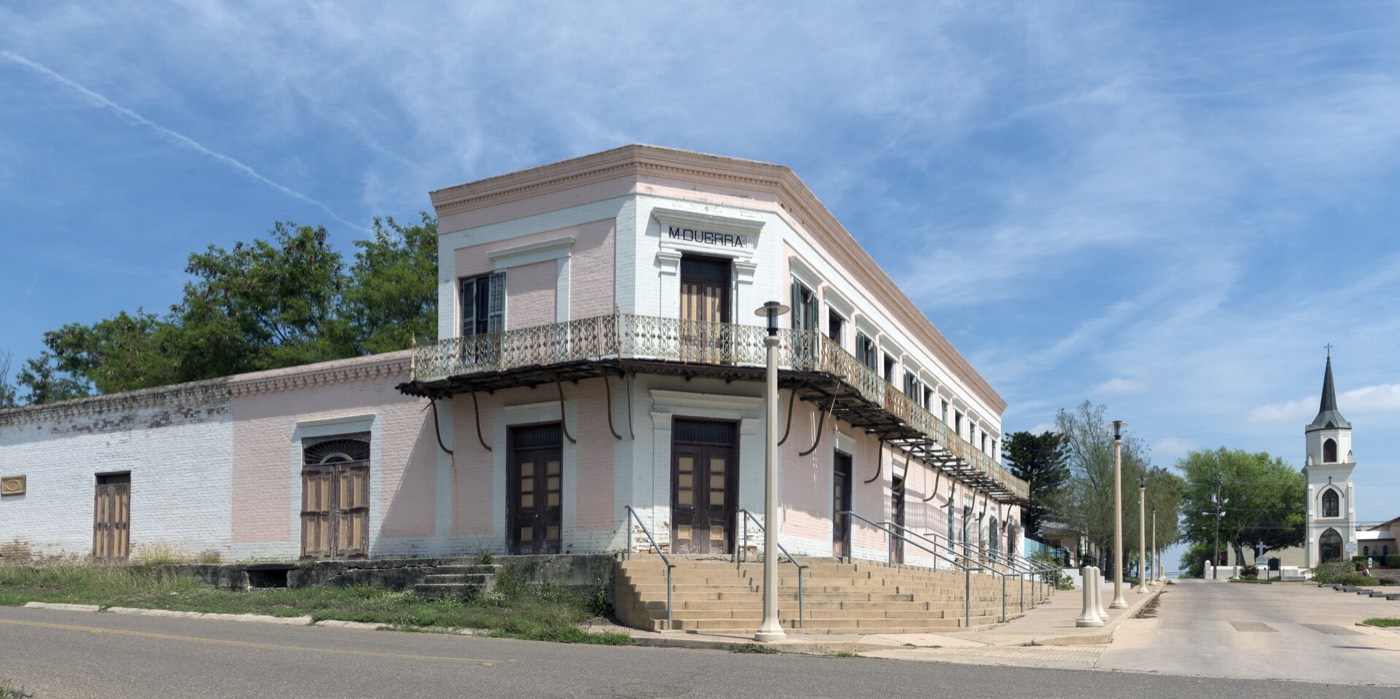
The oldest American Guerras were never immigrants in the usual sense. The border moved past them. In 1767 José Alejandro Guerra secured two Spanish land grants straddling the Rio Grande, and his descendants held that ground through the Mexican period and into the American one. Manuel Guerra, born in Mier, Tamaulipas, in 1856, settled at Roma, Texas, in 1877, built a ranching and merchant fortune, and ruled Starr County as political boss until his death in 1915. His family ran the county until 1946, and their store still stands above the river. Later generations moved up the corridors that built Mexican San Antonio.
California had its own dynasty. José de la Guerra y Noriega commanded the presidio at Santa Barbara from 1827 to 1842 and accumulated vast ranchos along the central coast. Casa de la Guerra and De la Guerra Plaza still carry the name in the middle of the city.
The Italian Guerras came later and by ship. Italians landed in numbers at the Gulf ports, joining the produce trade around Italian New Orleans and the immigrant quarter of Galveston, Texas. Others followed the coal and the railroads: the anthracite valleys around Pittston, Pennsylvania, the market gardening districts of Italian Denver, and the factory suburbs west of Chicago, where Melrose Park, Illinois became one of the most Italian towns in the Midwest.
In Tampa the streams met. The cigar factories of Ybor City drew Cuban, Spanish and Sicilian workers into the same few blocks, and Guerra appears on all three sets of rolls. Portuguese Guerras took the northern route instead, into the whaling and textile towns of New Bedford, Massachusetts.
The largest wave was the last. Mexican migration after 1910, the Bracero years, Cuban arrivals after 1959 and Caribbean and South American movement since the 1960s multiplied the American Guerras several times over, and the surname grew by 28 per cent between the 2000 and 2010 censuses alone.
Notable People Named Guerra
Guido Guerra V (about 1220 to 1272) was a Florentine nobleman of the Conti Guidi and a leading Guelph commander in thirteenth century Tuscany. Dante meets him in canto sixteen of the Inferno and treats him with real respect.
Abílio Guerra Junqueiro (1850 to 1923) was a Portuguese poet and parliamentarian whose satirical verse against the monarchy and the Church helped shape the mood behind the republican revolution of 1910. José de la Guerra y Noriega (1779 to 1858), the Santa Barbara commandant, belongs on the list too.
Learco Guerra (1902 to 1963), from Lombardy, was world road race champion in 1931 and won the Giro d’Italia in 1934. Italian crowds called him la Locomotiva Umana, the Human Locomotive, for the way he ground down flat stages.
Tonino Guerra (1920 to 2012), a poet and screenwriter from Santarcangelo di Romagna, wrote for Fellini, Antonioni, Tarkovsky and Angelopoulos, and was nominated for three Academy Awards, including one for Amarcord.
Juan Luis Guerra (born 1957) is the Dominican singer and bandleader of 4.40, whose merengue and bachata records made him one of the most decorated artists in Latin music, and Alfonso Guerra (born 1940) served as deputy prime minister of Spain from 1982 to 1991.
How Common Is Guerra Today?
Guerra is the 473rd most common surname in the United States, carried by 70,071 Americans at the 2010 census. Worldwide it is held by roughly 783,000 people, around 699th globally.
Mexico has the largest number of bearers, close to 95,000, followed by the United States, Venezuela, Colombia and Cuba. Measured against population the name is densest in Panama, where about one person in 135 is a Guerra, and Cuba, at one in 183. Spain holds roughly 36,000 and Italy roughly 32,000, so the European homelands account for under a tenth of the total.
The American picture is decisively Hispanic. The Census Bureau surname files recorded about 85 per cent of US Guerras reporting Hispanic origin in 2000, rising to roughly 87 per cent in 2010, with most of the rest non-Hispanic white, the category that holds the Italian American branch. So while Guerra is a real and old Italian name, an American Guerra is far likelier to descend from Spain, Mexico or the Caribbean than from Veneto.
| US rank (2010 Census) | #473 |
|---|---|
| Americans with the name | 70,071 |
| Origin | Spanish, Portuguese and Italian |
| Meaning | “War”, a nickname for a soldier or a belligerent man |
Frequently Asked Questions
What does the surname Guerra mean?
Guerra means “war” in Spanish, Portuguese and Italian. As a surname it was a medieval nickname for a soldier or a combative man. The word reached the Romance languages from a Germanic root, werra, meaning strife.
Is Guerra Italian or Spanish?
Both, genuinely. The word exists in Spanish, Portuguese and Italian, and each language produced the surname independently, so an Italian Guerra and a Spanish Guerra are usually unrelated. In the United States the balance is heavily Hispanic: about 87 per cent of American Guerras reported Hispanic origin in 2010.
Where does the Guerra family come from?
There is no single Guerra family. In Spain the name is spread across the whole peninsula, in Portugal it sits mainly in the north and centre, and in Italy it concentrates in Veneto, Emilia-Romagna and Lombardy. Claims of one origin in Asturias or Santander are family tradition rather than documented fact.
How common is the surname Guerra?
Guerra ranks 473rd in the United States with 70,071 bearers, and about 699th worldwide with roughly 783,000. Mexico has the most Guerras in absolute numbers, while Panama and Cuba have the highest concentration by population.
Is there a Guerra family crest or coat of arms?
No, and any site selling you one is selling a decoration rather than a lineage. In Spanish, Portuguese, Italian and British heraldry alike, arms are granted to an individual and pass to that person’s direct descendants, never to everyone sharing a surname. Since Guerra arose separately in three countries and dozens of unconnected families, one “Guerra coat of arms” could not possibly represent them all.
Are Guerra and Guerrero the same name?
They are related but not the same. Guerra is the noun, war, while guerrero and Portuguese guerreiro mean warrior, and the surnames formed separately from the same root. A Guerra family and a Guerrero family will almost never share an ancestor, and the two names sit differently across Spain and Latin America.
If your family carries the Guerra name, its route from Iberia or northern Italy to America is traceable. Atlas of Home can follow it from the Rio Grande land grants, the Gulf ports and the cigar towns to wherever your family landed, and to wherever you are now.