
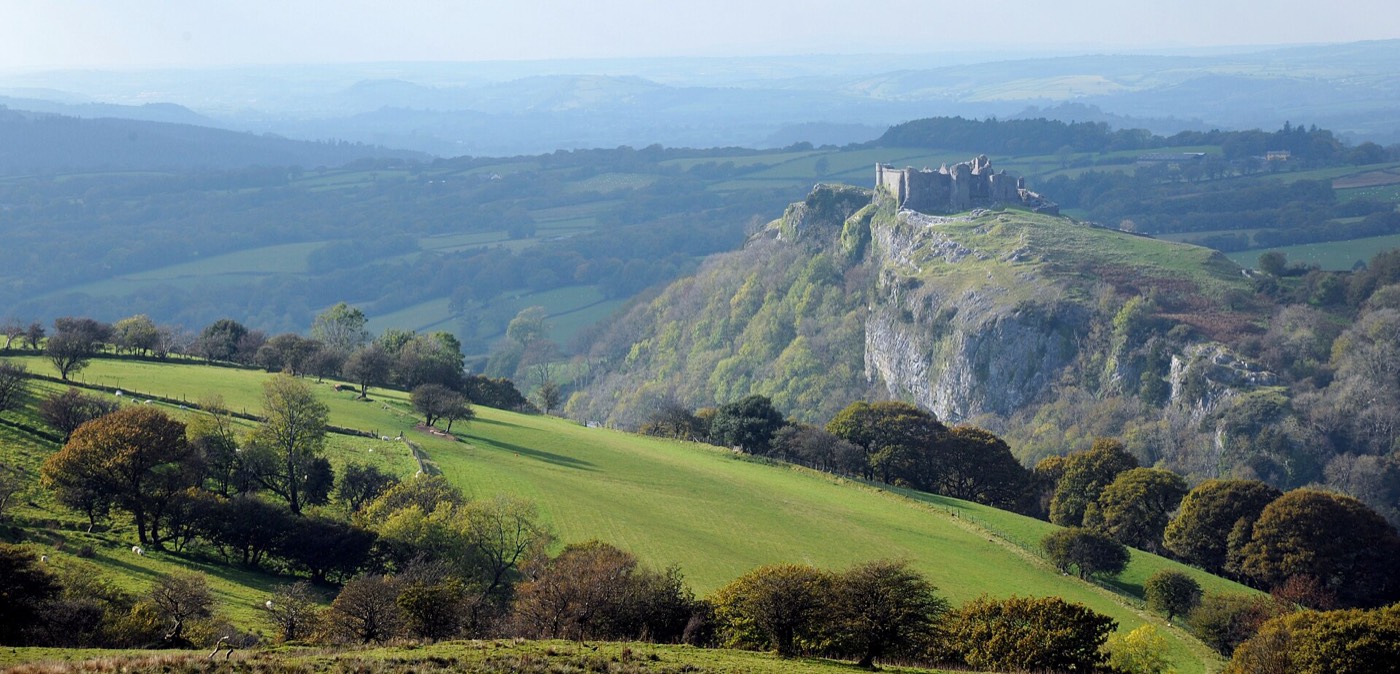
The Evans surname is Welsh and means “son of Ifan”, Ifan being the Welsh form of John. It hardened into a fixed family name across Carmarthenshire, Ceredigion and mid Wales in the sixteenth century, and it has never left the top rank since.
What Does the Surname Evans Mean?
Evans means “son of Ifan”. Ifan is the Welsh form of John, taken from the Latin Iohannes, which came in turn from the Hebrew Yochanan, “God is gracious”. The final s is an English possessive, added late.
The chain is unusually clean for a surname this common. A first-century Hebrew name passed through Greek into Latin as Iohannes, then into Welsh through the church, written Ieuan. Speech wore it down to Ifan, and because the Welsh letter f sounds like an English v, clerks writing in English spelled it Evan.
Add the English -s that marks “son of” in Jones, Roberts, Williams and Davies, and you have Evans. The name is therefore Welsh in every part except its ending, which is a piece of English record-keeping bolted on by Tudor administrators.
A minority theory derives Evans from the Norman-French Yvain. It appears in older literature, but the Ifan route accounts for the geography and the spelling variants far better, and it is what the standard reference works give.
Where the Evans Name Comes From
Evans comes from Wales. It is thickest in the old counties of Cardiganshire, now Ceredigion, and Carmarthenshire, and across Montgomeryshire in mid Wales, the districts that held on to Welsh-language patronymic naming longest.
Before surnames
Medieval Wales had no hereditary surnames at all. A man was known as his father’s son: Ifan ap Dafydd, Dafydd ap Ifan, the name shifting every generation. Genealogically minded families could recite the chain back six or eight steps, and did, because land and status depended on it.
The ap-collapse
The Laws in Wales Acts of 1535 to 1542 brought Wales into the English legal system, and English clerks needed fixed, inheritable names. The gentry had begun freezing their patronymics in the fifteenth century, and over the next few generations the practice spread down the social scale until the whole country had surnames.
The name Ifan crystallised along two routes. Some families kept the ap, which in Welsh softens to ab before a vowel, so ab Ifan compressed into Bevan. Others dropped the particle and took the English suffix instead: Evans. Two brothers could end up founding two different surnames.
Jones and Evans are the same name
Here is the fact that almost nobody who carries either name knows. Jones means “son of John”. Evans means “son of Ifan”. John and Ifan are the same name, Iohannes, arriving in Wales by two different roads.
John came through Norman French and English, and gave Wales Siôn and then the surname Jones. Ieuan came earlier, through Latin and the Welsh church, and gave Ifan, Evan and Evans. Wales then made two of its commonest surnames from them, by the same Tudor process, in the same decades.
A Jones and an Evans sitting in the same Carmarthenshire chapel in 1850 carried one ancestor’s name in two languages, and neither would have thought themselves related.
Spelling Variants and Related Names
The principal variants are Evan, Bevan, Beavan, Beaven, Bevans, Evens and the rare Evanson, alongside the living Welsh forms Ieuan, Ifan, Iwan and Ioan and the south Wales pet form Yanto.
Evan without the s survives as a surname in its own right, and far more commonly as a given name, which is why so many Evans families also contain an Evan Evans. Bevan, Beavan, Beaven and Bevans all descend from ab Ifan and are the other half of the same split, though the census records only about four thousand American Bevans.
Evens is usually clerical drift rather than a distinct family. On the Welsh side, Ieuan is the medieval literary spelling, Ifan the spoken one, Iwan and Ioan modern revivals, and Yanto the affectionate diminutive still heard in the south Wales valleys.
The same name across Europe
Evans belongs to a large family of surnames that all mean “son of John” in different languages: Ohanian from the Armenian Hovhannes, Ivanov from the Russian Ivan, Janssen from the Dutch Jan, Hansen from the Scandinavian Hans, and Jones from the English John.
The resemblance between the Welsh Ifan and the Russian Ivan is a coincidence of sound, not of contact. Two languages at opposite ends of Europe wore the same Latin name down to almost the same shape, and both then made a surname of it.
The Evanses in America
Evanses arrived in America by two entirely separate routes: Welsh emigration, mostly nineteenth-century and mostly industrial, and the adoption of the surname by formerly enslaved Americans after 1865.
The Welsh route began early, with Quakers and Baptists taking up land west of Philadelphia from the 1680s in what became the Welsh Tract. The great wave came much later, when Welsh coal, iron and slate skills were the most valuable export Wales had.
Anthracite drew them hardest. Welsh miners and mine managers filled the northeastern Pennsylvania coalfield, and the chapels, eisteddfodau and Welsh-language newspapers of the Welsh in Scranton and Wilkes-Barre made the Lackawanna and Wyoming valleys the densest Welsh settlement outside Wales itself.
North Walian slate quarrymen went instead to the Slate Valley of Vermont and upstate New York, while farming families settled the uplands around Remsen in Oneida County. Jackson County in southeastern Ohio was nicknamed Little Wales, and as late as 1900 Ohio still held some 150 Welsh-speaking congregations. Others joined the Cornish in Butte, Montana and the hard-rock west.
The second route is quite different, and it accounts for a large share of American Evanses today. In the 2010 census, 68.39 per cent of people named Evans identified as white and 25.72 per cent as Black, with 2.39 per cent Hispanic and 2.30 per cent of two or more races. Those are self-identification proportions recorded on a form, not measures of ancestry.
That quarter comes overwhelmingly from the years after emancipation, when nearly four million people chose fixed surnames for the first time: some the name of a former enslaver, some of an earlier household, some a name simply liked or already used by a neighbour. The same pattern produced the very large Black bearings of Williams and Jones. It means a Black American named Evans is, in most cases, not descended from a Welsh family. The name arrived by a different door.
Notable People Named Evans
Christmas Evans (1766 to 1838), born in poverty at Llandysul in Cardiganshire, became the most celebrated Welsh Baptist preacher of his age, a one-eyed itinerant whose sermons drew thousands.
Mary Ann Evans (1819 to 1880) published as George Eliot, and Middlemarch stands among the finest novels in English.
Sir Arthur Evans (1851 to 1941) excavated Knossos on Crete from 1900 and named the Minoan civilisation, adding a thousand years to the known history of Europe.
Gwynfor Evans (1912 to 2005) won the Carmarthen by-election of 1966 to become the first Plaid Cymru member of Parliament, and in 1980 forced the creation of the Welsh-language channel S4C by threatening a hunger strike.
Bill Evans (1929 to 1980) reshaped jazz piano, playing on Miles Davis’s Kind of Blue and then leading a trio that changed what a rhythm section could be.
Lee Evans (1947 to 2021) won the 400 metres at the 1968 Mexico City Olympics in 43.86 seconds, a world record that stood for twenty years, and helped found the Olympic Project for Human Rights.
How Common Is Evans Today?
Evans is the 53rd most common surname in the United States, carried by 355,593 people at the 2010 census. In Wales it is consistently among the five commonest names of all, and it is common throughout England, Australia and New Zealand.
That concentration is the Welsh naming-pool problem in miniature. A country that built nearly all its surnames from a handful of given names ended up with millions of unrelated Joneses, Davieses and Evanses, which is why Welsh genealogy leans so heavily on farm names, chapel records and middle names.
| US rank (2010 Census) | #53 |
|---|---|
| Americans with the name | 355,593 |
| Origin | Welsh (patronymic) |
| Meaning | “Son of Ifan”, the Welsh form of John |
Frequently Asked Questions
What does the surname Evans mean?
Evans means “son of Ifan”, and Ifan is the Welsh form of John. The name descends from Latin Iohannes and ultimately from the Hebrew Yochanan, meaning “God is gracious”. The final s is an English possessive added in the Tudor period.
Is Evans Welsh or English?
Evans is Welsh. The root name Ifan is Welsh and the surname formed in Wales during the sixteenth-century shift from patronymics to fixed surnames. Only the -s ending is English, supplied by clerks recording Welsh names in English documents.
Where does the Evans family come from?
There is no single Evans family. The name arose independently wherever a man named Ifan had sons, and it is densest in Ceredigion, Carmarthenshire and Montgomeryshire. Most Evans lines are unrelated to one another even within the same parish.
How common is the surname Evans?
Evans ranks 53rd in the United States with 355,593 bearers at the 2010 census, and sits among the five most common surnames in Wales. It is also widespread in England, Australia, New Zealand and Canada.
Is there an Evans family crest or coat of arms?
No. In British heraldry arms are granted to individuals and pass to their direct descendants, never to everyone who shares a surname. Since Evans arose separately in hundreds of unconnected Welsh families, no single coat of arms could belong to all of them. Websites selling an “Evans family crest” are selling a decoration, not a lineage.
Are Evans and Jones related?
As names, yes. Jones is “son of John” and Evans is “son of Ifan”, and John and Ifan are the same name, Iohannes, which entered Welsh twice by different routes. As families, no: they are two separate surnames built from one shared root.
If your family carries the Evans name, its route from Wales to America is traceable. Atlas of Home can follow it from the farms of Ceredigion and Carmarthenshire, or from a courthouse in the American South, to wherever your family landed, and to wherever you are now.
Further reading: Welsh surnames on Wikipedia, and the National Library of Wales Dictionary of Welsh Biography.