
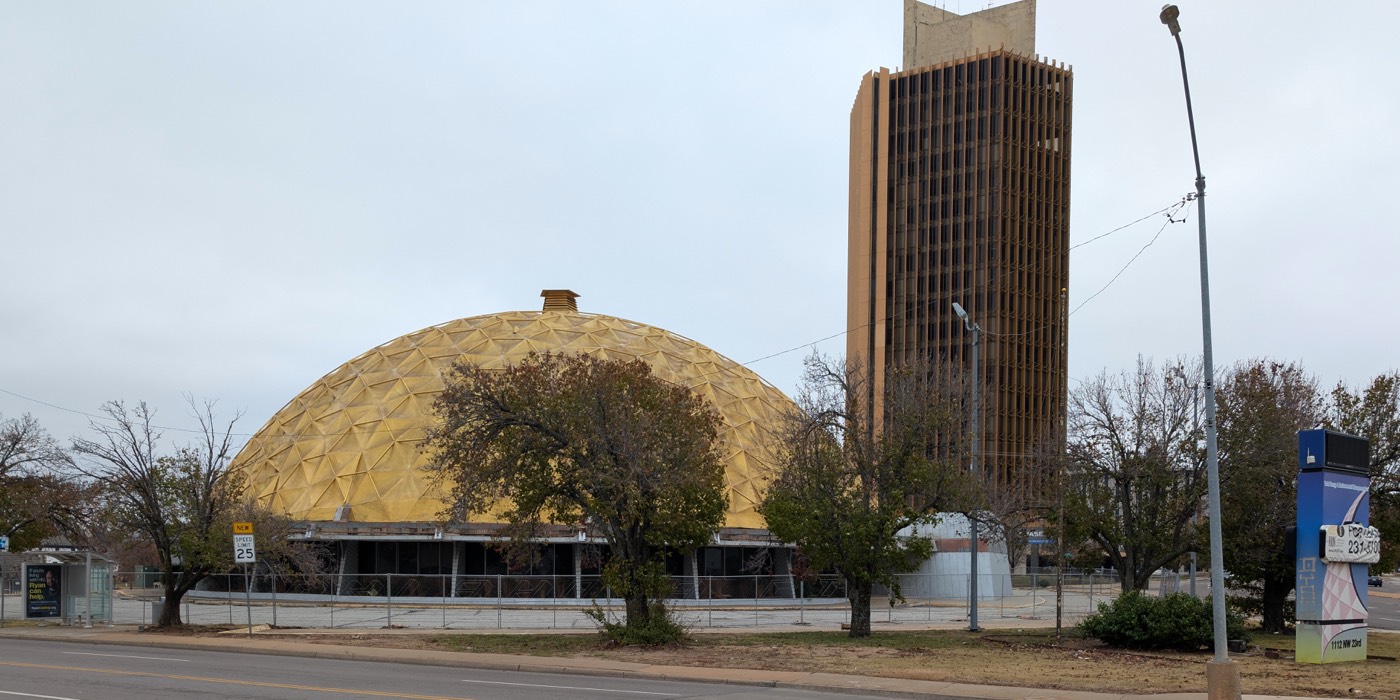
Drive north on Classen Boulevard and the first thing you see is a giant glass milk bottle perched on a brick wedge, and then, a few blocks on, a low bronze dome that looks like a flying saucer come to rest. Between those two oddly American landmarks sits one of the most quietly remarkable immigrant stories in the country: the Vietnamese in Oklahoma City, who turned a neighbourhood the rest of the city had abandoned into a thriving Little Saigon on the southern plains.
The Place
The Asian District runs along Classen Boulevard in central Oklahoma City, officially bounded by Northwest 23rd to Northwest 30th streets and Western to McKinley avenues, though the shops and restaurants spill north and south of that frame. It sits between Oklahoma City University to the west and the Paseo Arts District to the east, a short drive from downtown.
For decades this was not a place people chose. School desegregation and suburban flight in the 1960s and 1970s hollowed out the inner city, leaving cheap rents and empty storefronts behind. The neighbourhood had a reputation for crime long before it had a reputation for noodle soup.
What changed it was arrival. The same emptiness that had pushed families to the suburbs pulled in newcomers who needed somewhere affordable to begin again.
How It Became Vietnamese
The story begins in the spring of 1975. When Saigon fell to North Vietnamese forces in April of that year, hundreds of thousands of South Vietnamese fled, and a share of them were routed through resettlement camps and out into American cities by sponsoring agencies. Oklahoma City was one of the places they landed.
The first sponsors
Catholic Charities and a number of local Protestant congregations sponsored and resettled the earliest Vietnamese families in 1975 and 1976. The Catholic Archdiocese of Oklahoma City placed many of them near the Cathedral of Our Lady of Perpetual Help, which became an early community anchor as much as a place of worship.
These were not, for the most part, people who had planned to emigrate. They included former soldiers, teachers, clerks and skilled workers who had backed the losing side of a war and had reason to fear what came next. Among them was San Nguyen, who had worked as a translator at the United States Embassy in Saigon and went on, by the account of local historians, to help resettle nearly seven thousand Vietnamese families in Oklahoma before becoming a deputy court clerk and a Catholic deacon.
Finding the Classen corridor
The families who stayed gravitated toward the streets around Northwest 23rd and Classen Boulevard, then a struggling stretch of central Oklahoma City. Rents were low, storefronts were empty, and a community that needed to start businesses from nothing could afford to take the risk.
By 1980, roughly five years after the fall of Saigon, the state’s Vietnamese population had already passed six thousand. The newcomers worked first as brickmakers, builders and warehouse hands, and many of them saved toward a shop of their own.
The grocery that anchored everything
The turning point many residents point to is a grocery store. The original owners of a small Asian market called Cao Nguyen decided to move west in 1979 and sold the business to the Luong family, refugees who had first opened a convenience store in Fort Smith, Arkansas, near the Fort Chaffee resettlement camp. The Luongs relocated the market to Oklahoma City.
What began as a strip-mall shop selling fish sauce and rice to a few hundred families grew, over forty years, into Super Cao Nguyen, the largest Asian supermarket in the state, employing around fifty people and importing food from some sixty countries. A grocery that existed because a community had nowhere to buy its own food became the reason that community had a centre at all.
From boat people to professionals
A second wave followed in the late 1970s and 1980s, the so-called boat people who fled by sea. Vinh Nguyen, a lieutenant colonel in the South Vietnamese army, arrived this way and went on to work as a computer analyst for the Internal Revenue Service. That arc, from refugee camp to civil service or small business, repeated itself across thousands of households.
Vietnamese and Chinese-Vietnamese families came to own more than half the businesses in the district: restaurants, bakeries, salons, insurance offices, travel agencies and radio stations. The children of the brickmakers became lawyers, doctors and engineers.
Official recognition
For years the neighbourhood was simply Little Saigon to the people who lived there. In the 1990s and 2000s, as the community grew more diverse with Chinese, Korean, Thai and Indian arrivals, leaders made a deliberate choice to brand the area inclusively. In 2005 the Oklahoma City Council officially designated it the Asian District, and a 2007 general obligation bond paid for streetscaping and the bilingual signage that now lines Classen.
The Landmarks
Super Cao Nguyen, 2668 N Military Avenue. The supermarket that anchors the district, run by the Luong family since 1979 and now stocking ingredients from across Asia and beyond. Co-owner Ba Luong, who fled Vietnam on a small fishing boat before he was two, has become one of the most recognisable faces of the community. Walk the aisles and you can trace the whole map of the neighbourhood’s appetites.
Military Park, just south of NW 25th between Classen and Military Avenue. A small park created to honour Vietnam veterans and their allies, centred on a statue called Brothers in Arms that shows an American and a South Vietnamese soldier standing together. It is the district’s place of memory, and a natural orientation point for visitors trying to understand why the neighbourhood exists.
The Gold Dome, NW 23rd and Classen Boulevard. A 1958 geodesic bank building whose burnished dome marks the southern gateway to the district. Slated for demolition more than once, it has been fought for and saved by residents who see it as a symbol of the corridor, and it now reads as a kind of accidental landmark over the heart of the Asian District.
The Milk Bottle Grocery, on Classen near NW 24th. A tiny triangular 1930s building, topped since the 1940s by an enormous mock milk bottle, that has served as the unofficial entrance to the district for decades. The bottle has advertised everything from dairy to Vietnamese restaurants over the years, a small monument to how the neighbourhood keeps reusing what it inherits.
Pho Lien Hoa, on Classen. One of the district’s best-known pho houses, ladling out bowls of beef noodle soup with brisket, tripe and rare steak to a line of regulars that crosses every background in the city. It is the kind of unpretentious room that built the neighbourhood’s reputation as a food destination.
Lido Restaurant, in the former Little Saigon Center. A Vietnamese institution bought by the Lee family in 1990, long a fixture for big family meals and special occasions. Its longevity is its own quiet argument for how rooted the community has become.
The Cathedral of Our Lady of Perpetual Help, 3214 N Lake Avenue. The Catholic church whose archdiocese helped sponsor the first refugees, and which served as an early gathering place for Vietnamese Catholics in the city. Faith communities, Catholic and Buddhist alike, gave the new arrivals a structure to hold onto.
Where They Came From
The first Oklahoma City Vietnamese came overwhelmingly from the south, and above all from Saigon itself, the city whose fall in April 1975 set the whole migration in motion. Many had ties to the South Vietnamese government, military or the American mission, exactly the people with the most to lose under the new regime.
They did not arrive in Oklahoma directly. Most passed first through American holding camps, Fort Chaffee in Arkansas chief among them, where sponsoring agencies matched refugees to congregations and cities willing to take them in. That is how a landlocked prairie capital with no Vietnamese history at all became, almost overnight, a resettlement hub.
The later boat people of the late 1970s and 1980s came from a wider span of southern and central Vietnam, often after harrowing sea crossings and years in Southeast Asian refugee camps. Word of an established community in Oklahoma City, with its grocery, its church and its cheap rents, drew family members and friends in a chain that has continued ever since.
Oklahoma City Today
Oklahoma is now home to well over sixteen thousand people of Vietnamese descent, most of them split between Oklahoma City and Tulsa. In Oklahoma City the Vietnamese number in the neighbourhood of eleven to twelve thousand, close to two per cent of the population, a share that for years placed the city among the most Vietnamese in the country relative to its size.
The Asian District has matured into one of the city’s signature neighbourhoods. The Asian Night Market Festival, first held in Military Park in June 2018, drew an estimated fifteen thousand people to its debut and has become an annual fixture, lit up between the Milk Bottle building and the surrounding restaurants. Non-Asian businesses, coffee roasters and cafes have moved in alongside the pho houses, a sign of a district that is no longer struggling but desirable.
The honest present is one of generational change. The founders are ageing, some of the original shops have closed or changed hands, and the children who grew up behind the counters have scattered into professions across the metro. Yet the corridor still works the way it was meant to, as a place where a new arrival can find familiar food, a familiar language and people who have walked the same road. Oklahoma City’s Little Saigon began as a refuge of last resort. It became a home.
If you want to see how Vietnamese Americans built lives across the country, the same story unfolds in the Vietnamese community of Houston, Texas, in the Vietnamese enclaves of San Jose, California, among the Vietnamese of Irvine, California, and in the Vietnamese families of Milpitas, California. Each is a different answer to the same question of how to make a home far from the one you lost.
Frequently Asked Questions
Where is the Vietnamese neighbourhood in Oklahoma City?
The Vietnamese in Oklahoma City are centred on the Asian District, which runs along Classen Boulevard, officially between Northwest 23rd and Northwest 30th streets and Western and McKinley avenues. The Gold Dome and the Milk Bottle Grocery mark its southern gateway near NW 23rd.
Why did Vietnamese refugees settle in Oklahoma City?
After the fall of Saigon in 1975, Catholic Charities and local Protestant congregations sponsored Vietnamese refugees and resettled many of them in Oklahoma City. They gathered around the low-rent, partly emptied Classen corridor, where they could afford to open the first shops and restaurants.
How many Vietnamese people live in Oklahoma City?
Oklahoma City is home to roughly eleven to twelve thousand people of Vietnamese descent, close to two per cent of the population. Statewide, more than sixteen thousand Vietnamese live in Oklahoma, split mostly between Oklahoma City and Tulsa.
What is there to do in Oklahoma City’s Asian District?
The district is best known for its food, from pho houses like Pho Lien Hoa to bakeries and Vietnamese sandwich shops, anchored by the Super Cao Nguyen supermarket on North Military Avenue. The annual Asian Night Market Festival in Military Park, first held in 2018, draws thousands each summer.
What is Super Cao Nguyen?
Super Cao Nguyen is the largest Asian supermarket in Oklahoma, run by the Luong family since 1979. It grew from a small strip-mall grocery serving Vietnamese refugees into a store employing around fifty people and importing food from some sixty countries, and it remains the commercial heart of the district.
When did the Asian District get its name?
Locals called the area Little Saigon for decades, but as the community grew more diverse the Oklahoma City Council officially designated it the Asian District in 2005. A 2007 city bond funded the streetscaping and bilingual signage that mark the neighbourhood today.
If your family’s story passed through Oklahoma City, or any of the places Vietnamese have made home in America, Atlas of Home can trace that journey. From the fall of Saigon and the camps at Fort Chaffee to a milk bottle and a gold dome on Classen Boulevard, to wherever you are now.